Showing posts sorted by date for query higgins. Sort by relevance Show all posts

June 21, 2025

Book Review: The Best Laid Plans by Sidney Sheldon

"Everybody's got a little skeleton buried somewhere. All you have to do is dig it up, and you'll be surprised how glad they'll be to help you with whatever you need."

Sidney Sheldon was one of the many authors I read back in college during the eighties. 

In those days, Sheldon—along with the likes of Frederick Forsyth, Jack Higgins, Lawrence Sanders, Jeffrey Archer, Dick Francis, Alistair MacLean, Arthur Hailey, Len Deighton, Ken Follett, Desmond Bagley, Wilbur Smith, and even Harold Robbins and Irving Wallace—was known as a bestselling author.

(As an Amazon Associate I earn from qualifying purchases.)

I suppose they were known as bestselling authors not only because they were prolific, but also because their novels were often racy and regularly topped fiction charts, sold in the millions, and achieved mass-market success—I'd find their paperbacks everywhere, from bookstores to railway stations, and from footpath bookstalls to private circulating libraries. They had a certain global appeal. Many of their books were also adapted for the screen.

For the past forty years, I've been reading a handful of their novels every year, never quite sure if they hold up as well as they did back then. Sometimes they do, and sometimes they don't.

Most recently, I read The Best Laid Plans (1997) and quite enjoyed it; although, I found the ending rather abrupt and anticlimactic. It left me somewhat disappointed. There, I've given the game away already!

Still, The Best Laid Plans is a fast-paced political thriller that, for some reason, reminded me of Gore Vidal's 1967 novel Washington, D.C. Perhaps it's because both novels are about political morality, or more precisely, the lack of it. Power-hungry men willing to do whatever it takes to reach the highest office in the land.

Set in Lexington, Kentucky, The Best Laid Plans follows the lives of Leslie Stewart, a young, smart and ambitious PR executive, and Oliver Russell, a charismatic lawyer and down-on-his-luck political aspirant. Oliver hires Leslie's agency to revive his career and improve his chances of becoming governor of Kentucky. She is put in charge of his campaign, and predictably, the two fall in love and plan to marry.

That is, until Oliver dumps her just days before the wedding to marry the daughter of Senator Todd Davis, a political kingmaker whose influence and wealth help him win the Kentucky gubernatorial race. Davis then helps his son-in-law win the presidency as well, except for the fact that the senator has a secret agenda of his own
—he intends to call the shots from the Oval Office.

Leslie is heartbroken, but not done with Oliver. She vows to destroy him. She marries a middle-aged business tycoon and philanthropist, originally from Kentucky but settled in Arizona. Leslie transforms her husband's local newspaper into a powerful media empire, and uses it to bring Oliver down.

Does she succeed? Well, you'll have to read the book, which, by the way, also has subplots involving mysterious deaths linked to the drug Ecstasy, corruption, personal vendetta and media spin, all of which trace back to Oliver's administration and cover-ups.

The Best Laid Plans is classic Sidney Sheldon with its formula of power, betrayal and revenge, as we saw in his best-known work The Other Side of Midnight. The writing is crisp, the chapters short, there is plenty of dialogue, and just the right amount of suspense. All of this makes it entertaining, though there's not much depth to the primary characters and the plot feels a bit rushed toward the end.

In sum, a decent page-turner for the weekend.

September 18, 2020

Book Review: Drink with the Devil by Jack Higgins

Drink with the Devil by Jack Higgins book cover
I read Drink with the Devil—the fifth appearance of Jack Higgins' trademark hero Sean Dillon—before the lockdown and decided to finally review it during my sixth month of working from home. Somehow, I always seem to pick up a Higgins novel to revive my blog every few months. Maybe it's because he is my favourite action-thriller writer and also one of my comfort reads.

(As an Amazon Associate I earn from qualifying purchases.)

In Drink with the Devil (1996), Higgins offers a glimpse into Dillon's early life—first as a disillusioned IRA assassin, then as a skilled mercenary for the PLO and the Israelis, the KGB and the Red Brigades, and finally as an operative for a highly secret British intelligence unit answerable only to the prime minister.

The story begins in 1985, London.

The IRA sends Sean Dillon—posing as Martin Keogh—to team up with legendary Loyalist militant Michael Ryan and his young niece Kathleen. Together, they hijack a truck carrying £50 million worth of gold bullion. The IRA wants to prevent Ryan from using the gold to buy arms and ignite a civil war in Northern Ireland. Fortunately for Dillon, things do not go according to plan. One night, while he and Ryan are transporting the bullion across the Irish Sea aboard a hired boat, the crew attempts to seize the treasure for themselves. The resulting confrontation ends with the boat being blown up and the gold plunging to the bottom of the rough sea.

Cut to 1995, New York State.


Michael and Kathleen have vanished from the radar of both the IRA and British intelligence. The gold has never been recovered. Michael is serving a 25-year sentence in a New York State prison for a botched bank robbery and the shooting of a police officer. Kathleen, now working as a nurse at a nearby hospital, visits him every day. Living under the names Liam and Jean Kelly, they are believed to have died years earlier. 

Drink with the Devil by Jack Higgins book cover
But news of the lost bullion reaches the mafia family of Don Antonio Russo, who strikes a deal with Michael and Kathleen: a share of the gold—now worth £100 million—in exchange for their freedom. The discovery also attracts the attention of the American and British intelligence services, the president and the prime minister, and the IRA.

Enter Sean Dillon. The former IRA hitman is given a single mission: prevent the gold from jeopardising the fragile peace process in Northern Ireland. A decade after their last encounter, he comes face to face with his old friends Michael and Kathleen once again—and that is where the real twists begin.

While I haven't read many of the nearly two dozen Sean Dillon novels, I can say that Drink with the Devil is not one of his best. The story moves at a steady pace and has enough action and dialogue to keep the pages turning, but the plot felt rather flimsy. At times, it seemed as though even an amateur could have got away with stealing the gold. I also found it hard to believe that British intelligence could not trace either the missing bullion or the whereabouts of Michael and Kathleen. They could hardly have disappeared without a trace.

In Jack Higgins' defence, however, Dillon, his boss Brigadier Charles Ferguson, who heads the secret unit known as the Prime Minister's Private Army, and Special Agent Hannah Bernstein do not enter the picture until much later. Their story starts in 1995, when the tale of the Irish Rose lying beneath the Irish Sea begins.

Drink with the Devil by Jack Higgins book cover
Drink with the Devil has all the hallmarks of Higgins' simple, direct and conversational storytelling style. The characters—including the appearance of his other endearing hero, Liam Devlin—and the charming Lake District setting in northwest England, with its pubs and cafés frequented by Republicans and Loyalists alike, make the novel a fairly entertaining read. As in many of his IRA-themed novels, Higgins weaves the Northern Ireland conflict and its assorted players into the narrative. As a history buff, I found those political and historical undercurrents particularly interesting.

Whatever the strengths and weaknesses, it is always a pleasure to read Jack Higgins.

March 31, 2019

Confessions of a Book Collector: So Much for Restraint

In the first three months of this year, I bought more books than I did in the whole of 2018. So much for restraint. Any resolve to cut back on book buying quickly disappeared as I walked through book exhibitions and second-hand bookstalls looking for interesting books and comics.

A few titles, including Yuval Noah Harari's 21 Lessons for the 21st Century, were bought online (I already own his Sapiens and Homo Deus.) I also picked up several guides to better writing, two of which are featured below. And although I ordered Neil Gaiman's Norse Mythology for my son, I intend to read it myself at some point.

The highlight of the haul was the discovery of three rare Sudden novels by British author Oliver Strange, including two different Corgi editions of The Range Robbers. The book is the first of ten adventures featuring the Texas outlaw James Green, better known as Sudden for his lightning-fast draw. After Strange's death, English writer Frederick Nolan wrote five more Sudden novels under the pseudonym Frederick H. Christian. They remain my favourite westerns to this day.

(As an Amazon Associate I earn from qualifying purchases.)


21 Lessons for the 21st Century by Yuval Noah Harari book cover
Having explored humanity's past in Sapiens and its future in Homo Deus, Yuval Noah Harari turns his attention to some of the most pressing questions facing the modern world in 21 Lessons for the 21st Century.
Problem at Pollensa Bay by Agatha Christie book cover
Problem at Pollensa Bay and Other Stories shows Agatha Christie at her most versatile, with a mix of mysteries, twists and suspenseful tales featuring both familiar and lesser-known characters. 


The Wrath of God by Jack Higgins book cover
In The Wrath of God, Jack Higgins—my favourite writer of all time—combines action, suspense and political intrigue in a gripping tale of revenge set in a troubled South American republic.

The Mating Season by P. G. Wodehouse book cover
The Mating Season is a classic Jeeves and Wooster comedy, filled with Wodehouse's trademark humour, eccentric characters and tangled plots. 


Stony Man: Blind Eagle by Don Pendleton book cover
Blind Eagle is one of the many instalments in Don Pendleton's long-running Stony Man series, known for its military action, covert operations and fast-paced storytelling. 


The Wilt Alternative by Tom Sharpe book cover
The Wilt Alternative is the second novel in Tom Sharpe's popular Wilt series, known for its sharp satire, eccentric characters and wildly improbable comic situations. 


Captain America: The Secret Story of Marvel's Star-Spangled Super Hero
Captain America: The Secret Story of Marvel's Star-Spangled Super Hero offers a behind-the-scenes look at the character's creators, adventures and cultural significance over the decades. 


Norse Mythology by Neil Gaiman book cover 
Norse Mythology is Neil Gaiman's retelling of the classic Norse myths, capturing their humour, wonder, magic and tragedy in his distinctive storytelling style.

Dreyer's English by Benjamin Dreyer book cover
Dreyer's English combines writing tips, grammar guidance and editorial wisdom with a generous dose of humour. Drawing on decades of editorial experience, Benjamin Dreyer provides an entertaining and insightful guide to clearer, more effective writing.
100 Ways to Improve Your Writing by Gary Provost book cover
100 Ways to Improve Your Writing distils Gary Provost's years of writing and teaching experience into a practical collection of 100 concise tips to help writers communicate more clearly, effectively and confidently. 


The Range Robbers by Oliver Strange book cover
The Range Robbers is the first novel in Oliver Strange's Sudden series, introducing James Green, a mysterious drifter better known as Sudden for his lightning-fast draw. Guided by a strong sense of justice, the western hero repeatedly finds himself confronting outlaws, corruption and lawlessness across the American frontier, while making new friends wherever he goes. The book launched a series of 15 adventures, 10 written by Strange and a further five by Frederick Nolan after the author's death.


The Range Robbers by Oliver Strange book cover

September 25, 2018

Book Review: Rain on the Dead by Jack Higgins

I will give you my verdict right away. Rain on the Dead (2014) is one of the most disappointing Jack Higgins novels I have read.

The British writer's 76th action thriller features a familiar cast of anti-terrorism veterans: the legendary former IRA gunman Sean Dillon (in his 21st appearance); his boss, General Charles Ferguson, who heads a secret intelligence unit reporting to 10 Downing Street; Captain Sara Gideon, a decorated Afghan war veteran; Major Giles Roper, a wheelchair-bound technology wizard; and Billy Salter, a gangster-turned-MI5 agent, along with his gun-handy uncle Harry, who runs a dockside pub.

(As an Amazon Associate I earn from qualifying purchases.)

Rain on the Dead by Jack Higgins book cover
While those are good reasons to read the book, a weak story and an even weaker plot are compelling reasons to give it a miss. Unless, like me, you're a die-hard Jack Higgins fan who will read anything by the man who gave us such gripping novels as The Last Place God Made (1971), A Prayer for the Dying (1973) and The Eagle Has landed (1975).

Rain on the Dead begins with a failed assassination attempt on the charismatic former US President Jake Cazalet at his estate on Nantucket, an island off Cape Cod, Massachusetts. Unfortunately for the two Al Qaeda-backed Chechen gunmen, Ferguson and his team happen to be visiting Cazalet at the time and foil the plot masterminded by a faceless figure known only as the Master. Not very original and not very scary either.


From there, the action shifts to Drumgoole in Ireland, Paris and finally London, as Ferguson's team thwarts repeated attempts to kill Cazalet. Frustrated by these failures, the Master, who reports to some kind of grand council, hires more desperate men, including rogue special ops soldiers, to eliminate Dillon, Gideon and the others. They fail too.


Rain on the Dead by Jack Higgins book cover
Two more things kept me from enjoying the novel.

The writing, peppered with dialogue, often felt amateurish. Preposterous as it may sound, I even wondered whether the book had been ghostwritten. The narrative lacked depth, the conversations were at times school-grade, and there were even a few typos. This was not the Jack Higgins I grew up reading.

Then there is Sean Dillon himself. His role during the Troubles in Northern Ireland continues to haunt him, as it does many of Higgins' former IRA protagonists. Though still respected by his allies and feared by his enemies, Dillon is clearly past his prime. Maybe it was intentional. Here, he plays a largely supporting role, rarely doing more than turning up with his Colt .25. Instead, the brave Captain Sara Gideon and the young, reckless Billy Salter take centre stage as they hunt down the shadowy Master before he can get anywhere near Jake Cazalet, who first appeared in The President's Daughter (1997).  


So, will I stop reading Jack Higgins? Never. I still have many of his novels waiting on my shelves, and I'm certain most of them will remind me why he remains one of my favourite thriller writers.

October 08, 2017

Photo Essay: A tour of Mumbai's book haunts

Secondhand books have the tantalising aroma of a spicy Goan fish curry.

Browsing through books is half the pleasure. Buying them doesn't always have to be the happy ending. I have spent much of my reading life doing little more than scanning bookshelves, admiring covers, flipping through pages, reading blurbs, searching for forgotten bookmarks, and envying what other people find. Which means I get as much satisfaction from browsing as I do from buying. Of course, there have also been times when I've walked away empty-handed, only to regret leaving behind a coveted title or an out-of-print book. I've even returned the next day, only to find it gone. 

Old or new, in shops or on footpaths, books have been my companions ever since I started my reading journey with the Hardy Boys. Here are some of my favourite book haunts, mostly in South Mumbai, where I have browsed far more than I have bought. A few of these photographs have appeared on the blog before, but most were taken specifically for this post.

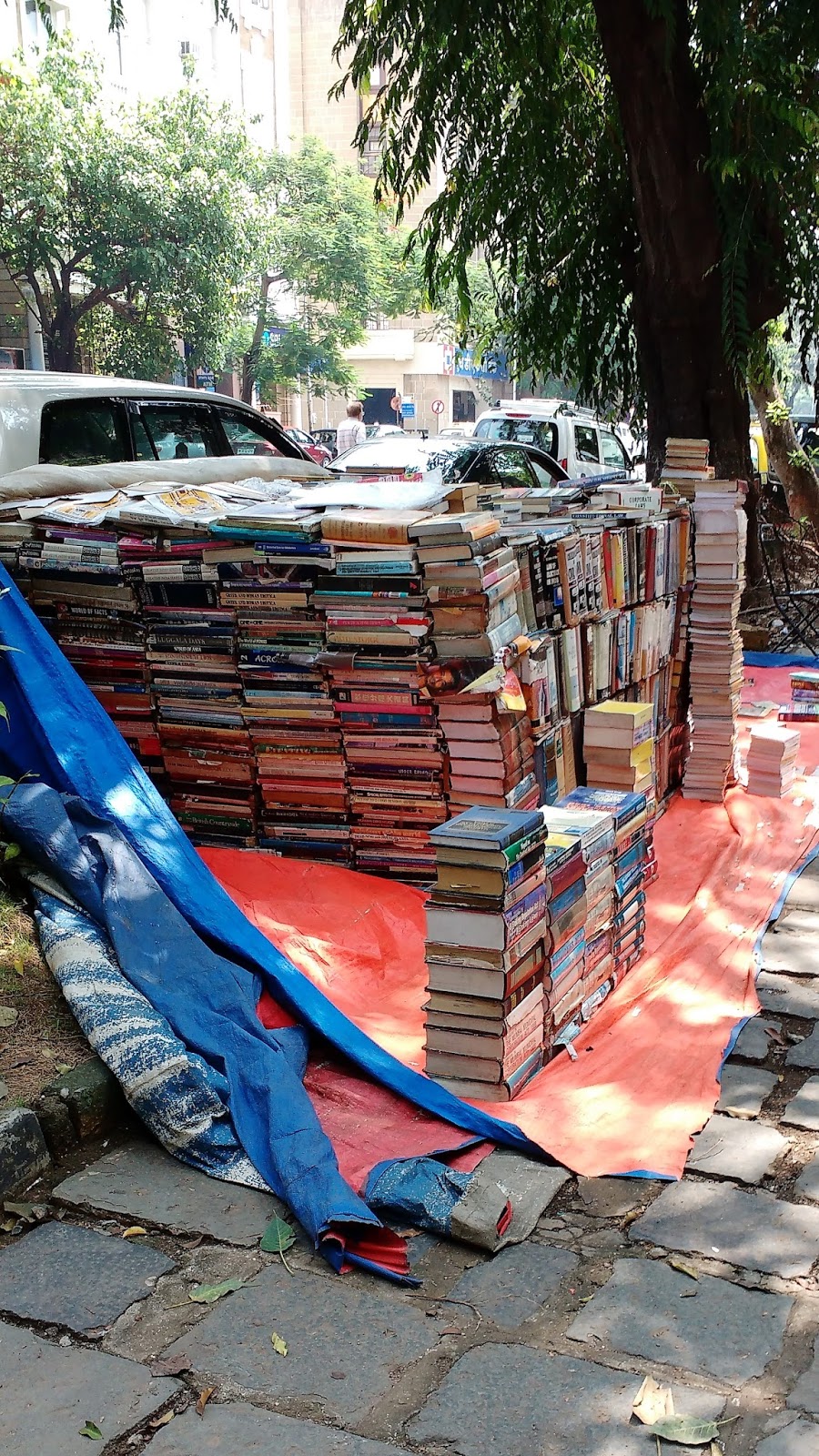
The footpath booksellers of Flora Fountain (Hutatma Chowk).
 
Books by Weight in South Mumbai, as far as the eye can see.

Abraham Lincoln in not-so-strange company.

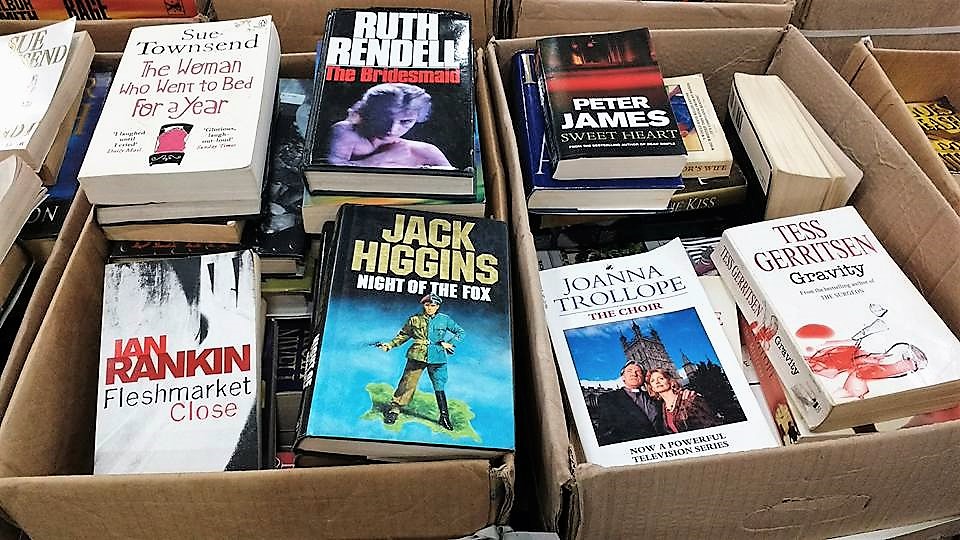
My pick from the box: Jack Higgins, my favourite author.

A pavement bookseller opens for the day.

The suburban bookshop where I browse—and board a bus home.

The English historical novelist on my TBR list.

Fiction rubs spines with self-help in South Mumbai.

Waiting for customers: This footpath bookseller knows his books.

British crime writer Martina Cole at Books by Weight.

A close-up of a footpath bookseller on Mahatma Gandhi Road.

Heavyweights jostle for space at a suburban bookshop.

Take your pick or toss a coin, at Books by Weight.

Spy novelist Craig Thomas is an old friend.

Books in a haystack near the old Central Telegraph Office.

This photo essay was first published in October 2017 and has been lightly updated in June 2026 with revised text and links to related posts. Some of these book haunts may have changed over the years, while others continue to welcome browsers and collectors. But the joy of browsing secondhand books remains the same.

© All photographs by Prashant C. Trikannad


July 08, 2017

Book Tag: A Q&A about my reading life

On June 17, my blog friend Tracy did a Book Tag post on her popular blog Bitter Tea and Mystery, answering a series of trivia questions about books and reading. She, in turn, had been inspired by similar book tags on other blogs. I found her version particularly enjoyable, not least because of the sheer variety of books she has read—and continues to read and review—across several genres.

(As an Amazon Associate, I earn from qualifying purchases.)

No reader ever reaches the end of the journey. I still have countless authors to discover, shelves of books waiting to be read, and many years, I hope, before I can look back with any sense of satisfaction. So I'm going to answer these questions honestly. Is there any other way? To adapt a famous line from Kurt Vonnegut's 1961 novel Mother Night—“We are what we read, so we must be careful about what we pretend to read and the books we pretend to talk about.”

Let’s see how it goes.

Shakespeare: Complete Works
What book has been on your shelf the longest?

My paternal grandfather's 1965 Tudor edition of Shakespeare: Complete Works (The English Library). I'm saving it for retirement, though I suspect the Bard will have plenty of company by then. Every other year I tell myself I'll finally settle down and read Shakespeare properly. Instead, I end up dusting the cover, the spine and the yellowing pages before placing it carefully back in the cabinet.


Shall We Tell the President? by Jeffrey Archer book cover
What is your current read, last read, and the book you plan to read next?

Current Read: The Midden by British satirical novelist Tom Sharpe (one of my favourite writers) and Shall We Tell the President?, an alternative fiction by Jeffrey Archer, one of several bestselling authors I read in college. 
I enjoy Sharpe's irreverent wit and outrageous humour. Archer, on the other hand, is an old hand at storytelling. Remember Kane and Abel?

Last Read: Past Tense, where prolific writer-blogger Margot Kinger introduced me to her affable sleuth Joel Williams, a former policeman turned academician.

Next Read: To be honest, I have no idea. My next book is usually a random choice, though I'm tempted to pick up a P.G. Wodehouse or an Agatha Christie from my wife’s collection. 
It's been a while since I last read either. Wodehouse still has me in splits, even if his humour occasionally follows familiar patterns.

The Sound and the Fury by William Faulkner book cover
What book do you tell yourself you’ll read, but probably won't?

I'm going to answer this one a little differently.

I struggled through the first 30-odd pages of William Faulkner’s The Sound and the Fury and nearly gave up. I had little idea what was happening. It remains one of the most challenging books I have attempted in recent years. At times it almost felt as though Faulkner himself was saying, "My narrative style isn't for you. Read something else." I wasn't amused.

What book are you saving for retirement?

Well, as I said, Shakespeare will probably have distinguished company: Dostoyevsky, Tolstoy, Gogol, Solzhenitsyn, The Rise and Fall of the Third Reich by William L. Shirer, Thus Spoke Zarathustra by Friedrich Nietzsche (which I never finished), and a few other classics. Of course, much will depend on my eyesight and state of mind.

Sudden: The Marshal of Lawless by Oliver Strange book cover
Which book character would you switch places with?
 
James Green, better known as Sudden, the Texas outlaw. I've admired the character ever since my paternal uncle introduced me to the eponymous western series when I was 14.

Created by British writer Oliver Strange, Sudden is my favourite Western hero. He earns both his nickname and his notoriety because of his lightning-fast draw, and is branded an outlaw for crimes he never committed. In reality, Green is a gentleman with a gun, defending ordinary folk against crooked gamblers, ranchers, rustlers and land-grabbers, even as he quietly hunts down the two men who killed the man who raised him. Sudden also has a badge—and a secret identity: Deputy Marshal of the United States, reporting directly to the Governor of Arizona.

While Strange, who never once travelled to America, wrote ten Sudden novels, 
fellow English writer Frederick H. Christian (better known as Frederick Nolan) added another five after Strange's death. You can hardly tell the difference. This remains the only series, in any genre, that I have read more than once.

Love Never Faileth by Eknath Easwaran book cover
What book reminds you of a specific place, time or person?

I'm usually so engrossed in a book that I rarely relate its plot, setting or characters to real places or people. It simply doesn't occur to me.


Which book has been with you most places?

Quite a few spiritual books, but mostly Love Never Faileth by the late Indian spiritual teacher and author Eknath Easwaran, 
who founded the nonprofit Blue Mountain Center of Meditation in California in 1961. This, and most of Easwaran's forty books, offers a practical guide to leading a more fulfilling life through his simple eight-point programme of passage meditation. You can open almost any page and think, "Hey, this is exactly what I needed."

Which book have you reread the most?

The books I have reread most often are philosophical and spiritual, particularly those by Easwaran and other mystics, including my own spiritual preceptor. They have been my comfort zone—my mental prop—for more than three decades.


(As an Amazon Associate, I earn from qualifying purchases.)

What book outside your comfort zone did you end up loving?

Not one, but two: The Mayor of Casterbridge and Jude the Obscure by Thomas Hardy. I read these powerful classics more than a decade ago on my wife's recommendation. Until then, I had never read an unabridged classic, apart from the abridged versions we encountered in school.

What are your three bookish confessions?

 
1. I collect books. I still own several unread books that I bought in the 1980s and 1990s. Having said that, I have been exercising some restraint. So far this year, I have bought just three books.

2. I will happily miss a bus, train or autorickshaw if I spot secondhand books for sale, even if I end up buying nothing and reaching home late.

3. I never lend books I treasure, such as my Corgi editions of the Sudden novels and my comic-books.


The Executioner: Death Load by Don Pendleton book cover
Do you prefer used or brand new books?
 
There is a certain charm about secondhand books, which make up most of my modest collection. This includes over two dozen secondhand—but mint-condition—paperbacks of Don Pendleton’s Mack Bolan: The Executioner. 
As for new books, I now buy more Kindle editions than paperbacks.

Have you ever seen a movie you liked more than the book?


Perhaps not more than the books themselves, but I thoroughly enjoyed the film adaptations of Jack Higgins' The Eagle Has Landed and A Prayer for the Dying, and Alistair MacLean's The Guns of Navarone, Where Eagles Dare and Ice Station Zebra. I also liked the screen versions of Harper Lee’s To Kill A Mockingbird, John Ball’s In the Heat of the Night, and, of course, 
the Harry Potter films.

Last page: read it first, or wait till the end? 

I've never read the last page first
—not even to finish a book sooner—although I was tempted while reading Irving Wallace’s The Second Lady. If you’ve read the book, you’ll know why.

DC Comics: Sixty Years of the World's Favorite Comic Book Heroes by Les Daniels book cover
Name a book that you acquired in an interesting way.

DC Comics: Sixty Years of the World's Favorite Comic Book Heroes (Bulfinch, October 1995).

Many years ago, I found this collector's edition at a new bookstore for Rs 450 ($9). I wanted it badly. But wisdom prevailed, and I walked away, convincing myself the money could be put to better use—perhaps on groceries and things like that.

A few days later, while on my way to the office in another part of town, I spotted the very same book at a roadside bookseller. It was in mint condition and priced at just Rs 125 ($2.5). I bought it without a second thought.

Final two questions, my own.


Which authors you wish you had read by now?

Most Indian authors. There is such richness and variety in Indian writing in English that I often wonder why I have neglected it for so long. In hindsight, the focus of my blog should probably have been more desi than Western. I hope to make up for that by reading—and reviewing—more Indian fiction in the years ahead.

If you didn’t read books, what would you be doing?

Probably painting or learning to play a musical instrument. I think it's important to have non-work pursuits among the arts and crafts. Much of everything else is so ordinary.


Bottom line: 
If these answers reveal anything, I hope it's not how many books I have—or haven't—read, but the kind of reader I am. There are still countless books waiting for me, and that's part of the pleasure. Reading isn't a race. The important thing is simply to keep reading, even if it's one book at a time.

Other notable Book Tag posts
 
Nancy Elin 

Brona's Books

On Bookes

Howling Frog Books

June 28, 2017

The novels of Jack Higgins: A master storyteller

Jack Higgins (Henry Patterson) is my favourite author. To me, the bestselling British writer ranks among the finest storytellers of his era. Like his compatriot Jeffrey Archer, Higgins made storytelling look effortless, whether he was writing wartime adventures, espionage thrillers or action novels.

Although I have not read all of his 85-odd novels, I have read many of them and look forward to reading the rest. My introduction to Higgins came in the early 1980s with his masterpiece, The Eagle Has Landed. It was followed by Hell Is Too Crowded, The Last Place God Made and A Prayer for the Dying—novels I still remember vividly.

Many of Higgins' protagonists are flawed—former IRA operatives, soldiers, mercenaries or reluctant heroes—who often live by their own moral code. They may not always be your conventional heroes, but they are easy to root for. The kind you want on your side because you know they're good men, almost saint-like, and all very likeable. 

Below are only a few of my favourite Jack Higgins novels. Ask me again tomorrow, however, and I might well replace some of them with Night of the Fox, Toll for the Brave, A Fine Night for Dying or The Keys of Hell. That's the problem—and the pleasure—of choosing favourites from an author whose books I've enjoyed for more than four decades.

Have you read Jack Higgins? If so, which of his novels would make your list?

(As an Amazon Associate, I earn from qualifying purchases.)

Hell Is Too Crowded by Jack Higgins book cover
In Hell Is Too Crowded, American engineer Matt Brady follows a beautiful, frightened woman home to London after a night out—and wakes up to find her murdered and himself framed for the crime. Imprisoned and desperate, he must break free to clear his name. This is one of Higgins' early thrillers, first published under his real name Henry Patterson. 


The Last Place God Made by Jack Higgins book cover
Set in 1938 Brazil, The Last Place God Made is the story of down-on-his-luck British pilot Neil Mallory, who teams up with Sam Hannah, a once-legendary WWI fighter pilot now scraping a living running supplies over the Amazon. When a mission station is massacred and two nuns go missing, the two men fly into the deadly heart of the jungle to find them.


The Savage Day by Jack Higgins book cover
Set against the Troubles in Northern Ireland, The Savage Day introduces British agent Simon Vaughan who is sent undercover into a tense, gun-running plot involving IRA factions and a hidden fortune in stolen gold. Betrayal, sectarian violence and shifting allegiances drive this suspense thriller. 


Hell Is Always Today by Jack Higgins book cover
The third in the Nick Miller series, Hell Is Always Today is a police procedural that follows Detective Sergeant Miller hunting "the Rainlover," a serial killer stalking London women on wet nights, while a separate case—an escaped boxer-turned-cat-burglar seeking revenge—runs alongside it.


A Prayer for the Dying by Jack Higgins book cover
In A Prayer for the Dying, IRA hitman Martin Fallon, sickened by a botched job that killed a child, flees to London hoping to escape his past—only to be blackmailed by a corrupt undertaker who witnessed his crime. Torn between a priest offering redemption and gangsters demanding one last kill, Fallon is trapped in a moral dilemma.