May 26, 2013

BOOK BUYS

Readings from the raddiwala


Some of the best books and comics in my collection have come from the ubiquitous raddiwala, but more about that later.

The raddiwala is roughly an old paper mart or a scrap dealer whose main business is to buy old newspapers, magazines, and books from residential and commercial premises. He also buys all kinds of other used stuff that you no longer use, like faucets, stoves, copper wires, utensils, and iron pipes, to give you an idea. Most of these items are recycled and at some point find their way back into your home, as brand new items. You wouldn’t know.

Mumbai recycles everything, even school notebooks and textbooks after your kid has passed out of an academic year, an annual ritual. The city has become one big recycle bin.
 

The raddiwala usually operates from a small shop often wedged between bigger shops on either side, selling fancier stuff. Like the omnipresent paanwala (betel leaf and tobacco seller), the raddiwala is found in all lanes and bylanes of Mumbai, as he is in every part of the country. His shop is easily distinguishable by the row of magazines and plastic containers hung from the corrugated iron roof. The raddiwala sits on a flat cushion or a wooden bench in front of a pair of weighing scales and a room lined with heaps of old newspapers. He usually lives in the hole in the wall, with his wife and kids.

The raddiwala is an important part of the commercial milieu of Mumbai. He comes from a poor background, mostly from the northern Hindi speaking belt of the country, but he can be enterprising too. He often deals in old newspapers and new mobiles at the same time and he may also have a chain of raddi shops across the city.


The current rate for old newspapers and magazines is Rs.9-10 per kg (less than 25 cents). It varies according to the ‘going’ price in the recycle market. The raddiwala weighs your old papers, calculates, and pays you cash on the spot. No questions asked. 

Most houses in Mumbai prefer to call the raddiwala home. He comes over to your place on his bicycle with a dirty sack and portable weighing scales in tow. He ties up your old newspapers into a neat bundle, hooks it up to the scales, and turns it towards the light so you can see the reading and calculate, lest you feel you’re being cheated. The exchange of paper for money is usually preceded by a little haggling over the price offered or the reading of the scales or both.

In Mumbai, people cultivate their raddiwala in the same way they cultivate their barber, grocer, vegetable vendor, and tailor. You seldom go elsewhere. The more you buy from the same place, the better the bargain and treatment you’ll get.

The raddiwala has been my favourite haunt for secondhand books for many years, though they’re much smarter nowadays, selling the used novels they get in their raddi to professional secondhand book dealers who know their value as well as you do.


Nonetheless, I have bought some fine books and comics from raddiwalas in the past. My most memorable acquisition from the raddiwala was half-a-dozen vintage Phantom and Mandrake comics under the erstwhile Indrajal imprint published by Bennett Coleman & Co. Ltd, owners of The Times of India. I bought them for Rs.50 ($1) only to have them eaten by termite a few months later.

Three purchases from the raddiwala I cherish are the 160-page The Science Fiction Book: An Illustrated History by Franz Rottensteiner, a hardback illustrated edition of Futuredays: A Nineteenth-Century Vision of the Year 2000 by Isaac Asimov, and Cows of Our Planet: A Far Side Collection by Gary Larson. They cost a pittance.

On the face of it, these books may not seem much. They do when you buy them from the raddiwala.
May 24, 2013

BOOK PREVIEW

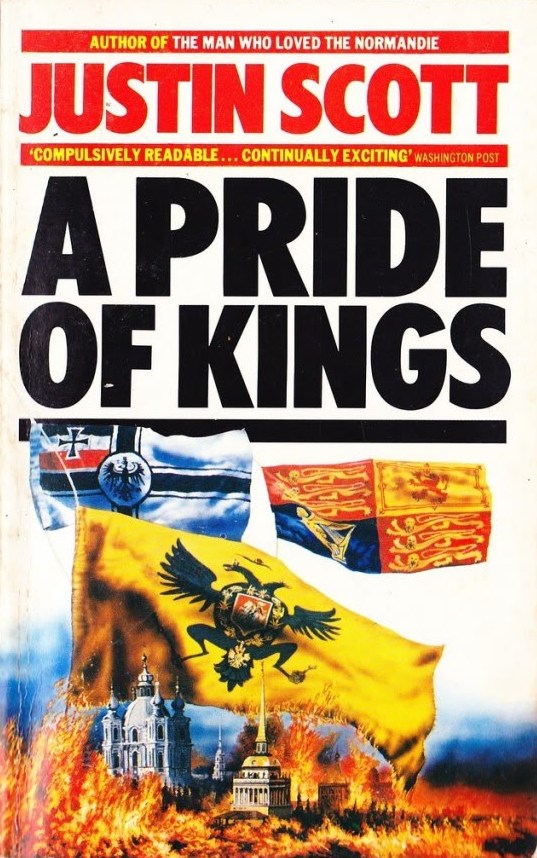
A Pride of Kings by Justin Scott (1982) 

Last evening, I wrote five paragraphs of my proposed review of The Snake, a Mike Hammer novel by Mickey Spillane, for Friday’s Forgotten Books at Patti Abbott’s blog Pattinase. Since then, the Word file has vanished.

Something came up and I had to leave my seat in office. Before I did, however, I closed the file. When I came back, I took up something else, several news reports for editing. In between, I deleted a few files and I think my incomplete review of The Snake, which lay coiled on my desktop, accompanied them to the recycle bin. Now I have this habit of clearing the bin no sooner I delete files and images, it’s a sort of reflex action. I knew at once that The Snake was gone.

Had it really? I mean, what if I’d mixed up my review with some of the news stories I was editing? I remember copying and pasting stuff at the time. What if those five paragraphs became a part of a story on the outlook for India’s construction equipment market or India’s policy on offshore wind energy? What fun! I spent the next half-hour opening all the official Word and QuarkXPress files and going through each of them with a fine-tooth comb. The Snake was not to be found, not even a shred of snake skin.

I still don’t know what happened to my review. I learnt some lessons, though: never write a blog post with a print deadline hovering over your head; better still, never write a blog post in office and even if you do, never leave your desk until you have finished it; never forget to save after every few words (that I do) and never forget to store the file on multiple drives; never leave too many software (Word, Excel, Chrome, MS Outlook, NoteTab…), or folders, open at the same time, especially if you’re working on just one file; and finally, never ever multitask. I do all the time.

Could I rewrite those five paragraphs from memory? I could if I tried but I know it won’t have the same ring to it. Yesterday was yesterday. So I have decided to write it all over again for FFB next week.

So far, the title of the book in the headline hasn't justified the content. So I’m going to tell you something about it. I have not read A Pride of Kings since I bought it for Rs.20 (less than 25 cents) two weeks ago. The 620-page novel set during WWI promises to be “A burning epic of action, love and treachery” which it might well be. Consider this synopsis on the back cover…


"The Russian Empire 1916: At war with Germany, seething with dissent, boiling on the brink of revolution…

"There is only one man King George V can trust to go into this cauldron of violence and intrigue to bring out his cousin Czar Nicholas II.

"That man is naval officer Kenneth Ash. And in the glittering cities and frozen wastes of Russia, Ash faces not only the torturers and assassins who will try to stop him, but also a more insidious foe: he must confront the fear, the failure and the lost love of his own haunting past…and this time, he must win." 


Justin Scott, aka Paul Garrison, J.S. Blazer, and Alexander Cole, has written 23 thrillers and mystery novels, including The Shipkiller and Normandie Triangle, and is known as “the Dick Francis of yachting” because many of his books are set at sea. He has also collaborated with Clive Cussler on the Isaac Bell adventures. You can read more about Justin Scott at www.justinscott-paulgarrison.com.

The last book I read on the Russian empire was The Romanov Succession (1974) by Brian Garfield and I loved it. So I’m looking forward to reading this one.

May 21, 2013

FILMS

The best of Ed Harris

It’s Tuesday and time for another dose of Overlooked Films, Audio and Video at Todd Mason’s blog Sweet Freedom.

There are actors you like and then there are actors you like more. Ed Harris falls in the second category. He is one of those actors whose action, or the lack of it, speaks louder than words. He brings to the screen a quiet intensity, a formidable presence, and a penetrating look that says it all. 

Enemy at the Gates
 
I have seen many films of Ed Harris whose film and television career spans more than three decades. I didn't know he was around that long. Last evening, I saw a part of Enemy at the Gates (2001), a film I’d already seen twice before, particularly for the intense sniper duel between him, a German officer, and Jude Law, a Russian soldier, during World War II. Don’t miss the background music.

I thought about his other films and had no hesitation in picking out three of his performances that I liked best. The other two are The Abyss (1989) and The Rock (1996), the latter in spite of Harris being overshadowed by Sean Connery and Nicholas Cage. He plays a villain, a rogue general who sets out to bomb San Francisco with chemical weapons, and comes out a hero.
 

The Abyss

James Cameron’s The Abyss (1989) is a cult film like Ridley Scott’s Alien (1979). The best part of this film is when Ed Harris, playing Virgil ‘Bud’ Brigman, dives into the oceanic depths to look for a missing nuclear submarine and almost to his death and, instead, meets up with aliens who give him an audio-video lesson in man’s destructive nature.

If I were to vote for any one of these films, it would be Enemy at the Gates. The duel between Harris and Law played out amidst the ruins of Stalingrad has enough suspense to whet your appetite for a long time.

The Rock

May 20, 2013

BOOKS 

The Iron Tiger by Jack Higgins (1966)

British novelist Jack Higgins, whose real name is Harry Patterson and who is one of my favourite authors, wrote The Iron Tiger early in his writing career. It’s not one of his best novels I have read. Nonetheless, I found the story interesting because it is set in a remote and hostile part of the world that few authors would venture to write about—the India-Tibet border region; it is told in the backdrop of the impending Chinese invasion of Tibet; and it demonstrates the bravery of an officer of the Indian Army.

My copy of the book
Most heroes in Jack Higgins’ novels are tough, dashing and oozing charm by the gallon. Jack Drummond is no less so. The former Royal Navy pilot and intrepid adventurer flies secret missions into Tibet, supplying guns and ammunition to the rebels in their fight against the Red Army. He is about to call it a day when a beautiful woman, a nurse, implores him to undertake one last mission—flying her and an ailing boy prince under her care out of the tiny Himalayan kingdom of Balpur and to safety.

But, before Drummond can fly out, the Reds invade the fictional kingdom, kill the young boy’s father, Old Khan, and vanquish his modest army, and destroy his charter plane. The Chinese want both Drummond and the Young Khan alive: Drummond, because he has been working for British Intelligence and could prove useful to Peking (now Beijing), and the Prince, because the communist government wants to quell the unrest in Balpur by installing him as a puppet king. 

This is where the story begins. Over the next 50-odd pages, Drummond and his trusted friend, Major Hamid of the Indian Army, risk everything to save the woman, the prince, and a catholic priest from the pursuing Reds. Higgins’ description of the treacherous land, right up to the nearest Indian Army border check post, is so graphic as to give the impression that it is real and he has been there. Neither is true for Higgins wrote from his own research and imagination. 

The Iron Tiger shows the Chinese in poor light, in context of Tibet and the invasion of Balpur, while India, though not part of the overall narrative, is seen as a friend with close links with the kingdom. Balpur might well be the Himalayan kingdom of Bhutan which has close ties with India. It is bordered by India on the east and China to the north. Higgins doesn't say anywhere.

Although there is plenty of action, in the form of gunfire and explosions, The Iron Tiger lacks the suspense of Higgins’ other novels like The Last Place God Made (1971) or The Eagle Has Landed (1975). The narrative tends to drag a bit in the latter half as Drummond and the others, aided for a brief while by Balpur army chief Sher Dil, struggle for survival through stormy mountainous terrain, as they make their way towards the Indian border. 


As the lead character, Jack Drummond conforms to Higgins' devil-with-a-heart hero, though, he lacks the hardboiled image of some of his fellow mercenaries like Paul Chavasse, Sean Dillon, Martin Fallon or Harry Martineau. 

The Iron Tiger, written in the author's easy going style, is a decent read but not decent enough to make it to the top of the pile of books to read. 

I will leave you with what Higgins has to say about The Iron Tiger, as reproduced from his "Forward" to a recent HarperCollins edition of the book (left).

“India has always fascinated me, although I had not visited the country when I wrote The Iron Tiger. I have since, of course, and was delighted to find that, thanks to careful research, I had got it right. The period during which I wrote the book, the early sixties, was one in which the Chinese occupying power treated the Tibetan people with great brutality and many thousands of those unfortunates died. The Chinese invasion of India (in 1962) hardly made them popular in that country and, because of this, The Iron Tiger was a great success with Indian people. However, a strange thing happened. It made me, as the author, highly popular for a while as for some reason people believed that I had simply fictionalised a true story about myself and that the events of the book had actually taken place.” 
— Jack Higgins, July 1996


Previous reviews of Jack Higgins novels

1. October 11, 2011: The Keys of Hell (1965)

2. June 7, 2012: A Fine Night for Dying (1969)

3. August 10, 2012: A Prayer for the Dying (1973)

May 14, 2013

FILMS

I have got into the habit of reviewing films in pairs (see list at bottom) and keeping the custom alive this week are two of Mel Gibson’s earliest films, and my entries for Overlooked Films, Audio and Video at Todd Mason’s blog Sweet Freedom.

Mad Max and Tim (1979)

No two Mel Gibson films are more unrelated than the low-budget Mad Max and Tim save for the fact that they were released in 1979, just three months apart, and that they were named after his characters, Max Rockatansky and Tim Melville, or vice versa.

I have a vague recollection of both the movies, having seen them more than two decades ago, Mad Max in the cinema hall and Tim in the living room. So this is for the record.

The characters Gibson plays in the two films are diametrically opposite: in Mad Max, he is a mad-as-hell, revenge-seeking, blood-thirsting cop out to nail the ugly biker gang that murdered his friend, his wife, and his kid; and, in Tim, he is a shy and reticent young man, a slow learner who finds comfort and understanding in the presence of a woman, Mary (Piper Laurie), twice his age.

In many ways, Mad Max and Tim are about the changing social mores of the time, as evident in Max’s insensate and remorseless destruction of the enemy and Tim’s growing friendship with Mary that pits him against hypocrisy and suspicion in society.

The one thing common in both the films, as it is in many of his films, is the passion Gibson brings to his role and it hasn't waned a bit over the past three decades, either as an actor or a director. He is one of the most intense actors of our times.

I don’t remember if Tim played in Indian theatres. Mad Max did and it was a big hit and it made Gibson a household name in this country. Suddenly, everyone wanted to be like Max, with his boyish good looks, leather attire, mean gun, monster wheels, cold-blooded intent, and a hostile land between him and his unsuspecting target.
 

Mad Max was a trailblazer. It was directed by George Miller whose sequel, Mad Max 2: The Road Warrior (1981), didn't hold as well. In 1985, he directed Mad Max: Beyond Thunderdome which I haven’t seen. Now Miller is due to release Mad Max: Fury Road in 2014 with Tom Hardy in Mel Gibson’s boots. I doubt they’ll fit.

Tim, directed by Michael Pate, is a very sensitive film. It is based on a novel by Colleen McCullough, the author of the much-acclaimed The Thornbirds.


May 11, 2013

Comic books on Mars

I haven’t done a Vintage Comics post since September 27, 2012, when I wrote about The Mighty Marvel Superheroes’ Cookbook (1977) and shared some of the favourite (junk-food) recipes of the world’s mightiest heroes. They not only love their burgers and submarines, combos and chowders, and pastas and steaks, they cook them too. The Hulkburger is a particularly mean looking burger.

This morning I read a news item about NASA’s ongoing mission to Mars, which hopes to send the first man to the red planet by 2037, when I decided to explore my collection of e-comics for any adventures on Mars. I found 14 e-comic books about the planet including Flash Gordon published under the erstwhile Indian imprint, Indrajal Comics.

I found all the e-comics at Archive, which deserves praise for showing consideration towards comics buffs like me. In gratitude, I have provided links to all the comics most of which are complete. The list is in no particular order. Happy reading, downloading, and reading!


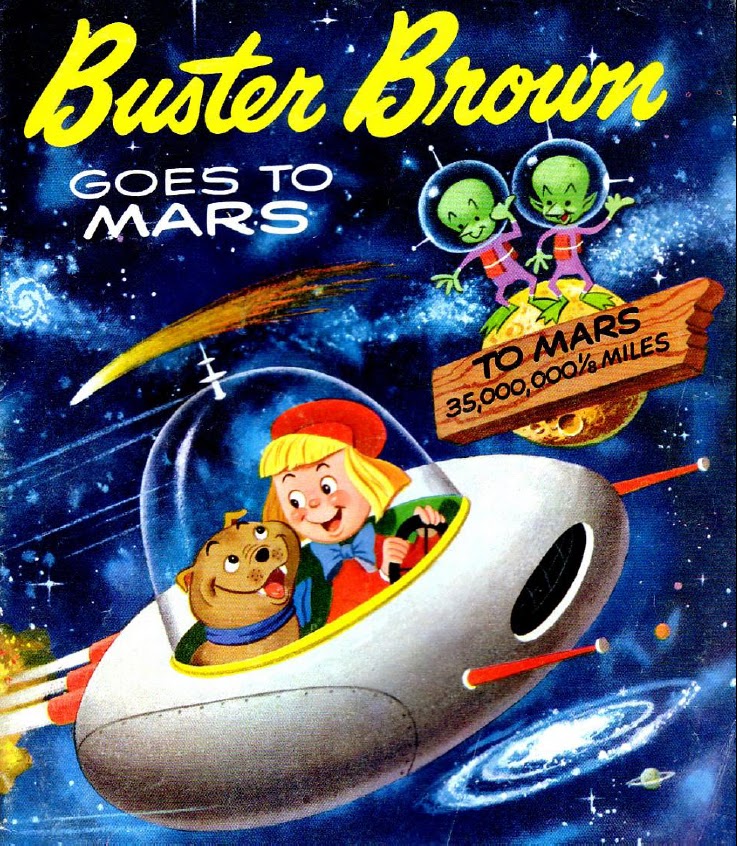
Buster Brown Goes to Mars 


Publisher: Western Publishing 
Year: Early 1958 


Mystery in Space: Cowboy on Mars 


Publisher: DC Comics 
Year: February-March 1952 


John Carter of Mars #36


Publisher: The Funnies 
Year: October 1938 


Mystery in Space: The Martian Horse


Publisher: DC Comics 
Year: August-September 1952 


Wonder Woman: Mystery of the Rhyming Riddle 


Publisher: DC Comics 
Year: March-April 1949 


Lars of Mars


Publisher: Ziff-Davis Comic #10 
Year: April-May 1951 


The Face on Mars


Publisher: Harvey Comics 
Year: September 1958 


John Carter of Mars #375

 
Publisher: Dell 
Year: 1952 


The Planetary Adventures of Flint Baker

 
Publisher: Planet Comics #1 
Year: January 1940 


The Martian from Gotham City 


Publisher: DC Comics 
Year: June 1960 


First Earthman on Mars

 
Publisher: Fiction House Comics 
Year: July 1944 


Lost in Space


Publisher: EC Comics 
Year: March/April 1955 


Flash Gordon: Trapped on Mars 


Publisher: Indrajal Comics (India) 
Year: November 1973 


Gulliver Jones: Warrior of Mars


Publisher: Marvel Comics 
Year: 1971 

May 08, 2013

Stamp of a Writer: Margaret Mitchell

The following quotes of Margaret Mitchell have been taken from an interview she gave Mrs. Medora Perkerson of The Atlanta Journal Sunday Magazine and broadcast over radio station WSB, Atlanta, Georgia, on July 3, 1936. The interview was published for the first time in a digital format at PBS. You can watch the full documentary, Margaret Mitchell: American Rebel, here and read the full text of her interview here. The Civil War had a major influence on her life and shaped her only major work.

"My novel (Gone With the Wind) is the story of a girl named Scarlett O’Hara, who lived in Atlanta during the Civil War and the days of Reconstruction. The book isn’t strictly a book about the war, nor is it a historical novel. It’s about the effect of the Civil War on a set of characters who lived in Atlanta at that time."

"When I was a child I had to hear a lot about the Civil War on Sunday afternoons when I was dragged hither and yon to call on elderly relatives and friends of the family who had fought in the war or lived behind the lines. When I was a little girl, children were not encouraged to express their personalities by running and screaming on Sunday afternoons. When we went calling, I was usually scooped up onto a lap, told that I didn't look like a soul on either side of the family and then forgotten for the rest of the afternoon while the gathering spiritedly refought the Civil War."
 

© Library of Congress

"While I’m talking about knees and laps, that cavalry knees were the worst knees of all. Cavalry knees had the tendency to trot and bounce and jog in the midst of reminiscences and this kept me from going to sleep."

"If Gone With the Wind has a central theme, I suppose is the theme of survival. What quality is it that makes some people able to survive catastrophes and others, apparently just as brave and able and strong, go under? I have always been interested in this particular quality in people. We've all seen the same thing happen in the present depression. It happens in every social upheaval, in wars, in panics, in revolutions."


P.S.: Margaret Mitchell was only 49 when she died of injuries sustained after a speeding car knocked her down while crossing Peachtree Street, Atlanta, on August 11, 1949.


For 24 previous Celebrity Stamps, see under Labels.