December 31, 2017

Nothing much happened in 2017

2017 was probably my worst year of reading and writing in recent memory. I read very few books and short stories, and reviewed even fewer on this blog. Personal and professional commitments took up most of my time, while the daily commute became increasingly stressful, leaving me with little energy to read or write. 

As the year wore on, my visits to other blogs declined. That was the one thing I missed the most. But a new year, as Calvin tells Hobbes, is a "new beginning" full of "new possibilities," and I look forward to reconnecting with fellow readers and bloggers. In fact, that's the first thing I'm going to do in 2018.

(As an Amazon Associate I earn from qualifying purchases.)

Godless TV drama series
I watched quite a few films and television series during the year, many of them Netflix originals. I particularly enjoyed Godless, a fine western, and Alias Grace, a psychological drama based on Margaret Atwood's novel, which I still haven't read. Beasts of No Nation, about a child soldier in a war-torn African country, was disturbing, though I felt Idris Elba's character could have been better developed.

For some reason, I also binge-watched Jason Statham's crime films on Netflix. They reminded me of the hard-boiled thrillers I enjoy reading. A couple of them, especially The Italian Job and The Bank Job, felt as though they had come straight out of a James Hadley Chase or Lionel White novel.


Another documentary I enjoyed was Minimalism: A Documentary About the Important Things. There was nothing particularly new about its central idea—mystics have preached "less is more" for centuries—but it served as a useful reminder. To be honest, I've been hoarding books when I should have been reading them and giving away those that no longer deserve a place on my shelves.

Alias Grace TV drama series
On the writing front, well, I'm still writing—or struggling to, thanks to time constraints and the occasional bout of what we call writer's block, which is probably just an excuse not to write and watch a film instead. I have unfinished short stories, a novel I've only recently begun, and a work of nonfiction that I hope will make people feel good about themselves. I intend to persist with all three in 2018, write every day and work to deadlines.  


One bright spot during the year was the publication of my first short story, A Little Murder at Dinner, on Juggernaut Books. It's an atmospheric tale about a police officer and his wife, set against the backdrop of a double murder.

So that's how the year was. Not much happened. But I hope to make things happen in 2018, particularly where my writing is concerned.

November 27, 2017

Book Review: Dead Line by Stella Rimington

The story of English author Stella Rimington is almost as interesting as the plot of Dead Line, the fourth novel in her espionage series featuring MI5 agent Liz Carlyle. Dame Rimington, who joined Britain's domestic counter-intelligence and security agency in 1969, was appointed Director-General in 1992, becoming not only the first woman to hold the post but also the first head of MI5 to go public.

(As an Amazon Associate I earn from qualifying purchases.)

With nearly three decades of intelligence experience behind her, the series is written with first-hand knowledge. Dead Line, the only novel in the series I have read so far, is a convincing and realistic entry in the world of spy fiction.

Dead Line by Stella Rimington book coverThe British government is weeks away from hosting a Middle East peace conference at Gleneagles in Scotland. While Syria and Israel are at the heart of the talks, heads of government from Britain, the United States, Jordan, Lebanon and Iran are expected to lend their weight to the proceedings. The conference may not produce an immediate breakthrough, but it is vital that it concludes without incident. The prestige of 10 Downing Street depends on it.

There are, however, rogue agents and even nations that will stop at nothing to wreck the conference. Acting on a tip-off from MI6, the Secret Intelligence Service, MI5 chief Charles Wetherby entrusts the sensitive case to Liz Carlyle. Her task is to track down two terror suspects, including a Syrian journalist, believed to be planning an attack on the summit.


But there is one problem: Liz has almost nothing to work with. Starting from scratch, she uncovers a conspiracy far more dangerous than she, Wetherby or anyone else in British intelligence had imagined. Her investigation puts her on a collision course with allies in the CIA and Mossad, while the trail leads to a shadowy Syrian operative with a chilling past and a thirst for revenge.

Dead Line by Stella Rimington book cover
Dead Line may not have the spectacle of a Tom Clancy thriller, the legacy of John le Carré or the technical detail of a Craig Thomas novel. What it does offer is a believable portrayal of how intelligence agencies might actually operate behind closed doors in the fight against terrorism and subversion. Rimington writes with clarity and her methodical plotting reflects one who has seen that world. Liz Carlyle is a credible intelligence officer, balancing the demands of her profession with career ambitions, family concerns and private emotions.

I plan to read more in the series by Britain's most famous spy.

October 08, 2017

Photo Essay: A tour of Mumbai's book haunts

Secondhand books have the tantalising aroma of a spicy Goan fish curry.

Browsing through books is half the pleasure. Buying them doesn't always have to be the happy ending. I have spent much of my reading life doing little more than scanning bookshelves, admiring covers, flipping through pages, reading blurbs, searching for forgotten bookmarks, and envying what other people find. Which means I get as much satisfaction from browsing as I do from buying. Of course, there have also been times when I've walked away empty-handed, only to regret leaving behind a coveted title or an out-of-print book. I've even returned the next day, only to find it gone. 

Old or new, in shops or on footpaths, books have been my companions ever since I started my reading journey with the Hardy Boys. Here are some of my favourite book haunts, mostly in South Mumbai, where I have browsed far more than I have bought. A few of these photographs have appeared on the blog before, but most were taken specifically for this post.

The footpath booksellers of Flora Fountain (Hutatma Chowk).
 
Books by Weight in South Mumbai, as far as the eye can see.

Abraham Lincoln in not-so-strange company.

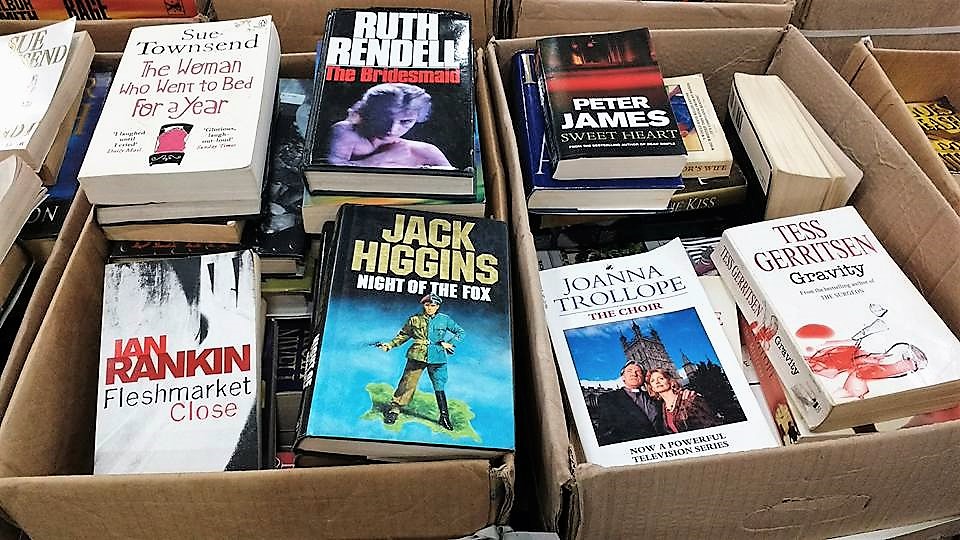
My pick from the box: Jack Higgins, my favourite author.

A pavement bookseller opens for the day.

The suburban bookshop where I browse—and board a bus home.

The English historical novelist on my TBR list.

Fiction rubs spines with self-help in South Mumbai.

Waiting for customers: This footpath bookseller knows his books.

British crime writer Martina Cole at Books by Weight.

A close-up of a footpath bookseller on Mahatma Gandhi Road.

Heavyweights jostle for space at a suburban bookshop.

Take your pick or toss a coin, at Books by Weight.

Spy novelist Craig Thomas is an old friend.

Books in a haystack near the old Central Telegraph Office.

This photo essay was first published in October 2017 and has been lightly updated in June 2026 with revised text and links to related posts. Some of these book haunts may have changed over the years, while others continue to welcome browsers and collectors. But the joy of browsing secondhand books remains the same.

© All photographs by Prashant C. Trikannad


October 03, 2017

Book Review: Sniff the Detective by Richard Scarry

Sniff is a detective.
He helps people find things.
He helps catch bad people.
He thinks with his head.
And he smells with his nose.


Every now and then I like stepping outside my reading comfort zone. That's how I ended up reading Sniff the Detective (Golden Books, 1988), a delightful children's mystery by the late American author and illustrator Richard Scarry. It was my first children's detective story in middle age, and I enjoyed it far more than I expected.

(As an Amazon Associate I earn from qualifying purchases.)

The illustrated book contains two stories—Sniff Catches the Robber and Sniff's Best Case Ever—set in a world of anthropomorphic animals who talk, work and solve crimes just like humans. They're impossible not to like.

In the first story, Chief Hound asks Sniff to investigate the mysterious disappearance of Mrs. Jewel's precious bracelets. Since the elderly pig has neither left her home nor received any visitors, Sniff spends the night there, hoping to catch the thief in the act.

The second story begins on a rainy day with Sniff happily staying in bed until duty calls from another city. It's almost his birthday and he'd rather be home eating cake and ice cream, but detectives don't always get holidays. His train journey introduces a few suspicious-looking passengers carrying violins and wearing dark glasses, making for an entertaining mystery.

The stories are simple, funny and gently suspenseful, while Richard Scarry's colourful illustrations and large typeface make the book ideal for reading aloud to young children. I especially liked Sniff's approach to detective work. He relies on observation, common sense and, naturally, an excellent nose.

Children's mystery, YA mystery or adult crime fiction—a good detective story is still a good detective story. You're never too young or too old to enjoy one.


Note: Writer-blogger Patti Abbott is hosting Friday's Forgotten Books over at her eclectic blog Pattinase, where you will read some fine reviews of forgotten or overlooked books.

September 27, 2017

Boot Hill: An Anthology of the West by Robert J. Randisi

"They died with their boots on."

© Forge Books
Boot Hill: An Anthology of the West (2002), edited by American author and anthologist Robert J. Randisi, is a remarkable and delectable collection of original short stories by some of the finest Western authors. Of the 15 stories only The Naked Gun by John Jakes (1967) is a reprint.

I borrowed the 351-page digital book from Archive.org and I have a fortnight to read all the stories before it probably vanishes automatically. I'm sure there's a waiting list. The stories revolve around Boot Hill in Dodge City, Kansas, the final resting place of some of the wildest and bizarre characters that rode the American West—“from the coffin-maker with a death wish to the drunken cowboy haunted by one night of greed and violence, to the vigilante piano man and the tough-talking soiled dove.”

So far I have read only Randisi’s pithy introductions of all the writers and his own enjoyable and rather humourous short story, The Gravediggers, where the eponymous Gravedigger welcomes the reader to Boot Hill and, in characteristic Old West lingo, talks about the history of the place, the “dead folks” and their stories (“if’n they could tell ’em that is”), the backbreaking work of digging graves, the bare wooden headstones (“with some writin’ on it”)...

The Gravediggers sets the tone for the remaining stories that I look forward to reading over the next few days. Meanwhile, here is the cast of authors in order of appearance.

01. The Gravediggers by Robert J. Randisi
02. The Naked Gun by John Jakes
03. The Ghost of Abel Hawthorne by Elmer Kelton
04. Sinners by Wendi Lee
05. The Guns of Dusty Logan by James Reasoner
06. Hard Ground by L.J. Washburn
07. The Comfortable Coffin of Miz Utopia Jones Clay by Tom Piccirilli
08. Anonymous by Randy Lee Eickhoff
09. The Last Ride of the Colton Gang by John Helfers and Kerrie Hughes
10. The Sellers by Troy D. Smith
11. The Piano Man by Robert Vaughan
12. Dead Weight by Richard S. Wheeler
13. A Disgrace to the Badge by Ed Gorman
14. Planting Lizzie Palmer by Marthayn Pelegrimas
15. A Damned Nuisance by Marcus Galloway


A Western anthology can’t get better than this.


Note: Writer-blogger Patti Abbott is hosting Friday's Forgotten Books over at her eclectic blog Pattinase, where you can read some fine reviews of forgotten or overlooked books.

September 20, 2017

Book Review: Booty for a Badman by Louis L'Amour

My belly was as empty as my prospect hole, and it didn't seem like I had much choice.

When young William Tell Sackett, the eldest of the three Sackett brothers, has no luck panning for gold, he agrees to carry 50 pounds of the yellow metal out of camp and deliver it safely to a bank in Hardyville—for the princely fee of $100. The gold belongs to four miners who trust him. There is just one problem: he must carry it through desert and mountain country over five days. And Tell knows he will not be alone on the treacherous journey. The Cooper gang, who make a living by robbing and killing successful prospectors, will be hot on his trail.  

Unmindful of the dangers ahead, the quiet, honest and tough cowboy packs a horse and rides out with the gold, each pound worth $1,000. He is not overly worried about the Coopers. He can take on the desperadoes, but he is less sure what to do when he encounters Christine Mallory, a pretty woman on the run from her soldier husband and stranded in the middle of nowhere. Disregarding his father Colburn Sackett’s advice to stay clear of women—“They’ll trouble you. Love ’em and leave ’em, that’s the way”—the chivalrous Tell agrees to escort her to Hardyville on the Colorado, even if it means slowing down and putting his life at greater risk.

Then, all of a sudden, the Cooper gang turns up. Here it comes.

Booty for a Badman is a fine Western, told in the engaging, concise, and easy style that is a Louis L'Amour trademark. The author evokes the wild country—the hostile terrain, the dust raised by pursuers in the distance, the campfire and smoke at night—without labouring over detail. Tell is a God-fearing and honourable man, as evident from his gentlemanly treatment of Christine, whom he addresses throughout as “Mrs Mallory.” Yet he cannot help dreaming of settling down with a woman like her and raising a family.

L’Amour also springs a couple of twists that I did not see coming. I was glad of that: the element of surprise is what holds my interest in a story, especially in a Western, a genre that can sometimes move towards a predictable finish. 

(As an Amazon Associate I earn from qualifying purchases.)

Booty for a Badman was first published in The Saturday Evening Post in July 1960, and was subsequently reprinted in the magazine in 1975 and 1988. It is included in The Collected Short Stories of Louis L’Amour: The Frontier Stories, Volume 1. There are at least four other volumes in the series and, together with his other stories, they add up to more than 250. I read L’Amour—one of the most popular and prolific writers of the last century—after many years, and this story has prompted me to read, and reread, his Sackett series, among other novels. among other novels.


Note: For more Friday's Forgotten Book reviews, visit Todd Mason's blog Sweet Freedom. Todd is doing the FBB honours this Friday in place of Patti Abbott at her blog Pattinase.

September 03, 2017

The lure of secondhand books in Mumbai

© Prashant C. Trikannad

Secondhand books are a little like antique furniture. They have a musty but pleasing smell, can carry surprising monetary value, and are much sought after by discerning readers and serious collectors. But just as it is not easy to buy old furniture, it is not always simple to get hold of forgotten and out-of-print books. You have to cultivate relationships with used-booksellers, rather like a news reporter nurturing a source for a scoop or a cop working an informant for a tip on an elusive gangster. Once you have a contact or two in the trade, you can sometimes track down almost any title on your wish list.

I remember nearly every secondhand book or comic-book I have bought over the past three decades, and none of them came easily.

Some years ago, I visited a prominent new-bookstore in South Mumbai to pick up a 1995 edition of DC Comics: Sixty Years of the World's Favourite Comic Book Heroes by Les Daniels, the well-known comic-book historian. The 256-page hardback, described as “The complete story of America’s favourite heroes and their talented and dedicated creators”, was on sale for the price of Rs.450 ($9 at the time). Naturally, I was elated. But I resisted the temptation to buy it. I thought the money could be put to better use and walked away. When it comes to books, however, even a devoted reader has to be practical sometimes.

It was just as well.

A couple of weeks later, I spotted a near-mint copy of the same volume at a pavement bookseller in the Fort-Fountain area, the central business district about 7 km from the bookstore. It was wedged between a tightly packed stack of academic journals and coffee-table books.

“It’s yours for Rs 150 (a little over $3),” said the bookseller, who knew his books better than I did.

I offered him Rs 100. We finally settled on Rs 125 ($2.5). It was a bargain I would have been a fool to turn down. Of course, it helped that the bookseller had been a “friend” for many years.

Not long after, I stumbled upon a fine—and, for me, rare—copy of The Penguin Book of Comics by Englishmen George Perry and Alan Aldridge, published in 1967. The 272-page volume chronicles the evolution of British and American comic books. While Perry wrote the text, Aldridge designed the cover and illustrations. The book examines the rise and fall of comics in the mid-20th century, in the wake of Fredric Wertham’s Seduction of the Innocent and the Comics Code, as well as the influence of comic strips and comic books on popular culture and on entertainment such as art, films and television.

Until the mid-1990s, booksellers lined the footpaths in that part of South Mumbai. Today, fewer than a dozen remain, thanks largely to eviction drives by the municipal corporation. Interestingly, the civic officer in charge of one such operation left the booksellers alone even as he went after other hawkers in the area. 

“Books are Saraswati,” he told me at the time, referring to the Hindu goddess of learning and knowledge. “I want people to buy and read books." 

Since the turn of the century, many sellers have abandoned books—which few people seem to be reading, let alone buying—for more lucrative goods such as mobile-phone accessories. Book collectors like me have been the losers.

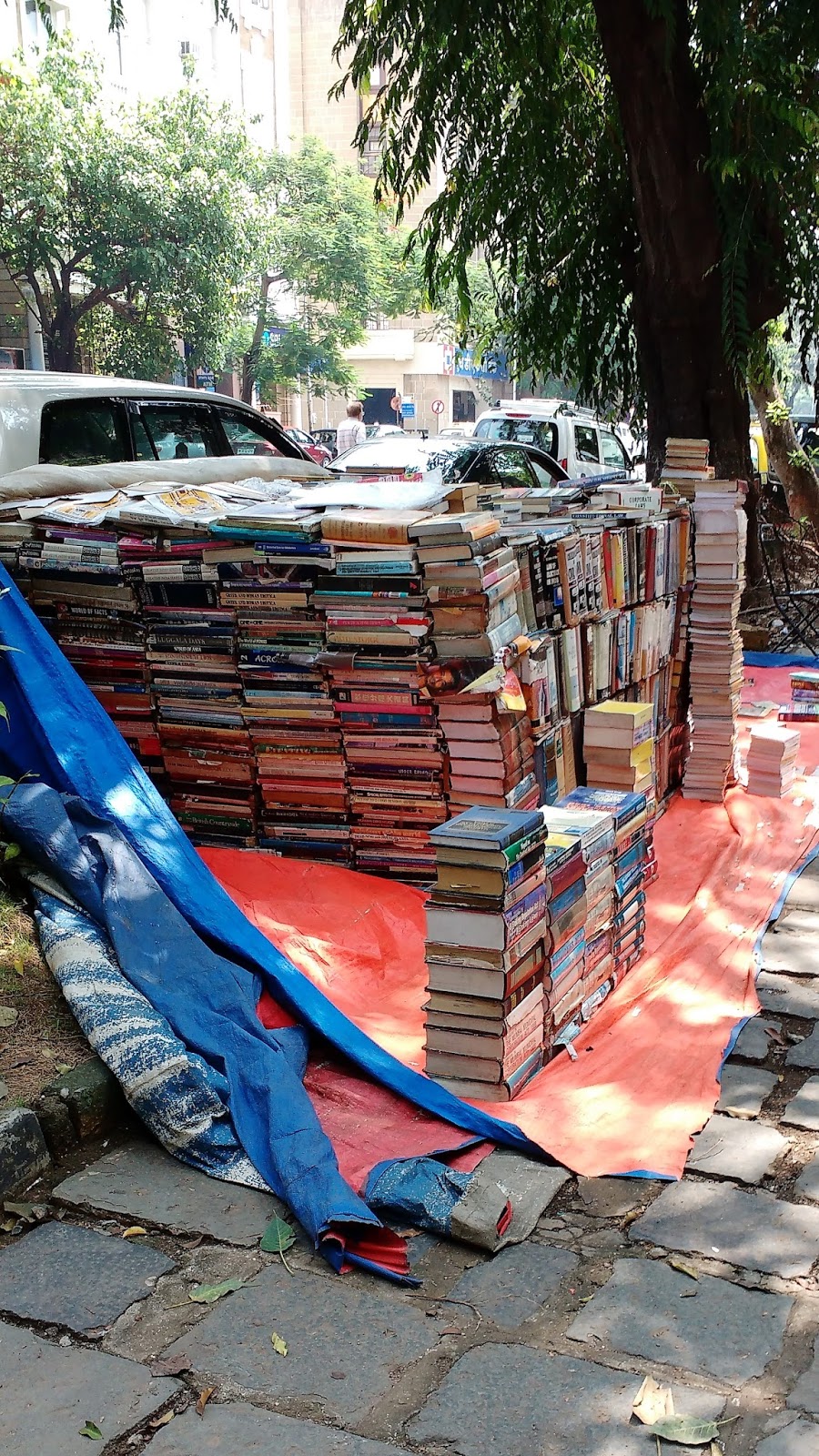
Secondhand books are not as elusive as one might think. You have to keep your eyes open and know where to look. Sometimes they are right under your nose; at other times, you have to sniff them out like a wolf tracking prey. After years of browsing, I can home in on a wanted title like a heat-seeking missile. All it takes is a quick sweep of stacks upon stacks of pavement books, provided the titles are displayed prominently. With practice, book-spotting can become an art.

Some of the most rewarding secondhand-book haunts in my city of approximately 18 million are raddiwalas. These hole-in-the-wall paper marts, scattered across the island city and its extended suburbs, are more than dusty repositories of old newspapers, plastic bottles and assorted junk. You never know what reading treasures you might find there. A few organised paper marts recognise the value of good books and pass them on to professional booksellers, but most stack them near the entrance and sell them cheaply. 

Like an archaeologist digging for bones, I have been prospecting raddiwalas for well over two decades, and with some success. I once bought a dozen rare Phantom and Mandrake comics, published under the Indrajal imprint, from a paper mart close to my home for Rs 10 each ($0.16)—almost as good as free.

The raddiwala clearly did not know their real value. Bennett Coleman & Co. Ltd, publisher of The Times of India, had stopped printing Indrajal Comics in 1990. Since then, booksellers and individual collectors have quoted obscene figures for these comics, which, apart from Lee Falk’s Phantom and Mandrake, included Indian artist Abid Surti’s hero Bahadur (the Brave), Roy Crane’s Buz Sawyer, Allen Saunders’ Kerry Drake and Mike Nomad, Alex Raymond’s Flash Gordon, Rip Kirby and Phil Corrigan, and Steve Dowling’s Garth.

(As an Amazon Associate I earn from qualifying purchases.)

Among the other prized books I bought secondhand were Art Spiegelman’s Maus I and Maus II; the 160-page The Science Fiction Book: An Illustrated History by Franz Rottensteiner; a hardback illustrated edition of Futuredays: A Nineteenth-Century Vision of the Year 2000 by Isaac Asimov; Cows of Our Planet: A Far Side Collection by Gary Larson; Sudden paperbacks by British writer Oliver Strange; a hardback of Nietzsche’s Thus Spoke Zarathustra; Calvin and Hobbes volumes; and dozens of DC and Marvel comics, including pocket-size war and western comic-books.

In the age of Amazon and e-books, the secondhand-book trade is slowly dying. Until it does—though I hope it never does—I will continue to look for elusive and priceless fiction and nonfiction. So far, I have been lucky enough to find a few gems every year. The secret to a productive secondhand-book hunt 
is patience, perseverance and, sometimes, luck—when a wanted title leaps out at you even when you are not looking. Those are the ones I like best.