July 14, 2014

Reading Habits #12: Sex in fiction

Are you still comfortable reading about sex in fiction? I say “still” because as I grow older and possibly more mature as a reader, I find that it doesn't make a difference any more. To the best of my knowledge, I haven't read a raunchy novel in over a decade. However, I have been reading books with a touch of romance or suggestive of sexual intimacy, but nothing explicit.

One reason for the absence of any kind of titillating stuff on my bookshelf or on my tablet is the change in my reading habits, hopefully, for the better. I read more classics and vintage books now while the crime and hardboiled fiction of the mid to late 20th century and modern novels that I occasionally delve into have little or no sex. Maybe, I'm not reading the right kind of books.

This does not mean that I haven’t read my share of adult literature in my younger days. While in school, I quickly graduated from Hardy Boys, Enid Blyton, and Just William to the popular and “sleazy” novels of Harold Robbins and Irving Wallace, to the dismay of an uncle who said I was too young to read the two worthies—“Wait till you are at least twenty.
 That's four years away! Instead, he recommended A.J. Cronin and Frank G. Slaughter. I'm glad he did for I enjoy reading their books till today.

The mass appeal of Robbins lay in his stories, told in plain English, and in his next-door middle-class characters who lost their virginity no sooner they reached puberty. His A Stone for Danny Fisher where a tragic young man dreams big in a crooked world and 79, Park Avenue where a beautiful young girl is forced to become a prostitute when everyone begins to treat her like one, are among his better-known novels. Never Love A Stranger, The Lonely Lady, and Dreams Die First are also entertaining.

Wallace wrote some decent novels, too, but The Celestial Bed based on sex therapy and technique is not one of them. I’d recommend The Man in which a black man becomes President of the United States and The Second Lady, a Cold War political thriller where the KGB kidnaps the US First Lady and replaces her with a Soviet impostor. More on the latter.

Everything goes smoothly for the impostor till it’s time for the inevitable, making love with the President, who has absolutely no clue that the woman sharing his bed is not his real wife. I think initially she spurns his overtures. While the KGB has got everything sorted out, it clearly forgot to take care of that little intimate detail between POTUS and FLOTUS.

The clever “hero” on the KGB side is attracted to the captive First Lady and falls in love with her in what is a one-sided affair. But he is a ruthless professional—the state before self and all that. So to protect his girlfriend’s identity in the White House, he must find out how the President’s wife performs in bed and pass on the information to her. He does the obvious: he sleeps with her. Now the First Lady wasn't born yesterday. She loves her husband and realises that the only way to expose the fraud in her bedroom is to have sex with the KGB agent in a way she and the President never did. Throw off the enemy agent on one hand and arouse her husband’s suspicion on the other. Does it work?

If ever I've read a graphic account of sex in fiction in my teens, it’s in those four to five pages of The Second Lady which has a very ingenious, even if outlandish, plot, and an entirely unexpected ending.

Later, I read most of the titles under English writer René Lodge Brabazon Raymond’s famous pseudonym, James Hadley Chase, and discovered the deceptive covers of his crime paperbacks—semi-nudes on the cover, barely a kiss inside. What a letdown. But Chase told good stories. I liked the ones about cops the most.


For previous Reading Habits, see under ‘Labels’.

July 12, 2014

New additions to the ‘library’

It has been awhile since I added any new books to my collection of some 100-odd physical books and 500-plus ebooks. Earlier this week I bought two used paperbacks, a mystery and a western. I don’t think twice before picking up westerns. I have some two dozen of them, unread as yet. The sight of the horseback paperbacks makes me want to read them right away. I probably would have if I didn't read anything else. Among all fiction I like the cover art of western novels the most.

The two books I picked up were Only a Matter of Time, 1969, a Dell Murder Ink Mystery, by V.C. Clinton Baddeley, and The Texan, 2001, by Joan Johnston, an American writer of over forty contemporary and historical romance novels. Both are new authors for me.

Born in Devon, England, Baddeley’s full name was Victor Vaughan Reynolds Geraint Clinton-Baddeley. He was more than a writer; he was also involved in theatre and plays, films, and radio. He wrote both fiction and nonfiction including Death’s Bright Dart reviewed by Yvette at In So Many Words… Steve at Mystery File has a more detailed piece about the author.

The back of the book has this to say about Only a Matter of Time: “On Friday afternoon, the directors of Bexminster Electronics were gathering for a top secret meeting. And a few miles down the road, the inhabitants of King’s Lacey were preparing for their annual festival. No one dreamed that the weekend would be shattered by mayhem and murder. Certainly not Dr. Davie, the distinguished poetry professor with a knack for detective work.”


Dr. R.V. Davie is V.C. Clinton-Baddeley’s main protagonist who is in search of diversion in what I think is a nice little mystery about poetic justice, so to speak.

In The Texan, Joan Johnston, the New York Times bestselling author of The Cowboy, “weaves a tale of two feuding families—the Blackthornes and the Creeds—and of two extraordinary people, loner Owen Blackthorne and beautiful, headstrong Bayleigh Creed, irresistibly drawn to each other despite the desperate odds against their love.”

This is the first time I’d be reading a true romantic western with a sex scene or two. I hope it works as well as the westerns I’m used to reading which is usually about a lone cowboy or gunfighter in search of some meaning in life.


I'll finish this post with a vague thought on who I'd like to see as the two lead actors in the remake of Tombstone, 1993, should there be one. I'd like to see either Leonardo DiCaprio or Brad Pitt replace Kurt Russell as Wyatt Earp and Jude Law or Matt Damon step into the shoes of Val Kilmer as Doc Holliday. What do you think?

July 08, 2014

Flight of the Phoenix, 2004

It’s Tuesday and here’s an entertaining desert film to back up Overlooked Films, Audio & Video at Todd Mason’s blog Sweet Freedom.

Last week, I set out to watch Robert Aldrich's The Flight of the Phoenix, 1965, starring James Stewart, Richard Attenborough, Peter Finch, George Kennedy, and Ernest Borgnine.

Instead, I ended up watching its remake, John Moore's Flight of the Phoenix, 2004, starring Dennis Quaid, Tyrese Gibson, Giovanni Ribisi, Hugh Laurie, Miranda Otto, and Tony Curran.

Both films are based on the novel by Elleston Trevor (born Trevor Dudley Smith). I have not read the book.

Stewart and Quaid play the lead character, Frank Towns, the captain of the ill-fated cargo plane that crash lands during a storm in the Sahara Desert in Africa and in the Gobi Desert in Mongolia, depending on which version you've seen.

Frank Towns (Quaid) and his co-pilot A.J. (Tyrese Gibson) are on their way back to civilisation after picking up crew and cargo at an immobilised oil well when a mighty dust storm forces Towns to crash his C-119 Flying Boxcar in the Gobi, somewhere in the middle of nowhere. The plane is at least two hundred miles off course and there are immediate casualties.


Towns is initially indifferent and is reluctant to take charge of the situation, the meagre rations of food and water, and the rudderless passengers, but relents when Kelly Johnson (Miranda Otto), one of the oil workers, pricks his conscience. 

What follows next is a lesson in team motivation and management as Towns strives to keep the spirits of his despairing passengers alive on one hand and struggles to protect his restless flock from the vagaries of the desert weather and ruthless smugglers on the other.

How they manage to get out of the desert, which can well be described as last place god made, is what makes this special effects film worth watching even though the plot is so-so. Of particular note is the way Towns brings down the plane through swirling storm and sand, in brief but terrifying moments that an artist or a photographer would capture perfectly on canvas or through a lens. The brilliant tan of the desert sand, caught on camera by cinematographer Brendan Galvin, seems to stretch forever and forms an immense backdrop throughout the nearly two-hour film.

In terms of individual performance, Dennis Quaid’s acting is along expected lines, only his films change. The actor to watch, if at all, is the reclusive Elliott (Giovanni Ribisi), a slightly eccentric design engineer who builds model airplanes. He’s the guy who plays Phoebe’s crazy half-brother in Friends.

July 05, 2014

Fourth of July

I'm probably a day late, but here's wishing all my American blogger friends a Happy 4th of July!

© J.L.G. Ferris/Wikimedia Commons
In the picture, Benjamin Franklin reads a draft of the Declaration of Independence as the other Founding Fathers, John Adams (seated) and Thomas Jefferson (standing), listen. The number of key Founding Fathers has been put at seven which includes George Washington. The painting is by Jean Leon Gerome Ferris (1863-1930), an American painter who famously recreated 78 scenes from American history known as The Pageant of a Nation, which, according to Wikipedia, is the largest series of American historical paintings by a single artist. It'd be worth taking a look at the others.

July 02, 2014

Q2 review: more books, fewer stories

I'm still in the thick of "closing" the special edition of my newspaper, which I mentioned in my last post. It'll have dozens of specially commissioned views and interviews of experts in the field of infrastructure in India. It is in the context of the new political dispensation in New Delhi, the result of a nine-phase general election held in April-May—the world's largest electoral exercise by the world's largest democracy. Hope has replaced despair, for now. While the articles are informative and analytical, they are obviously not as stimulating as fiction and fantasy. There are more exciting things outside of a job.

A slight respite from all the editing and pagemaking allowed for this post, a summary of books and short stories I read during the second quarter, April-June.

In the first quarter I read nine books and twenty short stories. In the second quarter I read eleven books and only seven short stories.

First, the books...


My pick of the quarter.
Crime: Public Murders by Bill Granger, 1980

War: The Legion of the Damned by Sven Hassel, 1957

Espionage: Stallion Gate by Martin Cruz Smith, 1986

Western: The Hell Raisers (originally Saddle Pals) by Lee Floren, 1988

Quasi Western: Carved in Sand by Erle Stanley Gardner, 1933

General (academia): The Common Room by K.B. Rao, 2014

General (media): The Bread Line: A Story of a Paper by Albert Bigelow Paine, 1899

General (media): The Imperfectionists by Tom Rachman, 2010

Thriller: The Last Place God Made by Jack Higgins, 1971

Thriller: The Savage Day by Jack Higgins 1972

Classic: A Tale of Two Cities by Charles Dickens, 1859

The last three books were re-reads.

And the short stories…

The Fifth String, The Conspirators, and Experiences of a Bandmaster by John Philip Sousa

Anne by Fanny Stevenson, 1899

The Intruders by Evan Hunter, 1954

Lamb to the Slaughter by Roald Dahl, 1953

Love Story by Irving E. Cox, 1956

I could swear I read more shorts. Then again, maybe I did not.

If I were to do a SWOT analysis of my less than average reading during the past three months, it'd be something like this.

Strengths: Quick to start
Weaknesses: Slow to finish
Opportunities: Plenty of books, plenty of time
Threats: Other distractions, mainly movies, chess, and Scrabble

Talking about movies, I recently saw (again) Raid on Entebbe (1977) directed by Irvin Kershner (Star Wars: The Empire Strikes Back, RoboCop 2, Never Say Never Again, Eyes of Laura Mars).

Based on a true story, as any film or book about Israel seems to be, this one too has many well-known stars like Peter Finch, Charles Bronson, Martin Balsam, John Saxon, Horst Buchholz, Jack Warden, Sylvia Sidney, Robert Loggia, and James Woods. A plane with as many as hundred Jewish passengers is hijacked by militants loyal to the Palestine movement and flown to Entebbe, Uganda. Since Israel does not negotiate with terrorists, it sends commandos to Entebbe, located more than 2,000 miles away, to flush out the hijackers and rescue its citizens. The rescue op is realistic. The highlight of the film is Yaphet Kotto as President Idi Amin.

Next up is The Flight of the Phoenix (1965) made by Robert Aldrich (The Dirty Dozen) based on a novel by Elleston Trevor (born Trevor Dudley Smith). I haven’t seen this one before. In between, I’ll be reading some books.

June 27, 2014

Musings on a fourth Thursday

I'm going to be awfully busy over the next ten days as I rush to “close” the anniversary edition of my fortnightly tabloid-size newspaper which completed thirteen years in May. In my case and probably in the case of every other journalist on the news desk in India, the term “closing” is associated with sending a paper or magazine to print which means writing and editing stories, overseeing production, and meeting deadlines. It has become a sort of a joke in the family. If someone invites me over for a function around the due date of my paper, the word out is, “Oh no, he can’t make it. He has his closing this week” which is met with the predictable response “Not again!” I'm secretly happy, for genuine as the reason is, it has allowed me to skip many a social gathering.

The immediate casualty of my workload is a Forgotten Books review over at Patti Abbott’s blog, Friday, and a second quarter roundup of books and short stories I read during April to June. The summary will have to wait until next weekend.

These days I’m reading more books, watching more films, and reviewing less, because I’m afflicted with what I’d like to call review fatigue.

I finished reading three nice books recently—Stallion Gate by Martin Cruz Smith and The Hell Raisers (or Saddle Pals) by Lee Floren—both of which I started over a month ago, and The Imperfectionists by Tom Rachman. I’m undecided on which of these to review; most likely it’ll be the first-edition western paperback by Lee Floren. It has a couple of unusual cowboy characters who get involved in a range war between simple farmers and a devious cattleman in Wyoming, and some interesting elements with regard to life in the plains and the badlands.

NetGalley has sent me Rachman’s The Rise & Fall of Great Powers which I intend to read and review in July.

The six western movies I saw and wrote about in the third week of this month have had a few more companions since, in the form of The Avengers, The Towering Inferno, and The Dirty Dozen.

I’d forgotten that Fred Astaire had a part in The Towering Inferno, his last major picture, I think, or that O.J. Simpson played a young security officer in the ill-fated building. It was one of many disaster movies to come out of the seventies alongside The Poseidon Adventure, Earthquake, Hurricane, Avalanche, and the Airport series.

I'm now looking for The Cassandra Crossing, Black Sunday, Rollercoaster, and Damnation Alley.

As you can see I have a predilection for blockbusters with lots of famous actors commonly seen in war, western, action, and disaster flicks.

The death of Eli Wallach, June 24, had me watching The Magnificent Seven and The Good, the Bad and the Ugly all over again, and each time it seems like the first time.

There are a lot of memorable scenes in both the films and many of those involve Wallach. The Magnificent Seven opens with a fine musical score by Elmer Bernstein which plays in the background as Calvera (Eli Wallach) and his bandits ride into the farming village. In fact, the orchestral score plays throughout in the background. In the Sergio Leone classic, his ‘Ugly’ character, Tuco, is transformed into an ecstatic ten-year old as he runs circles around the gravestones literally in step with Ennio Morricone’s lilting score that has become a popular mobile ringtone.

How would you rate his performance in the two movies where he is said to have overshadowed both Yul Brynner and Clint Eastwood and the others? I don’t think he stole the limelight from Brynner, Buchholz and company as much as he did from Eastwood and Lee Van Cleef in their respective films.

I’ll end this post by recommending one of Eli Wallach’s last films, The Holiday (2006), a nice little romantic comedy. Born in the second year of World War I, Wallach was 91 when he made this film. How is that for a perspective?

June 24, 2014

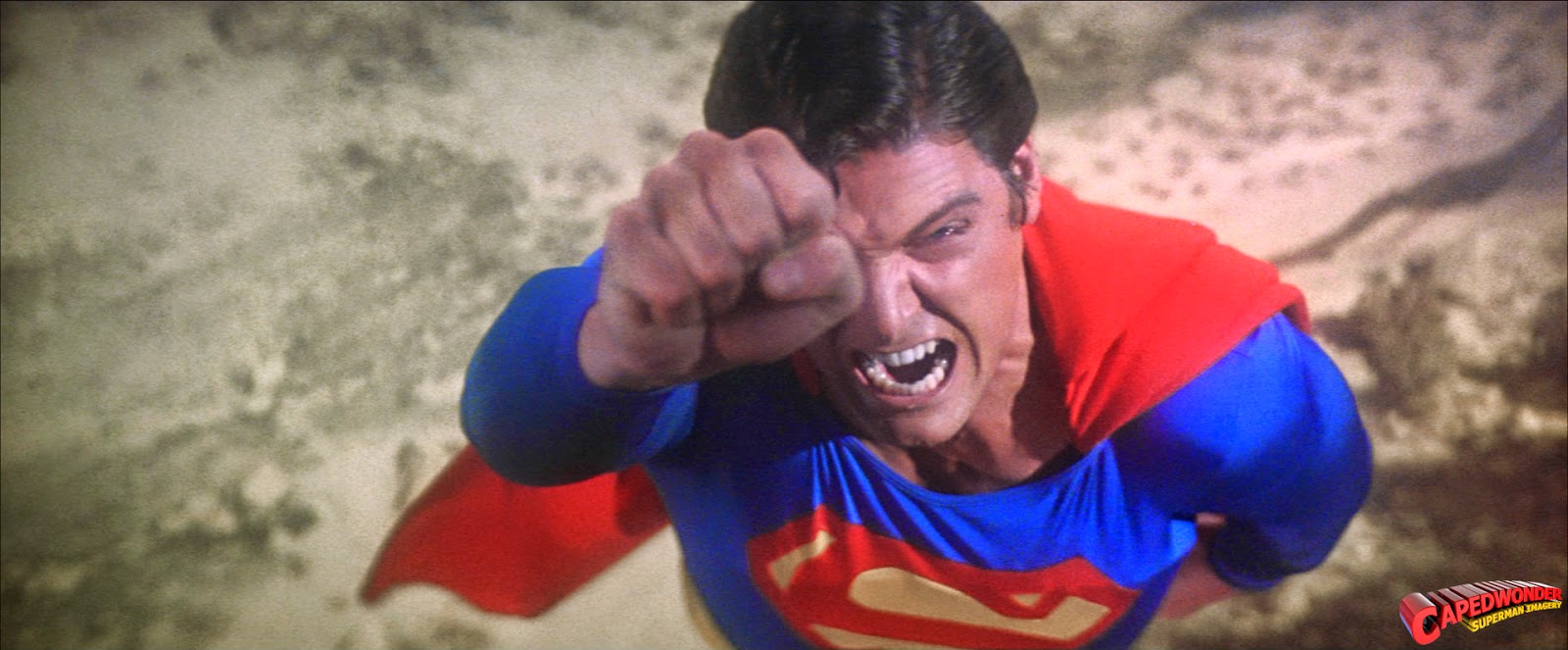
Superman, 1978, and Superman II, 1980

A different take on the mother of all superhero films for this Tuesday’s edition of Overlooked Films, Audio & Video at Todd Mason’s blog Sweet Freedom.


This is not a review of Superman or its sequel directed by Richard Donner and Richard Lester, respectively. Rather, this post looks at two specific scenes in both the films which invited ridicule from a lot of viewers in India, including me and my friends. I saw the films in my teens and I recall emerging from the theatre absolutely spellbound—Hollywood had made a real man fly not just through earth's atmosphere but through infinite space without any strings attached.

Everything is spot-on about Superman I & II (though the plot in the sequel was too weak as to be really convincing), except for a couple of scenes that took some of the shine off the films. Both scenes take place in the end.

In Superman, the Man of Steel is distraught with grief when he finds Lois Lane (Margot Kidder) buried alive in her car, the result of an earthquake triggered by a nuclear explosion set off by the villainous Lex Luthor (Gene Hackman). What happens next is almost unbelievable: Superman flies and flies around earth at hundreds of times of the speed of light and turns the world, or time, back to pre-quake. He returns to earth in time to see Lane alive and out of her car and Jimmy Olsen (Marc McClure), his best friend at The Daily Planet, making his way towards them. Superman had saved Olsen earlier. All's well again.

That one scene, turning the time back, is the stuff of science fiction, but it defies logic in the movie even though it can be argued that Superman is a product of that genre. It raises so many questions that you don't know where to begin. For instance, Lane remembers the earthquake and going under ground and while she is visibly flustered she seems okay with it, and since there has been no nuclear triggered earthquake, why does Superman hand Luthor and his sidekick Otis (Ned Beatty) over to the police? Superman knows Luthor is a criminal, in fact, “The greatest criminal mind of our time!” as Luthor brags, but what’s the charge. Am I missing something here?

I thought the scene was silly and Richard Donner lost his way. I'm sure Donner must have toyed with several endings. Sadly, he settled for one that didn't work in what was otherwise a technically brilliant film with excellent music by John Williams. 

In Superman II, Lois Lane is hyper when she finally discovers, over Niagara Falls, that Superman is actually Clark Kent, her bespectacled and bumbling colleague at the paper. Superman, ever the magnanimous and self-sacrificing hero, decides to put his girlfriend out of her misery: he kisses her and erases her memory of him as Superman. When she opens her eyes, she sees Clark Kent and not Superman before her and, I think, she straightaway orders the poor fellow to fetch coffee or something. Again, all’s well that ends well.

With that one scene, Superman proves that he is also Supergod. Although there can be no limit to his superpowers, I can stretch disbelief only so much.

Thirty-six years on Christopher Reeve remains the ultimate Superman/Clark Kent as I've known the kryptonian of the comic books. In 2006, Brandon Routh bravely stepped into those famous red boots, in Superman Returns, but there can be no comparison with Reeve—in coat or cloak, Routh looked the same as Clark Kent and Superman. I'm surprised Lois Lane (Kate Bosworth) didn't see the close resemblance.

While we’re on Superman, it’s one of three movies whose catchy soundtrack has stayed with me since my teens, the other two being Jaws and The Omen. Turn off the sound and you’ll see what I mean.