Showing posts sorted by date for query secondhand. Sort by relevance Show all posts

May 12, 2026

New Fiction: Books about books, libraries and bookshops

Crossword Bookstore at Kemps Corner, Mumbai, by Prashant C. Trikannad

There seems to be no shortage of novels about books, libraries, and bookshops. There is a growing audience for what might be called “books about books,” or bibliophilic fiction, as it’s also known. I have seen more films and television shows revolving around books and literary culture than I have read novels in this genre.

Below are only a few such books that caught my attention, though I haven't read any of them. There are many others in this ever-growing bookish genre—some I have read about, some of which are now on my TBR, and many I still have to discover.

(As an Amazon Associate I earn from qualifying purchases.)

April 28, 2024

Are we reading fewer books than we used to?

Images and Video by Prashant C. Trikannad

Is buying and reading paper books declining as a habit?  

It certainly appears to be the case in this digital age, where people are increasingly turning to e-books, audiobooks, and podcasts. E-books, in particular, are more accessible and convenient to buy, store and read.

As we do at every opportunity, my wife and I recently visited a book sale close to our home in suburban Mumbai. Under a large shamiana (or tent), there were hundreds of thousands of books—mostly paperbacks in near-mint condition
—neatly lined in rows, their spines and titles facing up. As book exhibitions go, this one was quite impressive. The collection ranged from classic literature to contemporary bestsellers and everything in between.

Except for one thing.

The books seemed to be more on display than for sale. During our visit, most people appeared to be casual browsers, drifting in more out of curiosity than any real intent to buy. They would linger for a few minutes before moving on to other attractions—the colourful handlooms and handicrafts in the adjoining tents.

For over a decade now, the only people I regularly discuss books with are my family members and a few online friends who blog about the books they read. Almost no one in my immediate circle seems to be reading books. And if they are, I rarely hear about it.

Here are five reasons why people are probably no longer buying or reading books as they once did.

  • Digital media—social media, smartphones and streaming services—offer constant entertainment and quick, short-term diversions, often displacing leisure reading.
  • There appears to be a gradual decline in reading culture, particularly among younger generations, possibly due to reduced exposure to books within families and everyday life. My wife and I, like many of our generation, grew up surrounded by books, and they have stayed with us into adulthood.
  • Many people say they simply do not have the time to read, citing busy schedules, constant multitasking, and long, tiring commutes.
  • The attention economy—the digitally driven overload of information—may also be eroding sustained focus, making it harder for people to engage with long-form content such as books. In contrast, short-form content like posts, videos and stories is easier to consume and more engaging.
  • Physical books are often perceived as less accessible and more expensive than e-books, especially in places where bookstores and libraries are limited. Bookshops and even secondhand bookstalls are also slowly disappearing, and not everyone can afford to buy books regularly.

While book sales may be declining, as people are either buying fewer books or reading less, they are still actively engaging with other forms of written content online—social media posts, articles, blogs and webzines.

This suggests that books are still very much present; it is our reading habits and preferences that have changed. It also means that my wife and I often have book fairs almost entirely to ourselves. And perhaps that is not such a bad thing after all.

September 08, 2023

Why I chose to give away my books

Photo by Prashant C. Trikannad


Each one of us has a unique relationship with books. We all have anecdotes and stories to tell about the books we buy, collect, read, hoard, and never read. Then, one day, something—I don't know if it's age, wisdom, or common sense—prompts us to do what once seemed unthinkable: downsize our collection. Give away books we have been holding on to for years. Free up space on shelves, in cabinets, and up in the loft. And start again, one book at a time.

At least, that was my plan.

I owned very few books in my youth, the years between 14 and 25 when I read the most books. In those days, I could finish a novel in two or three sittings, sometimes in half a day, and start another by night. I borrowed books from private circulating libraries, the British Council Library and the American Library. 

Then, somewhere down the years, career and family life took precedence. I stopped going to libraries because of the distance and lack of time, and instead started buying booksmore than I could read. Not that anyone or anything stopped me from reading as I did before. Yet, somehow, I never quite read with the same intensity again.

Over the next three decades, I accumulated so many books that several of my mysteries, thrillers and westerns followed me to every new place of work. They sat quietly in office desks and cabinets, seldom getting a chance to tell me their stories. Then came the comforts and distractions of the tech age, and my goal of reading a certain number of books and short stories every month—in other words, reducing my TBR pile—went out the window.

About a year after the onset of the pandemic, I decided enough was enough. We were in the middle of a home renovation when I took stock of my collection and removed nearly two hundred books. I eventually gave them away to anyone who was interested or sold them to footpath booksellers at throwaway prices. 

I had little choice. Some of those books had remained unread for years. My logic was simple: if I hadn't read them by then, I sure as hell wasn't going to read them now. Fortunately, most of the books I weeded out were secondhand and didn’t cost a lot of money, though the parting did hurt for a while.

Now I have fewer than a hundred books, mostly paperbacks by some of my favourite authors and a small collection of nonfiction. 

(As an Amazon Associate I earn from qualifying purchases.)

Among them are several books on the craft of writing by seasoned writers that I return to every now and then. These include On Writing Well: The Classic Guide to Writing Nonfiction by Stephen King, Reading Like a Writer by Francine Prose, Zen in the Art of Writing by Ray Bradbury, Bird by Bird: Instructions on Writing and Life by Anne Lamott, Dreyer's English: An Utterly Correct Guide to Clarity and Style by Benjamin Dreyer, The Writing Life by Annie Dillard, and Bryson's Dictionary: for Writers and Editors by Bill Bryson. They are my writing companions, offering lessons in craft, sharing the wisdom of experience, and helping me become a better reader and writer.

Over the past three years, I have made up for the "loss" of my books by buying ebooks or downloading them from public-domain and online libraries. I read them on my Kindle and Samsung tablet. I still buy paper books, of course, but no more than half a dozen a year. Most come from Amazon, second-hand booksellers, and book fairs, depending on what I happen to find.

The thing about de-cluttering books, to borrow a phrase from George Bernard Shaw in another context, is the illusion that it has taken place. No matter how many books we discard, there are always plenty around the place. I guess the only way to pare down our collections is to read books as soon as we buy them.

May 30, 2022

Why I left a book fair empty-handed

About a month ago, I visited a Books by Weight exhibition in South Mumbai hosted by Butterfly Books and, in a rare display of self-restraint, left empty-handed. 

It wasn't because there were no good books to buy. I simply didn't feel the urge. Perhaps two years of working from home, followed by a hybrid routine, had something to do with it. Apart from evening walks, the occasional social visit and grocery runs in the neighbourhood, I had barely ventured out until that day.

I was also conscious that there was little point in adding to a collection of books that already contained many unread books. Only a few months earlier, my wife and I had given away more than a hundred paperbacks. I had no desire to replace them with another stack that might sit unread for months, if not years.

BooksbyWeight Book Fair – Photo by Prashant C. Trikannad

As I grow older, though not necessarily wiser, I find myself increasingly drawn to the idea of owning fewer things and making better use of what I already have. That applies to books as much as anything else: read them, enjoy them and then pass them on. 

One evening, my wife asked me, "What are you finally going to do with all your books? It's time to move on." 

She had a point. It's not as though I own a treasure trove of rare and valuable editions, aside from a few out-of-print western paperbacks and some books with particularly memorable covers. What she really meant, I think, was that I needed to outgrow the habit of buying books simply because I loved the idea of owning them. There was a time for that, and perhaps that time had passed.  

We still have many books, I more than she. I'm also holding on to my comic books, some of which I've owned for decades. What will become of them when I retire, I don't know. Paper, after all, has a shelf life.

These days, I do most of my reading on a Kindle and a tablet. Both are convenient, reader-friendly and, above all, kind to limited shelf space. Physical books possess a charm that ebooks can never quite replicate, but practicality has led me to draw a line between the two. My reading is now roughly 70 per cent digital and 30 per cent print.

BooksbyWeight Book Fair – Photo by Prashant C. Trikannad

I still buy the occasional paperback from secondhand bookshops and book exhibitions, but only after asking myself if it's really worth having the book and wouldn't an ebook serve my purpose just as well. 

The answer to those questions is increasingly shaping my book-buying habits. Having fewer books doesn't mean reading less.

October 21, 2020

The last books I bought before lockdown

If there was one thing I missed during the lockdown and the long months of working from home, it was regular visits to secondhand bookshops, pavement booksellers and book exhibitions

During that period, I bought only two books from Amazon India—a used but rare Corgi edition of Sudden and a new Fantastic Four: The Coming of Galactus comic-book digest, both featured here. 

Finding Sudden felt like winning the lottery. I was surprised and delighted to come across the paperback—with its striking cover art—on Amazon India for just Rs.295. My favourite western isn't the sort of book one easily stumbles upon at second-hand book sales in Mumbai.

Most of the books in this post, however, were purchased in the weeks and months before the pandemic changed our routines. I've included their covers, original publication years and brief synopses below.
 

(As an Amazon Associate I earn from qualifying purchases.)

The New Collected Short Stories by Jeffrey Archer book cover


"This brand new edition brings together three of Jeffrey Archer's classic collections of short stories—To Cut a Long Story Short, Cat O' Nine Tales and And Thereby Hangs a Tale—showcasing the master storyteller's skill like never before. Every reader will have their own favourites: the choices run from love at first sight across the train tracks to the cleverest of confidence tricks, from the quirks of the legal profession, and those who are able to manipulate both sides of the Bar, to the creative financial talents of a member of Her Majesty's diplomatic service—but for a good cause. In `Caste-Off', Jamwal and Nisha fall in love while waiting for a traffic light to turn green in Delhi, and in `Don't Drink The Water', a company chairman tries to poison his wife while on a trip to St Petersburg, with unexpected consequences... The stories held in these pages are irresistible: ingeniously plotted, with richly drawn characters and deliciously unexpected conclusions. Some will make you laugh. Others will bring you to tears. And, as always, every one of them will keep you spellbound."

The Twisted Thing by Mickey Spillane book cover
The Twisted Thing by Mickey Spillane

"This was some household.

"The kid was a genius, the father a scientist of international repute. Money was problem. Not shortage of money but the opposite: too much. The sort of money that brings the envious and the scheming clustering like flies round a pile of ripe offal: nieces, nephews, cousins - a family of mean minds and gross appetites.

"The hired help had its peculiarities too: the chauffeur, an ex-con; the governess, formerly a featured act in strip clubs from New York and Miami; a secretary with a well developed taste in other women.

"Quite a household. And not one to welcome the arrival of Mike Hammer
not when the kid had been kidnapped and everyone else was a suspect."

Snobs by Julian Fellowes book cover
Snobs by Julian Fellowes

"The English, of all classes as it happens, are addicted to exclusivity. Leave three Englishmen in a room and they will invent a rule that prevents a fourth joining them."

"The best comedies of manners are often deceptively simple, seamlessly blending social critique with character and story. In his superbly observed first novel, Julian Fellowes, creator of the Masterpiece sensation Downton Abbey and winner of an Academy Award for his original screenplay of Gosford Park, brings us an insider's look at a contemporary England that is still not as classless as is popularly supposed.

"Edith Lavery, an English blonde with large eyes and nice manners, is the daughter of a moderately successful accountant and his social-climbing wife. While visiting his parents' stately home as a paying guest, Edith meets Charles, the Earl Broughton, and heir to the Marquess of Uckfield, who runs the family estates in East Sussex and Norfolk. To the gossip columns he is one of the most eligible young aristocrats around.

"When he proposes. Edith accepts. But is she really in love with Charles? Or with his title, his position, and all that goes with it?"

Sudden: Law O' The Lariat by Oliver Strange book cover

Sudden: Law O' The Lariat by Oliver Strange

"The word had filtered out that Sudden was dead—and there was no one around to contradict it. Men who had cringed before, swaggered now; others boasted of their encounters with Sudden, the coward.

"Only one man stayed quiet: a tall, saturnine fellow wearing two guns tied low. When he heard the rumours, he gave a thin smile; and when someone asked him who he was, he said shortly: James Green. James Green — alias Sudden!"

Maigret and the Headless Corpse by Georges Simenon

Maigret and the Headless Corpse by Simenon book cover

"Two brothers find a grisly package clinging to the propeller of their barge in the Canal de Saint Martins, and by the time Maigret arrives most of a mysterious corpse has been assembled, except for the head. The search shifts from finding the missing piece to finding a motive, as the Inspector's keen mind assembles clues from the dismembered torse which lead to a trio of suspects. A flash of intuition linking the principal suspect's sordid life to the whereabouts of her victim on his last day alive closes the case but opens Maigret's mind to the reason for the crime."

I have yet to read Julian Fellowes and Georges Simenon.

Fantastic Four: The Coming of Galactus! by Marvel book cover


January 14, 2020

Secondhand Book Finds: Able Team, Louis L’Amour and Sudden

In my first blog post of 2020, I wrote about my poor reading through most of the previous year. That, however, did not stop me from buying more books, some of which I mentioned in that post. Here are three paperbacks—two westerns and a thriller—that I picked up secondhand in 2019. I was especially pleased with Able Team and Sudden, both of which are rare finds where I live.

(As an Amazon Associate I earn from qualifying purchases.)

Ironman is the 19th book in the Able Team action-adventure series written under the pseudonyms authors, G.H. Frost and Dick Stivers. The series—a spinoff of Mack Bolan: The Executioner, created by Don Pendleton—was first published in 1982 by Gold Eagle.

I have been collecting Mack Bolan and its spinoffs—Able Team, Phoenix Force and Stony Man— for nearly a decade and own some 25 novels, including a few written by Pendleton himself. These books take me back to my teens, when I used to read James Hadley Chase, Nick Carter and Perry Mason, many of which are still available in secondhand bookshops in Mumbai.

Synopsis: "Able Team's Carl Lyons travels to the cloud-swept Sierra Madre without his partners and without his weapons. But what was supposed to be well-earned R&R turns into a nightmare of conspiracy and terror when a Fascist international surveillance team identifies Lyons as one of the American specialists who wrecked Unomundo's attempt to seize Guatemala two years earlier."

Carl 'Ironman' Lyons is an old Able Team hand. As a bright LAPD detective, Lyons was tasked with bringing Bolan in—dead or alive; that is, till the Executioner saved his life. Later, he is recruited by Hal Brognola who heads a special organised crime task force.


Western fiction is my favourite genre. I think of Westerns as a blend of several others—crime, mystery, suspense, action, romance, politics, war, and even religion. So I had no hesitation in picking up the Bantam edition of Hanging Woman Creek by Louis L'Amour, another author I read widely in my younger days.

Synopsis: "Barnabus Pike is no gunfighter and not much of a street fighter. Eddie Holt is a black boxer in a white man's world. They've both taken their share of hard knocks. Now they're looking to survive a brutal winter in a remote Montana line shack, collect their pay, and settle down for good. Then they cross paths with a hardworking Irish immigrant and his beautiful, spirited sister, who've been burned off their land. It's a fight Pike and Holt don't want, don't need, and don't dare turn their backs on-especially when one of the perpetrators might be one of Pike's old friends. Hunted like animals across the frozen countryside, Pike and Holt will risk everything-including their reputations, their dreams-and their lives."


If you're familiar with my blog, you'll know how much I enjoy reading the Sudden novels. James Green—better known as Sudden, the Texas outlaw— was created by British writer Oliver Strange, who wrote only ten books. Later, English author Frederick Nolan added five more Sudden novels, including Apache Fighter, under the pseudonym Frederick H. Christian. The original Corgi editions are so rare in India that they sell for hundreds, even thousands of rupees.

Synopsis: "There was a reward of five thousand dollars for the man who could bring Barbara Davis out of Apacheria alive. Every outlaw, gunman, and scalphunter in the south-west had drifted in to Tucson, then out into Apache country, lured by the dream of easy gold. The Apaches killed some of them slowly and horribly; but still they came. Governor Bleke knew unless the girl was brought out soon, he would have a full-scale Indian war on his hands. He sent for the one man who might be able to do it. A tall, slow-drawling man who wore his six-guns tied low and looked as if he knew how to use them. A Texas outlaw on the run: SUDDEN!"

I have been reading these books through different phases of my reading life, and I pick them up whenever I find them in secondhand bookshops and book sales.

January 23, 2019

So many books, so little time: Looking forward to The White Nile

When it comes to reading, I don't make New Year's resolutions, though every year I mentally tell myself I'll buy fewer books, and read more of the ones I already have. Last year, I kept half my promise. I bought just about a dozen secondhand books but read so few that there was hardly any point writing about them.

This year, somewhat surprisingly, things have gone the other way.

Less than two weeks into 2019, I had already added four "new" books to my groaning TBR shelves and, happily, read an equal number. My aim is to finish at least seven books and novellas a month, along with as many short stories and poems as I can manage. Time, however, is not on my side, so I'll be reviewing only a select few each month.


(As an Amazon Associate I earn from qualifying purchases.)

The White Nile by Alan Moorehead book cover

Of the four books I picked up at the Books by Weight exhibition, the one I'm eager to read is my Penguin edition of The White Nile, 1960, by Alan Moorehead, the Australian-born war correspondent and writer of popular history. 

I've been curious about this book for quite some time. It chronicles the exploration of the Nile in the second half of the nineteenth century, when much of central Africa remained unknown to Europeans and the river's source was still one of geography's great mysteries.

Part travel narrative, part history, The White Nile has earned a reputation as a classic account of adventure and discovery. Its blend of historical detail, larger-than-life personalities, and dramatic expeditions has kept it in print for more than six decades. 

Separately, my wife picked up three books—Sense and Sensibility by Jane Austen as a replacement copy, Father Brown by G.K. Chesterton, and The Railway Children by Edith Nesbit.

I also bought a few ebooks, but that's a guilt trip for another day.

December 06, 2018

Timequake by Kurt Vonnegut and other books

I bought no more than a dozen secondhand books this year. I’m pretty sure of that. Let me see—a few westerns, thrillers and spy fiction, some Lee Child, P.G. Wodehouse, Agatha Christie, Erle Stanley Gardner, Enid Blyton and Kurt Vonnegut. Yes, that’s about it. I haven’t read any of the books yet.

© Prashant C. Trikannad
I also ordered some nonfiction from Amazon. They're all there in the picture on the left. I haven't read those either. Although I have been dipping into the books on writing, I don't read them from cover to cover.

(As an Amazon Associate I earn from qualifying purchases.)

Separately, I also picked up Khushwant Singh’s autobiography Truth, Love & A Little Malice (2002). Singh was a diplomat, journalist, columnist, parliamentarian and author. He was also one of India's most entertaining storytellers. I enjoyed his clear, straightforward style. The book itself had a troubled publication history and was delayed for several years because of a court case.


Truth, Love & A Little Malice by Khushwant Singh book cover

I also added a handful of comic-books to my collection as well. These included two graphic adaptations from the Warrior Cats series by Erin Hunter, the shared pen name of several children's writers. I also downloaded a few titles offered during Amazon's Free Comic Book Day promotion. Most of my comics reading happens during the daily commute.

Of the fiction books, I plan to start with Kurt Vonnegut's Timequake. It's presented as a novel, though from what I've gathered it's part-fiction, part-autobiography and part-reflection on writing and life. Vonnegut himself described it as a "stew" and his last novel.

The central idea is an intriguing one. A glitch in time forces everyone to relive ten years of their lives exactly as before, unable to change a single decision or action. Vonnegut uses that premise as a starting point, but the book seems to wander freely into memories, observations and stories about family, aging and the business of being a writer.

We'll see how it goes. 


Timequake by Kurt Vonnegut book cover
Kurt Vonnegut is one of my favourite writers. I like his writing so much that I'm often tempted to imitate his style. His sentences were short, simple and almost staccato. He had a knack for saying a lot with very little. Add to that a wry sense of humour, and it's easy to see why I keep returning to his books.

October 08, 2017

Photo Essay: A tour of Mumbai's book haunts

Secondhand books have the tantalising aroma of a spicy Goan fish curry.

Browsing through books is half the pleasure. Buying them doesn't always have to be the happy ending. I have spent much of my reading life doing little more than scanning bookshelves, admiring covers, flipping through pages, reading blurbs, searching for forgotten bookmarks, and envying what other people find. Which means I get as much satisfaction from browsing as I do from buying. Of course, there have also been times when I've walked away empty-handed, only to regret leaving behind a coveted title or an out-of-print book. I've even returned the next day, only to find it gone. 

Old or new, in shops or on footpaths, books have been my companions ever since I started my reading journey with the Hardy Boys. Here are some of my favourite book haunts, mostly in South Mumbai, where I have browsed far more than I have bought. A few of these photographs have appeared on the blog before, but most were taken specifically for this post.

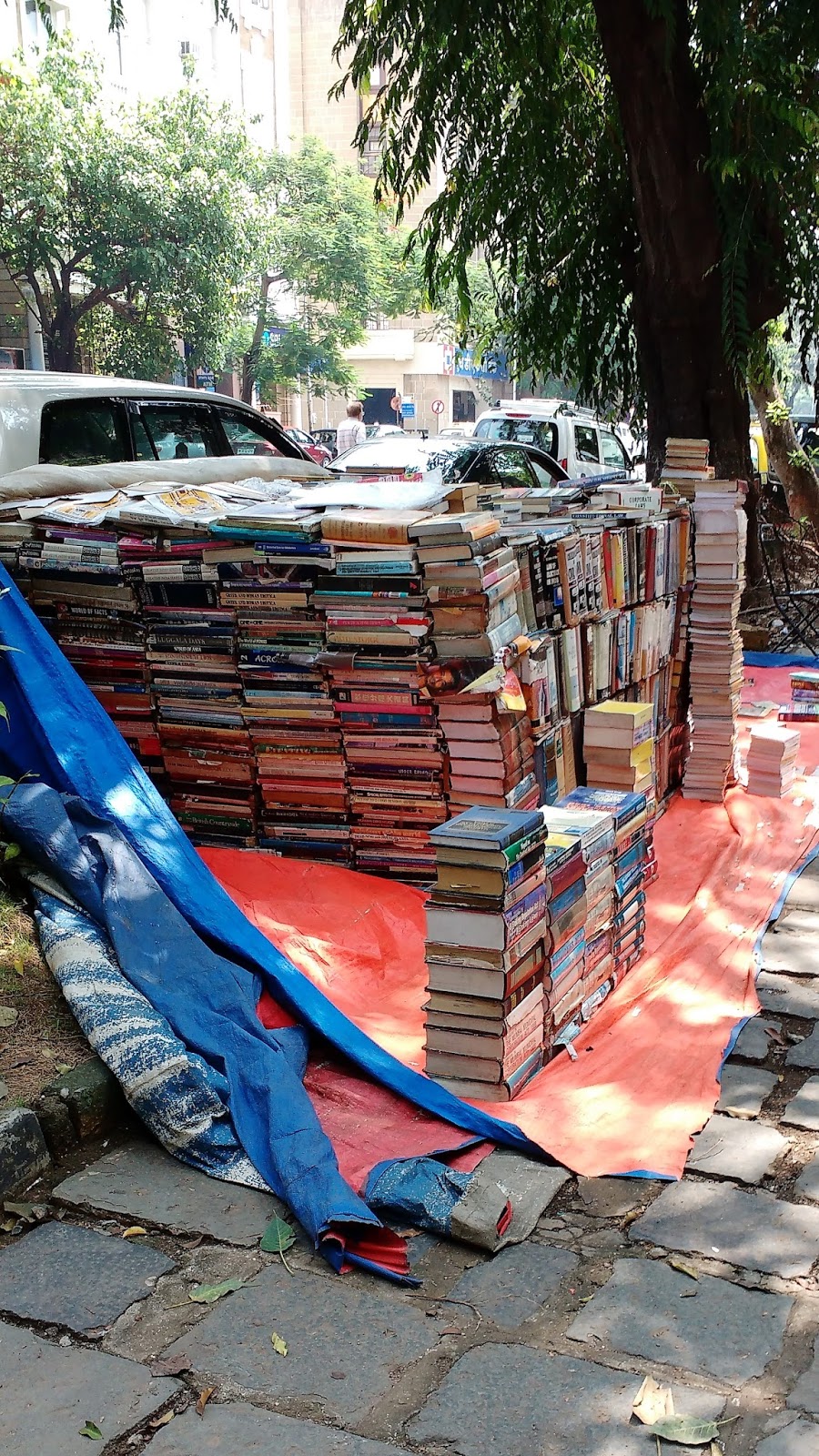
The footpath booksellers of Flora Fountain (Hutatma Chowk).
 
Books by Weight in South Mumbai, as far as the eye can see.

Abraham Lincoln in not-so-strange company.

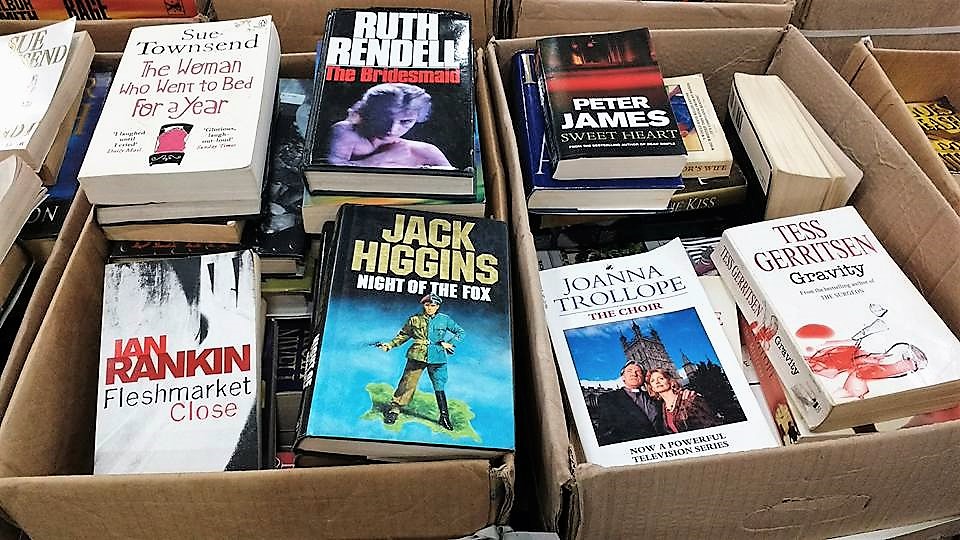
My pick from the box: Jack Higgins, my favourite author.

A pavement bookseller opens for the day.

The suburban bookshop where I browse—and board a bus home.

The English historical novelist on my TBR list.

Fiction rubs spines with self-help in South Mumbai.

Waiting for customers: This footpath bookseller knows his books.

British crime writer Martina Cole at Books by Weight.

A close-up of a footpath bookseller on Mahatma Gandhi Road.

Heavyweights jostle for space at a suburban bookshop.

Take your pick or toss a coin, at Books by Weight.

Spy novelist Craig Thomas is an old friend.

Books in a haystack near the old Central Telegraph Office.

This photo essay was first published in October 2017 and has been lightly updated in June 2026 with revised text and links to related posts. Some of these book haunts may have changed over the years, while others continue to welcome browsers and collectors. But the joy of browsing secondhand books remains the same.

© All photographs by Prashant C. Trikannad


September 03, 2017

The lure of secondhand books in Mumbai

© Prashant C. Trikannad

Secondhand books are a little like antique furniture. They have a musty but pleasing smell, can carry surprising monetary value, and are much sought after by discerning readers and serious collectors. But just as it is not easy to buy old furniture, it is not always simple to get hold of forgotten and out-of-print books. You have to cultivate relationships with used-booksellers, rather like a news reporter nurturing a source for a scoop or a cop working an informant for a tip on an elusive gangster. Once you have a contact or two in the trade, you can sometimes track down almost any title on your wish list.

I remember nearly every secondhand book or comic-book I have bought over the past three decades, and none of them came easily.

Some years ago, I visited a prominent new-bookstore in South Mumbai to pick up a 1995 edition of DC Comics: Sixty Years of the World's Favourite Comic Book Heroes by Les Daniels, the well-known comic-book historian. The 256-page hardback, described as “The complete story of America’s favourite heroes and their talented and dedicated creators”, was on sale for the price of Rs.450 ($9 at the time). Naturally, I was elated. But I resisted the temptation to buy it. I thought the money could be put to better use and walked away. When it comes to books, however, even a devoted reader has to be practical sometimes.

It was just as well.

A couple of weeks later, I spotted a near-mint copy of the same volume at a pavement bookseller in the Fort-Fountain area, the central business district about 7 km from the bookstore. It was wedged between a tightly packed stack of academic journals and coffee-table books.

“It’s yours for Rs 150 (a little over $3),” said the bookseller, who knew his books better than I did.

I offered him Rs 100. We finally settled on Rs 125 ($2.5). It was a bargain I would have been a fool to turn down. Of course, it helped that the bookseller had been a “friend” for many years.

Not long after, I stumbled upon a fine—and, for me, rare—copy of The Penguin Book of Comics by Englishmen George Perry and Alan Aldridge, published in 1967. The 272-page volume chronicles the evolution of British and American comic books. While Perry wrote the text, Aldridge designed the cover and illustrations. The book examines the rise and fall of comics in the mid-20th century, in the wake of Fredric Wertham’s Seduction of the Innocent and the Comics Code, as well as the influence of comic strips and comic books on popular culture and on entertainment such as art, films and television.

Until the mid-1990s, booksellers lined the footpaths in that part of South Mumbai. Today, fewer than a dozen remain, thanks largely to eviction drives by the municipal corporation. Interestingly, the civic officer in charge of one such operation left the booksellers alone even as he went after other hawkers in the area. 

“Books are Saraswati,” he told me at the time, referring to the Hindu goddess of learning and knowledge. “I want people to buy and read books." 

Since the turn of the century, many sellers have abandoned books—which few people seem to be reading, let alone buying—for more lucrative goods such as mobile-phone accessories. Book collectors like me have been the losers.

Secondhand books are not as elusive as one might think. You have to keep your eyes open and know where to look. Sometimes they are right under your nose; at other times, you have to sniff them out like a wolf tracking prey. After years of browsing, I can home in on a wanted title like a heat-seeking missile. All it takes is a quick sweep of stacks upon stacks of pavement books, provided the titles are displayed prominently. With practice, book-spotting can become an art.

Some of the most rewarding secondhand-book haunts in my city of approximately 18 million are raddiwalas. These hole-in-the-wall paper marts, scattered across the island city and its extended suburbs, are more than dusty repositories of old newspapers, plastic bottles and assorted junk. You never know what reading treasures you might find there. A few organised paper marts recognise the value of good books and pass them on to professional booksellers, but most stack them near the entrance and sell them cheaply. 

Like an archaeologist digging for bones, I have been prospecting raddiwalas for well over two decades, and with some success. I once bought a dozen rare Phantom and Mandrake comics, published under the Indrajal imprint, from a paper mart close to my home for Rs 10 each ($0.16)—almost as good as free.

The raddiwala clearly did not know their real value. Bennett Coleman & Co. Ltd, publisher of The Times of India, had stopped printing Indrajal Comics in 1990. Since then, booksellers and individual collectors have quoted obscene figures for these comics, which, apart from Lee Falk’s Phantom and Mandrake, included Indian artist Abid Surti’s hero Bahadur (the Brave), Roy Crane’s Buz Sawyer, Allen Saunders’ Kerry Drake and Mike Nomad, Alex Raymond’s Flash Gordon, Rip Kirby and Phil Corrigan, and Steve Dowling’s Garth.

(As an Amazon Associate I earn from qualifying purchases.)

Among the other prized books I bought secondhand were Art Spiegelman’s Maus I and Maus II; the 160-page The Science Fiction Book: An Illustrated History by Franz Rottensteiner; a hardback illustrated edition of Futuredays: A Nineteenth-Century Vision of the Year 2000 by Isaac Asimov; Cows of Our Planet: A Far Side Collection by Gary Larson; Sudden paperbacks by British writer Oliver Strange; a hardback of Nietzsche’s Thus Spoke Zarathustra; Calvin and Hobbes volumes; and dozens of DC and Marvel comics, including pocket-size war and western comic-books.

In the age of Amazon and e-books, the secondhand-book trade is slowly dying. Until it does—though I hope it never does—I will continue to look for elusive and priceless fiction and nonfiction. So far, I have been lucky enough to find a few gems every year. The secret to a productive secondhand-book hunt 
is patience, perseverance and, sometimes, luck—when a wanted title leaps out at you even when you are not looking. Those are the ones I like best.

July 08, 2017

Book Tag: A Q&A about my reading life

On June 17, my blog friend Tracy did a Book Tag post on her popular blog Bitter Tea and Mystery, answering a series of trivia questions about books and reading. She, in turn, had been inspired by similar book tags on other blogs. I found her version particularly enjoyable, not least because of the sheer variety of books she has read—and continues to read and review—across several genres.

(As an Amazon Associate, I earn from qualifying purchases.)

No reader ever reaches the end of the journey. I still have countless authors to discover, shelves of books waiting to be read, and many years, I hope, before I can look back with any sense of satisfaction. So I'm going to answer these questions honestly. Is there any other way? To adapt a famous line from Kurt Vonnegut's 1961 novel Mother Night—“We are what we read, so we must be careful about what we pretend to read and the books we pretend to talk about.”

Let’s see how it goes.

Shakespeare: Complete Works
What book has been on your shelf the longest?

My paternal grandfather's 1965 Tudor edition of Shakespeare: Complete Works (The English Library). I'm saving it for retirement, though I suspect the Bard will have plenty of company by then. Every other year I tell myself I'll finally settle down and read Shakespeare properly. Instead, I end up dusting the cover, the spine and the yellowing pages before placing it carefully back in the cabinet.


Shall We Tell the President? by Jeffrey Archer book cover
What is your current read, last read, and the book you plan to read next?

Current Read: The Midden by British satirical novelist Tom Sharpe (one of my favourite writers) and Shall We Tell the President?, an alternative fiction by Jeffrey Archer, one of several bestselling authors I read in college. 
I enjoy Sharpe's irreverent wit and outrageous humour. Archer, on the other hand, is an old hand at storytelling. Remember Kane and Abel?

Last Read: Past Tense, where prolific writer-blogger Margot Kinger introduced me to her affable sleuth Joel Williams, a former policeman turned academician.

Next Read: To be honest, I have no idea. My next book is usually a random choice, though I'm tempted to pick up a P.G. Wodehouse or an Agatha Christie from my wife’s collection. 
It's been a while since I last read either. Wodehouse still has me in splits, even if his humour occasionally follows familiar patterns.

The Sound and the Fury by William Faulkner book cover
What book do you tell yourself you’ll read, but probably won't?

I'm going to answer this one a little differently.

I struggled through the first 30-odd pages of William Faulkner’s The Sound and the Fury and nearly gave up. I had little idea what was happening. It remains one of the most challenging books I have attempted in recent years. At times it almost felt as though Faulkner himself was saying, "My narrative style isn't for you. Read something else." I wasn't amused.

What book are you saving for retirement?

Well, as I said, Shakespeare will probably have distinguished company: Dostoyevsky, Tolstoy, Gogol, Solzhenitsyn, The Rise and Fall of the Third Reich by William L. Shirer, Thus Spoke Zarathustra by Friedrich Nietzsche (which I never finished), and a few other classics. Of course, much will depend on my eyesight and state of mind.

Sudden: The Marshal of Lawless by Oliver Strange book cover
Which book character would you switch places with?
 
James Green, better known as Sudden, the Texas outlaw. I've admired the character ever since my paternal uncle introduced me to the eponymous western series when I was 14.

Created by British writer Oliver Strange, Sudden is my favourite Western hero. He earns both his nickname and his notoriety because of his lightning-fast draw, and is branded an outlaw for crimes he never committed. In reality, Green is a gentleman with a gun, defending ordinary folk against crooked gamblers, ranchers, rustlers and land-grabbers, even as he quietly hunts down the two men who killed the man who raised him. Sudden also has a badge—and a secret identity: Deputy Marshal of the United States, reporting directly to the Governor of Arizona.

While Strange, who never once travelled to America, wrote ten Sudden novels, 
fellow English writer Frederick H. Christian (better known as Frederick Nolan) added another five after Strange's death. You can hardly tell the difference. This remains the only series, in any genre, that I have read more than once.

Love Never Faileth by Eknath Easwaran book cover
What book reminds you of a specific place, time or person?

I'm usually so engrossed in a book that I rarely relate its plot, setting or characters to real places or people. It simply doesn't occur to me.


Which book has been with you most places?

Quite a few spiritual books, but mostly Love Never Faileth by the late Indian spiritual teacher and author Eknath Easwaran
who founded the nonprofit Blue Mountain Center of Meditation in California in 1961. This, and most of Easwaran's forty books, offers a practical guide to leading a more fulfilling life through his simple eight-point programme of passage meditation. You can open almost any page and think, "Hey, this is exactly what I needed."

Which book have you reread the most?

The books I have reread most often are philosophical and spiritual, particularly those by Easwaran and other mystics, including my own spiritual preceptor. They have been my comfort zone—my mental prop—for more than three decades.


(As an Amazon Associate, I earn from qualifying purchases.)

What book outside your comfort zone did you end up loving?

Not one, but two: The Mayor of Casterbridge and Jude the Obscure by Thomas Hardy. I read these powerful classics more than a decade ago on my wife's recommendation. Until then, I had never read an unabridged classic, apart from the abridged versions we encountered in school.

What are your three bookish confessions?

 
1. I collect books. I still own several unread books that I bought in the 1980s and 1990s. Having said that, I have been exercising some restraint. So far this year, I have bought just three books.

2. I will happily miss a bus, train or autorickshaw if I spot secondhand books for sale, even if I end up buying nothing and reaching home late.

3. I never lend books I treasure, such as my Corgi editions of the Sudden novels and my comic-books.


The Executioner: Death Load by Don Pendleton book cover
Do you prefer used or brand new books?
 
There is a certain charm about secondhand books, which make up most of my modest collection. This includes over two dozen secondhand—but mint-condition—paperbacks of Don Pendleton’s Mack Bolan: The Executioner
As for new books, I now buy more Kindle editions than paperbacks.

Have you ever seen a movie you liked more than the book?


Perhaps not more than the books themselves, but I thoroughly enjoyed the film adaptations of Jack Higgins' The Eagle Has Landed and A Prayer for the Dying, and Alistair MacLean's The Guns of Navarone, Where Eagles Dare and Ice Station Zebra. I also liked the screen versions of Harper Lee’s To Kill A Mockingbird, John Ball’s In the Heat of the Night, and, of course, 
the Harry Potter films.

Last page: read it first, or wait till the end

I've never read the last page first
—not even to finish a book sooner—although I was tempted while reading Irving Wallace’s The Second Lady. If you’ve read the book, you’ll know why.

DC Comics: Sixty Years of the World's Favorite Comic Book Heroes by Les Daniels book cover
Name a book that you acquired in an interesting way.

DC Comics: Sixty Years of the World's Favorite Comic Book Heroes (Bulfinch, October 1995).

Many years ago, I found this collector's edition at a new bookstore for Rs 450 ($9). I wanted it badly. But wisdom prevailed, and I walked away, convincing myself the money could be put to better use—perhaps on groceries and things like that.

A few days later, while on my way to the office in another part of town, I spotted the very same book at a roadside bookseller. It was in mint condition and priced at just Rs 125 ($2.5). I bought it without a second thought.

Final two questions, my own.


Which authors you wish you had read by now?

Most Indian authors. There is such richness and variety in Indian writing in English that I often wonder why I have neglected it for so long. In hindsight, the focus of my blog should probably have been more desi than Western. I hope to make up for that by reading—and reviewing—more Indian fiction in the years ahead.

If you didn’t read books, what would you be doing?

Probably painting or learning to play a musical instrument. I think it's important to have non-work pursuits among the arts and crafts. Much of everything else is so ordinary.


Bottom line: 
If these answers reveal anything, I hope it's not how many books I have—or haven't—read, but the kind of reader I am. There are still countless books waiting for me, and that's part of the pleasure. Reading isn't a race. The important thing is simply to keep reading, even if it's one book at a time.

Other notable Book Tag posts
 
Nancy Elin 

Brona's Books

On Bookes

Howling Frog Books