Showing posts sorted by relevance for query poetry. Sort by date Show all posts

June 15, 2012

BOOK REVIEW

The Haunted Hour: An Anthology
by Margaret Widdemer (1920)


This book review is offered as part of Friday’s Forgotten Books meme over at Patti Abbott’s blog Pattinase. Hop over and check out the eclectic mix of reviews by other bloggers. It will be worth your while.

While I read poetry whenever I am in the mood for it, I have never read ghostly poetry, at least not in an anthology of poems and verses by more than sixty poets.

The Haunted Hour: An Anthology edited by Margaret Widdemer, the American poet and novelist (1884–1978), is a compilation of some very imaginative ghost-poems that are divided into eleven categories — The Nicht Atween the Sancts an' Souls, All the Little Sighing Souls, Shadowy Heroes, Rank on Rank of Ghostly Soldiers, Sea Ghosts, Cheerful Spirits, Haunted Places, You Know the Old, While I Know the New, My Love That Was So True, 
Shapes of Doom, and Legends and Ballads of the Dead.

Several names in the anthology are familiar to me. These include Rudyard Kipling, H.W. Longfellow, Walter by De La Mare, Christina Rossetti, Sir Edwin Arnold, Katharine Tynan, William Butler Yeats, and Sir Walter Scott.

Bret Harte, whom I know to be a writer and not a poet (my ignorance), chips in with Newport Romance, a rather longish but quite an enjoyable poem.

Then there are six poems by Theodosia Garrison, American poet and author, whose poem The Neighbours I liked very much. It goes...
 

At first cock-crow
The ghosts must go
Back to their quiet graves below.

I have read Garrison's poetry before but not her prose. More than anything else, I remember Garrison for her very quotable quote — "The hardest habit of all to break is the terrible habit of happiness." Never break that habit.

A few more poets ring a distant bell and I might have read their poems in passing. Nevertheless, I enjoyed reading their long and short verses, at least the ones I could comprehend. It’s not always easy to understand poetry.

Coming back to Margaret Widdemer, there isn't a lot about her on the internet. According to Wikipedia, in 1919, she won the Columbia University Prize for Poetry (now the Pulitzer Prize) for her collection The Old Road to Paradise (1918), a prize she shared with Carl Sandburg, fellow writer, editor and poet, for his collection of poems titled Corn Huskers.

Widdemer established her credentials as a poet with her first poem The Factories (1917) that looked at the sensitive issue of child labour. In her memoir Golden Years I Had (1964), she recounts her friendships with Ezra Pound, F. Scott Fitzgerald, T.S. Eliot, Thornton Wilder, and Edna St. Vincent Millay. Her essay Message and Middlebrow, published in Review of Literature in 1933, apparently popularised the term "middlebrow" which means "Someone who is neither a highbrow nor a lowbrow."

Margaret Widdemer, who lived until 94, was a prolific writer as is evident from her forty novels that included The Rose-Garden Husband and Why Not?, nine poetry collections, nine children's fiction, two books on writing titled Do You Want to Write? and Basic Principles of Fiction Writing, and three memoirs, namely Golden Friends I Had, Summers at the Colony, and Jessie Rittenhouse: A Centenary Memoir-Anthology.

Her first two novels, The Rose-Garden Husband (1915) and Why Not? (1916), were made into films — the 1917-film A Wife on Trial and the 1918-film A Dream Lady, respectively. 

I am no critic of poetry. I only enjoy reading poems. The purpose of writing about this (forgotten) book is to bring it to the reader's notice. I will, therefore, leave you with Margaret Widdemer’s brief preface to The Haunted Hour: An Anthology. It reads as follows... 

“This does not attempt to be an inclusive anthology. The ghostly poetry of the late war alone would have made a book as large as this; and an inclusive scheme would have ended as a six-volume Encyclopedia of Ghostly Verse. I hope that this may be called for some day. The present book has been held to the conventional limits of the type of small anthology which may be read without weariness (I hope) by the exclusion not only of many long and dreary ghost-poems, but many others which it was very hard to leave out.

"I have not considered as ghost-poems anything but poems which related to the return of spirits to earth. Thus, ‘The Blessed Damozel,’ a poem of spirits in heaven, ‘La Belle Dame Sans Merci,’ whose heroine may be a fairy or witch, and whose ghosts are presented in dream only, do not belong in this classification; nor do such poems as Mathilde Blind's lovely sonnet, ‘The Dead Are Ever with Us,’ class as ghost-poems; for in these the dead are living in ourselves in a half-metaphorical sense. If a poem would be a ghost-story, in short, I have considered it a ghost-poem, not otherwise. In this connection I wish to thank Mabel Cleland Ludlum for her unwearied and intelligent assistance with the selection and compilation of the book; and Aline Kilmer for help in its revision and arrangement."


Margaret Widdemer

If you want to learn more about Margaret Widdemer, you can read the short essay titled Asbury Park Life: Stimulus for Author by Peter Lucia.

Note: The preface is courtesy Project Gutenberg Ebook
December 31, 2016

A year gone, a year to come

Since I did not write or review much this year, I thought I would at least end the year with a post on one of my favourite literary genres—classical poetry. Fittingly, a poem about New Year's Eve or New Year.

There was plenty to choose from. I read Alfred Lord Tennyson's The Death of the Old Year, Thomas Hardy's New Year's Eve, Christina Rossetti's Old and New Year Ditties, Robert Burns' Auld Lang Syne, Helen Hunt Jackson's New Year's Morning, D.H. Lawrence's New Year's Night, Sylvia Plath's New Year on Dartmoor, and John Clare's The Old Year.

I liked them all.

A lot of people look at the old year with sadness, regret, and emotion. And a lot of writing, and especially poetry, reflect those feelings. We remember it mostly as just another year when we grew old and where we could have done so much more, personally and professionally. Fortunately, our minds are trained to conveniently hide unhappy memories, if not erase them completely. Every passing year brings in its anguished wake a new year filled with renewed hope, optimism, and purpose of life, where we dream of doing better than we did in the previous year, and where we truly believe—"This is going to be my year. And I am going to make things happen for me and my family."

Of all the beautiful poems I read, the one that resonated with me this evening, hours before New Year, was The Year by American author-poet Ella Wheeler Wilcox (1850-1919). I thought it was realistic and balanced. I liked the way it bids goodbye to the Old Year and ushers in the New Year, depending on how you read it. And it rhymes very well too.

What can be said in New Year rhymes,
That's not been said a thousand times?

The new years come, the old years go,
We know we dream, we dream we know.

We rise up laughing with the light,
We lie down weeping with the night.

We hug the world until it stings,
We curse it then and sigh for wings.

We live, we love, we woo, we wed,
We wreathe our prides, we sheet our dead.

We laugh, we weep, we hope, we fear,
And that's the burden of a year.


Ella Wheeler's most famous poem was Solitude which gave us the equally famous opening lines:

Laugh, and the world laughs with you
Weep, and you weep alone.
For the sad old earth must borrow its mirth
But has trouble enough of its own.


I sincerely hope you will have lots of reasons to laugh in 2017 and beyond. I wish you a joyous New Year filled with health and happiness.

August 09, 2012

VINTAGE PICTURES

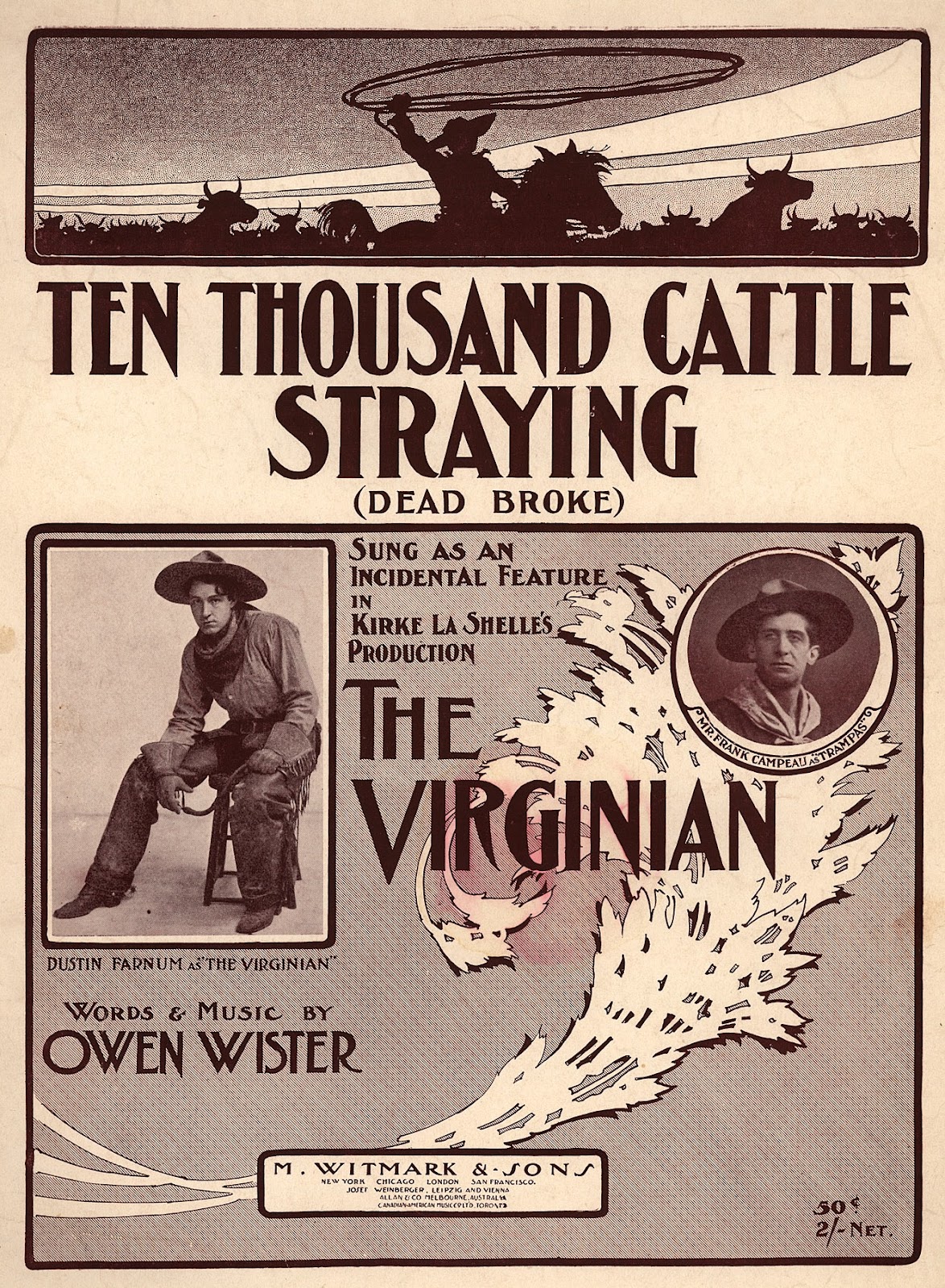
Ten Thousand Cattle Straying (Dead Broke)

Ten thousand cattle straying,
They quit my range and travell'd away,
And it's “sons-of-guns” is what I say,
I am dead broke, dead broke this day.
Dead broke. 


There is some confusion over the exact year in which Owen Wister, the American writer and pioneer of western fiction, wrote and composed the music of Ten Thousand Cattle Straying (Dead Broke) for the stage version of The Virginian, his epoch-making western novel that gave shape to the quintessential cowboy.

Some say 1888, others say 1904.

If Wister did, indeed, pen the song in 1888, he would have been only 28 years at the time and would have, remarkably, composed it 14 years before he wrote his famous novel, in 1902. 

© American Heritage Center
Further reading on the subject revealed that Wister (left) actually wrote the song in 1904, for theatre man Kirke La Shelle’s stage production of The Virginian. It was to be one of the last three successful plays of La Shelle, the other two being The Education of Mr. Pipp and The Heir to the Hoorah. La Shelle died in 1905 at the age of 43.

Ten Thousand Cattle Straying (Dead Broke) was the inspiration for American folk singer and writer Katie Lee’s best-known book Ten Thousand Goddam Cattle, A History of the American Cowboy in Song, Story and Verse, a study of the music, stories, and poetry of the American cowboy. The book, published in 1976, has illustrations by cowboy artist William Moyers and was also recorded as an album. 

US actor Dustin Farnum (pictured left in the poster) was cast as the first Virginian in Cecil B. DeMille’s 1914 film adaptation of Wister’s novel. The role was reprised by several actors, most notably Gary Cooper, in the first sound version of the film directed by Victor Fleming in 1929. There have also been a couple of television series based on The Virginian.

John D. Nesbitt, the author and teacher, has written a splendid article on Owen Wister titled "Inventor of the Good-guy Cowboy" and describes him as the creator of “the classic Western hero and the popular western novel.” You can read it here.

The Western and Cowboy Poetry Music & More at the Bar-D Ranch has carried an interesting article on Owen Wister’s Virginian on its website.

October 07, 2012

Stamp of a Writer: Maxim Gorky

"Why, (reading books) is the only pleasure I have. While I'm reading it is as if I were living in another city, and when I have come to the end, as if I were falling from the belfry."

"The most beautiful words in the English language are 'not guilty'."

"Many contemporary authors drink more than they write."

"I caught a chill while I was tipsy. I had typhoid fever. When I began to get well—it was torture ! I lay quite alone all day and all night, and it seemed to me as if I were dumb and blind, thrown into a pit like a pup. Thanks to the doctor, he gave me books all the time, or else I'd have died of depression... I kept reading poetry... I read, and it was as sweet as if I were swallowing milk. There is, brother, such poetry, that when you read it, it's like your sweetheart kissing you. And sometimes a verse will give you such a blow on the heart: you blaze up as if it had struck a spark."
— From Three of Them

In the maxim of the past you cannot go anywhere.

The good qualities in our soul are most successfully and forcefully awakened by the power of art. Just as science is the intellect of the world, art is its soul.”
— From Untimely Thoughts: Essays on Revolution, Culture, and the Bolsheviks, 1917-1918

"You must write for children in the same way as you do for adults, only better."

"Keep reading books, but remember that a book’s only a book, and you should learn to think for yourself."

Note: For the 19 previous Celebrity Stamps, click here.

Leo Tolstoy and Maxmim Gorky


Anton Chekhov with Maxim Gorky


July 17, 2014

Who Murdered the Vets? by Ernest Hemingway

A look at Ernest Hemingway’s other writings for Friday’s Forgotten Books at Patti Abbott’s blog Pattinase.

In Who Murdered the Vets?, a firsthand news report on the Florida hurricane, Ernest Hemingway seems to be referring to the Labour Day Hurricane which has been described, on Wikipedia, as “the strongest tropical cyclone of the 1935 Atlantic hurricane season, and the most intense hurricane to make landfall in the United States and the Atlantic Basin in recorded history.” This is my understanding.

The hurricane lasted thirteen days, from August 29, 1935 until September 10, 1935, and Hemingway wrote his hard-hitting piece on its deadly impact exactly a week later, in the left-wing magazine, New Masses, September 17, 1935.

In this compelling article, the American writer demands answers to many questions: Who sent nearly a thousand US war veterans to live in frame shacks on the Florida Keys in hurricane months? Why were the men not evacuated before the hurricane struck the Keys? Who delayed sending the ten-car rescue train that washed away between mainland Florida and Key West? Finally, who was responsible for their deaths?

Hemingway raises his eyebrows at Washington for possible answers.

After the hurricane, Hemingway travelled to the Keys and found hundreds of bodies of civilians and veterans strewn everywhere, in the sea, in the mangroves, in the shelters, in the trees, in the rails, wherever the strong winds and storm waters swept them.

In Camp Five, Hemingway talks about finding only eight survivors out of a total of 187 vets though only sixty-nine bodies are accounted for, the rest having been washed up in the mangroves and other places.

Hemingway, who was resident-writer of Key West for several years, has used his firsthand knowledge of the archipelago, its history, its inclement weather, its hurricanes and storm warnings, its inhabitants, its railroad, and its boats and harbours, to write this piece. He paints an intense picture of the deadly hurricane and its tragic aftermath, which is a testament to his personal experience and to his sublime writing. Not surprisingly, the article also reads like a short story. Hemingway often wrote articles for magazines, left leaning I suspect, given his own political ideology.

I've reproduced below two passages that reveal Hemingway’s anguish over the fate of the war veterans and others.


Who sent them down there?

I hope he reads this—and how does he feel?

He will die too, himself, perhaps even without a hurricane warning, but maybe it will be an easy death, that's the best you get, so that you do not have to hang onto something until you can't hang on, until your fingers won't hold on, and it is dark. And the wind makes, a noise like a locomotive passing, with a shriek on top of that, because the wind has a scream exactly as it has in books, and then the fill goes and the high wall of water rolls you over and over and then, whatever it is, you get it and we find you, now of no importance, stinking in the mangroves.

* * * *

You're dead now, brother, but who left you there in the hurricane months on the Keys, where a thousand men died before you in the hurricane months when they were building the road that's now washed out?

Who left you there? And what's the punishment for manslaughter now?

This has turned out to be Ernest Hemingway week for I also discovered, and promptly read, a book of poems by the writer.

The Suppressed Poems of Ernest Hemingway, published by The Library of Living Poetry, Paris, has two sections, ‘Miscellaneous Poems’ (poems from The Double Dealer and Querschnitt), and ‘Ten Poems’ (from Three Stories and Ten Poems). Each poem is dated, beginning June 1922 and ending May 1929.

Some of the poems read like limericks. I enjoyed reading many of them although there were some I didn’t understand. I got the impression that Hemingway might have written them on an impulse, perhaps for want of anything better to do, as poetry is often written. Here are the ones I liked.

Ultimately
He tried to spit out the truth;
Dry-mouthed at first,
He drooled and slobbered in the end;
Truth dribbling his chin.


The Ernest Liberal's Lament
I know monks masturbate at night
That pet cats screw
That some girls bite
And yet
What can I do
To set things right?


Oklahoma
All of the Indians are dead
(a good Indian is a dead Indian)
Or riding in motor cars —
(the oil lands, you know, they're all rich)
Smoke smarts my eyes,
Cottonwood twigs and buffalo dung
Smoke grey in the tepee —
(or is it my myopic trachoma)

The prairies are long,
The moon rises
Ponies
Drag at their pickets.
The grass has gone brown in the summer —
(or is it the hay crop failing)

Pull an arrow out:
If you break it
The wound closes.
Salt is good too
And wood ashes.
Pounding it throbs in the night —
(or is it the gonorrhea)

Captives
Some came in chains
Unrepentant but tired.
Too tired but to stumble.
Thinking and hating were finished
Thinking and fighting were finished
Retreating and hoping were finished.
Cures thus a long campaign,
Making death easy.

December 30, 2012

Books I read in 2012

I read fewer than 50 books in 2012. Slow reading, personal and professional preoccupations, lack of discipline, and too much non-fiction, including current affairs and political commentary, both print and online, is no excuse for not reading more novels this year.

The 50 books include physical books and ebooks but not the many short stories, comic-books, poetry, anthologies, and journals and magazines I read.

Again, of the 50 books I reviewed less than 20, most of them for Friday’s Forgotten Books at Patti Abbott’s blog, Pattinase, in what was an informative and fun-filled challenge. It is with renewed enthusiasm that I look forward to participating in FFB and Tuesday’s Overlooked Films at Todd Mason’s blog, Sweet Freedom, in 2013.

Looking back, there were quite a few books I enjoyed reading, though I didn't review all of them. I have put together a list of 20 books that I liked for various reasons including cover and originality.


Western
01. Saddle on a Cloud, 1952, by Frank C. Robertson
02. The Lone Deputy, 1960, by Wayne D. Overholser
03. Gun Man, 1985, by Loren D. Estleman

Mystery
04. The Doctor, His Wife, and the Clock, 1895, by Anna Katharine Green
05. The Secret Adversary, 1922, by Agatha Christie
06. The Murder on the Links, 1923, by Agatha Christie
07. The Case of the Gilded Lily, 1959, Erle Stanley Gardner

Thriller
08. Cape Fear (The Executioners), 1957, by John D. MacDonald
09. Run, Mann, Run!, 1975, by James Keenan
10. The Ninth Configuration, 1978, by William Peter Blatty

Espionage 
11. A Fine Night for Dying, 1969, by Jack Higgins
12. A Prayer for the Dying, 1973, by Jack Higgins
13. The Payoff, 1973, by Don Smith
14. Atlantic Scramble, 1982, by Don Pendleton and Gar Wilson
15. Journey Toward Death, 1983, by Amos Aricha
16. Black Dice: Mack Bolan, The Executioner, 1987, by Don Pendleton

Drama
17. A Prairie Infanta, 1904, by Eva Wilder Brodhead
18. Beyond the Black Stump, 1956, by Nevil Shute
19. The Summer Man, 1967, by Jory Sherman

SF & Fantasy
20. Tarzan at the Earth’s Core, 1929, by Edgar Rice Burroughs

My reading of western, mystery, and sf/fantasy is badly in need of overhaul. I simply need to read more books in these spellbinding genres. Apart from this 
I have only one other challenge, one other resolution, for 2013: to read a hundred books which, hopefully, will include fiction by non-Western authors. About this time, next year, I’ll do a similar post and let you know whether I breasted the finish line and set a new record. Fingers crossed. 

April 13, 2015

My Friend, Ron

© Buddies in the Saddle
Last night, I went to bed with a heavy heart, for I learnt that my friend, Ron Scheer, had passed away following illness. Like many of my blog friends, I dreaded the news even though I knew it would be inevitable one day. 

Can someone whom you never met in real life be your friend? Ron Scheer proved that you can in more than one way.

I met Ron through our blogs and especially his, Buddies in the Saddle, where he delighted readers with penetrating reviews of western novels and films, and interviews with some of America’s finest western authors. There was a perceptive depth to all of his writing. His blog was a definitive work on western fiction and film, and will be relevant for all time.

Following his illness, last year, Ron took to a new kind of writing: he started a Sunday journal where he wrote bravely and candidly about his thoughts on life and death, his personal beliefs, on philosophy, and such light-hearted matters as his cooking of chicken soup. They were good for our soul. Reading his journal you wouldn’t know he was ailing. His posts were positive and inspiring and laced with humour. I looked forward to reading his diary every weekend often forgetting the context he wrote in.

As Patti Abbott observed, “His journal from the last year touched me every week. He turned his death into poetry as few people can. Never maudlin, always brave and honest it was a model for all of us.”

Ron, who was an authority on frontier fiction as he liked to call western fiction, was a blogger with a big heart. He first visited my blog in January 2012 and didn't stop until a couple of months ago. He was both supportive and appreciative of my posts and left behind generous comments. I particularly looked forward to his feedback on my reviews of western novels which, henceforth, will miss hearing his authoritative voice.

Like many among us, I’ll miss Ron very much and I’ll cherish our virtual friendship, which was more real than a real one.

I offer my deepest sympathies to his wife, Lynda, and their children.


Tributes to Ron from our common friends

Patti Abbott — Pattinase 
David Cranmer — The Education of a Pulp Writer
Charles Gramlich — Razored Zen
Richard Wheeler — Wheeler's World
Elisabeth Grace Foley — The Second Sentence
Brian Busby — The Dusty Bookcase

February 14, 2017

History, My Story

Last year, I sent this nostalgic piece to an online poetry website. This morning, I received a polite and sympathetic rejection of my submission as well as an encouragement to submit again any time I liked. I’m grateful to the editor for considering my work—one of over a hundred thousand he receives every year. His is a tough call. I will continue to write—and write better, hopefully—and continue to send out my stuff. Hope springs from the roster of famous writers who were repeatedly rejected before they were first published. I’m still taking guard at the starting block of creative writing.

Here is the slightly modified version of my poem History, My Story.


Chronicle of past times
and all of human history.
Record of peoples and events
glorious and dark.

My beloved subject
in high school and after.
Till a teacher's misdemeanour
makes me hate it, almost.

Bell rings, class out
rushing down the aisle.
He grabs me by the collar
slams me against the wall.

What did I do?" A fearful cry
"How dare you distract!" he rages.
Pleading look, sniggering mates
they wink and smile. 

Calendars later, I still remember
the day, the date, the pain.
'twas a history lesson
I will never forget.


© Prashant C. Trikannad

January 03, 2018

The books I added to my shelves in 2017

I bought fewer than a dozen books and ebooks in 2017, and intentionally so. It was in keeping with my resolution to read as many books as I could from my collection of 100-odd paperbacks before buying new ones. The plan did not quite work.

Even so, there were a few acquisitions during the year that I was especially glad to have made.

Past Tense by Margot Kinberg book cover
Author Margot Kinberg, who blogs about crime fiction at Confessions of a Mystery Writer, very kindly sent me a signed copy of Past Tense, the third novel in her mystery series featuring ex-cop Joel Williams. Now a professor in the Department of Criminal Justice at the fictional Tilton University, Williams is an affable and unassuming sleuth with a knack for sniffing out clues. Past Tense is an engaging campus mystery. You can click here to read the review.

Blaze! Red Rock Rampage by Ben Boulden book cover
Ben Boulden's debut novel Red Rock Rampage, #15 in the Blaze! Adult Western Series, introduces J.D. and Kate, a husband-and-wife team of gunfighters, in an action-packed tale told at a brisk pace. I reviewed the book and interviewed Ben here. I will also be reviewing his 25-page Western short story Merrick (since reviewed). You can learn more about Ben and his work at his blog Gravetapping.

Sudden Strikes Back by Frederick H. Christian book cover
During the year, I was lucky enough to track down three out-of-print Sudden paperbacks, my favourite Western series created by British author Oliver Strange. One of them was Sudden Strikes Back by Frederick H. Christian who wrote five Sudden novels after Strange's original ten. That brought my collection to Sudden novels, which I have been reading and rereading since the 1980s.
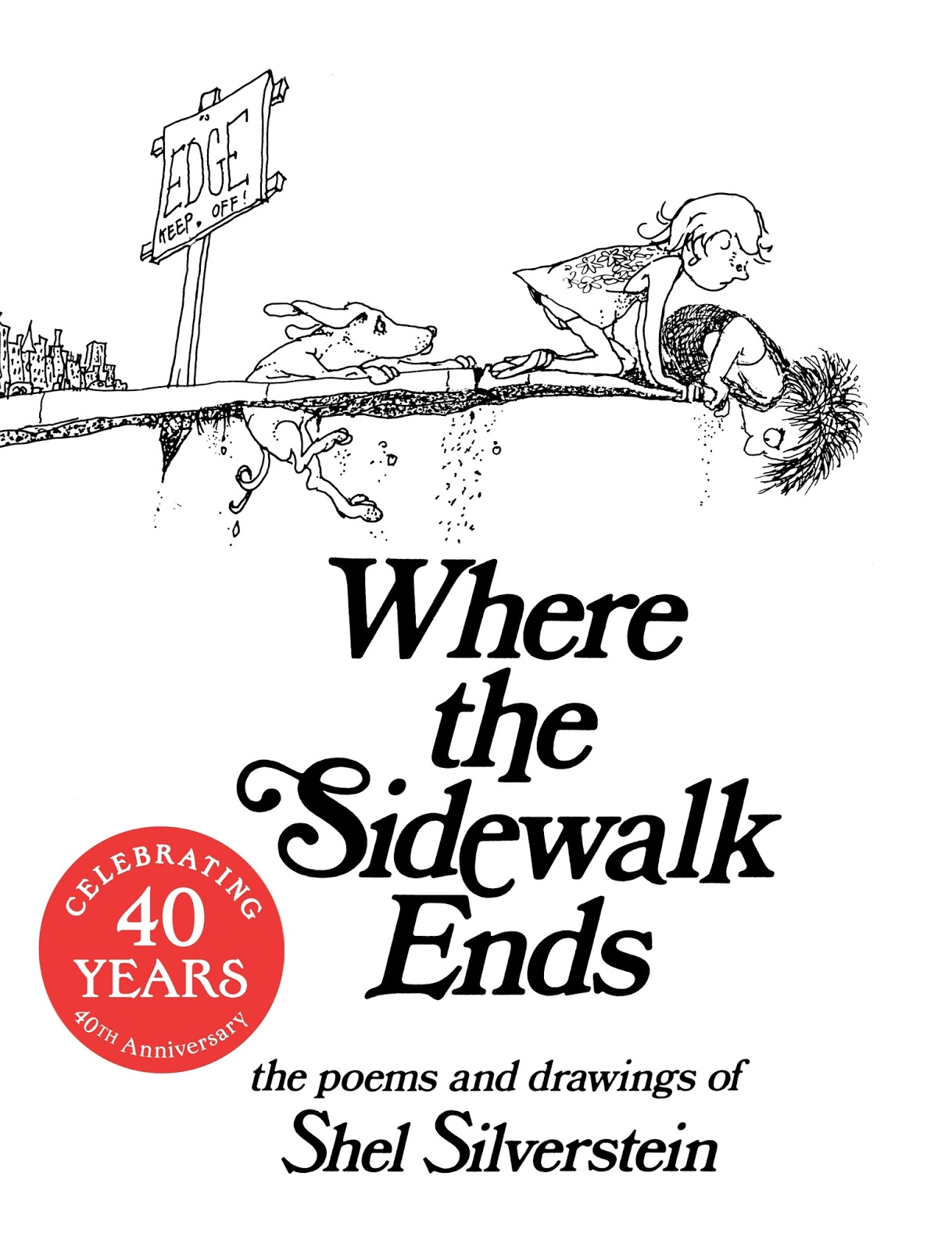
Where the Sidewalk Ends by Shel Silverstein book cover
Finally, a friend and colleague gifted me a lovely hardback edition of Where the Sidewalk Ends, Shel Silverstein's delightful collection of children's poems and illustrations. Silverstein once said he never studied the poetry of others and instead developed his own "quirky style, laid back and conversational." It shows. Where the Sidewalk Ends is one of those rare books that makes you want to put pen to paper and try writing a few verses yourself.

(As an Amazon Associate I earn from qualifying purchases.)

Sudden Makes War by Oliver Strange book cover
 Sudden Rides Again by Oliver Strange book cover 

August 27, 2016

The Laws of the Spirit World by Khorshed Bhavnagri, 2009

In Ghost, Sam (Patrick Swayze) is killed by a thief in an alley, leaving his girlfriend Molly (Demi Moore) shattered. It is no ordinary street mugging. Sam comes back as a spirit to warn Molly that her life is in danger. But since he cannot be seen or heard, he takes the help of a reluctant psychic, Oda Mae Brown (Whoopi Goldberg), to communicate with Molly and save her from his crooked friend and mastermind Carl Bruner (Tony Goldwyn).

The film was a big hit because of the unusual storyline and the romantic poetry of Swayze and Moore and, I suspect, its underlying theme—afterlife—and the mystery surrounding it.

Everyone at some point or another wonders—is there life after death? If yes, then what is it like? So far a credible answer has been as elusive as the possibility of life in space. It has even eluded mystics who, for want of a better response, instruct us to keep our faith and not question the here and hereafter.


In The Laws of the Spirit World (2009), Khorshed Bhavnagri takes the reader through her painful quest to find the answer that eventually helps her turn her personal tragedy into an endearing spiritual journey—and come to terms with the death of her loved ones. Along the way she rediscovers peace, solace, and more.

Khorshed’s small world and her faith in God came crashing down when her two motorsport-loving sons, Vispi, 31, and Ratoo, 30, died in a car accident one winter’s day in December 1980. It was all but the end of the world for her and her husband, Rumi Bhavnagri, who lived in Byculla in central Bombay (now Mumbai). 


“I had been very religious. Now, for the first time, I began to question whether there was a God. If there was a God then why should He do this terrible thing to me, snatch my sons away when I have never harmed a hair on anyone’s head? I was ready to give up God, religion and life,” the distraught mother said.

Khorshed Bhavnagri
A few days after the funeral, a chance encounter with a powerful medium changed their lives once again—only this time for the better and for the spiritual benefit of scores of other sufferers. The Bhavnagris provided guidance and comfort to both young and old, and offered counsel to troubled people. Questions about personal and spiritual matters were addressed and minds set at ease. These are reproduced in the second part of the book.

The psychic held seances to help Khorshed and Rumi “communicate” with their sons in the spirit world. They did so first by automatic writing and then via telepathy. “You must not cry for us or miss us, we are much happier here,” Vispi and Ratoo told their parents who, guided by the boys, set out on their noble mission of spiritual awakening. The devout couple were inspired by the life and teachings of spiritual messiahs.

The 380-page book, published by Mumbai's Jaico Publishing House, is the true and affecting story of grief-stricken parents and their desperate search for the meaning of existence, the realms of life and death, the power of the subconscious mind, and concepts of good and evil and heaven and hell. It is borne out of their sons’ desire to explain the laws of the spirit world to the mortal world.

The Laws of the Spirit World is not out of my comfort zone. Since I have been reading spiritual books from my early teens, the book resonated with me. But there is plenty of food for thought even for those not inclined to the metaphysical. What is required is an open mind and the willingness to accept concepts beyond one’s deep-rooted beliefs and principles. It offers a refreshing perspective on various aspects of life and death, and it is up to readers to accept or reject them. For example, readers who don’t believe in the afterlife and the mediums and seances associated with it can still take away valuable tips the author offers on how people, as individuals or families, can lead a happy and contented life. Isn’t that the purpose of every beautiful life?

The writing is simple and lucid and set in broad typeface that makes the book aesthetically appealing.

Rumi and Khorshed Bhavnagri passed away in 1996 and 2007, respectively, and as they would've, no doubt, liked everyone to know, “happily reunited with their sons in the spirit world.”


A few reviews from Amazon

“The book has changed my life, and I am sure it will change yours too.”
 
— Shiamak Davar, noted Indian choreographer and follower of Khorshed Bhavnagri

“An excellent read. Changes one's perspective towards life. A book for believers in God, Karma and reincarnation. Death, the imminent event in everyone's life, is mostly an enigma. This book enables the reader to strike peace with death and solve that mystery i.e. death is nothing but a foray into eternal life.”
— Radha

 
“For one who has read Indian philosophy, and works (of) Dr. Brian Weiss etc., I find that this book reinforces the same universal message. It takes faith to believe in the spirit world but the message is universal—we need to connect with our inner selves and everyone around us is a noble person living out his/her 'spirit'ual goal.”
— J. Mallaparajuon

July 25, 2011

The magic of comics

“An entire magazine devoted to comics! Who’s going to read it?” Friends and colleagues were sceptical that an intellectual magazine which went far beyond the scope of its tagline ‘Mindspace for Men’ could sell on a childhood passion, one that most men usually outgrow by the time they walk into their first job and out of their first marriage—comics.

And yet, Gentleman magazine, last published by Express Publications (Madurai) Ltd until 2001, turned the February 2000 issue on its head by dedicating 60-odd pages to comics and comic strips, and little else. Titled Inner World of Comics, it was, and probably is, the only magazine in the world to do so.

The criticism, mild as it was, seemed justified. After all Gentleman wrote extensively on such cerebral topics as books, music, art, cinema, food, and poetry among other heady addictions. Well-known writers and critics worked on cover themes with a lot of fun and passion, be it science fiction, essential listening, horror stories or underrated movies.

But why comics? No particular reason except that two comic-book fans who were passionate about comics (and I believe still are) decided it was time Gentleman got its own speech bubble, and a big one too.

The believe-it-or-not issue was put together by senior journalist and then editor Premnath Nair and this blog writer with handsome contributions from noted writers and poets like Adil Jussawalla, Farrukh Dhondy, Boman Desai, Rafique Baghdadi, Pradeep Sebastian, Devangshu Datta, Ajoy Alexander, and yes, the late Anant Pai, the father of Indian comics and creator of the fabled Amar Chitra Katha (Immortal Picture Stories).

Inner World of Comics was a veritable who’s who of the comic book universe beginning with The Yellow Kid, the first-ever comic strip. Almost no one was left out, at least not intentionally, and all the major league comic book characters were in.

Come to think of it, there was more to Inner World of Comics. In some way we rekindled our long-forgotten inner world too.

As writer-columnist Farrukh Dhondy concluded in his article Childhood Pleasures, “Books were longer to squeeze satisfaction out of. Films were still not accessible. Coca-Cola was unaffordable, chewing gum was forbidden, making eyes at the dhobi’s girl was the closest one got to sex, and TV hadn’t come to India. There was playing with the dog, Dara’s Meccano set, marbles, throwing stones at tamarind trees, reading comics…”

April 30, 2015

The Fog Horn by Ray Bradbury, 1951

Todd Mason is assembling the links for Friday’s Forgotten Books at his blog Sweet Freedom, in the absence of Patti Abbott who usually does the honours at Pattinase.

Ray Bradbury writes like a poet, which is not surprising as he has admitted to being influenced by his favourite poets and reading poetry every day of his life. The Fog Horn, a science fiction story he wrote in 1951, is a good example of his lyrical prose. Consider this passage.

“Sounds like an animal, don’t it?” McDunn nodded to himself. “A big lonely animal crying in the night. Sitting here on the edge of ten billion years calling out to the Deeps, I’m here, I’m here, I’m here. And the Deeps do answer, yes, they do.”

The “lonely animal” is a sea monster which is attracted to the “deep cry” of a foghorn in a remote lighthouse. The mysterious giant—a Loch Ness or a Godzilla or a dinosaur of some sort—comes out of the deep sea on the same night once a year to visit the lighthouse and cry out in unison with the foghorn.

But things don’t go as planned on that fateful night, three years later, when McDunn, the veteran, and Johnny, his junior and narrator of this story, lie in wait in the high tower. When the monster comes out of the sea, in the dark and stormy night, and hears the foghorn blow, it answers back. Here, Bradbury’s description is again poetic.


“A cry came across a million years of water and mist. A cry so anguished and alone that it shuddered in my head and my body. The monster cried out at the tower. The Fog Horn blew. The monster roared again. The Fog Horn blew. The monster opened its great toothed mouth and the sound that came out from it was the sound of the Fog Horn itself. Lonely and vast and far away. The sound of isolation, a viewless sea, a cold night, apartness. That was the sound.”

Ray Bradbury's own James Bingham painting
for ‘The Fog Horn.’
© www.natedsanders.com
The sound of the foghorn comes and goes and over time it arouses feelings in the monster living under the icy depths of the sea, because their cries sound exactly the same. The monster thinks it has found one of its own kind but the lighthouse doesn’t respond to its romantic wailing. The monster, as you might have guessed from the picture, doesn’t take the betrayal too kindly.

Ray Bradbury has written this allegorical story so incredibly well that you can picture yourself in the shoes of McDunn and Johnny and reliving their experience of the terrifying and lonesome monster and its tragic attachment to the tower. I get carried away with beautiful writing and
intend to reread the story in future. I’d recommend it even to those who don’t usually read sf and fantasy.

The Fog Horn appears to enjoy a cult status among Bradbury's many stories. It is the first one in his collection The Golden Apples of the Sun. It was made into a film called The Beast from 20,000 Fathoms, 1953, which incidentally was the original title till the author changed it. It is said to have been originally published in The Saturday Evening Post, 1951, though at least one site attributed its first appearance in Argosy the same year. The story has been adapted for plays, comics, and an animated series, and it even influenced a Star Trek episode. 

December 30, 2011

Books I read in 2011

“Predictable” is the word I would use to describe the sort of books I read in 2011, a diverse mix of fiction and non-fiction, including philosophy, but no surprises, really. I did not have a reading plan for this year and I don’t have one for next year either, save for a couple of authors I have mentioned in my posts. I intend to read more short stories, poetry and classics in 2012, though.

I read a few books over the past twelve months. This does not include the dozens of comics I read. To give you a rough idea, this is what my assorted ‘fiction’ list looks like…


Ernest Hemingway — For Whom the Bell Tolls

Tom Clancy — The Hunt for Red October

Agatha Christie — The Murder of Roger Ackroyd & The Mysterious Affair at Styles

A.J. Cronin — The Spanish Gardener


P.G. Wodehouse — Piccadilly Jim & Money for Nothing

Jack Higgins — Keys of Hell, Storm Warning & The Iron Tiger

John Irving — The 158-Pound Marriage, The World According to Garp (re-read) & The Hotel New Hampshire

Ed Gorman — Cavalry Man: The Killing Machine

Thomas Hardy — Jude the Obscure

Jonathan Kellerman — Dr. Death

Elmore Leonard — Pagan Babies

Don Pendleton — Mack Bolan, the Executioner: Death Load

Leon Uris — The Angry Hills

Boris Pasternak — Dr. Zhivago

Harold Robbins — A Stone for Danny Fisher (re-read)

Among non-fiction, I had fun reading The Complete Prose of Woody Allen.

Like I said, no surprises...


November 05, 2012

Stamp of a Statesman: Jawaharlal Nehru

The following quotes have been excerpted from Toward Freedom: The Autobiography of Jawaharlal Nehru (1941), which the first Prime Minister of independent India dedicated to his wife Kamala Nehru. His prose in this book as well as in his other two major works, The Discovery of India and Glimpses of World History, is mersmerising.

"(Toward Freedom) was written entirely in prison, except for the postscript and certain minor changes, from June 1934 to February 1935. The primary object in writing these pages was to occupy myself with a definite task, so necessary in the long solitudes of jail life, as well as to review past events in India with which I had been connected to enable myself to think clearly about them. I began the task in a mood of self-questioning and, to a large extent, this persisted throughout. I was not writing deliberately for an audience, but, if I thought of an audience, it was one of my own countrymen and countrywomen. For foreign readers I would probably have written differently, or with a different emphasis..."

"Letter writing and receiving in jail were always serious incursions on a peaceful and unruffled existence. They produced an emotional state which was disturbing; for a day or two afterward one's mind wandered, and it was difficult to concentrate on the day's work."

"My main occupation (in jail), however, was reading and writing. I could not have all the books I wanted, as there were restrictions and a censorship, and the censors were not always very competent for the job. Spengler's Decline of the West was held up because the title looked dangerous and seditious. But I must not complain, for I had, on the whole, a goodly variety of books." 

"The only books that British officials heartily recommended were religious books or novels. It is wonderful how dear to the heart of the British Government is the subject of religion and how impartially it encourages all brands of it."

"I was well up in children's and boys' literature; the Lewis Carroll books were great favorites, and The Jungle Books and Kim. I was fascinated by Gustave Dore's illustrations to Don Quixote, and Fridtjof Nansen's Farthest North opened out a new realm of adventure to me. I remember reading many of the novels of Scott, Dickens, and Thackeray, H.G. Wells's romances, Mark Twain, and the Sherlock Holmes stories. I was thrilled by The Prisoner of Zenda, and Jerome K. Jerome's Three Men in a Boat was for me the last word in humor. Another book stands out still in my memory; it was Du Maurier's Trilby; also Peter Ibbetson. I also developed a liking for poetry, a liking which has to some extent endured and survived the many other changes to which I have been subject."

"It is a little absurd to discuss this question of freedom of mind in prison in India when, as it happens, the vast majority of the prisoners are not allowed any newspapers or writing materials. It is not a question of censorship but of total denial." 

"In Lucknow Jail I used to sit reading almost without moving for considerable periods, and a squirrel would climb up my leg and sit on my knee and have a look round. And then it would look into my eyes and realize that I was not a tree or whatever it had taken me for. Fear would disable it for a moment, and then it would scamper away."

"Reading was my principal occupation during those winter days and long evenings. Almost always, whenever the superintendent visited us, he found me reading. This devotion to reading seemed to get on his nerves a little, and he remarked on it once, adding that, so far as he was concerned, he had practically finished his general reading at the age of twelve!"


"Sometimes I would weary of too much reading, and then I would take to writing. My historical series of letters to my daughter kept me occupied right through my two-year term, and they helped rne very greatly to keep mentally fit."

"From sunset to sunrise (more or less) we were locked up in our cells, and the long winter evenings were not very easy to pass. I grew tired of reading or writing hour after hour, and would start walking up and down that little cell four or five short steps forward and then back again. I remembered the bears at the zoo tramping up and down their cages. Sometimes when I felt particularly bored I took to my favorite remedy, the shirshasana (a yogic exercise) standing on the head!"

"Travel books were always welcome records of old travelers, Hiuen Tsang, Marco Polo, Ibn Battuta, and others, or moderns like Sven Hedin, with his journeys across the deserts of Central Asia, and Roerich, finding strange adventures in Tibet. Picture books also, especially of mountains and glaciers and deserts, for in prison one hungers for wide spaces and seas and mountains. I had some beautiful picture books of Mont Blanc, the Alps, and the Himalayas, and I turned to them often to gaze at the glaciers when the temperature of my cell or barrack was 115 F or even more. An atlas was an exciting affair. It brought all manner of past memories and dreams of places we had visited and places we had wanted to go to." 

"One extravagance which I have kept up will be hard to give up, and this is the buying of books."

For previous Celebrity Stamps, see under Labels to your right.

March 04, 2012

Do you have a hobby?

“Do you have a hobby?” is probably the most annoying question that well-meaning uncles and aunts ask their teenage nephews and nieces. They asked me when I was a kid. I don’t recall being irritated, though. My parents probably asked the same silly question. I don’t know if it annoyed my cousins. I’m sure it did.

Flamingo Library was located in the foyer of Hotel Sona.

At times, their cursory interest in my hobbies, after I had revealed them, stretched to: “Oh, so you play chess, do you?” And you know what’s coming next. “Do you think you could teach my son? I will send him over every Sunday morning. I want him to cultivate at least one hobby. Thanks, uh.”

Indulging in a hobby is time spent gainfully so long as you’re enjoying yourself. There’s never a dull moment. For me, hobbies are primarily about passion, creativity, private space, and personal fulfillment.

I had many hobbies and nearly every one of them was introduced to me by my father, hobbies like pouring over his assorted collection of stamps and creating my own album, playing chess or scrabble with him in marathon sessions that often lasted morn to eve, buying and reading comic-books, solving crosswords and jigsaw puzzles together, and drawing and painting everything from abstract to still life.

Speaking of chess, I spent a lot of time playing with Bobby Fischer and Boris Spassky during my teens. That is, replaying their games from the controversial 1972 world chess championship at Reykjavik in Iceland.

Between these simple pleasures of childhood, we played cricket at home, with a wooden bat and a tennis ball, using a part of the door as stumps; took potshots at small wooden puppets with a ping-pong ball gun, keeping points, five for every hit; or played table tennis across the dining table,
with a stick balanced delicately on two inverted glasses serving as a net. 

Leafing through the dictionary for strange words and their strange meanings and using latitudes and longitudes to locate mysterious cities and towns in a world atlas were other useful pastimes that helped shape my growing years.

A rather silly pursuit was book cricket: you flipped the pages and stopped at random, the page numbers on the left serving as scores. We even drew up eleven-member rival teams, each a famous cricketer. It doesn’t make sense now, but it did back then. At least you didn’t sweat it out or injure yourself
.

During my seventy-five day summer vacation, my friends and I, bored playing outdoor games in hot sun, would pick up books and comic-books from the local circulating library and take turns reading them during the week. We, thus, read the entire hardbound Hardy Boys series from the popular Flamingo Library located in the foyer of Hotel Sona in the idyllic and sleepy town of Panjim, the capital of the beautiful coastal state of Goa, a favourite destination among foreign tourists. 

Childhood was never better. It still isn’t. What was yours like?


How others look at hobbies…

“The only insult I've ever received in my adult life was when someone asked me, "Do you have a hobby?" A HOBBY?! DO I LOOK LIKE A FUCKING DABBLER?!”
― John Waters, Role Models, American filmmaker, actor and stand-up comedian

A hobby a day keeps the doldrums away.
― Phyllis Mcginley, American author of children's books and poetry

It's the safety valve of middle life, and the solace of age.
― Mary Roberts Rinehart, American writer, often called the American Agatha Christie

June 19, 2015

Harvest of War by Charles Gramlich, 2012

"Across a snowfield that lies red with dawn, the Orc charge comes. And is met." — opening line

© Razored Zen Press
I'm not very familiar with fantasy fiction or science fiction and it takes me some time to understand stories in the two intricate styles. I often find the plot and the narrative complex. Still, I enjoy reading fantasy and sf stories a lot and I read them regardless of my incomprehension.

But every so often comes along a story that makes reading fantasy or sf a satisfying and delightful experience. Such as Harvest of War, a fantasy short story by noted author Charles Gramlich.

In this story Charles blends rich prose and poetry to narrate a riveting tale of creatures and beasts who clash in the land of startling imagination that is both fascinating and terrifying.

It begins with a gory war between the vicious Orcs and their Human foes, a fight to the death where only one race may survive, or maybe none.

But there is a victor. The Human cavalry led by their leader, Lord Aaron, manages to slay the Orc army. Except for one of their kind who is taken captive and caged and treated so horribly, that his fate in the human settlement is probably worse than in hell.

"Victory rewards the most brutal."

In spite of being grievously wounded and tormented by his oppressors, Khales, the captured Orc, knows no pain or fear. He is a proud warrior of his humanoid race.

As time passes and the Orc begins to accept his barbaric fate, he receives compassion from an unexpected quarter—a small human girl with "red hair and grayish-blue eyes." She is Ehma, daughter of Lord Aaron, who rises above her father's blood-thirsty and vengeful tribe to befriend one of their worst enemies and treat him with kindness. She helps the Orc escape but not before arousing something inside him.

There is hope and redemption in each bloody war, every brutal conflict. The Orc gets a chance to redeem himself, and his own villainous race, when in the absence of the human soldiers, he returns to defend his little friend and her colony against the mighty underground beasts called Reapers, foe to both the Orcs and the Humans.

I may sound clichéd when I say this but, Charles Gramlich, author of several fantasy, horror, and sf novels and short stories, has written a cracker of a fantasy story. It is lucid in style and relentless in pace and action. I liked it very much, partly because I understood the story. I only wish the poetic-prose narrative of Harvest of War was longer than the twenty-odd pages of my Kindle edition. I thank Charles for a free copy of the short story available for $0.99 at Amazon.

Highly recommended.


Notes:  Previously, I reviewed Charles' Killing Trail and also interviewed him. You can learn more about the author and his work on his blog Razored Zen and his Amazon page.

December 03, 2014

Delhi is Not Far: The Best of Ruskin Bond, 1994

© Wikimedia Commons
Roald Dahl and Ruskin Bond have common ground in India. The British novelist, born in Wales to Norwegian parents, and the Indian author, born in Himachal Pradesh to British parents, are two very popular writers of children’s literature. Their books are prominently displayed in Indian bookstores and continue to sell in good numbers.

Bond, 80, is more Indian than many Indians and this reflects in his vast body of work consisting of many novels, short stories, essays, and songs and love poems. He writes about life in the hill stations close to the Himalayas in North India. The award-winning author has been singularly responsible for the growth of children’s literature. Bond was born in Kasauli, Himachal Pradesh, in 1934, and now lives with his adopted family in Mussoorie, Uttarakhand, at the foothills of the mountain range. He has never left his adopted country.


© Prashant C. Trikannad
In many ways Ruskin Bond reminds me of that other celebrated Indian writer, the late R.K. Narayan, who wrote about the charming life in a small fictional town called Malgudi in South India. While Bond’s and Narayan’s stories essentially grew out of their experiences in the north and south, respectively, their writing styles run parallel in terms of simplicity and lucidity of prose.

As with Roald Dahl, both young and old read Ruskin Bond and R.K. Narayan. They are the ambassadors of Indian literature.

© www.littlesistersofthepoor.in
I don’t think I have written about Ruskin Bond earlier. An opportunity arose when I recently bought his collection, Delhi is Not Far: The Best of Ruskin Bond, 1994, from the annual charity sale at Home for the Aged run by Little Sisters of the Poor, founded by Jeanne Jugan in 1839, in France. The old-age home is located behind my house and I have picked up many good books from their yearly fair, as much for a charitable cause as for my own.

Delhi is Not Far is a 428-page anthology of four decades of Ruskin Bond’s writing, particularly the best of his prose and poetry and essays and short stories. India Today has described his writing thus: “Bond’s sentences are moist with dew and the mountain air, with charm, nostalgia and underplayed humour… (he is) our resident Wordsworth in prose.”

While I read his stories a long time ago, this is the first time I’d be reading them in an anthology and I’m looking forward to it, especially his five tales of the macabre. I didn’t know Ruskin Bond wrote those too. He begins his introduction with these lines: And here I am again, in my little room overlooking the winding road to Tehri, writing another introduction. No one has ever offered to write an Introduction for any of my books, and so, perforce, I must do my own.”