April 24, 2015

Gladiator by Philip Wylie, 1930

Spotlighting a famous but unread novel for Friday’s Forgotten Books at Patti Abbott’s blog Pattinase.

First edition cover
© Wikipedia
Blogging has been educational in so many ways that I have lost count. For instance, I just learned that the inspiration for Superman (1938) could have come from a science fiction pulp novel called Gladiator (1930) written by Philip Wylie, though Jerry Siegel and Joe Shuster who created the Man of Steel never confirmed it. However, reports on the internet suggest that, in 1940, Wylie threatened to sue the two for borrowing the idea.

I found the story at Archive, though I have not read it. It is likely that I have read about Gladiator and its author in the past but right now it is beyond my ken.

“The story concerns a scientist who invents an ‘alkaline free-radical’ serum to ‘improve’ humankind by granting the proportionate strength of an ant and the leaping ability of the grasshopper. The scientist injects his pregnant wife with the serum and his son Hugo Danner is born with superhuman strength, speed, and bulletproof skin. Hugo spends much of the novel hiding his powers, rarely getting a chance to openly use them,” says Wikipedia.

The article also draws a parallel between Hugo Danner and Spider-Man (1962): “The concept of a human having the proportional strength of an insect is very similar to the concept of Spider-Man having strength proportional to that of a spider.” Again, there is no evidence that creators Stan Lee and Steve Ditko were influenced by the novel.

Cover of Marvel Preview
© www.herogohome.com
Unlike Superman and Spider-Man and other superheroes, Philip Wylie’s hero does not don a costume and fight crime. While Danner has the super gift, he does not reveal it or use it. Going by the covers he sounds more like Adonis than Superman.

In 1938, Gladiator was made into a comedy movie starring Joe E. Brown, only two months after Superman first appeared on the stands. It was also adapted as Marvel Preview for Marvel Comics in 1976.

American author Philip Wylie wrote widely, his books, short stories, and essays covering pulp science fiction and mysteries, social diatribes and satire, and ecology and the threat of nuclear holocaust. Two of his famous works are said to be When Worlds Collide (1933), with Edwin Balmer, and A Generation of Vipers (1942). 

Author Philip Wylie
© Wikipedia
The covers of his novels including The Murderer Invisible (1931) and The Savage Gentleman (1932) are quite something and tempting enough to make you want to read them right away.

Let's here it from you, Todd!

April 21, 2015

It’s our 25th Wedding Anniversary!

April 22, 1990
Twenty-five years ago, on April 22, 1990, Parizad and I got married in a simple and memorable ceremony attended by family and friends. Ours was a civil marriage because my wife is a Zoroastrian-Parsi by birth and it allowed her to keep her faith well as I am a Hindu. We were both born in Bombay where we live.

We met on December 7, 1986, the day she walked into the newspaper office, where I was already working as a cub reporter, and into my life. After a four-year courtship, during which we walked and talked and read books and watched movies together, we decided to tie the knot.


April 22, 2015
Parizad and I have two beautiful children. Nyrica, 23, our daughter who is studying to become a CA, and Thayn, 18, our son who is in senior college and plans to pursue an MBA.

My marriage to Parizad remains the best decision of my life though I can’t say the same for her. True to her name, which means born of a fairy, she has given me more than I could have ever wished for. I’ll borrow a line from Erich Segal’s Man, Woman and Child to sum up all those years of wedded bliss—“(Parizad) is why I believe in marriage” to which I’ll add “and in life too.”

Our children Nyrica and Thayn

April 15, 2015

Interview with James Reasoner

‘It’s human nature to ask, What if?’ 
That’s the appeal of alternate history’

© James Reasoner
This interview with James Reasoner—renowned and prolific American writer of Western novels and Civil War books—could not have happened at a better time. For, I have just learned that Western Fictioneers is honouring Reasoner with its fourth Life Achievement Peacemaker Award. Since writing his first Western novel thirty years ago, Reasoner has authored several hundred novels and short stories in numerous genres, both under his own name and various pseudonyms. It is a richly deserved award. Congratulations, Mr. Reasoner!

The real occasion for this interview is my April 7 review of James Reasoner’s The Blood of the Fallen: The history that never happened. I was fascinated by the short story that turned Abraham Lincoln’s famous Gettysburg speech on its head and offered a side to the Civil War president that I never thought of. But that’s Alternate History for you.

I asked James Reasoner about the story as I was curious to learn more about it and especially how he came to write it, and he was very kind to respond to my questions.


How did the idea for The Blood of the Fallen: The history that never happened occur to you?
I was asked to write a story for an anthology called Alternate Gettysburgs. I was writing the ‘Civil War Battles’ series at the time, and the editor on those books was the same one who edited Alternate Gettysburgs. So the theme of it was there from the first.

What were your reasons for choosing Abraham Lincoln and his Gettysburg speech as the subject of your story?
I didn't want to write a story about the battle—I'd been writing about various battles in my own series—and Lincoln's speech seemed to be the best-known thing about Gettysburg other than the battle itself. I started thinking about how I could change it around and come up with a different result.

© Rough Edges Press
How long did it take you to write it? What was the writing process like?
The actual writing probably took a couple of days. There was quite a bit of research leading up to it, though, because I wanted to get all the details as accurate as possible and follow the history closely up until the point where the story diverged from what really happened.

Was it difficult to write the story given Lincoln’s vastly significant contribution to American history?
No, not really, if anything it was easier because there's such a wealth of research material about Lincoln in general and the Gettysburg Address in particular.

While writing the story, did you picture Abraham Lincoln as one who might cry out for “vengeance” and swear to shed “rebel blood”?
Actually, that seemed like something that Lincoln wouldn't do under normal circumstances. Many historians have speculated that Reconstruction wouldn't have been so harsh on the South if Lincoln had lived. So what I had to come up with was a circumstance so traumatic for Lincoln that he would go against his natural inclinations, something that would make him hurt so much that he would lash out at the most convenient target—in this case, the Confederacy.


I read somewhere that a lot of people find “alternate or alternative history” entertaining? Why do you think this is and how would you best describe the term?
Well, a lot of people are interested in history, period, and it's human nature to ask, "What if?" I think that's the appeal of the alternate history genre, the endless speculation of the ripple effect caused by one or two simple changes in what really happened.

Have you written any other stories with a similar theme?
I wrote one story, The East Wind Caper, about the Japanese attack on Pearl Harbour, but that's my only other alternate history story. I'd be interested in doing more but just haven't had the opportunity (or the right idea).

How different would America have been today if the events retold in The Blood of the Fallen had actually happened?
I don't know. That would probably take a whole novel to figure out—which is something I've actually thought about doing, if I ever get around to it. Nathan Bedford Forrest is an interesting, if somewhat controversial, figure in American history and I'd be interested in writing more about him. That's where you'd have to start to get to where we'd be today if that history was different.

Would you consider Lincoln’s Gettysburg address as one of the greatest speeches delivered by a world leader or statesman?
Certainly. For a speech to be that short, yet that powerful and memorable, is quite an achievement. Would that all politicians spoke so well—and so briefly!

How is Abraham Lincoln seen by the American people today? And how relevant is his ‘Emancipation Proclamation’ in our times?
When asked about the greatest president, Lincoln is usually the first or second choice, so I think people generally still hold him in very high regard. At the time, I think the ‘Emancipation Proclamation’ was more of a strategic political move than anything else, but it's important because it was the start of something that had to be done and its consequences wound up being much more far-reaching than just helping Lincoln get reelected.

Finally, as a veteran writer and historian, what is your own view of President Lincoln and his achievements?
It's probably going too far to consider me a historian! I'm a storyteller more than anything else, and Abraham Lincoln, in many ways, is a larger-than-life character, so it was fun (although in a bleak sort of way, considering how the story turned out) to write about him. His achievements are legendary and so is his personality. I remember reading a biography of him when I was seven or eight years old, so it was nice to be able to write about him, to peek behind the historical figure, all those years later.

Thank you, Mr. Reasoner.

April 13, 2015

My Friend, Ron

© Buddies in the Saddle
Last night, I went to bed with a heavy heart, for I learnt that my friend, Ron Scheer, had passed away following illness. Like many of my blog friends, I dreaded the news even though I knew it would be inevitable one day. 

Can someone whom you never met in real life be your friend? Ron Scheer proved that you can in more than one way.

I met Ron through our blogs and especially his, Buddies in the Saddle, where he delighted readers with penetrating reviews of western novels and films, and interviews with some of America’s finest western authors. There was a perceptive depth to all of his writing. His blog was a definitive work on western fiction and film, and will be relevant for all time.

Following his illness, last year, Ron took to a new kind of writing: he started a Sunday journal where he wrote bravely and candidly about his thoughts on life and death, his personal beliefs, on philosophy, and such light-hearted matters as his cooking of chicken soup. They were good for our soul. Reading his journal you wouldn’t know he was ailing. His posts were positive and inspiring and laced with humour. I looked forward to reading his diary every weekend often forgetting the context he wrote in.

As Patti Abbott observed, “His journal from the last year touched me every week. He turned his death into poetry as few people can. Never maudlin, always brave and honest it was a model for all of us.”

Ron, who was an authority on frontier fiction as he liked to call western fiction, was a blogger with a big heart. He first visited my blog in January 2012 and didn't stop until a couple of months ago. He was both supportive and appreciative of my posts and left behind generous comments. I particularly looked forward to his feedback on my reviews of western novels which, henceforth, will miss hearing his authoritative voice.

Like many among us, I’ll miss Ron very much and I’ll cherish our virtual friendship, which was more real than a real one.

I offer my deepest sympathies to his wife, Lynda, and their children.


Tributes to Ron from our common friends

Patti Abbott — Pattinase 
David Cranmer — The Education of a Pulp Writer
Charles Gramlich — Razored Zen
Richard Wheeler — Wheeler's World
Elisabeth Grace Foley — The Second Sentence
Brian Busby — The Dusty Bookcase

April 11, 2015

The Citadel by A.J. Cronin, 1937

Three of my favourite authors made a successful writing career out of their chosen professions—Scottish physician A.J. Cronin in medicine, American lawyer Erle Stanley Gardner in law, and British aeronautical engineer Nevil Shute in aviation. Their stories often reflected their obsession with their vocations. They wrote some fine novels, each in his distinct style. Their books spawned many films and television series. Reading their novels is always a pleasant experience. 

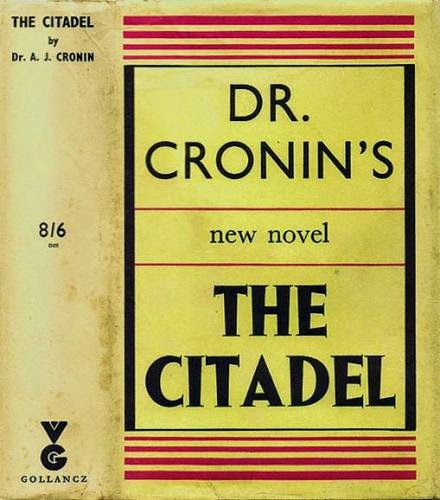
A replica of my copy of the book.
Last month, I read The Citadel (1937), the fifth novel by A.J. Cronin. It is set in the medical profession, like several of his novels are, including Grand Canary, Shannon's Way, The Judas Tree, and A Pocketful of Rye, and novellas such as Country Doctor, Kaleidoscope in ‘K’, Vigil in the Night, and The Valorous Years.

My own favourite Cronin novel is the non-medical Beyond This Place.

The Citadel tells the story of Andrew Manson, a young, idealistic, and ambitious doctor—a fairly common protagonist in many of his novels—who moves to a small and little-known mining town called Drineffy in the English countryside. He works as assistant to the ailing Doctor Page though he did not know before arriving from Scotland that his mentor was an invalid.

However, Manson soon finds that he is dealing with more than he’d bargained for—his senior’s overbearing sister, Miss Page, handling medical cases, including the difficult ones, all by himself, his meagre wages, and poor conditions in the Welsh town. Not long after, he falls in love with the very proper Christine Barlow, the petite school teacher, gets married, and moves to another coal mining town where he immerses himself in medical research, quite successfully. But there is always an unpleasant turn in the life of every happily married couple, even in the life of the good doctor.

© Wikipedia
The Citadel refers to Andrew Manson’s hard-fought and hard-earned life as an honest doctor and how it comes crumbling down when he succumbs to greed and the spoils of the medical profession in London, jeopardising his marriage to the woman he loves, only to rebuild it in the end, and reconcile his ideals and ethics with the profession he worships.

A.J. Cronin’s writing is beautiful, his characters are intense, and his narrative is seamless. There is an old charm to it all. He is often considered as a rather depressing writer but I have never felt that way. There is always hope behind despair in his stories, which makes them realistic. I’d like nothing better than to sit in one place and read his book while the hours pass by.

Of this groundbreaking novel, Cronin said, “I have written in The Citadel all I feel about the medical profession, its injustices, its hide-bound unscientific stubbornness, its humbug… The horrors and inequities detailed in the story I have personally witnessed. This is not an attack against individuals, but against a system.”

The novel was made into a film in 1938. It starred Robert Donat as Dr. Andrew Manson and Rosalind Russell as Christine Barlow. It has also been adapted for television more than once. The Indian film industry borrowed it liberally, the 1971 Hindi version titled Tere Mere Sapne (roughly, ‘Yours and My Dreams’) being more popular of the lot.

Recommended.

April 07, 2015

The Blood of the Fallen by James Reasoner, 2002

© Rough Edges Press
There are some stories that you can’t review without spoilers. The Blood of the Fallen: The history that never happened by prolific American author James Reasoner is one of them. 

The 18-page story is narrated by Stark, the captain of the military guard assigned to protect President Abraham Lincoln. I’m not sure if the detail actually existed but it seemed to have preceded the Secret Service formed in July 1865 under the Department of the Treasury. Apparently, the legislation creating the agency was on Lincoln's desk the very night he was assassinated.

But that’s not really the story.

The Blood of the Fallen refers to President Lincoln’s famous Gettysburg speech in November 1863 dedicating a new cemetery to the soldiers whose Union army defeated the Confederates in the Battle of Gettysburg. Just before his speech, Lincoln learns from Stark that his youngest son, Thomas ‘Tad’ Lincoln, had succumbed to a fever and that his wife, Mary Todd Lincoln, overcome with grief, had hanged herself. The double tragedy comes not long after the death from illness of his elder son William ‘Willie’ Lincoln. In real life, however, Mary outlived her husband and three of her four sons; Tad Lincoln died in 1871 of heart failure and not fever. 


An 1864 photo of President Lincoln 
with his youngest son, Tad.
© Wikipedia
Remember, this is history that never happened.

In spite of his great sorrow, Lincoln delivers his landmark address beginning with “Four score and seven years ago…” and ending with “…government of the people, by the people, for the people, shall not perish…” as we have known it for more than a century.

But something snaps inside the president. Haunted by the deaths of his wife and sons, Lincoln reveals a side to him that you’d scarcely think of. Delineating from his prepared speech, the president, “his face dark with anger and hatred,” swears vengeance on the Confederacy, the southern states that ceded from the United States in 1861 leading to the Civil War.

Lincoln’s extempore remarks changes the course of the war, in a way that left me speechless and at the same time marvelling at James Reasoner’s imaginative telling of the story. I was quite unprepared for it, I admit.


I very much enjoyed reading this tale of alternate history by the author of the Civil War Battles series and hundreds of other books. It made me think how different history might have been if we looked at other epoch-making events of the world in a similar manner. For instance, what would have happened if Mahatma Gandhi hadn't been thrown out of a first-class coach of a train at Pietermaritzburg, South Africa, one of many humiliations he suffered and which provoked him into returning to India and fight for independence from the British?

The Blood of the Fallen, which originally appeared in the anthology Alternate Gettysburgs, is available at Amazon. Highly recommended.


Note: Previous reviews of short stories by James Reasoner: The Red Reef and The Man in the Moon.

April 06, 2015

Go Set a Watchman by Harper Lee, 2015

I intend to read this 288-page book after it is released on July 14, 2015, exactly fifty-five years (thanks, Sergio) after the celebrated but reclusive author wrote her award-winning To Kill a Mockingbird (1960).

© Harper
Go Set a Watchman, a title borrowed from Isaiah 21:6, is said to be a prequel to Harper Lee’s debut novel. She wrote it before To Kill a Mockingbird, her only published novel till date, though media reports have labelled it as a sequel.

Describing Go Set a Watchman as “An historic literary event,” Publisher Harper said it was originally written in the mid-1950s. Harper Lee first submitted it to her publishers but it was never published—“Assumed to have been lost, the manuscript was discovered in late 2014.”

Go Set a Watchman features many of the characters from To Kill a Mockingbird some twenty years later. Returning home to Maycomb to visit her father, Jean Louise Finch-Scout—struggles with issues both personal and political, involving (her father) Atticus, (his attitude toward) society, and the small Alabama town that shaped her.

“Exploring how the characters from To Kill a Mockingbird are adjusting to the turbulent events transforming mid-1950s America, Go Set a Watchman casts a fascinating new light on Harper Lee’s enduring classic. Moving, funny and compelling, it stands as a magnificent novel in its own right.”

It’d be interesting to read Go Set a Watchman and then immediately reread To Kill a Mockingbird and connect the lost thread between the two novels that have somewhat similar covers.