April 03, 2015

Musings on a Good Friday

As far as my reading in 2015 goes, I have begun the year with woes rather than wows. I’m running out of excuses and lamentations on why I’m reading and reviewing fewer books and blogging even less, although I have been managing to visit a few blogs. And yet, I find there is no dearth of alibis and they’re all genuine; that is if alibis can, indeed, be genuine.

Over the past few days I have been caught up in both personal and official responsibilities like a fortnight of major home repairs, helping a friend look for a new house, a Wi-Fi router on the blink and in need of immediate replacement, a brief out-of-town visit to my company’s annual sales conference, braving above 32-degree Celsius (90 F) temperature that is so humidifying as to take the fun out of reading in non-air conditioned trains—my library on wheels—and single-handedly writing, editing and filing stories for my paper and portal. 


An illustrative picture of an autorickshaw.
© Wikimedia Commons
It’ll be a while before I regain my mood to read books and improve my statistics that nearly hit the bottom in March. I’ll cover that in two sentences in my next post. For now, I’ll tell you about my travel to the annual conference. 

Thursday morning, I took the ‘local’ train to a distant suburban railway station from where I took a “sharing” autorickshaw to the venue, a resort, located some 15 km (9 miles) on National Highway-8. “Sharing” means you share the auto and the fare with five or six people. It’s a popular money-saving concept in India. We were seven passengers and three of us, including myself, sat next to the driver on a seat that was no bigger than a large pillow. My left leg and half my ass were out. Don’t ask me how I managed. The incentive was the fare per passenger, Rs.40 (0.64 cents). 

© Prashant C. Trikannad
As I got off at the station, called Naigaon, where “nai” means new and “gaon” means place or village, I felt as if I’d got off at a station in the countryside hundreds of miles from Mumbai when, in fact, it was less than 30 km (18 miles) from the bustling suburb where I live. As you can see from the picture, the station was so deserted, I found it spooky. If you’re from Mumbai, you’re not used to such empty platforms. From 7 am to 11 pm there are no less than a thousand people on the platforms at each of the dozens of stations within the city and its neighbouring suburbs.

At Naigaon, there were no buildings on the east side where I was headed; only a creek, salt pans, and open land almost till we touched NH-8. The place wasn't quaint or anything like that. But it struck me as odd because I realised development hadn't even remotely touched this distant suburb, ironically, in spite of its proximity to India's financial capital. It's a good thing it hasn't. The last thing we need is one more urban jungle ill-defined by narrow thinking and claustrophobic living.


I resisted the urge to drive down to the venue because a fast train cuts travel time by half and besides you get to read on the 45-minute single journey, as I did yesterday. On the way back I listened to some good old Hindi film songs, equivalent to 50s & 60s hits in America.

Today is Good Friday, a public and bank holiday in India. I don’t have an official holiday but my Christian colleagues are entitled to take the day off. I walked in late as I had to sort out a few things with the contractor and his kadias (masons) at home. I thought I’d file this piece before I left office later this evening. In case I don’t come back on the weekend, here’s wishing ‘Happy Easter’ to all my blog friends and their families.

March 27, 2015

America, America by Elia Kazan, 1962

This would be my sixth review under my “First Novels” challenge and, I’d assume, a deserving entry for Friday’s Forgotten Books at Patti Abbott’s blog Pattinase, which is being handled by Evan Lewis at his blog Davy Crockett's Almanack today.

My copy of the book.
Elia Kazan, the renowned Greek-American filmmaker, wrote his first novel America, America in 1962 and made it into an award-winning film a year later. It was released as The Anatolian Smile in the UK.

By then, however, Kazan, who The New York Times called “one of the most honoured and influential directors in Broadway and Hollywood history,” had already produced and directed many acclaimed films like A Streetcar Named Desire, On the Waterfront, East of Eden, The Arrangement (based on his book), and The Last Tycoon. He also acted in a few films including City for Conquest alongside James Cagney and Ann Sheridan.

I’m familiar with Kazan as a filmmaker but not as an author of some half-a-dozen novels, including The Arrangement which he wrote in 1967 and filmed in 1969, besides nonfiction works like Elia Kazan: A Life, his autobiography.

I was, therefore, surprised when I came across the first 1969 Sphere Books edition, pictured above. At first I thought it was a work of nonfiction; perhaps, a book about filmmaking; he has written those too. Instead, it turned out to be semi-autobiographical where Kazan gives us more or less a fictional account of a youth who spends his life in hardship and poverty and his burning desire to run away to America and start a new life. Kazan was born in Istanbul, to Cappadocian Greek parents who migrated to the US.

The 186-page novel has an introduction by playwright-screenwriter Samuel Nathaniel Behrman titled ‘An Effrontery of a Director.’ It is set in and around a poor village situated at the foot of Mount Argaeus in Anatolia, known as the Asian part of Turkey. I believe the period is late 19th century when the centuries-old Ottoman Empire ruled by Muslim Turks persecuted the Greek and Armenian minorities.

It is the story of Stavros Topouzoglou, a young handsome Greek and the eldest of five brothers and three sisters, who feels stifled in his large simple-minded but poverty-afflicted family. His yearning for America keeps him out of the house a lot of the time and he spends a good deal of it with a proud and fearless Armenian rebel called Vartan whom he idolises. The Turkish rulers terrorise the Armenians more than the Greeks and during one brutal crackdown on an underground meeting, Vartan is killed.

Fearing for his family, Stavros’ father, Isaac, entrusts him with all the family wealth including jewellery, rugs, utensils and clothes, and sends him to distant Constantinople (modern-day Istanbul), to a cousin who deals in rugs. The obedient Stavros, bound by respectful traditions like bowing before his father and kissing his hands, agrees to undertake the “mission of hope” and sets out on a donkey.

America, America is all about that momentous journey Stavros takes, in the hope that he will do well by his family and also realise his dream of going to the ultimate land of freedom and opportunity. But, man proposes, god disposes. The young man’s journey soon turns into a nightmare. In addition to being obedient and honest, Stavros is also naïve and trusting, and for the reader infuriatingly dumb. He is set upon by a thieving opportunist who befriends him, robs him of everything, and betrays him to the law, eventually forcing Stavros to murder his oppressor. By the time he arrives at his uncle’s home in Constantinople, he is penniless; even his donkey has run out on him.

Stavros finds himself homeless and hungry, scavenging for food and doing hard jobs for survival. But does he learn his lesson? Does he realise his dream?

There is more to the novel than I have let on. I don’t want to spoil it for those who haven't read it. Elia Kazan has written a brilliant and moving story of one man’s dream and in a style that is at once captivating. I'm not sure if Kazan wrote it in English or if this is a translated work. Either way, the language is simple yet emotive, a reflection of the way it was probably spoken in rural Turkey more than a century ago. For a frame of reference, think of For Whom the Bell Tolls by Ernest Hemingway, though not in the same way.


Elia Kazan’s narrative is also unintentionally funny as you will see from the following dialogue..

Aleko releases a sort of sigh: “Ach…ach…”

Other brothers: “Ach…ach…ach…”

Aleko: “Too much. Too much food!”

Other brothers: “Too much! Too much!”

More sighs. Then, one by one, they undo the top buttons of their trousers, and thus ease out their bellies.

Aleko: “I tell those women don’t put so much food on the table, but they don’t listen.”

March 25, 2015

Musings from my Facebook page

This would be my first Musings post this year. I’d forgotten all about it. I thought I’d share with you some of my inane jottings on my Facebook page under the heading ‘Odds and Ends’ which is neither here nor there, or anywhere else for that matter.

March 25: The fat is really in the fire. It’s an absolute scorcher out there, 41 degree Celsius (105.8 F) at 2 pm, up from 33 (91.4 F) on Monday. Wet with sweat? No, it’s much more than that. It's sweaticles! This is the time I wish I’d heeded my mother’s advice—“Finish your graduation and get a nice job in a bank,” she said. “You can stay there till retirement,” she said. “You’ll get free bank loans and so many holidays,” she said. Free bank loans? Never mind. I'm thinking of all the public holidays and no travelling to work. Right now, I'm staring at next fortnight’s calendar and asking myself—“Why couldn't I have had an employer like RBI, our federal bank?” What a generous fellow! Take a look.

March 28: Ram Navami (the day Lord Ram, the Hindu god, was born)
March 29: Sunday
April 1: Annual Closing of Accounts (at least no customers)
April 2: Mahavir Jayanti (the day Lord Mahavira, the founder of Jainism, was born)
April 3: Good Friday
April 4: Half-day, being Saturday
April 5: Sunday

Withdraw your money in advance. Later, there’ll be a run on ATMs. The machines will dry up, that is, if the heat doesn't melt your card first. You can’t bank on anyone these days.


March 24: I'm putting my neck on the guillotine. It is two months since I jumped on the Fb bandwagon and here is my verdict. It does wonders for the bruised ego, for the ego is always bruised. All these likes (and yikes), comments (and laments), and shares (and tears), making you seem popular and notorious at the same time, or notoriously popular if you like. A mild and harmless activity, really, even if a self-conscious and self-absorbing one. An occupational hazard, for the more prolific you are here, the less productive you are elsewhere. I, me, myself, 24x7, well almost. So here I am: addicted to my status, for all it is worth, 7 likes and 4 comments.

March 23: A week ago, it was 24 degree Celsius (75.2 F) at Churchgate. Either the winter gods had overstayed their visas or the sun gods were in snooze time. Today, it is 33 degree Celsius (91.4 F) and climbing, and it looks as if the hot gods are making up for lost time—they're throwing flames out there. One singed my eyebrows, another seared my earlobes and I can
already feel the skin peeling off my back in April-May.

While I can’t run off to 14°C (57.2 F)  Darjeeling, here's what I'm going to do to take some of the heat off from the fire-breathers in heaven—cut down on tea and coffee and drink four bottles of water a day, with a couple of fresh coconut water thrown in; eat plenty of fruits and salads without sugar and salt; cover my head with a wide-brimmed hat like the sombrero, they come in many colours; wear loose cotton clothes, preferably a poncho for maximum cross-ventilation; remain indoors, switch on the air-conditioner, and forget about next month’s electricity bill; speak less, that way I scream less; and finally, meditate, to keep a lid on my simmering temper—the sun total of all our troubles every summer.

March 20: I'm back in the 8.03 am local. Me and my fellow commuters are doing things without actually doing anything. Scanning financial newspapers, playing with cellphones, snoozing and snoring, reading books without turning pages, staring aimlessly into space, staring at each other, listening to music without earphones, reading shlokas and scriptures...a compartment of collective boredom and symbolic gestures. Aren't we the fortunate ones?

March 19: With so many logins and passwords online, it’s a wonder we don’t forget our own names. It’s not always easy to remember which login goes with which password and where, especially if you haven’t written it down somewhere. I usually devise my passwords by mixing and matching titles of, and characters from, books and comics and films and television series as well as memorable lines from all of these sources. I like them long. I find them easier to remember and I mostly log in successfully in my first attempt.

Sometimes I have a lot of fun thinking up weird and whacky passwords like these.

youmiserablethumbsuckingswine (you miserable thumb sucking swine)

whatthebloodyhell (what the bloody hell)

youlistentomeandyoulistengood (you listen to me and you listen good)

keepyourfilthypawsoffme (keep your filthy paws off me)

I think I'll lay off crime fiction and crime films for some time.

March 18: Every time I sit to meditate, I remember what the mystics say, "Witness the flow of your mind. Let your thoughts come and go." Thoughts come and go, all right, only to be replaced by newer and more robust ones. They are a formidable lot, these thoughts of ours. They play musical chairs in our head. This morning, for instance, try as I might, I couldn't remain immune to my thoughts, particularly one nagging thought that just wouldn't go away—“what shall I post on Fb today?” I found myself very eager to answer the question.

March 17: This morning, Mumbai woke up to pleasant weather and a cool breeze. It's March 17 and the temp is 24 degree Celsius at Churchgate, 9.25 am. Let's not wake up the sun gods.

March 20, 2015

No Orchids for Miss Blandish by James Hadley Chase, 1939

Another week, another review for my “First Novels” challenge and for Friday’s Forgotten Books at Patti Abbott’s blog Pattinase.

Like The Case of the Velvet Claws (1933), the first novel by Erle Stanley Gardner I reviewed last Friday, No Orchids for Miss Blandish (1939), the first novel by James Hadley Chase does not require a full-scale review. Most readers, and especially fans of crime and mystery, have read both these hardboiled novels featuring some very hardnosed characters of mid-20th century noir fiction. Both these novels set a trend in terms of characterisation and plotting, for a lot of crime fiction that followed.

I can’t help thinking that both Gardner and Chase wrote their first novels as something of an experiment and in spite of much success and acclaim, they changed tack—Gardner, in his characterisation of Perry Mason from a gruff and tough lawyer-detective to a suave and smart attorney, and Chase, by toning down the vileness and violence in his stories. Either way, it worked for both the authors.

In No Orchids for Miss Blandish, also known as The Villain and the Virgin, Chase takes the immoral high ground in his stark and brutal depiction of a high-profile kidnapping and the villainous characters behind it. The abductors of the beautiful and diamond studded Miss Blandish, the daughter of a Kansas City millionaire, are both small-time thugs and big-time gangsters, although she spends months of drugged existence in captivity of the latter, namely the Grisson gang led by the fat and repulsive Ma Grisson and her knife-wielding psychopathic son, Slim, who takes a wicked shine to the girl.

Unlike in The Case of the Velvet Claws where Perry Mason is around to fight for his client, Eva Belter, there are no heroes for Miss Blandish in this novel; at least not until much later when her father, John Blandish, frustrated by the failures of the local police and the FBI, hires underworld reporter turned private investigator, Dave Fenner, to look for his daughter. Dave is tough and street smart but he’s just a good guy who knows the gangsters inside-out. His investigation finally leads him to the nefarious gang and the horrible truth behind the girl’s abduction.

As you read through Chase’s gritty and fast-paced narrative, you can’t help agreeing with John Blandish, that his drugged and deflowered girl, even if found alive and rescued, is better off dead.

There are no major characters in this story. There are only a handful of bad guys and good guys whose fate, one way or other, revolves around the one person who says and does the least—Miss Blandish herself. This gripping novel has an imaginative plot, plenty of drama, and some clever writing by James Hadley Chase.


Recommended


Note: J. Kingston and Keishon have posted excellent reviews of No Orchids for Miss Blandish over at their blogs Rap Sheet and Yet Another Crime Fiction Blog, respectively.

March 18, 2015

Do you get turned off by TV drama?

Last week, I decided to stop watching Downton Abbey, the television drama which chronicles the trials and triumphs of an aristocratic English family and their servants. I was discouraged by the last episode, S4/E4, where Anna Bates (Joanne Froggatt), a lady’s maid to the Crawley family, is raped by a visiting valet in the deserted servants’ quarters while everyone is engrossed in a performance by a famous opera singer.

© ITV
Until the crime, Anna and John Bates (Brendan Coyle), her husband and butler to Robert Crawley, Earl of Grantham, were the perfect couple—madly in love, fiercely caring and loyal, kind and thoughtful, and of charitable disposition. They have had their share of trouble in the wrongful conviction of Mr. Bates for the murder of his ex-wife. He spends weeks on death row before Anna investigates and finds proof of his innocence. Mr. Bates is released and they are back in Downton where the two lovebirds rent a cottage and live happily.

And then the rape happens and their happy little world comes crashing down, and with it my interest in the television drama.
 

© ITV
Couldn't the makers of this refined soap opera have at least spared the Bates? Weren't they content with the many instances of misfortune and tragedy that strikes both the Crawleys and their servants? Why drag Anna and John into it?

The fact that Anna and Mr. Bates continue to share a beautiful relationship, in spite of the heinous crime and its sad aftermath, wasn't enough. They ought to have been left alone. Maybe, I'm getting old and sentimental. The family explained that the makers of Downton Abbey were being realistic and that such things happened to normal people in real life, so why not to characters in a television show. It was merely part of the script. I wasn't convinced. 

© ITV
I think a part of me wanted the goodness and perfection represented by the Bates to go on forever; perhaps, because we see far too much of the opposite of the two virtues in the real world.

I don’t recall the last time I was so affected by something I saw on television or in film. Maybe, this is why.

Two episodes later, when Mr. Bates finds out what happened to Anna that night and why she had distanced herself from him, this is what takes place between them.


Anna: But I am spoiled for you, and I can never be unspoiled.

Bates: You are not spoiled. You're made higher to me and holier because of the suffering you have been put through. You're my wife and I have never been prouder nor loved you more than I love you now in this moment.


It was an affecting scene and I was glad, at least, the makers of Downton Abbey had maintained the sanctity of the Anna-John relationship.

Does this sort of thing happen to you?

March 16, 2015

Photo Essay: Books by Weight is back!

I could have browsed all night…

As the title suggests, this post is largely pictorial. The Books by Weight exhibition of Butterfly Books in South Mumbai, of which I wrote about in 2013, is back again. Millions of books—paperbacks and hardbacks
are on sale according to their weight. General fiction weighs at Rs.100 ($1.6) a kg, children’s, literature and reference books Rs.200 ($3) a kg, and books by premium authors are up for Rs.300 ($4.7) a kg.

Books by Weight, currently on inside the sprawling Sunderbhai Hall near Churchgate Station, is the brainchild of entrepreneurs, husband and wife Ajay and Madhavi Gupta, who personally  oversee the exhibition which opened on March 4 and will run through April 1.

The exhibition is a sight for sore eyes. A lover of books can spend an entire day browsing through the horizontal stacks. There are also open cartons filled with books specific to genres like science fiction and children’s literature, particularly Enid Blyton. This afternoon, I spent two hours at the exhibition and though I found many books that I’d have loved to buy, I couldn’t make up my mind. Finally, I bought four novels, one each by Don Pendleton, Carter Dickson, Donald E. Westlake, and Ed McBain, weighing less than 1 kg and costing a total of Rs.70 ($1.1). The books were in good condition.

The main categories of books on sale include, apart from fiction, biographies, sports, law and academia, children’s literature, science fiction, health, craft and cooking, travel, antiques, interiors, astrology, religion, war, history, wildlife, gardening, and photography.

I’ll be going back for more as the venue is less than a kilometre from my office, which doesn’t help my reading cause.


Where does it end?

A few popular authors.

Cartons of science fiction.

Another row, more books.

More famous authors and their books.

Hardbacks on parade.

Books, books everywhere...

© All photographs by Prashant C. Trikannad

March 13, 2015

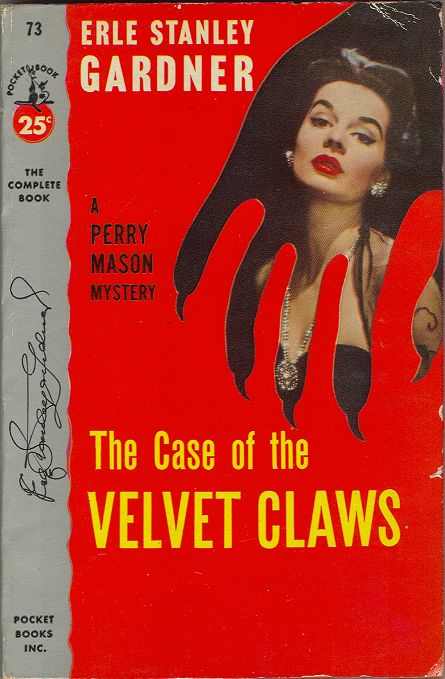
The Case of the Velvet Claws by Erle Stanley Gardner, 1933

I review this novel as part of my own “First Novels” challenge and for Friday’s Forgotten Books over at Patti Abbott’s blog, Pattinase.

The Case of the Velvet Claws (1933), the first Perry Mason mystery by Erle Stanley Gardner, is unlike any Perry Mason I have read. 

Mason doesn’t go to court, so there is neither a court trial nor a court battle. There is no district attorney Hamilton Burger or Lieutenant Arthur Tragg. A young and emotional Della Street and a sleepless and hardworking Paul Drake assist him on the case. There is a beautiful and seductive client who hires him to rescue her out of possible blackmail, involving her and an ambitious politician. She pays him a handsome retainer, flirts with him, lies to him, pleads with him, and turns around and accuses him when her husband, the owner of a society rag, turns up dead. Finally, there is Mason himself who, in spite of being in serious trouble, refuses to ditch his client and dump the case.

The Case of the Velvet Claws requires no introduction or review. Most readers of mystery and legal thrillers and especially fans of Perry Mason have read it. The tale of blackmail and murder has enough grit and grime and reads like the plot of a hardboiled novel. What really elevates the story is the hardnosed character of Perry Mason who pulls out every trick from his legal hat to extricate himself from the mess and sticks his neck out to prove his crafty client’s innocence. In this, he is both gangster-like and gentlemanly.

During an emotional lip-locking scene between Perry Mason and Della Street, Gardner uses a term which, I thought, best describes his character in the novel—“gruff tenderness.”

Fans of Perry Mason will enjoy The Case of the Velvet Claws for the excellent storyline and characterisation and because, like I said, it’s unlike any Mason novel you are likely to read subsequently.

Recommended.