August 08, 2014

The White Fruit of Banaldar by John D. MacDonald, 1951

An interesting story with a twist in the tail for Friday’s Forgotten Books at Patti Abbott’s blog Pattinase.

The auctioning of the five planets marked the end of one part of life, the beginning of a new, for Timothy Trench.

September 1951
The White Fruit of Banaldar is a science fiction tale by John D. MacDonald and was published in the September 1951 issue of Startling Stories. It is about man’s curious nature and his innate desire to posses the very thing that is out of his reach.

Timothy Trench is a tall, young man with an entrepreneurial streak. He wants to buy the planet of Banaldar that his former employer, Transgalactic Development, is putting up for auction along with four other planets. He has a vision for Banaldar where he once worked. It is a beautiful earth-size planet with green hills, rolling seas, and a climate fit for man. After much pleading and begging he manages to raise two thousand mil-pesos from reluctant investors. The auction takes place in Mexico City, capital of the world. However, his hopes and dreams are soon dashed when he is outbid by Morgan, leader of the Free Lives, a group of seven hundred men, women, and children who live the way they were meant to live—naked.


“What are you going to do on Banaldar?” Timothy asked hopelessly.

Morgan turned. “Do? We live naked and eat berries and hunt with stones and clubs. What do you think men are meant to do? Live like this?” He included in an expressive gesture all of the glitter and bustle of the capital. “No. We live in caves and we fill our bellies and breed our children and sleep well at night.”

Timothy still has a chance of acquiring his beloved planet. As the second highest bidder he is entitled to the planet if Morgan does not develop or populate it at the end of three years.

The young man has little patience. He takes off for Banaldar almost immediately. When he lands on the planet, he finds it deserted and uninhabited. He searches far and wide but the Free Lives are nowhere to be seen. And then he sees them—hanging in clusters in five-hundred foot giant trees he thought were long dead. The Free Lives have undergone physiological changes. They are like pale fruit. They are white, soft, and bloated. They have green stalks entering the backs of their necks. Their eyes are almost closed and they look deeply contented. They sway helplessly in the breeze.


As Timothy stares in fascination at the new form of the Free Lives, one of the monster trees casts its hypnotic spell on him and begins to nuzzle him at the back of his neck and nibble at it with a million little needle-like teeth.

The White Fruit of Banaldar is traditional science fiction until you come to the end when John D. MacDonald takes you by surprise with an element of horror. I didn’t see it coming but I was a trifle disappointed with the end. As I see it, though, horror is not misplaced in science fiction, especially when you don’t know what’s out there. All in all, a nice little story told in JDM’s inimitable style.

August 05, 2014

The Laurel-Hardy Murder Case, 1930

After you read this don’t forget to hop over to Todd Mason’s blog Sweet Freedom for more reviews of Overlooked Films, Audio & Video.

Mr. Laurel and Mr. Hardy decided that they needed a rest. They had been looking for work since 1921.

If the tagline of this classic Laurel and Hardy movie brings a smile to your face, this short film directed by old L&H hand James Parrott will have you in splits from scene one.

Stan Laurel and Oliver Hardy are sitting on the docks with their legs over the side. They are at peace with themselves and with the world. Laurel is trying to catch fish while Hardy is trying to catch forty winks. That is, if Laurel allows him to. Laurel is swinging his fishing tackle—a ball of string tied round a piece of wood—over his head, with the harmless intent of dropping it into the sea and baiting the fish; instead, he hooks it into his friend’s hat and tosses it into the water. And that is just the beginning of their troubles and our laughter.

Matters between the two friends would probably have taken a turn for the worse, if such a thing is indeed possible, if a fish-wrapped newspaper didn’t catch poor Hardy smack in the face. As he pulls the damp and smelly paper away, a news item catches his attention—Ebeneezer Laurel has just died and has left behind a vast estate. Relatives of the wealthy man are advised to gather at the Laurel mansion where the will is to be read.

Hardy, who thinks for both of them, usually with disastrous results, is convinced that Laurel is the long lost heir and that they, mind you, not Laurel alone, are going to become millionaires. He promptly throws his friend’s ingenious tackle into the water.


It’s another story that the only Ebeneezer Laurel our Laurel thinks he knew broke his neck a long time ago.

When Laurel and Hardy reach the mansion on a dark and stormy night, they are greeted by a devilish-looking butler, police detectives, and half-a-dozen claimants to the property. The chief inspector informs the pair that he had planted the notice about the will in the paper so that he could bring all of Ebeneezer’s relatives together in one place. Apparently, the rich man was murdered and the police are investigating the crime.

What follows next is the finest bit of slapstick comedy I have seen. Laurel and Hardy, already scared to death, are shown to their room, which just happens to be the one where Ebeneezer was murdered. The room is in darkness and all the furniture is covered in shrouds of white, giving the place an eerie appearance in candlelight. Our friends are convinced the mansion is haunted. In effect, they become their own worst spooks.

As Laurel and Hardy prepare for bed (they wear their night clothes under their suits), they see ghosts everywhere, in the howling of the wind, in the cat that darts across their bellies, in the bat that hides under their white blanket and takes to the air with it, in the wooden clothes rack that Laurel inadvertently drags through the hall. Each ghostly episode is followed by a fresh round of terrified screams both from Laurel and Hardy and from the assorted guests who run helter-skelter and fall over each other, to the irritation of the police inspector and his gun-toting men.

The film seemingly culminates with the real murderer, a man disguised as a woman, and his accomplice, the butler, luring all the guests one by one into Ebeneezer’s office where a trapdoor swallows them. But then, a film about Laurel and Hardy must end with Laurel and Hardy and it does so in a nice little anticlimax. You won’t see it coming.

If you like slapstick comedy as I do, then this film is for you, for there is no one better at it than Laurel and Hardy. They mean well even if they are not “there” most of the time. Their humourous appeal lies in their utter innocence and in the acceptance of their lot, as they chase one dream after another with little more than a smile to gain.

Highly recommended.

Incidentally, in 1934, MGM released Oliver the Eighth whose plot was loosely based on this film.

August 04, 2014

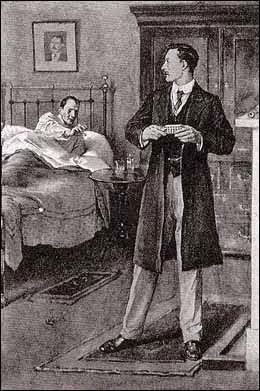
The Adventure of the Dying Detective by Arthur Conan Doyle, 1913

“He's dying, Dr. Watson,” said she. “For three days he has been sinking, and I doubt if he will last the day.”

November 1913
In The Adventure of the Dying Detective, the famous sleuth of 221B, Baker Street, London, is very ill and dying from a rare eastern disease. At least, that is what his landlady Mrs. Hudson and his friend Dr. Watson fear. As would his readers who may be forgiven for their initial startled reaction to Holmes' dire state.

Watson is especially horrified when he finds his friend confined to bed and ailing from a disease he didn’t know Holmes had. The detective is delirious and incoherent and his face is pale and gaunt with bones sticking out of it. His sickly appearance sends a chill into Watson’s heart.

Lest we forget, Holmes is a master of disguise and he uses it most effectively to divert Watson’s attention from his real purpose—to expose Culverton Smith as the man who murdered his own nephew, Victor, by injecting him with the same virus that has apparently made Holmes sick.


Smith is an expert in tropical diseases, including the one afflicting the detective, and he has already tried to kill Holmes in a similar manner. Only the sleuth knows about it.

Holmes in his bed.
Holmes is secretive and ingenious as he instructs Watson to summon Culverton Smith to his house at any cost, ostensibly to cure him but in reality to unmask him in a final showdown.

I liked Watson’s role in this story. He shows his worth as a true and loyal friend when he doesn't ask too many questions and does exactly as Holmes bids him to do. Admirably, Watson is not upset when Holmes summons another doctor to cure him or when Holmes speaks to him in a brusque manner and orders him around. 

In the end Watson realises why, as his dear friend solves Victor’s murder and his own attempted murder from his so-called deathbed. 

The thing with Arthur Conan Doyle's fiction is that, having tasted one, you want several more helpings of his well-crafted stories.

The Adventure of the Dying Detective was first published in Collier’s Weekly Magazine in November 1913 and subsequently in The Strand Magazine in December 1913. Later, it formed one of eight stories in His Last Bow collection. The short story is available free online.

August 01, 2014

Famous Monsters’ Film Fantasy Yearbook, 1982

Todd Mason, who hosts Friday’s Forgotten Books in place of Patti Abbott, will have more knowledge about this magazine and its background.

March 1982
If you like watching horror, fantasy, and science fiction movies, then you’ll like this annual yearbook on some of the famous monsters brought to life by Hollywood.

The 1982 edition of Famous Monsters’ Film Fantasy Yearbook looks at the “creatures” in eleven films, namely Raiders, Titans, Superman II, Halloween II, Dragonslayer, The Howling, Friday the 13th II, Wolfen, Excalibur, Outland, and Werewolf. The cover image is awful while inside the text is clear though the pictures are hazy.


Famous Monsters was one of several horror-fantasy-sf magazines launched by James Warren who founded Warren Publishing in 1957. Over the next twenty-six years, until 1983, he published magazines like After Hours, Creepy, Eerie, Famous Monsters of Filmland, Help!, Spacemen, and Vampirella. The last of these, reproduced below, has cover art by the legendary Frank Frazetta who was noted for his fantasy and sf artworks as well as covers of books and comic books, posters, paintings, and LP record albums. I just read about him.

No.1, September 1969.
Cover art by Frank Frazetta
Warren’s initial publications, Famous Monsters of Filmland and Monster World, were edited by Forrest J. Ackerman, an American collector of science fiction books and movie memorabilia.

I don’t know much about these magazines and chanced upon this hundred-page free yearbook at Archive. You can read more about Warren Publishing at Wikipedia.

July 30, 2014

Key in the ignition

I hope to resume my blog posts Friday, August 1, most likely with a review for Forgotten Books at Patti Abbott's blog Pattinase, which Todd Mason of Sweet Freedom will host again this week. I'm also looking forward to posting a review of a legal thriller I just finished reading. It was a cracker of a novel. I'm glad it was just a fictional story. In the meantime, my visits to other blogs will continue.

July 23, 2014

Musings on a rainy Wednesday

The rains were late by a whole month this year but their advent in July brought welcome relief to Mumbai (Bombay) which was scorching through ninety days of Indian summer. The seven lakes supplying water to the city are at last filling up and the municipal corporation has decided to scale down the water cut in residential areas. The rainfall deficit has come down from 41 per cent to about 15 per cent. Over the next few days all eyes will be on the lake levels which used to be published in newspapers every week, like the winning numbers on a lottery ticket. So much depends on water, and on public transport and migrant labour. 

On the flip side, heavy rains cause flooding and bring public transport, so very critical in this city, to a near halt. What is worse, in my case at least, is that roadside booksellers are forced to take evasive action which means browsing under a tarpaulin roof with water dripping down your neck. The books are well protected. During this wet season I seldom buy any from the footpath libraries.

As it is, I've got plenty to read. I'm currently reading an ebook version of The Dunwich Horror, 1928, the classic short fiction by H.P. Lovecraft. It is about a mysterious and terrifying entity that haunts a small place called Dunwich, a fictional town in Massachusetts. Some of the families in Dunwich lead a life of decay and decadence. I won't be reviewing the story because I don't think I can. It is a complex tale.

Three days ago, I was on my way to the local railway station by an autorickshaw when I saw four uniformed police constables standing at a junction notorious for traffic jams. Two of the cops were sipping cutting chai, or half a glass of tea each, a third was smoking a cigarette, while the fourth was talking on his mobile phone. They were on duty. I realised that dereliction of duty is another vile form of corruption.

I'm on the mailing list of a few book sites one of which sent me a free Kindle edition of a novella called 3 a.m. (2013) by Nick Pirog. This and his other novel, Unforeseen, have received good reviews on Amazon. He writes thrillers. The description of 3 a.m. says, "Henry Bins has Henry Bins. A sleeping disorder, named after him. He is awake for one hour a day. He wakes up at 3 a.m. then falls asleep at 4 a.m. Life is simple. Until he hears the woman scream. And sees the man leave the house across the street. But not just any man. The President of the United States."

I get carried away by books that come to me this way and I'm tempted to download them on my tab, where they lie for a long time or till I rediscover them among five hundred other ebooks. Still, I feel inclined to read 3 a.m. I think someone among my blog acquaintances has already reviewed it.

Among nonfiction books, I'm rereading The Power of Your Subconscious Mind (1963) by Joseph Murphy. I'm always reading self-help and philosophy books. They enable me to get a handle on things. 

The power of thought is a penetrating and fascinating subject because there is no end to its immense possibilities, for better or worse. To be in control of our mind instead of our mind being in control of us, as is the case, is as old as the hills. Easier said and read than done. But no harm in trying, is there?


Murphy's book reminded me of a particular quote by motivational speaker Earl Nightingale who said, “Whatever we plant in our subconscious mind and nourish with repetition and emotion will one day become a reality.”

If we sit back and think about it honestly, we’ll see that most of what we plant and nourish is negative, and usually stays with us for a long time, probably a lifetime. Joseph Murphy tells us how we can reverse those long years of negative conditioning.


Note: For previous 'Musings' see under Labels.

July 22, 2014

The Odd Life of Timothy Green & The Food Guide to Love

A refreshing pair of films for Tuesday’s Overlooked Films, Audio & Video at Todd Mason’s blog Sweet Freedom.

The purpose of this loosely written post is to bring these new and possibly overlooked films to your notice.

Both the films were telecast on Indian cable in the past two days. I watched the first half-hour of The Odd Life of Timothy Green (2012) directed by Peter Hedges and the last half-hour of The Food Guide to Love (2013) made by Dominic Harari and Teresa Pelegri. The latter is an Irish film and was showcased at the Dublin Film Festival.

My impression of the family drama and the romantic comedy is that both are clean, colourful, vibrant, and feel-good fairytale movies. The kind that the entire family can watch over the weekend, the kind that probably didn't come to a theatre near you, the kind that you'd have most likely skipped even if it did, and the kind that got mixed reviews. In short, an enjoyable fare where opinions don't really matter. I certainly liked the parts I saw.

I won't review the movies as I haven't seen them completely as I hoped to. Something came up. Instead, I’ll reproduce someone else’s…


The Odd Life of Timothy Green - Walt Disney Pictures: “Jim Green (Joel Edgerton) and Cindy Green (Jennifer Garner), desperately wanting a child but unable to conceive, dream up their “ideal offspring” in a fit of whimsy and bury their wishes in the backyard. To their great surprise, the next morning, a 10-year old boy materialises on their doorstep. Dealing with sudden parenthood thrust upon them, the Green's adventures in adapting to this ‘gift’ take on unforeseen aspects as they slowly begin to realise that Timothy (C.J. Adams) is anything but a ‘normal’ child.”

The film is from Jennifer Garner's perspective. Timothy is a cute kid and has leaves growing from his ankles that a friendly botanist can’t seem to snip off.

The Food Guide to Love – Berlinale (International Film Festival of Berlin): “The Food Guide to Love is a charming romantic comedy set in Dublin about a trendsetting Irish food writer and the feisty Spanish beauty who inspires him to put his heart before his stomach in matters of love. Food journalist Oliver Byrne (Richard Coyle) is in crisis. His multimedia column on fine eating and finding a soul mate has become the hottest read in town. But his own love life is a complete mess, featuring a string of relationships which seem appetising at first but then always lose their flavour. When he meets Spanish art curator Bibiana (Leonor Watling), Oliver feels an unlikely but undeniable attraction despite the fact they have nothing in common. She’s into good causes, he’s into good food. She’s a kamikaze in love, diving head first into impossible relationships, while he is terrified of commitment. Is this romance a recipe for disaster, or has he finally found the ingredients for true love?”

Shot on location in Dublin, the Irish capital with its assorted cafes and restaurants is picturesque. In the film Richard Coyle has a beautiful house.

They sound like nice films. The posters look like book jackets.