May 11, 2013

Comic books on Mars

I haven’t done a Vintage Comics post since September 27, 2012, when I wrote about The Mighty Marvel Superheroes’ Cookbook (1977) and shared some of the favourite (junk-food) recipes of the world’s mightiest heroes. They not only love their burgers and submarines, combos and chowders, and pastas and steaks, they cook them too. The Hulkburger is a particularly mean looking burger.

This morning I read a news item about NASA’s ongoing mission to Mars, which hopes to send the first man to the red planet by 2037, when I decided to explore my collection of e-comics for any adventures on Mars. I found 14 e-comic books about the planet including Flash Gordon published under the erstwhile Indian imprint, Indrajal Comics.

I found all the e-comics at Archive, which deserves praise for showing consideration towards comics buffs like me. In gratitude, I have provided links to all the comics most of which are complete. The list is in no particular order. Happy reading, downloading, and reading!


Buster Brown Goes to Mars 
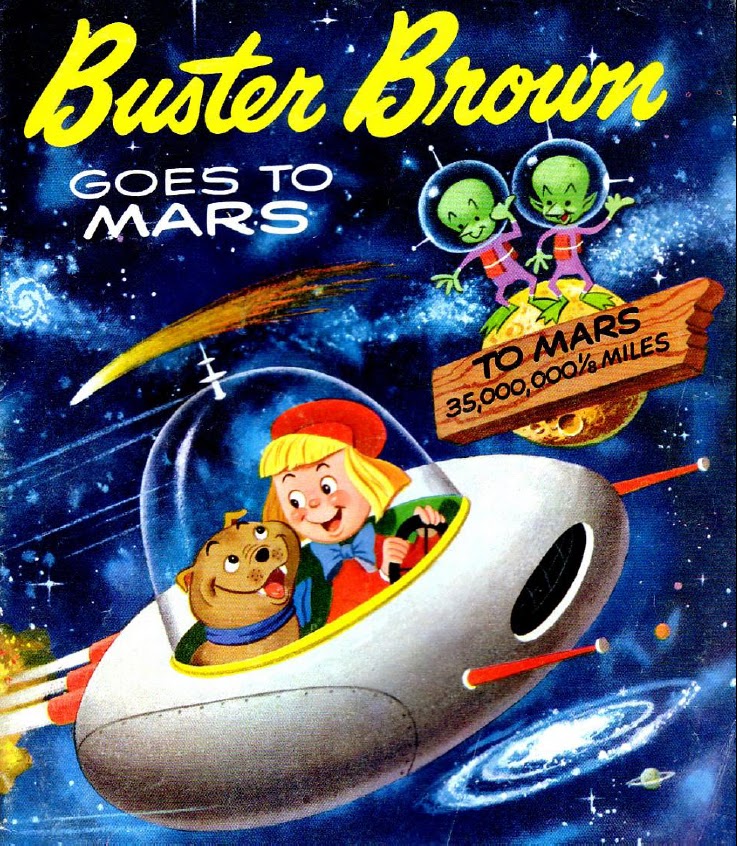

Publisher: Western Publishing 
Year: Early 1958 


Mystery in Space: Cowboy on Mars 


Publisher: DC Comics 
Year: February-March 1952 


John Carter of Mars #36


Publisher: The Funnies 
Year: October 1938 


Mystery in Space: The Martian Horse


Publisher: DC Comics 
Year: August-September 1952 


Wonder Woman: Mystery of the Rhyming Riddle 


Publisher: DC Comics 
Year: March-April 1949 


Lars of Mars


Publisher: Ziff-Davis Comic #10 
Year: April-May 1951 


The Face on Mars


Publisher: Harvey Comics 
Year: September 1958 


John Carter of Mars #375

 
Publisher: Dell 
Year: 1952 


The Planetary Adventures of Flint Baker

 
Publisher: Planet Comics #1 
Year: January 1940 


The Martian from Gotham City 


Publisher: DC Comics 
Year: June 1960 


First Earthman on Mars

 
Publisher: Fiction House Comics 
Year: July 1944 


Lost in Space


Publisher: EC Comics 
Year: March/April 1955 


Flash Gordon: Trapped on Mars 


Publisher: Indrajal Comics (India) 
Year: November 1973 


Gulliver Jones: Warrior of Mars


Publisher: Marvel Comics 
Year: 1971 

May 08, 2013

Stamp of a Writer: Margaret Mitchell

The following quotes of Margaret Mitchell have been taken from an interview she gave Mrs. Medora Perkerson of The Atlanta Journal Sunday Magazine and broadcast over radio station WSB, Atlanta, Georgia, on July 3, 1936. The interview was published for the first time in a digital format at PBS. You can watch the full documentary, Margaret Mitchell: American Rebel, here and read the full text of her interview here. The Civil War had a major influence on her life and shaped her only major work.

"My novel (Gone With the Wind) is the story of a girl named Scarlett O’Hara, who lived in Atlanta during the Civil War and the days of Reconstruction. The book isn’t strictly a book about the war, nor is it a historical novel. It’s about the effect of the Civil War on a set of characters who lived in Atlanta at that time."

"When I was a child I had to hear a lot about the Civil War on Sunday afternoons when I was dragged hither and yon to call on elderly relatives and friends of the family who had fought in the war or lived behind the lines. When I was a little girl, children were not encouraged to express their personalities by running and screaming on Sunday afternoons. When we went calling, I was usually scooped up onto a lap, told that I didn't look like a soul on either side of the family and then forgotten for the rest of the afternoon while the gathering spiritedly refought the Civil War."
 

© Library of Congress

"While I’m talking about knees and laps, that cavalry knees were the worst knees of all. Cavalry knees had the tendency to trot and bounce and jog in the midst of reminiscences and this kept me from going to sleep."

"If Gone With the Wind has a central theme, I suppose is the theme of survival. What quality is it that makes some people able to survive catastrophes and others, apparently just as brave and able and strong, go under? I have always been interested in this particular quality in people. We've all seen the same thing happen in the present depression. It happens in every social upheaval, in wars, in panics, in revolutions."


P.S.: Margaret Mitchell was only 49 when she died of injuries sustained after a speeding car knocked her down while crossing Peachtree Street, Atlanta, on August 11, 1949.


For 24 previous Celebrity Stamps, see under Labels.

May 07, 2013

FILMS 

Sleepless in Seattle and You've Got Mail 

Two not dissimilar romcoms for this week’s Overlooked Films, Audio and Video at Todd Mason’s blog Sweet Freedom where you’ll find many more reviews.

I often get a sense of déjà vu when I'm watching movies. Last week, I sat down with the family to watch Sleepless in Seattle (1993). Thirty minutes into the film, I said aloud, "This film looks familiar. It's a lot like You've Got Mail (1998). The lead actors are the same, Tom Hanks and Meg Ryan. And then I discovered the director is same too, Nora Ephron. Until the turn of the century, I did not pay much attention to the director. Now I'd feel like an idiot if I didn't know who made the films I saw.

Ephron, who died in June 2012, brings Hanks and Ryan together by post in Sleepless in Seattle and via internet in You've Got Mail—marking a smooth transition from the postbox to the inbox. They don't know each other in both the films. Of course, in You've Got Mail they do know each other as owners of two rival bookstores—Hanks' mega store trying to gobble up Ryan's tiny shop—but not as two anonymous email friends. In the end, Hanks finds out first but by then he has already shut her down. 

Neither film requires a refresher. Nonetheless, in Sleepless in Seattle, Hanks plays a widower who is still grieving over the death of his wife. He has an adolescent son who misses his mother as much. He convinces his father to narrate his sob story on a radio talk show in the hope that he will find another wife. He finds many, including Ryan, who falls for Hanks through the air waves and dumps her fiancé, Bill Pullman. His fall guy image reminded me of Patrick Dempsey who is left high and dry in Sweet Home Alabama (2002) when Reese Witherspoon returns to her husband, Josh Lucas.

Father and son and the mysterious woman finally meet in the viewing gallery atop the Empire State Building, like Cary Grant and Deborah Kerr in An Affair to Remember. Reference is repeatedly made to the 1957 classic.
 

Director Nora Ephron (1941–2012)

Sleepless in Seattle may have looked like a decent romcom 20 years ago though it looked quite silly last week. The story seemed improbable. By comparison, You've Got Mail was more convincing perhaps because it came out two years after Hotmail. However, the family's verdict was that both Tom Hanks and Meg Ryan were very good actors and had excellent on-screen chemistry, so that was that. 


Memorable lines


We also saw a part of Predator (1987) the same evening or the next, I don't remember. My favourite part in this film is the final battle between Dutch (Arnold Schwarzenegger) and the Predator (Kevin Peter Hall) and the scene where Dutch says, "What the hell are you?” and the self-destructive monster replies, "What the hell are you?"

Schwarzenegger has long been a favourite among Indian fans of Hollywood action movies, the common refrain being that his films are highly entertaining and there is no tension while watching them.

May 06, 2013

BOOKS 

Babu English

The copyright-free world of books has given me access to some rare and vintage books on India written during and after the British occupation of the subcontinent. Most of these books are authored by Englishmen who lived and worked in India or travelled extensively between India and England, both in their personal and professional capacity. Some of these books are also written by Americans.

The books I have read so far chronicle the rich social, cultural, economic, and political diversity of India. I believe they provide a fairly objective picture of life in India, as it existed then, and underline the strengths and weaknesses of the country and its people, without prejudice. 


Oliver Bainbridge
Drawing by Alexander Scott
One particular book written neither by an Englishman nor an American that caught my fancy was India To-day by Oliver Bainbridge, an author and lecturer from Australia. He travelled widely across Europe, Japan, China, India, and the Pacific islands, and wrote about his experiences and discoveries in each of the countries. 

Bainbridge died at the age of 46. By then, he had written many travel books. An obituary in The Sydney Morning Herald of April 11, 1922, noted: “He next spent several years in India as the guest of ruling princes, writing further books, entitled India To-day and The Truth About Britain in India. Amongst his other works are Our Ally, Japan, The Balkan Tangle, Rambles in Thoughtland, and The Lesson of the Anglo-American Peace Centenary. He was an ardent Imperialist, and it was his ambition, as one who thoroughly understood the problems and resources of the British Empire, to unite it closer in bonds of affection and general intercourse.”

I was fascinated by the fifth chapter in India To-day. Titled 'Babu English', it provides many hilarious examples of the semi-literate manner in which Indians wrote in English. Before I reproduce a few of these, a brief explanation on the origins of the word ‘Babu’.

The word ‘babu’ originally came from the Bengali word for a gentleman. Today, Bengali is one of the major Indian languages, spoken by the people of West Bengal, a state in eastern India. The British referred to the administrative staff, the clerks, as babus. Why they did so, I have no idea. It was also considered the equivalent of “mister” or “sir”.
 

Since the 20th century, ‘babu’ became synonymous with bureaucrats as well as with red tape, inefficiency, and corruption. That is pretty much the opinion of Indians today. Any government official who demands a bribe to get work done and moves lazily or shirks work is one afflicted by the ‘babu mentality,’ a derogatory reference. Today, Indian citizens would be only too happy to avoid going to a babu for any kind of work, for the work rarely gets done in quick time or without a little chai-pani, which actually means ‘tea and water’ but in this context it refers to a petty bribe.

According to an article on Wikipedia, “The distinguishing characteristics of Babu English (back then) are the florid, excessively polite, and indirect manner of expression, which have been reported for amusement value, in works such as Cecil Hunt's Honoured Sir collections, and lampooned, in works such as F. Anstey's Baboo Jabberjee, B.A., for over a century.”

You will find considerable amusement in the following examples of Babu English:


An application for quarters to be repaired

Sir,
We beg most respectfully to inform your honor, that the house allot to us by Railway Company for our residences have many leakings in its roof, for which we are suffering the much troubles, also our wives, and family.

Also we have utmost difficulty to prepare our foods and in rain time it cannot be done therefore all our bellys remain empty in night time which is not good for our health's sake.

Kindly order for full repairs of all our habitation at earliest date for which act of clemency we shall be ever prayed. 

We remain, Sir, etc.

Complaint made to a magistrate by the headman of a village

Sir,
Most respectfully, and with deepest humility, I beg to draw your attention that the village in which place is my home, is being repeatedly devastated by a man-eater tiger who scarcely troubles even in time of daylight to conceal himself in the surrounding hill.

For some period his ravage was on catties, and other animals only, but grown more bold by experience of our helplessness he has now chosen to indulge in the human form. Several men, women, and children of all ages have already fallen his victims and are partly eaten by his voracious appetite, and we now fear of our (lives) from shades of evening to morning dawn.

This dreadful monster accustoms himself to prowl about our very door step until some unfortunate being strays a few yards outside, when by one kick of his forward leg, the poor victim is stretched insensible, or dead, after which time he is drag a short distance and eaten so much he wants.

Sir, the native police have no power in the matter, and we have no proper ball gun here, neither we feel confidence in our aims, we therefore hope you to order some European gentlemen to shoot it at your earliest convenience.

I shall ever pray your long lifes and prosperity.


An appeal for a transfer

Sir,
Be not angry on one for thus troubling you for necessity has no law, and I am about to be dead if too long remaining here.

After completing my daily labor I am so much weary that I care not to consume any of the foodings prepared, and remain prostrate in my bed whole night, and ever by morning time the balm of sleep not always restores my vigorousness.

Mankind cannot for ever withstand such trouble without failing of his healths therefore your goodness may kindly transfer me at some easy place of work where I may be rested until recovery.

Never I before complain to your honor of the duty inflicted but in this time there is no excuse for my silence as, the failing health is explained in former part.

I remain,

On the state of education in pre-independence era, Bainbridge writes, "After years of triumphant talk about educational progress, the Government of India is beginning to find out that " progress " of a particular sort is not, after all, a matter of rejoicing. I have been forced to the conclusion that those who are responsible for the educational condition of India are on a perilously wrong track, and that, unless they find the right road speedily, they will plunge the country into a complexity of woes." 

The ambit and standard of education in India nearly a hundred years later is well below the 100 per cent mark.

India To-day, illustrated with drawings, sketches and photographs, is published by Henry J. Drane, London, 1913.

April 30, 2013

Indian TV: English channels with subtitles

A peep at the as-yet unseen The Secret Invasion, Thunderbolt and Lightfoot, and The Hunting Party for Overlooked Films at Todd Mason’s blog Sweet Freedom.

Most English entertainment and movie channels beamed in India carry English subtitles at the bottom of the screen. This is a fairly recent practice. It has its advantages and disadvantages depending on how you look at it.

On the plus side, subtitles help viewers who find it difficult to follow American and British accents to understand English sitcoms and films better.


On the minus side, subtitles are like annoying pop-up ads; even if you are able to follow the accents clearly, you end up looking at the bottom of the screen and reading the lines.

Either way, you’re caught somewhere between looking at the screen, listening to the dialogues, reading the subtitles, and watching one-fourth of a film.

I have found a new use for the subtitles, one, I suspect, everyone else has too. Whenever the children have their exams I switch off the volume and let the subtitles take me through the sitcoms and movies I am watching. Problem is I have got into the habit of watching soundless television even otherwise.


One channel that does not carry subtitles is MGM, a decent substitute for TCM India which went off the air last year. As a result, I often miss watching some very good movies.

For instance, on Friday, April 26, MGM telecast The Secret Invasion (1964). Directed by Roger Corman, the film tells the story of British intelligence using criminals to work behind enemy lines in Yugoslavia during WWII. It stars Stewart Granger, Raf Vallone, Mickey Rooney, and Edd Byrnes. I’d never heard of this war film or of Vallone and Byrnes before.

The next day the channel showed Thunderbolt and Lightfoot (1974) directed by Michael Cimino. Clint Eastwood, George Kennedy, Jeff Bridges, and Catherine Bach star in this film about bank robbers who plan a daring heist of the fortress-like Montana Armored Depository.
 

Then, this evening, MGM is telecasting The Hunting Party (1971) which sounds even more interesting than the above two. Made by Don Medford, this western film stars one of my favourite actors, Gene Hackman, Oliver Reed, and Candice Bergen and relates the story of a ruthless rancher who pursues an outlaw who has kidnapped his wife, with a twist in the tale.

The good thing about Indian television channels is that they repeat everything, even news. Likewise, the same films are shown repeatedly over a long period of time which means I can always watch all three movies in my retirement.

April 28, 2013

When books go abegging

The Little Sisters of the Poor Home for the Aged next to my house in northwest Mumbai (Bombay) organises annual sales of a range of new and old household items like clothes, furniture, books, and foodstuffs, as well as lucky draws for the unlucky, the proceeds from which go towards the care of the elderly inmates of the Home.

This morning we attended one such bargain sale and I made my way to a small unused pantry where the section on books was located. The novels, mostly paperbacks and selling at less than half a dollar, were strewn carelessly above and below the dusty kitchen platform, in the dry sink, and in a couple of cartons.


Most visitors to the sale looked inside the pantry, probably murmured “oh books,” and went away. So we had the place all to ourselves except for the elderly lady who managed it. She sat there reading some biblical pamphlet. The only time she said anything was when two young men walked in, picked up a couple of books at random, put them back, and walked out. She said, “Your eyes and hands should know the books you’re looking for.” I think what she meant was the moment your eyes spot a book your hands will automatically pick them up, because, as a book lover, you’re familiar with the book and its author. It left me scratching my head, nonetheless.

On display in the pantry were assorted novels by various authors such as Dick Francis, Len Deighton, Patricia Cornwell, John Grisham, Irving Wallace, Sidney Sheldon, Michael Crichton, Charles Dickens, Alistair MacLean, Jack Higgins (Harry Patterson), Jeffrey Archer, Henry Miller, Barbara Taylor Bradford, J.T. Edson, Max Brand (Frederick Schiller Faust), Oliver Strange, Joseph Conrad, George G. Gilman, Loren D. Estleman, James Herriot, A.J. Cronin, Daniel Steele, David Baldacci, Ken Follett, Frederick Forsyth and a dozen others whose names I can’t recall, post-lunch.


Whoever donated all these books knows books well; hopefully, well enough to have read them first and then donated them for a worthy cause. 

We bought nine books of which four were mine of which two were by my favourite writers, namely Sudden Strikes Back, a rare western by Frederick H. Christian (English author Frederick Nolan) based upon characters originally created by his countryman Oliver Strange, and the monstrous 544-page Hatter’s Castle by Scottish writer A.J. Cronin of whom reference has been made elsewhere on this blog.

The other two novels I picked up were both westerns: Bloody Season by seasoned American writer Loren D. Estleman, and Breakheart Pass by popular Scottish author Alistair MacLean.

Breakheart Pass rang a bell for some time until my wife mentioned that we had seen the movie. I reached for IMDb. The film, made by Tom Gries in 1975, is about “A train with medical supplies and a small US Army unit heading through the Rocky Mountains towards the plagued Fort of Humboldt. Its passengers include a territory governor, a priest, a doctor, and a US Marshal with his prisoner, John Deakin. However, nothing on that train is what it seems.” The film starred Charles Bronson, Ben Johnson, Richard Crenna, Jill Ireland, and Charles Durning.

Many of MacLean’s novels have been turned into successful films, notably The Guns of Navarone, Ice Station Zebra, Where Eagles Dare, and Force 10 From Navarone.
 

The back cover of my used 1987 Fonata/Collins edition says, “The Rocky Mountains, Winter 1873… One of the most desolate stretches of railroad in the West. Travelling along it is a crowded troop train, bound for the cholera-stricken garrison at Fort Humboldt. On board—the Governor of Nevada, the daughter of the fort’s commander and a US marshal escorting a notorious outlaw. Between them and safety are the hostile Paiute Indians—and a man who will stop at nothing—even murder…

Both the novel and the film look interesting and I might allow my yellowed and dog-eared copy of 
Breakheart Pass to jump the queue. In fact, I've been toying with the idea of my own Alistair MacLean Festival for quite some time now. All his novels have been reprinted. Like many popular authors of his era, MacLean was predictable but entertaining. 

The nine books, which included three Jeffrey Archer titles, cost us Rs.180 ($3.6)—a fine catch on a lazy Sunday afternoon.

April 27, 2013

BOOKS

A tale of the classics

I am not qualified to review classic literature. The kaleidoscope of people and places and the variegated events and elements, not to mention the Victorian style of writing, in a classic makes the task of reviewing one rather daunting. It requires a keen study of, and insight into, this form of literature and a sound knowledge of an author's entire body of work. If I must review any one book by Dickens, then I must have read most of his other books, if not all, for only then can I have a clear and credible perspective of the author, his writing, and the novel I intend to review. This much I have learned from the experts and biographers whose authoritative introductions adorn most classics reprinted today. Whether I am up to the task is another matter. 

In his introduction to The House of Mirth (1905) by Edith Wharton, which I am reading at present, Prof. R.W.B. Lewis, the author of Edith Wharton: A Biography, ends on an incisive note: “The House of Mirth has undergone a curious sea-change in the years since. It is not so much that the novel has grown on us, though that has happened too. But even more, the novel has appeared to grow in itself, to enlarge and thicken, to enrich and complicate before our beholding eyes. Cultural circumstances have obviously contributed to the event, especially the dimensionally increased attention of late to the achievements of American women. But when all that is taken into account, something pleasingly is left over. In some inexplicable way, The House of Mirth has become a masterpiece.”

One can take delight in the biographer’s well-written analysis of Wharton’s foremost novel in context of what he says about her second most famous book, The Age of Innocence: “It is not—the point is worth stressing—the society mirrored in The House of Mirth. Edith Wharton’s own vanished New York was portrayed in The Age of Innocence, written in 1920 and looking back to the 1870s; and its disappearance is that handsome novel’s central and ambiguously nostalgic motif. For The House of Mirth, Mrs. Wharton concentrated instead on a social world larger, showier, morally much looser, and even richer than the Joneses’ set: “the new breed,” as the longer-established folk called them; “the ultra-fashionable dancing people,” in a phrase of the 1880s.”
 

A studious comparison of Wharton’s two great novels, such as the one Lewis provides us with, would not have been possible without a thorough research of her work and, more importantly, the period she lived and wrote in. Both the stories are set in the aristocracy of late 19th century New York, which Edith Wharton called “a society of irresponsible pleasure-seekers” in The House of Mirth.

Classics, like Renaissance art, are masterpieces, and they need to be treated as such.

While I have read many classics, many more remain to be read. Among the classics I read in recent times, I liked Jude the Obscure and loved The Mayor of Casterbridge, both by Thomas Hardy. His two main characters in these books, Jude Fawley, the young stonemason, and Michael Henchard, who sells his young wife and daughter in a drunken stupor, are essentially flawed—powerful yet pathetic, dignified yet depressing, intense yet imperfect—and destined to meet a tragic fate.

I have been advised not to read Hardy in succession.
 

Although Hardy wrote the two novels over a hundred years ago, his stories mirror the failings and shortcomings of modern-day life in all its avatars. 

Jude the Obscure, for instance, created a stir when it was published in 1895. In it Hardy exposes three of the most hallowed institutions in Victorian England—religion, education, and marriage—and their role in the undoing of man and his dreams. In particular, his extreme views on marriage and relationship—as evident in the impulsive wedding of Jude and Arabella and their consequent separation and divorce; Jude’s romance with his cousin Sue Bridehead who is married to the school teacher, Phillotson, whom she divorces to live-in with Jude; two children born out of wedlock in addition to Jude and Arabella’s unwanted 12-year old son, who kills the children before killing himself; a distraught Sue’s turn to religion for solace and her return to a husband she never loved, as a form of repentance; Jude’s return to his drinking ways and Arabella tricking him into remarrying her; and finally his utter state of despair and desolation—offended the moral sensibilities of Victorian England. 

In Hardy’s dystopian world, Jude Fawley and Michael Henchard have a right to dream but they have no right to live those dreams.