August 25, 2012

I can't leave a comment...

Blogger has tweaked something, somewhere. Google's blog-publishing service has been rejecting my comments on other blogs that require word verification. I have no problem commenting on blogs where I don't have to prove I'm not a robot. I tried to leave comments through a PC and two laptops just in case there was something amiss with the one I use. No luck. There are no such issues with Wordpress, though. I can't think of a solution at the moment. Do you have one? Many thanks...

August 23, 2012

BOOK REVIEW

Comic-books on economy

A not-too-insignificant contribution to this Friday’s Forgotten Books edition over at Patti Abbott’s blog Pattinase. Don’t forget to read the fine reviews of forgotten books by other bloggers over there.

Back in school, comic-books gave me more education than text-books, starting with Amar Chitra Katha (Immortal Picture Stories), India's largest and most popular comics imprint. In spite of their often mediocre artwork, these comics retold captivating stories from the great Indian epics like the Mahabharata and Ramayana, history, mythology, fables and folklore, and the Indian freedom movement, apart from easy-to-read profiles of noted social reformers, political leaders, freedom fighters, and spiritual gurus—all in comic-book format.

I don't know much about economy, so these days I'm brushing up my knowledge of this rather tiresome subject by reading the comic-book series brought out by the publications division of the Federal Reserve Bank of New York. You can read and learn the basics of economy in comic-book format and enjoy it too.

Here are introductions to six comics from the series, courtesy of the Federal Reserve Bank of New York, Public Affairs Department.


Learn the major functions of the Federal Reserve System, the tools of monetary policy and how they work, and the other ways in which the Fed helps the US economy and financial system to function.


A history of the US monetary system and events leading to the establishment of the Federal Reserve System.


This comic-book explains the meaning and purpose of monetary policy, how the Federal Reserve makes monetary policy, and how the tools of monetary policy work.


Find out the causes and effects of inflation.


Illustrates the importance of savings, how it benefits all of us, and the various types of savings instruments and institutions.


Three young entrepreneurs use sophisticated bank services over a 23-year period. It also explores the role of checking deposits and lending in money creation.

August 13, 2012

VINTAGE ADS

Unknown World


This is the ad that Fawcett Publications, Inc. of Greenwich, Connecticut, USA, published in its inaugural issue of Unknown World, released in June 1952, to advertise its new comic magazine. Will Lieberson was the executive editor and Al Jetter was the art editor.

According to his obituary in The New York Times, published January 17, 1995, William H. Lieberson, 79, was a successful director and playwright before he became editor-in-chief of Fawcett Comics, "where he oversaw the production of such monthly comic books as Captain Marvel."

Fawcett published comics across many genres including horror comics in the 1950s, a string of titles which, apart from Unknown World, also included This Magazine Is Haunted, Beware! Terror Tales, Worlds of Fear, and Strange Suspense Stories.

Lieberson and Jetter also collaborated on other horror comics from the Fawcett stable, notably This Magazine Is Haunted, which resembled EC's distinct brand of horror comics.

August 10, 2012

BOOK REVIEW

A Prayer for the Dying by Jack Higgins (1973)

A Prayer for the Dying by Jack Higgins is my contribution to this Friday’s Forgotten Books edition over at Patti Abbott’s blog Pattinase and Todd Mason's blog Sweet Freedom. Don’t forget to read the fine mix of reviews of forgotten books by other bloggers over there.

What took place then was like something out of a nightmare, frozen in time, no reality to it at all. As the man in the dark overcoat glanced up, the priest produced an automatic with a long black silencer on the end. There was a dull thud as he fired. Fragments of bone and brain sprayed out from the rear of the victim’s skull as he was slammed back against the gravel.

Father da Costa gave a hoarse cry, already seconds too late, “For God’s sake no!”


Father Michael da Costa witnesses Martin Fallon kill gangster Janos Krasko, kneeling before his mother’s grave, in cold blood. The ex-IRA bomber, disguised as a priest, looks up and aims the deadly Czech Ceska at Father da Costa but doesn’t fire. Instead, he lowers the gun, turns around and quietly walks out of the cemetery.

Fallon doesn’t kill the innocent even though he once murdered for a cause and is now on the run from his former associates in the Irish Republican Army, British Military Intelligence, and Special Branch.

With nowhere to run, Fallon reluctantly accepts the contract from Jack Meehan, whose respectable funeral business is a front for drug-pushing, prostitution, gambling and protection, to bump off his hated rival, Krasko. The contract killing is Fallon’s route to freedom, with some hard cash and a passport to Australia.

But, before he goes away, Fallon does something unusual for a hired assassin: he makes a confession in Father da Costa’s rundown church, because “the secrets of the confessional are inviolate.”

Father da Costa, who was imprisoned and tortured by the Chinese during the war, is a man of honour and swears by Fallon's confession even as an exasperated Detective-Superintendent Nick Miller, head of the CID, threatens legal action that will force the priest to speak out as a witness.

Miller has been on Jack Meehan’s tail for years but hasn’t been able to nail the gangster for lack of evidence. He is convinced of Meehan’s role in Krasko’s public murder and sees an opportunity to bring the undertaker to justice.

The very evil Meehan orders Fallon to kill the priest but the gunman refuses, saying he has taken care of the matter. The crook, who hammers nails into the palms of his own men as punishment every time they fail him, decides to get rid of both Fallon and Father da Costa.

With Fallon still around, that’s easier said than done.

Irishman Martin Fallon is one of several popular fictional characters created by Harry Patterson who 
widely wrote as Jack Higgins. Two others, Paul Chavasse, who works undercover for The Bureau, a secret arm of British Intelligence, and Sean Dillon, ex-IRA turned hired mercenary, figure in many of his novels. There is, of course, the charming Liam Devlin, the Irish patriot with a poetic touch, and the hero of his best-known work The Eagle Has Landed. In fact, nearly all of Higgins’ quiet, brooding and intelligent heroes are assassins with a big heart. They stick around to protect those who become unintentional victims in their sinister games, are often gifted, poetically and musically, and are hopeless romantics. 

A priest and his church and vulnerable women are a given in many of Higgins' novels. For instance, in A Prayer for the Dying, Father da Costa has a niece called Anna, a blind girl who is rather lovely. Though Higgins doesn't say so outright, she is “one of those plain faces that for some strange reason you found yourself looking at twice,” as Fallon muses. There's also another young woman called Jenny Fox who is forced into prostitution by Meehan to keep his clients happy. She must now "take care" of Fallon but the IRA gunman gently turns down her overtures as he is too old for her and because he is a "walking corpse," a common refrain among all the heroes who often address the women with a "girl dear" and a gentle caress of the cheeks. The girls, inevitably, fall for the men though that's not how it usually ends.

Higgins is also big on religion with battle-scarred priests, who, having taken lives during the war, take to healing souls in the church. It's probably an Irish thing but the Catholic priests often dish out advice to other Catholics, good men and bad men like Fallon and Meehan, in a vain bid to reform them to the ways of God. 

So, when you read a Jack Higgins novel, be prepared to be affected by the Stockholm syndrome. There is no hostage situation but you’d rather be standing beside his hero than in front of him, looking down the barrel of his Browning or Walther PPK. I strongly recommend all his novels.

Many of Jack Higgins’ novels have been made into films including A Prayer for the Dying starring Mickey Rourke as Martin Fallon, in the 1987 film directed by Mike Hodges. It also stars Bob Hoskins as Father da Costa, Sammi Davis as Anna, and Alan Bates as Jack Meehan.

My earlier reviews of novels by 

Jack Higgins:
A Fine Night for Dying &
The Keys of Hell

both Paul Chavasse  stories.

August 09, 2012

VINTAGE PICTURES

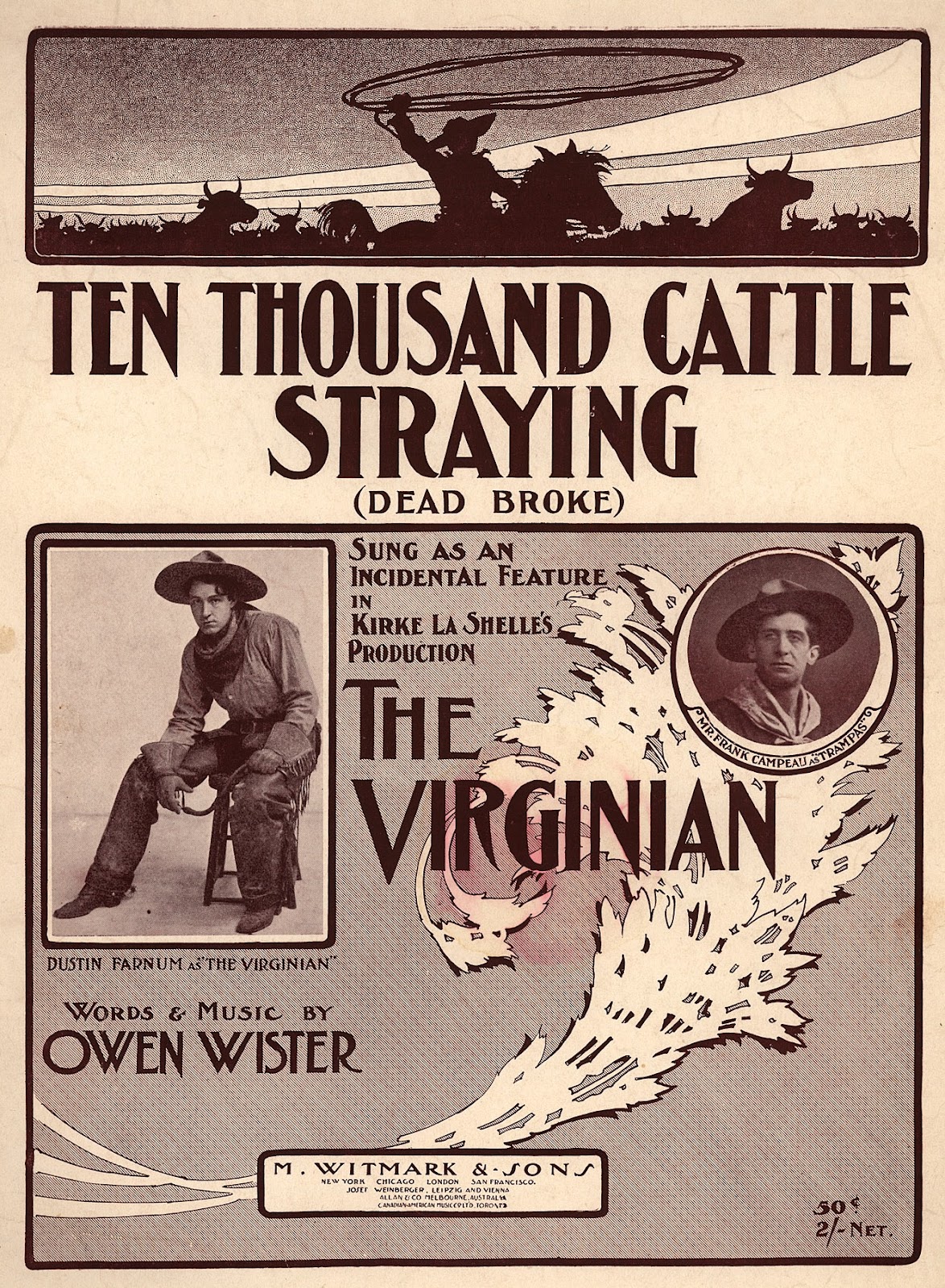
Ten Thousand Cattle Straying (Dead Broke)

Ten thousand cattle straying,
They quit my range and travell'd away,
And it's “sons-of-guns” is what I say,
I am dead broke, dead broke this day.
Dead broke. 


There is some confusion over the exact year in which Owen Wister, the American writer and pioneer of western fiction, wrote and composed the music of Ten Thousand Cattle Straying (Dead Broke) for the stage version of The Virginian, his epoch-making western novel that gave shape to the quintessential cowboy.

Some say 1888, others say 1904.

If Wister did, indeed, pen the song in 1888, he would have been only 28 years at the time and would have, remarkably, composed it 14 years before he wrote his famous novel, in 1902. 

© American Heritage Center
Further reading on the subject revealed that Wister (left) actually wrote the song in 1904, for theatre man Kirke La Shelle’s stage production of The Virginian. It was to be one of the last three successful plays of La Shelle, the other two being The Education of Mr. Pipp and The Heir to the Hoorah. La Shelle died in 1905 at the age of 43.

Ten Thousand Cattle Straying (Dead Broke) was the inspiration for American folk singer and writer Katie Lee’s best-known book Ten Thousand Goddam Cattle, A History of the American Cowboy in Song, Story and Verse, a study of the music, stories, and poetry of the American cowboy. The book, published in 1976, has illustrations by cowboy artist William Moyers and was also recorded as an album. 

US actor Dustin Farnum (pictured left in the poster) was cast as the first Virginian in Cecil B. DeMille’s 1914 film adaptation of Wister’s novel. The role was reprised by several actors, most notably Gary Cooper, in the first sound version of the film directed by Victor Fleming in 1929. There have also been a couple of television series based on The Virginian.

John D. Nesbitt, the author and teacher, has written a splendid article on Owen Wister titled "Inventor of the Good-guy Cowboy" and describes him as the creator of “the classic Western hero and the popular western novel.” You can read it here.

The Western and Cowboy Poetry Music & More at the Bar-D Ranch has carried an interesting article on Owen Wister’s Virginian on its website.

August 07, 2012

FILM REVIEW

Beauty and the Beast (1991)

Beauty and the Beast is my animated contribution to Tuesday’s Overlooked/Forgotten films and television over at Todd Mason’s blog Sweet Freedom. Don't forget to check out the other fascinating reviews over there. 


Gaston: How can you read this? There’s no pictures! 
Belle: Well, some people use their imagination. 

There are two kinds of films that have a special charm—animated and musical. Many animated movies are musicals too. Animated films transport you into a magical world you linger in long after you’re back in your own. They will rarely disappoint and are absolutely delightful to watch.

Last weekend, I saw Tangled (2010) and The Prince of Egypt (1998) on television and enjoyed both animated films immensely. Tangled, which is about a lost princess who finds love and her parental kingdom in the end, is the sort of film you ought to watch on the big screen: it’s one of the most colourful animated movies I’ve seen in recent years. The Prince of Egypt is the story of Moses who delivers his people from slavery and torture under the king of the pharaohs. 

While this post is not about Tangled or The Prince of Egypt, the two movies got me thinking about my favourite animated film—Beauty and the Beast—the musical fantasy from the Disney stable. Everything about this film is wonderful: from the animation and music score by Alan Menken, who composed music for The Little Mermaid, Aladdin and Pocahontas to the sad story of a cursed prince whose salvation lies in loving a woman and receiving her love in return. Only then will the spell of an evil enchantress break and turn the hideous beast back into the handsome prince he really is.

Since you already know what this award-winning animated film is about, I’ll touch upon just one aspect of the film that I really liked: Belle’s love of books.

The pretty-little peasant girl has little to do in her village except look after her father, an eccentric inventor, take care of their small cottage, and read books. She visits the local bookstore, rather impressive for a small village where people are anything but bookish, and is disappointed when she doesn’t find a new book to read. So she picks up a book she has read before and makes her way back home—singing along the way.

As Belle (Paige O'Hara) walks back, she meets Gaston (Richard White), the local hunter and the village narcissist, who thinks he owns the girl and has the right to marry her without, of course, asking her or her father, Maurice (Rex Everhart). The egomaniac has no brains and so he doesn’t understand books. On the other hand, the Beast (Robby Benson) delights in listening to Belle read out to him, in his dark and foreboding mansion where he holds her captive in exchange for her father’s freedom, because he’s learning to fall in love with her.

Beauty and the Beast is an enchanting film with a sad beginning and a happy ending, like all fairy tales are, and leaves you with a nice feeling. See it if you haven’t yet. Now then, sit back and take a trip with Belle and her books…


Source for images: Walt Disney Pictures

August 06, 2012

Stamp of a Director: Alfred Hitchcock

On Films and Filmmaking
"The length of a film should be directly related to the endurance of the human bladder."

"To me Psycho (1960) was a big comedy. Had to be."

"A good film is when the price of the dinner, the theatre admission and the babysitter were worth it."

"Our original title, you know, was 'The Man in Lincoln`s Nose'. Couldn't use it, though. They also wouldn't let us shoot people on Mount Rushmore. Can`t deface a national monument. And it`s a pity, too, because I had a wonderful shot in mind of Cary Grant hiding in Lincon`s nose and having a sneezing fit." — On 'North by Northwest', 1959

"For me, the cinema is not a slice of life, but a piece of cake."

"To make a great film you need three things—the script, the script and the script."

"Always make the audience suffer as much as possible."

"Blondes make the best victims. They're like virgin snow that shows up the bloody footprints."

"Give them pleasure—the same pleasure they have when they wake up from a nightmare."

"I am a typed director. If I made Cinderella, the audience would immediately be looking for a body in the coach."

"Self-plagiarism is style."

"Cary Grant is the only actor I ever loved in my whole life."

"There is nothing quite so good as burial at sea. It is simple, tidy, and not very incriminating."


On Murder
"Some of our most exquisite murders have been domestic, performed with tenderness in simple, homely places like the kitchen table."

"Man does not live by murder alone. He needs affection, approval, encouragement and, occasionally, a hearty meal."

"In films murders are always very clean. I show how difficult it is and what a messy thing it is to kill a man."

"One must never set up a murder. They must happen unexpectedly, as in life."


On Fear
"The only way to get rid of my fears is to make films about them."

"I am scared easily, here is a list of my adrenaline-production: 1: small children, 2: policemen, 3: high places, 4: that my next movie will not be as good as the last one."

"There is no terror in the bang, only in the anticipation of it."

"I'm frightened of eggs, worse than frightened, they revolt me. That white round thing without any holes... have you ever seen anything more revolting than an egg yolk breaking and spilling its yellow liquid? Blood is jolly, red. But egg yolk is yellow, revolting. I've never tasted it."
— On his lifelong fear of eggs.

"Luck is everything... My good luck in life was to be a really frightened person. I'm fortunate to be a coward, to have a low threshold of fear, because a hero couldn't make a good suspense film."


On Television
"Television is like the American toaster, you push the button and the same thing pops up every time."

"Seeing a murder on television can help work off one's antagonisms. And if you haven't any antagonisms, the commercials will give you some."

"Television has brought back murder into the home—where it belongs."


On Books
"The paperback is very interesting but I find it will never replace the hardcover book—it makes a very poor doorstop."


Note: You'll find 18 other Celebrity Stamps under Labels. On October 31, 2011, I wrote a short piece on Hitchcockian humour that includes some of the quotes reproduced above. You can read it here.