Showing posts sorted by date for query poetry. Sort by relevance Show all posts

January 03, 2018

The books I added to my shelves in 2017

I bought fewer than a dozen books and ebooks in 2017, and intentionally so. It was in keeping with my resolution to read as many books as I could from my collection of 100-odd paperbacks before buying new ones. The plan did not quite work.

Even so, there were a few acquisitions during the year that I was especially glad to have made.

Past Tense by Margot Kinberg book cover
Author Margot Kinberg, who blogs about crime fiction at Confessions of a Mystery Writer, very kindly sent me a signed copy of Past Tense, the third novel in her mystery series featuring ex-cop Joel Williams. Now a professor in the Department of Criminal Justice at the fictional Tilton University, Williams is an affable and unassuming sleuth with a knack for sniffing out clues. Past Tense is an engaging campus mystery. You can click here to read the review.

Blaze! Red Rock Rampage by Ben Boulden book cover
Ben Boulden's debut novel Red Rock Rampage, #15 in the Blaze! Adult Western Series, introduces J.D. and Kate, a husband-and-wife team of gunfighters, in an action-packed tale told at a brisk pace. I reviewed the book and interviewed Ben here. I will also be reviewing his 25-page Western short story Merrick (since reviewed). You can learn more about Ben and his work at his blog Gravetapping.

Sudden Strikes Back by Frederick H. Christian book cover
During the year, I was lucky enough to track down three out-of-print Sudden paperbacks, my favourite Western series created by British author Oliver Strange. One of them was Sudden Strikes Back by Frederick H. Christian who wrote five Sudden novels after Strange's original ten. That brought my collection to Sudden novels, which I have been reading and rereading since the 1980s.
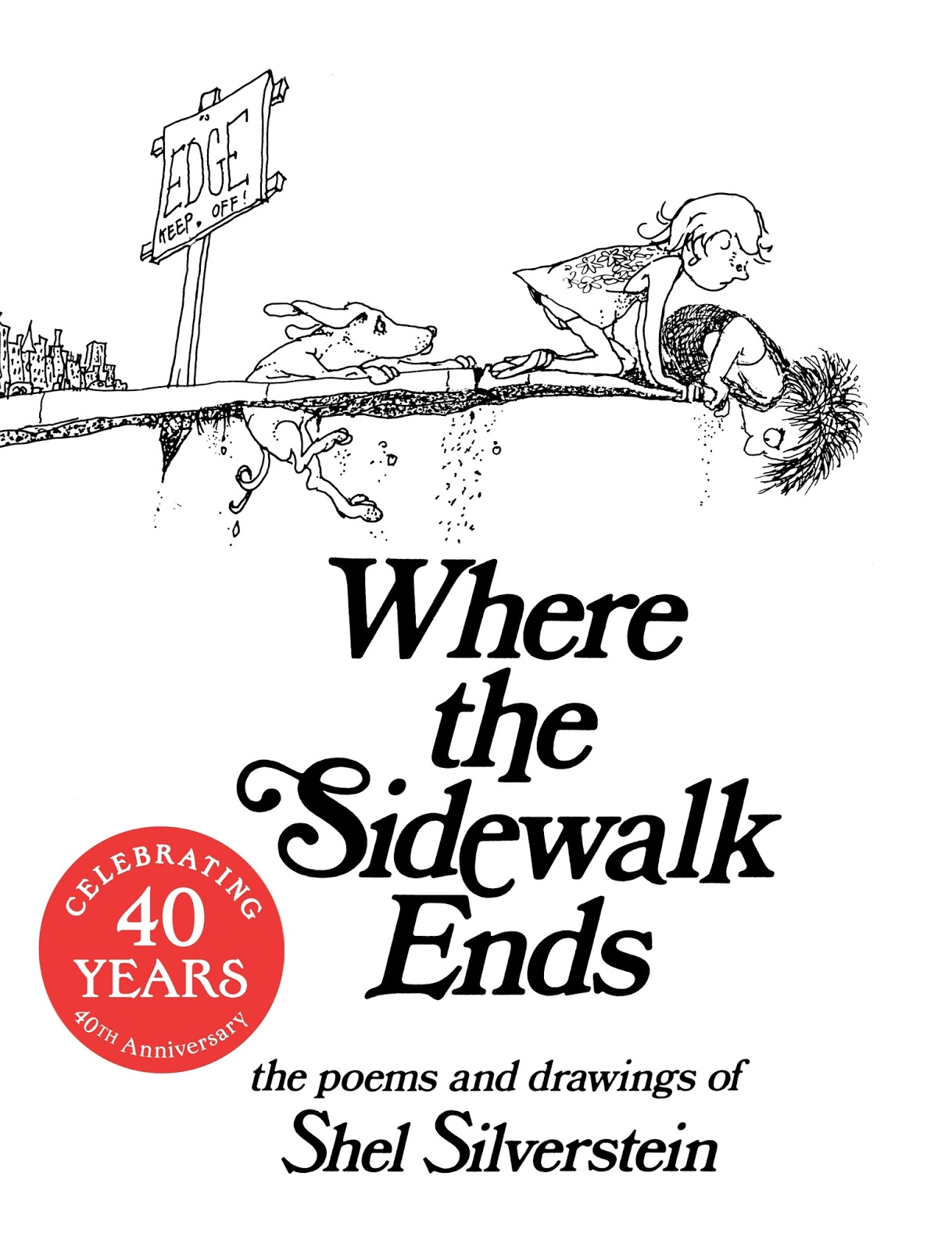
Where the Sidewalk Ends by Shel Silverstein book cover
Finally, a friend and colleague gifted me a lovely hardback edition of Where the Sidewalk Ends, Shel Silverstein's delightful collection of children's poems and illustrations. Silverstein once said he never studied the poetry of others and instead developed his own "quirky style, laid back and conversational." It shows. Where the Sidewalk Ends is one of those rare books that makes you want to put pen to paper and try writing a few verses yourself.

(As an Amazon Associate I earn from qualifying purchases.)

Sudden Makes War by Oliver Strange book cover
 Sudden Rides Again by Oliver Strange book cover 

February 14, 2017

History, My Story

Last year, I sent this nostalgic piece to an online poetry website. This morning, I received a polite and sympathetic rejection of my submission as well as an encouragement to submit again any time I liked. I’m grateful to the editor for considering my work—one of over a hundred thousand he receives every year. His is a tough call. I will continue to write—and write better, hopefully—and continue to send out my stuff. Hope springs from the roster of famous writers who were repeatedly rejected before they were first published. I’m still taking guard at the starting block of creative writing.

Here is the slightly modified version of my poem History, My Story.


Chronicle of past times
and all of human history.
Record of peoples and events
glorious and dark.

My beloved subject
in high school and after.
Till a teacher's misdemeanour
makes me hate it, almost.

Bell rings, class out
rushing down the aisle.
He grabs me by the collar
slams me against the wall.

What did I do?" A fearful cry
"How dare you distract!" he rages.
Pleading look, sniggering mates
they wink and smile. 

Calendars later, I still remember
the day, the date, the pain.
'twas a history lesson
I will never forget.


© Prashant C. Trikannad

December 31, 2016

A year gone, a year to come

Since I did not write or review much this year, I thought I would at least end the year with a post on one of my favourite literary genres—classical poetry. Fittingly, a poem about New Year's Eve or New Year.

There was plenty to choose from. I read Alfred Lord Tennyson's The Death of the Old Year, Thomas Hardy's New Year's Eve, Christina Rossetti's Old and New Year Ditties, Robert Burns' Auld Lang Syne, Helen Hunt Jackson's New Year's Morning, D.H. Lawrence's New Year's Night, Sylvia Plath's New Year on Dartmoor, and John Clare's The Old Year.

I liked them all.

A lot of people look at the old year with sadness, regret, and emotion. And a lot of writing, and especially poetry, reflect those feelings. We remember it mostly as just another year when we grew old and where we could have done so much more, personally and professionally. Fortunately, our minds are trained to conveniently hide unhappy memories, if not erase them completely. Every passing year brings in its anguished wake a new year filled with renewed hope, optimism, and purpose of life, where we dream of doing better than we did in the previous year, and where we truly believe—"This is going to be my year. And I am going to make things happen for me and my family."

Of all the beautiful poems I read, the one that resonated with me this evening, hours before New Year, was The Year by American author-poet Ella Wheeler Wilcox (1850-1919). I thought it was realistic and balanced. I liked the way it bids goodbye to the Old Year and ushers in the New Year, depending on how you read it. And it rhymes very well too.

What can be said in New Year rhymes,
That's not been said a thousand times?

The new years come, the old years go,
We know we dream, we dream we know.

We rise up laughing with the light,
We lie down weeping with the night.

We hug the world until it stings,
We curse it then and sigh for wings.

We live, we love, we woo, we wed,
We wreathe our prides, we sheet our dead.

We laugh, we weep, we hope, we fear,
And that's the burden of a year.


Ella Wheeler's most famous poem was Solitude which gave us the equally famous opening lines:

Laugh, and the world laughs with you
Weep, and you weep alone.
For the sad old earth must borrow its mirth
But has trouble enough of its own.


I sincerely hope you will have lots of reasons to laugh in 2017 and beyond. I wish you a joyous New Year filled with health and happiness.

September 09, 2016

A few eminent Indian writers in English

Whenever someone asks me to recommend good fiction or nonfiction in English, I invariably draw their attention to books written by Western authors. And that’s because my reading of Indian literary works is abysmal. I have read very few writers from my own country known for its rich and diverse literary heritage, including many spellbinding works translated from a dozen languages. There are novels by globally acclaimed writers I should have read long ago. That I haven’t all these years is my loss. Every year I resolve to read Indian writers in English and every year I break that resolution.

Maybe, this chronological list of books by some of the most celebrated desi authors will motivate me to finally give Indian fiction its due. So far I have only read Khushwant Singh, R.K. Narayan, Salman Rushdie, and Rohinton Mistry, though just not these titles. They are all good books and worth reading.


Train to Pakistan by Khushwant Singh, 1956

Khushwant Singh was one of India’s most widely readand also one of its most provocativenovelists, satirists, and journalists.

“In the summer of 1947, when the creation of the state of Pakistan was formally announced, ten million people—Muslims and Hindus and Sikhs—were in flight. By the time the monsoon broke, almost a million of them were dead, and all of northern India was in arms, in terror, or in hiding. The only remaining oases of peace were a scatter of little villages lost in the remote reaches of the frontier.

© India Opines
One of these villages was Mano Majra. It is a place, Khushwant Singh goes on to tell us at the beginning of this classic novel, where Sikhs and Muslims have lived together in peace for hundreds of years. Then one day, at the end of the summer, the “ghost train” arrives, a silent, incredible funeral train loaded with the bodies of thousands of refugees, bringing the village its first taste of the horrors of the civil war.”

Train to Pakistan is the story of this isolated village that is plunged into the abyss of religious hate. It is also the story of a Sikh boy and a Muslim girl whose love endured and transcends the ravages of war.”


The Guide by R.K. Narayan, 1958

One of India’s most celebrated authors, R.K. Narayan’s best-known stories are set in the fictional town of Malgudi in South India. The Guide won Narayan the National Prize of the Indian Literary Academy, the country's highest literary honour.

The Guide describes the transformation of the protagonist, Raju, from a tour guide to a spiritual guide and then one of the greatest holy men of India.

“Formerly India's most corrupt tourist guide, Raju—just released from prison—seeks refuge in an abandoned temple. Mistaken for a holy man, he plays the part and succeeds so well that God himself intervenes to put Raju's newfound sanctity to the test.”


Grimus by Salman Rushdie, 1975

Salman Rushdie, whose Midnight’s Children won the Booker Prize and whose The Satanic Verses put a bounty on his head, made his literary debut with Grimus—a fantasy and science fiction novel.

“After drinking an elixir that bestows immortality upon him, a young Indian named Flapping Eagle spends the next seven hundred years sailing the seas with the blessing—and ultimately the burden—of living forever. Eventually, weary of the sameness of life, he journeys to the mountainous Calf Island to regain his mortality. There he meets other immortals obsessed with their own stasis and sets out to scale the island’s peak, from which the mysterious and corrosive Grimus Effect emits.


© Emory College of Arts and Sciences
“Through a series of thrilling quests and encounters, Flapping Eagle comes face-to-face with the island’s creator and unwinds the mysteries of his own humanity. 

“Salman Rushdie’s celebrated debut novel remains as powerful and as haunting as when it was first published more than thirty years ago.”


The Golden Gate by Vikram Seth, 1986

The Golden Gate is the debut novel of novelist and poet Vikram Seth (below). Its uniqueness lies in its narrative form—it is composed in verse, 590 Onegin stanzas. The book was apparently inspired by Charles Johnston's translation of Alexander Pushkin's Eugene Onegin.

“Set in the 1980s in the affluence and sunshine of California's Silicon Valley, The Golden Gate is an exuberant and witty story of twenty-somethings looking for love, pleasure and the meaning of life. It was awarded the 1986 British Airways Commonwealth Poetry Prize.”

© Penguin Books India


The Shadow Lines by Amitav Ghosh, 1988

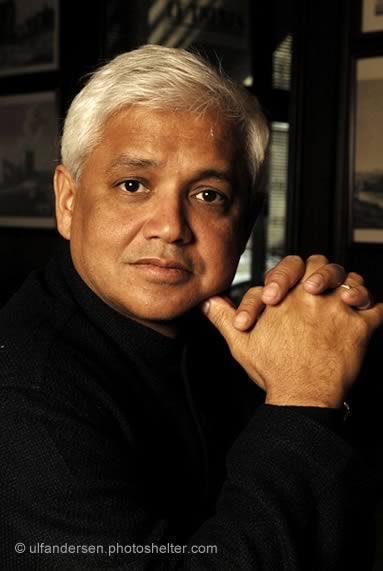
Amitav Ghosh (below), who is best-known for historical fiction, has written both fiction and nonfiction of international acclaim. Many of his novels are set around “the Bay of Bengal, the Arabian Sea, the Indian Ocean, and the connections and the cross-connections between these regions.”

“Opening in Calcutta in the 1960s, Amitav Ghosh's radiant second novel, The Shadow Lines, follows two families—one English, one Bengali—as their lives intertwine in tragic and comic ways. The narrator, Indian born and English educated, traces events back and forth in time, from the outbreak of World War II to the late twentieth century, through years of Bengali partition and violence, observing the ways in which political events invade private lives.

© Amitav Ghosh


English, August by Upamanyu Chatterjee, 1988

Upamanyu Chatterjee is an IAS officer whose debut novel English, August: An Indian Story was adapted to film. Its success inspired many low budget independent movies in Indian cinema. Punch described English, August as “a marvelously intelligent and entertaining novel, and especially for anyone curious about modern India.”

“Agastya Sen, known to friends by the English name August, is a child of the Indian elite. His friends go to Yale and Harvard. August himself has just landed a prize government job. The job takes him to Madna, “the hottest town in India,” deep in the sticks. There he finds himself surrounded by incompetents and cranks, time wasters, bureaucrats, and crazies. What to do? Get stoned, shirk work, collapse in the heat, stare at the ceiling. Dealing with the locals turns out to be a lot easier for August than living with himself.

English, August is a comic masterpiece from contemporary India. Like A Confederacy of Dunces and The Catcher in the Rye, it is both an inspired and hilarious satire and a timeless story of self-discovery.”

Such A Long Journey by Rohinton Mistry, 1991

Indian-born Canadian author Rohinton Mistry’s second novel, Such A Long Journey, was shortlisted for the Booker Prize and the Trillium Award. It has won several awards including the Governor General's Award, the Commonwealth Writers Prize for Best Book, the W.H. Smith/Books in Canada First Novel Award, and the Neustadt International Prize for Literature.

“It is Bombay in 1971, the year India went to war over what was to become Bangladesh. A hard-working bank clerk, Gustad Noble is a devoted family man who gradually sees his modest life unravelling. His young daughter falls ill; his promising son defies his father’s ambitions for him. He is the one reasonable voice amidst the ongoing dramas of his neighbours.

“One day, he receives a letter from an old friend, asking him to help in what at first seems like an heroic mission. But he soon finds himself unwittingly drawn into a dangerous network of deception. Compassionate, and rich in details of character and place, this unforgettable novel charts the journey of a moral heart in a turbulent world of change.

A River Sutra by Gita Mehta, 1993

Gita Mehta, who comes from a political family, is a well-known writer, journalist, and documentary filmmaker. She was a television war correspondent for NBC. Her first book, Karma Cola, 1979, is about thousands of Westerners who came to India in the 1960s and 1970s to rediscover “the magic and mystery missing from their lives.”

A River Sutra is an enchanting collection of vignettes tells the story of a retired bureaucrat who has escaped the world to spend his twilight years running a guest house on the banks of the country’s holiest river, the Narmada. But he has chosen the wrong place for peace and quiet: too many lives converge here and he meets a series of unusual characters including a privileged young executive bewitched by a mysterious lover; a novice Jain monk moving from opulence to poverty; and a woman with a golden voice and a broken heart. As the bureaucrat moves from story to story, he ponders the meaning of each tale and the dark secrets which the river hides within its waters.

© Penguin Books India