Showing posts sorted by relevance for query comics. Sort by date Show all posts

February 01, 2013

BOOK REVIEW

British Comics: Commando, Love Stories, 
and All Girls

Evan Lewis has the links to this Friday’s Forgotten Books at his blog Davy Crockett's Almanack of Mystery, Adventure and the Wild West where you’ll find many interesting entries. 

A childhood without comics is like a newspaper without the comics page.

Issue No.1, July 1961
Last Friday, I took a trip down memory lane and relived the many hours I spent reading the Hardy Boys with my childhood friends. Not surprisingly, I took a few blog friends with me on this nostalgic whirligig. We shared the joys of reading the adventures of amateur detectives Frank and Joe, and Nancy Drew.

A week later, I am still in memory lane, pottering around in the library of my youth, shaking the dust from some more books, and comics, I read as a kid. Of these I have fond memories of three kinds of comic-books I read back then—war, romance, and young adult.

These comics had four common features: their pocket size, impressive cover art, black-and-white illustrations, and speech bubbles. Otherwise, the themes and stories were as different as Daredevil and Donald Duck.

Commando: For Action and Adventure (originally known as Commando War Stories in Pictures), published by D.C. Thomson and Company of Dundee, Scotland, since 1961, remains my favourite war comic-book, though there have been several offshoots the size of your palm.

The Commando comics, numbering more than 4,000 including reprints in celebration of 50 years in 2011, are usually set during WWII and feature stories of bravery, friendship, patriotism, nobility, defection, and cowardice. Most of the time the enemies are the Nazis and the Japanese, who are depicted as very evil, but it is not uncommon to see an Allied soldier and a German soldier becoming friends and risking their lives to save each other. In a typical scene one enemy soldier will carry the other on his shoulder and run to safety. In one particular comic, two enemy soldiers discover, in the thick of battle, that their fathers knew each other, as friends or foes I don’t recollect.

My favourite Commando comics are the ones where the battle plays out in a different war theatre, such as North Africa, the desert sands of Arabia, or the battlegrounds of Indo-China. Likewise, I have a preference for non-combat troops like the French and Italian partisans who fought alongside the Allies.

There is no dearth of ideas for the storyboard and nearly every one of the 68-page comic-book seems real. The stories are fictional, of course, but they leave you wondering if the events really took place. The comics are known as much for their cover art in colour and black-and-white sketches inside as they are for the stories and their often exaggerated plotlines.

Their popularity is evident in the continuation of the series over more than 50 years, new reprints in a size falling between a pocketbook and a regular comic-book, and omnibus editions. These modern-day Commando comics sell for Rs.60 (a little over $1) in India. However, a few years ago, I was fortunate enough to buy a big lot for as little as Rs.5 (almost free in dollar terms), all original.

Unlike Commando, which I still read, I don’t have much recollection of the pocket-sized romance comics called Star: Love Stories in Pictures published by D.C. Thomson or Love Story Picture Library published by the Amalgamated Press, both British imprints. These romance comics also had covers in colour and illustrations in black and white. The stories and pictures were never erotic or vulgar and kissing was the maximum you could get out of a man and his gal. They were milder versions of M&B except they were in comic-book format.

D.C. Thomson, which used to publish the popular Beano and Dandy comics, also brought out a series of pocket-sized comics for young girls under the age of 16. These were known as Bunty, Judy, Mandy, and Debbie. In later years, some of these comics, Judy in particular, were merged with Emma and Mandy and it’s all very confusing. If I remember correctly, the comics were only titled as Bunty, Judy, Mandy, and Debbie and there were no real characters by those names. 

The comics told stories about the everyday lives of teenage girls, their trials, their triumphs, and their glories, with a moral in the end. The all-girls comics were around until the 1990s and I think they have long ceased publication.

Do you remember reading any of these comics? What are your memories of early comic-books?

May 11, 2013

Comic books on Mars

I haven’t done a Vintage Comics post since September 27, 2012, when I wrote about The Mighty Marvel Superheroes’ Cookbook (1977) and shared some of the favourite (junk-food) recipes of the world’s mightiest heroes. They not only love their burgers and submarines, combos and chowders, and pastas and steaks, they cook them too. The Hulkburger is a particularly mean looking burger.

This morning I read a news item about NASA’s ongoing mission to Mars, which hopes to send the first man to the red planet by 2037, when I decided to explore my collection of e-comics for any adventures on Mars. I found 14 e-comic books about the planet including Flash Gordon published under the erstwhile Indian imprint, Indrajal Comics.

I found all the e-comics at Archive, which deserves praise for showing consideration towards comics buffs like me. In gratitude, I have provided links to all the comics most of which are complete. The list is in no particular order. Happy reading, downloading, and reading!


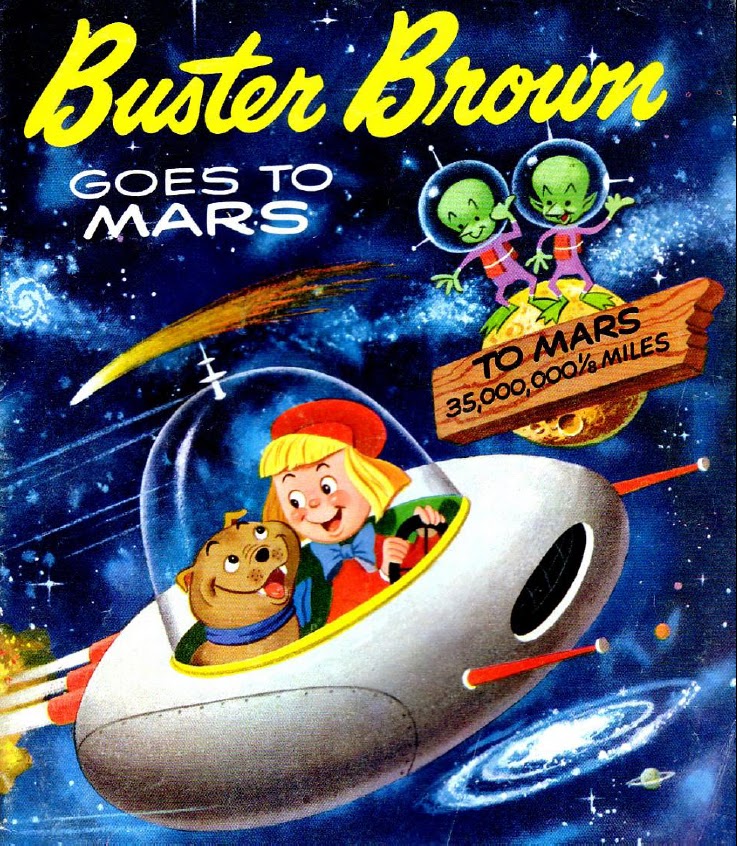
Buster Brown Goes to Mars 


Publisher: Western Publishing 
Year: Early 1958 


Mystery in Space: Cowboy on Mars 


Publisher: DC Comics 
Year: February-March 1952 


John Carter of Mars #36


Publisher: The Funnies 
Year: October 1938 


Mystery in Space: The Martian Horse


Publisher: DC Comics 
Year: August-September 1952 


Wonder Woman: Mystery of the Rhyming Riddle 


Publisher: DC Comics 
Year: March-April 1949 


Lars of Mars


Publisher: Ziff-Davis Comic #10 
Year: April-May 1951 


The Face on Mars


Publisher: Harvey Comics 
Year: September 1958 


John Carter of Mars #375

 
Publisher: Dell 
Year: 1952 


The Planetary Adventures of Flint Baker

 
Publisher: Planet Comics #1 
Year: January 1940 


The Martian from Gotham City 


Publisher: DC Comics 
Year: June 1960 


First Earthman on Mars

 
Publisher: Fiction House Comics 
Year: July 1944 


Lost in Space


Publisher: EC Comics 
Year: March/April 1955 


Flash Gordon: Trapped on Mars 


Publisher: Indrajal Comics (India) 
Year: November 1973 


Gulliver Jones: Warrior of Mars


Publisher: Marvel Comics 
Year: 1971 

August 02, 2011

When it’s time to sell your comics

Would you still be a comic-book fan if you woke up one morning and decided to sell your entire collection of comics? Well…umm…yes; then again...maybe not. There are always two ways of looking at something and comics are no exception to that rule.

I suppose you will always cherish comics even if they no longer occupy pride of place in your dusty attic; and yet, it’s your sweat-of-the-brow collection that singles you out as a comic-book fan, in a crazy sort of way. Without your carton of comics you are incommunicado in the comics universe. A world without pictures, dark and foreboding.

And so it was with a lot of anguish that I read on the internet about one Jason Neale's ill-advised decision to sell his 4,000-odd collection of comics built over 25 years (see link below).

My first thought was: You’re crazy! You can’t do that!! No one does that to comics!!!

So what has driven Jason to find foster homes for his poor old comic books? “A family and a change of priorities,” says Jason, who is hoping to make a neat pile of around $4,500 (nearly Rs.2 lakh) from selling his soon-to-be-orphaned comics through online auction.

Different people have different priorities like family, health, job, religion, wealth, and relationships. You can add a dozen more to that list and you still won’t find comics anywhere near, unless you start bottom up. Or, better still, join the comic-book industry for then it becomes your job and a priority and no wife and kids can shake your comics off you.

In this case, though, a family does call for a change of priorities and $4,500 is a heck of a lot of money. In India, Rs.2 lakh is retirement benefit.

But, it’s one thing to sell comics purely as an investment (you might as well sell underwear), it’s another to be a diehard comic-book fan and have to sell it, especially if you don’t want to, especially if…

Jason’s dilemma is every CB fan’s dilemma: if he holds on, he loses; if he sells, he still loses. Figure it out.

Do we detect a hint of sadness when he says, “It’s saying goodbye to an old friend. I spent many years actually searching for this collection....It’s been a big part of my life.”

It’s a big part of many other lives too. I once lost some prized Phantom comics to thieving termites (I hate termites). A friend of mine lost his entire lot to flash floods (he hates rains). His friend lost his collection to space invaders (and he hates aliens). It’s a fate worse than selling comics and making money and buying more comics.


[Link to the Jason Neale article: www.abc.net.au/local/audio/2011/08/02/3283208.htm]

Copyright: Hodder Dargaud

October 24, 2013

Action Comics #1, an anthology of comics, 1938

For Friday’s Forgotten Books at Patti Abbott’s blog Pattinase.

The only time you hear or read about Action Comics #1, 1938, is when newspapers report the sale of the first issue of the comic book to the highest bidder for over a million dollars, which has happened on a few occasions. Comic buffs who cannot even think of bidding for one can read this rare comic, or a part of it, online, as I did. It’s a very small consolation for one who is short of a million by several zeroes.

Action Comics #1 requires no formal introduction. Nor do Jerry Siegel and Joe Shuster who used it as a storyboard to bring Superman into our world. I’d never read the comic before and when I finally did, I was intrigued by a few things.

The Man of Steel, who is not known thus, has evolved by leaps and bounds from his era, the Golden Age, through the Modern Age of Comic Books. Neither is Superman’s real name, Kal-El, mentioned anywhere, which isn't surprising as his birth planet, Krypton, isn't mentioned either. He bears the name Kent even though his foster parents, Jonathan and Martha Kent, are not in the picture yet. 


Superman in the comic and Superman in the 1978 movie.

Clark Kent, a reporter with The Daily Star and not The Daily Planet, is in love with Lois, not Lois Lane, who on her part is patronising towards him. She prefers his alter ego, although that isn't so obvious. When some hoodlums accost her, Kent plays it down by urging her to leave the dance hall. Lois, ever the feisty gal, slaps one of the men as Clark mutters “Good for you, Lois!” She then stomps off with the “spineless, unbearable coward” running behind her. When the gangsters kidnap her, he sheds his suit and dons his caped costume, the iconic Superman logo just a crude letter 'S'.

Among other things, Superman doesn't fly as much as he leaps in the air, climbs up the face of a building, and walks the tightrope. But he does smash cars and steel doors and takes bullets that ricochet off his chest.

I found this first issue interesting for two reasons.

One, Superman plays detective when he wakes up the governor in the middle of the night and gets him to pardon a girl minutes before she is to be put to death for a murder she didn’t commit. He leaves the real murderess tied up on the governor’s lawns.

Two, he gets involved in a family squabble when he slams an ugly looking man into the wall for beating his wife senseless.

As expected, Superman displays his feats of strength right from childhood, lifting a couch and a steel bar, racing a train, and clearing tall buildings with a giant leap. In one unit, his amazing strength is compared, scientifically, to that of an ant and a grasshopper.

While the comic is primitive by today's standards, as is to be expected, I was happy to see that the basic persona of Clark Kent/Superman has largely remained intact over the last 75 years. This is a rare treat for comic book lovers.

But did you know that Action Comics #1 is an anthology of 11 comic book stories? I did not. I have reproduced the rest of the contents below.

Chuck Dawson, a western, by Homer W. Fleming, primarily a political cartoonist whose work as writer, penciller, and inker appeared in Detective Comics, Action Comics, The Big All-American Comic Book, Classics Illustrated, Cowboy Western Comics, and Flash Comics.

Zatara, the master magician, and Pep Morgan by Fred B. Guardineer, American illustrator and comic book writer-artist during the Golden Age of Comic Books, best known for the western series The Durango Kid.

South Sea Strategy by Captain Frank Thomas, one of Walt Disney's team of animators known as the Nine Old Men. He co-authored Disney Animation: The Illusion of Life, 1981, with fellow Disney legend Ollie Johnston.

Sticky-Mitt Stimson by Alger (real name: Russell Cole), another writer-artist from the Golden Age, created many of the early issues of Action Comics and Detective Comics.

The Adventures of Marco Polo by Sven Elven, who contributed artworks to various comic books including Fawcett and Centaur in the 1930 and 1940s.

Scooby the Five Star Reporter by William "Bill" Ely, another writer-penciller-inker who worked for National Periodicals Publications now famously known as DC Comics.

Tex Thompson, which was created by comics publisher-writer-editor Bernard Baily (with Ken Fitch), was a DC superhero known as Mr. America and The Americommando. He also created Spectre and Hourman.

Stardust by The Star-Gazer. I have no idea who he (or she) was.

Odds 'N Ends by Sheldon Moldoff, who died last year, was an American comic book artist whose famous characters included Hawkman and Hawkgirl, and Black Pirate (Jon Valor). He was one of Batman creator Bob Kane's ghost artists and went on to co-create other DC superheroes and supervillains like Poison Ivy, Mr. Freeze, Bat-Mite, Bat-Girl, Batwoman, and Ace the Bat Hound.

I intend to track down some of these early comics online.


January 05, 2011

India to host first comics convention
 
A costumed Iron-Man shows off at Comic-Con 2009 in USA.


Comic book readers and collectors in India will be delighted to know that the country will host its first comics convention this year. The debut event is proposed to be held in Dilli Haat—the Indian crafts and food bazaar located in the heart of Delhi—on February 19 & 20. It aims to facilitate direct interaction between readers and writers for creating new projects in the comics industry, says a Press Trust of India report.

"We want the people to meet and connect with the writers and publishers in our comics industry and explore the current trends," Jatin Verma, who is organising the event, tells PTI. "There is a lot of potential in this industry which needs to be tapped. It is an effort to celebrate our love for comics and give a boost to the industry."

Well-known publishers of comics like Diamond, Vimanika, Level 10, Raj and Amar Chitra Katha are expected to be a part of the event.

"It will be an opportunity for publishers to sample the growing popularity of comic books and graphic arts in India, and reach out to diehard comics enthusiasts," PTI quotes Verma.

The annual convention will have a book fair that will feature the biggest comics and graphics publishers from around the world as well as workshops for budding comic book writers and artists. It hopes to attract producers of animation films and teleserials based on the Indian comic book heroes.

"There are many Hollywood films on international comics heroes like Spiderman and Superman. We want producers to take note of the likes of Naagraj and Doga, and come out with movies and serials on them," Verma tells PTI.

The convention aims to nurture new talent in comics writing. As Verma adds, "The backbone of any great comic is the story and it comes from creative individuals. This place will be a chance for the writers to showcase their work to the world."

The inspiration for India's first comics convention, no doubt, comes from the world-renowned comics convention held annually in San Diego, California, USA. This year San Diego is hosting its 41st convention, known as Comic-Con 2011, over four days from July 21 to 24 (visit www.comic-con.org/cci). It's not easy to get in but once in you don't want out.

Let's hope that's the case with India's Comic-Con too.

September 09, 2010

Where have all the comics gone?

Old and out-of-print Indrajal comics have almost disappeared from Bombay’s pavements, circulating libraries and old paper marts. It's a pity, really, considering that these comics—Phantom, Mandrake, Bahadur, Flash Gordon, Rip Kirby and the rest—are fetching a fortune online, though you wonder who's buying. They are up for sale on auction sites with price tags of hundreds and thousands of rupees (or dollars if you like). Who doesn’t dream of being a lakhpati overnight (or a millionaire if you like)?

While there are many willing to sell or pawn their Indrajals, it’s difficult to say if there are any buyers willing to fork out that kind of money. That’s because, unlike America, Europe and Australia, a comic book is not a serious investment proposition in India—and I doubt it will ever be one.

Trade in rare and secondhand comic books usually takes place among collectors in western countries with scarce attention paid to aficionados in countries like India. There are some very serious collectors here too.

There is, however, a market for comics in India, albeit a limited one. Sales of comics are mostly restricted to the ever-popular Amar Chitra Katha for their historical and mythological value or the odd Tintin and Asterix. You will rarely find parents buying, say, a Marvel or DC, for their children. Enid Blyton and education books top the charts.

Parents who have an ‘open access’ policy on comics are the ones who read and collected them during their own childhood. You just can’t let go of some things in your life, can you?

There is another reason why comics are a low priority in India: their cover price. While Amar Chitra Katha, Tintin and Asterix, Gotham Comics and Commando are reasonably cheap, Marvel, DC and the like can bore a hole through your pockets. Mega retail outlets like Landmark and Crosswords are stocking up on imported comic books and graphic novels with entire shelves devoted to this category of literature. While these comics are hugely entertaining, they are also frightfully expensive. A typical middle-class family will rarely buy a Wolverine or a Spider-Man for Rs 500 (around $10) and above. Only the serious and well-heeled collector will.

So back to square one. The pavements and old paper marts of Bombay and in other metros of India, are still the best bet for comics long gone. You will find them if you look long and hard.

For instance, I purchased half-a-dozen Classics Illustrated—no, not the 50s and 60s priceless originals—but those published by Acclaim Books in 1997-98, for Rs 30 (about 65 cents) apiece. The bookseller in south Bombay told me that even these were flying off his pavement space and replacements were hard to come by.

His neighbouring bookseller was selling tattered Indrajal comics in English and Hindi, both equally in high demand. When I asked him the price, he said: “Rs 60 each (a little over a dollar). Rates have gone up. There is big demand for Indrajal comics. If you have any, sell them to me. I will pay you Rs 10 each!”

Did I say comic books were not a serious investment in India?

Recommended Read: For those who came in late... White Skin, Black Mask at www.outlookindia.com/article.aspx?207314

January 04, 2013

BOOK REVIEW

The Penguin Book of Comics (1967)
by George Perry and Alan Aldrige


For the new year’s first Forgotten Books at Todd Mason's blog Sweet Freedom and Patti Abbott’s blog Pattinase, a glimpse into the magic world of comic books.

We think in pictures; we dream in pictures.” 

I can recollect every single comic book I have purchased over more than three decades. Some more than others because those are the ones I am especially fond of. I had to wait a long time before acquiring them. Collecting comics is like collecting stamps: you have to be patient. You don’t have to find them, they will find you.

For a long time, I wanted to own The Penguin Book of Comics that I had heard so much about. If I wanted to, I could have arranged for the purchase of the volume. I didn't because I knew it was waiting for me, somewhere, not very far from home. And it was, one day, under a dusty and used pile of books and magazines on a footpath in downtown Mumbai, once famous for secondhand books. I bent down and picked up one of the finest specimens of used comic books I had ever come across. It cost me only Rs.100 ($2). A good number of years had passed between my desire to own the book and the time I actually owned it, but it was worth the long wait.

Published in 1967 by Penguin Books, the 272-page soft volume was the most creative, imaginative, and authoritative chronicle of British and American comic books of its time. Forty-five years and countless number of comics and compendiums later, this Penguin continues to hold its head high. The “slight history” of comic books has been devised by two Englishmen: writer and editor George Perry who wrote the text and artist and graphic designer Alan Aldrige who did the amazing cover art and illustrations.

The Penguin Book of Comics begins with a fine essay on the evolution of comics from the Paleolithic or stone age and what they can give us, looks at the tradition in Britain and the revolution in America, analyses the rise and fall of comics in the mid-20th century in context of Dr. Frederic Wertham’s damning thesis and the comics code, and the influence of comic strips and comic books on other popular culture and entertainment like art, films, and television.


The essays are interspersed with hundreds of images and illustrations starting with the first known pictures by man some 30,000 years ago to all the comic-strips, illustrated newspapers and magazines, and comic-books known to you and me, right up to 1967. I don’t think the authors left out even a single picture or comic-strip between the two extremities of time. Immense study and research has gone into the making of this book.

If I were to mention some of the comic strips and comic books, I wouldn't know where to begin or when to stop. Nonetheless, I will refer to some of the rare and forgotten ones, such as, The Yellow Kid, Katzenjammers, Alphonse and Gaston, Happy Hooligan, The Two Pickles, Chuckles, The Funny Wonder, The Firefly, Dan Dare: Pilot of the Future, Chips, Thunderbirds, Puck, Buster Brown, Pogo, Krazy Kat, Barney Google, Gasoline Alley, Tillie the Toiler, Betty Boop, Prince Valiant, Terry and the Pirates, Steve Canyon, Skippy, Jane’s Journal, Buck Ryan, Flook, Tiffany Jones, and Male Call. Ring bells?


Every one of these comic strips and comic books were created before my time and yet I can identify with many of them, thanks in part to my enthusiasm for this delightful medium and in main to copyright-free content on the internet. The Penguin Book of Comics is an absolute must for any comics buff. You won’t find a better comic book encyclopedia. 

I started this post by recalling how I came to possess a near-mint copy of this book and I will end it by recounting a similar experience with another book—the 256-page hardback DC Comics: Sixty Years of the World's Favourite Comic Book Heroes (Bulfinch, October 1995) by the late Les Daniels, a renowned historian of comic books.

Some years ago, I discovered the DC book in a swanky new bookstore, selling at a discounted price of Rs.450 ($9). I resisted the urge to buy it mainly because I could put the money to better use. Two months later, I bought it from a roadside seller not far from where I had purchased The Penguin Book of Comics, for Rs.125 ($2.5) and in mint condition.

July 25, 2011

The magic of comics

“An entire magazine devoted to comics! Who’s going to read it?” Friends and colleagues were sceptical that an intellectual magazine which went far beyond the scope of its tagline ‘Mindspace for Men’ could sell on a childhood passion, one that most men usually outgrow by the time they walk into their first job and out of their first marriage—comics.

And yet, Gentleman magazine, last published by Express Publications (Madurai) Ltd until 2001, turned the February 2000 issue on its head by dedicating 60-odd pages to comics and comic strips, and little else. Titled Inner World of Comics, it was, and probably is, the only magazine in the world to do so.

The criticism, mild as it was, seemed justified. After all Gentleman wrote extensively on such cerebral topics as books, music, art, cinema, food, and poetry among other heady addictions. Well-known writers and critics worked on cover themes with a lot of fun and passion, be it science fiction, essential listening, horror stories or underrated movies.

But why comics? No particular reason except that two comic-book fans who were passionate about comics (and I believe still are) decided it was time Gentleman got its own speech bubble, and a big one too.

The believe-it-or-not issue was put together by senior journalist and then editor Premnath Nair and this blog writer with handsome contributions from noted writers and poets like Adil Jussawalla, Farrukh Dhondy, Boman Desai, Rafique Baghdadi, Pradeep Sebastian, Devangshu Datta, Ajoy Alexander, and yes, the late Anant Pai, the father of Indian comics and creator of the fabled Amar Chitra Katha (Immortal Picture Stories).

Inner World of Comics was a veritable who’s who of the comic book universe beginning with The Yellow Kid, the first-ever comic strip. Almost no one was left out, at least not intentionally, and all the major league comic book characters were in.

Come to think of it, there was more to Inner World of Comics. In some way we rekindled our long-forgotten inner world too.

As writer-columnist Farrukh Dhondy concluded in his article Childhood Pleasures, “Books were longer to squeeze satisfaction out of. Films were still not accessible. Coca-Cola was unaffordable, chewing gum was forbidden, making eyes at the dhobi’s girl was the closest one got to sex, and TV hadn’t come to India. There was playing with the dog, Dara’s Meccano set, marbles, throwing stones at tamarind trees, reading comics…”

November 04, 2009

Take a bow, Asterix & Tintin!

So Asterix turned 50 last week. So what? We all do except for one small detail—Asterix is immortal. And he doesn't even need the magic potion equivalent of the nectar of the gods. Goscinny and Uderzo's brave Gallic warrior will live long after we are gone.

So will Tintin—the indefatigable Belgian reporter created by Georges ‘Hergé’ Remi—who turned 80 in January this year.

You are never too old for some things in life, such as comics, Enid Blyton and jigsaw puzzles, and I am grateful that I can still read and savour, as many times as I want, the adventures of two of the greatest characters in the history of comic books. Snapping at their heels, playfully, are the endearing “husband-and-wife” pair of Tom & Jerry. There, I have said it.
Be it Asterix and Tintin or Phantom and Mandrake, why do fans react to comic book milestones in an almost identical fashion? Mention comics and the first thing they do is jump into the time capsule and blast off into the past, usually to a fount of childhood memories, and recollect the many hours spent reading a wide assortment of comics. You will see a kinda dopey look on their faces as they reminisce. It doesn’t go away soon.

I know it sounds crazy, but the other thing I noticed about Asterix-Tintin fans is that they talk about them as if they are sole heirs to, and the only ones who read, them. Listen to me.

You saw it happen when Asterix turned 50, when out-of-print Indrajal comics were suddenly back in demand, when the controversial Tintin in the Congo was released in 2005 or when Lee Falk, creator of Phantom and Mandrake, died in 1999.

I suppose it’s because we associate comics with the carefree joys of childhood, a period filled with innocence, laughter and magic realism; and my guess is that we refuse to grow up so that we can dive between the pages of our prized comics, with their colourful characters and speech bubbles, and lose ourselves anytime we want—our own private little haven.

We fans are crazy!

I have my share of dopey-eyed reminiscences too. I first met Asterix and Tintin, and their pals Obelix and Dogmatix and Snowy, Capt. Haddock and Prof. Calculus, when I was eight years old. My father brought them home from the circulating library and they haven’t left since. I remember he would sit cross-legged and hunched up on his bed, place the comics on the pillow, and read them. Every now and then I would hear sporadic bursts of laughter from his room. In fact, he used to laugh so loudly, that the bed would shake and move with him, as if the room was struck by a mild tremor.

In the years since then, I was introduced to a galaxy of heroes and superheroes from the infectious world of comics.

Instead of pontificating over Asterix and Tintin—like there is something about the comic duo that hasn’t been said already—I would like to share a few things about why these comics are hugely successful. Nothing new there either but I got to fill up my next speech balloon. So here goes…

Let’s put the fantastic art and storyboard aside. I seriously doubt whether Asterix or Tintin would have been as funny and captivating if they didn’t have a buddy (or buddies).

For instance, imagine Asterix without his boar-gorging, menhir-delivery, Roman-bashing friend Obelix. Alone, the Gallic warrior is never really as funny as he is with Obelix. On the other hand, left to himself, Obelix can be a riot.

In fact, several of Asterix's neighbours in the village of indomitable Gauls, most notably, Unhygienix, the fishmonger, and Fulliautomatix, the smith, who are always fighting; chief Vitalstatistix who is frequently ‘let down’ by his shield-bearers; Cacofonix the bard who loves singing while everyone else thinks he is unspeakable; and Geriatrix the oldest inhabitant who, when excited, brings his wooden stick down on Fulliautomatix’s foot—are often funnier.

Mercifully, Asterix and Obelix have been together in all 34 books including the latest Asterix and Obelix's Birthday: The Golden Book which celebrates the 50th anniversary of the yellow-mustachioed Gaul.

Ditto for Tintin, whose solo acts in comics like The Black Island, The Broken Ear and Tintin in America, are no patch on other titles where he is paired with Haddock, the bearded, drink-loving, foul-mouthed captain with a heart, and Calculus, the brilliant but hard-of-hearing, little-to-the-left pendulum-swinging scientist.

Now read the above three titles and then read Tintin in Tibet, Red Rackham's Treasure and the two-part Destination Moon and Explorers on the Moon and you’ll see what I mean.

Most rib-tickling “couples” in comics and movies are seldom funny on their own. Their magic appeal lies in being together and doing their stuff together. Thus, you can’t think of Laurel without Hardy, Tom without Jerry, Mutt without Jeff, Bud Spencer without Terrence Hill, Calvin without Hobbes, Hägar without Lucky Eddie, Sadsack without the Sarge, Thomson without Thompson, Dennis without Mr Wilson or Lucky Luke without Jolly Jumper…and vice-versa.

Finally, the question on everyone’s lips: who do you like more—Asterix or Tintin? Ouch!

Recommended articles: Mr Walker's last mile by Vir Sanghvi at www.rediff.com/news/1999/mar/29vir.htm and Forget the critics, my vote goes to Tintin by Vir Sanghvi at www.livemint.com/2008/01/24235725/Forget-the-critics-my-vote-go.html

July 05, 2013

Racism in Phantom and Mandrake comics

I offer this post as part of Friday’s Forgotten Books which Todd Mason is hosting at Sweet Freedom in place of Patti Abbot who usually does the honours at her blog Pattinase.

A childhood without comics is like a newspaper without the comics page.

Phantom—The Ghost Who Walks, The Man Who Cannot Die and Guardian of the Eastern Dark—and Mandrake the Magician—who gestures hypnotically—are considered racist comics by many and for more than one reason. Personally, I've never read them with prejudice. To me they're just comic books, to be read and savoured.

I'm sure Lee Falk, the American writer, director and producer who created the famous heroes, never meant the comic strips to be racist. Mandrake first appeared in 1934 preceding Phantom by two years. I think he wanted both the strips to be original and appealing and popular, which they have been over 70-odd years of their existence. Over the years the comics have gone through a few changes.

However, the racist implications in both the comics are unmistakable. 


The Phantom reads out to Guran. I have no idea what.

Initially, Phantom’s abode, the Deep Woods, was located in Bengali, probably a reference to Bengal in eastern India. It all started when a band of pirates called the Singh Brotherhood attack the ship captained by Christopher Walker’s father somewhere in the 16th century.

The 20-year old lad witnesses his father’s brutal murder by the pirates in the Bay of Bengalla (which, I think, is Bay of Bengal) and takes an irreversible oath on the skull of the killer-pirate.

"I swear to devote my life to the destruction of piracy, greed, cruelty, and injustice, in all their forms! My sons and their sons shall follow me."

Christopher Walker thus became the first Phantom. We are now reading the adventures of the 21st century Phantom, known to us as Kit Walker, married to Diana, who works for the UN, and with twins, Kit and Heloise.

The portrayal of the Singh Brotherhood (not that it exists) as thieving and murdering pirates raised objections in India, prompting Lee Falk to take Phantom out of Bengali and transport him to a far-away jungle near Denkali in Africa. I don’t know how far this is true. I believe Bengali (originally Bengalla) was supposed to be a fictional country located near India, but the similarities between the two are all too obvious.

The racist charge doesn't end there. The young Christopher Walker, the sole survivor of the pirate attack, is washed ashore on a Bengali (or Denkali) beach and is saved by pygmies of the dreaded Bandar tribe, the poison people, who nurse him back to health. Now the pygmies are the only people who know that The Ghost Who Walks is a mortal with a long line of Phantom ancestry. Believing him to be the Man Who Cannot Die, the other jungle tribes worship the masked hero and even bow before him. He is treated like the lord of the jungle. He is their messiah, their saviour, their guardian. His every word and wish is their command. Phantom, of course, treats them with respect and kindness. 

Mandrake and Lothar
Lothar, the black prince, is to Mandrake the Magician what the Bandar tribe and its present-day leader, Guran, are to the Phantom. Lothar, a classic image of Mr. Universe, is Mandrake’s man Friday, sidekick, bodyguard, and troubleshooter. In reality, he is the magician’s best friend and confidant. A quiet man with impeccable integrity, Lothar does what Mandrake tells him to do, including thumping the bad guys when the need arises. He lives with Mandrake in his high-security mansion, Xanadu, and their respective girlfriends, Princess Narda from Europe, and Princess Karma, a black African model.

I first read Phantom and Mandrake comics in school. At that time it never occurred to me that both the crusaders against crime were white or that their friends were black. I read the comics in all innocence. I still read comics except now I also see them through tinted eyes. I don't let it bother me. I read comics because I love reading them.

September 12, 2011

DC Comics rewrites history

2011: The new issue of Justice League #1.
Copyright: DC Comics

Purists among comic-book fans are in for a surprise, perhaps even a rude shock. DC Comics is rebooting, revising, resettling, reintroducing, whatever you call it, its legendary superheroes as if they never existed—appearing on newsstands and bookstores for the first time ever.

On August 31, DC Comics created history by launching a renumbering of the entire DC Universe line of comic books with 52 first issues. The rejig began with Justice League No.1 that erases fond memories of all previous issues of this popular series.

1960: The original Justice League of America #1. 
Copyright: DC Comics


DC, owned by Time Warner Inc., is not sparing even titles like Action Comics and Detective Comics which gave us Superman and Batman in the 1930s. According to a report in The New York Times, the reason for rewriting history is "A last-ditch plan to counteract years of declining sales throughout the comics business."


You will find the NYT story Heroes Take Flight, Again at www.nytimes.com/2011/08/31/books/dc-comics-reboots-justice-league-and-other-series.html?pagewanted=all

This comic-book story is a real page turner, all right!

December 02, 2018

It's a bird, it's a plane, it's a comics fan!

© Miika Laaksonen/Unsplash

Bill Maher, political commentator and television host, was accused of mocking comic-book fans for mourning the death, November 12, of Marvel legend Stan Lee. He wrote on his blog, “The guy who created Spider-Man and the Hulk has died, and America is in mourning. Deep, deep mourning for a man who inspired millions to, I don’t know, watch a movie, I guess,” and added, somewhat self-righteously, “Personally, I’m grateful I lived in a world that included oxygen and trees, but to each his own.”

As a comic-book fan, reading and collecting comics for over four decades, I wasn’t offended by the American comedian’s ill-conceived remarks. Maybe he was trying to be funny, except no one felt like laughing. Comics are a serious business, an alternate religion, even for the lighthearted among diehard fans.

Here’s what happened next. Like dirty linen, Lee fans took Maher to the cleaners, to be washed, rinsed, spun and dried on social media. His attempts to clarify that he meant no disrespect to Stan Lee failed to cut ice with his legion of followers.


Stan Lee and Peter Parker in Spider-Man 3. © Sony/Marvel

The outrage against Maher can perhaps be explained in the words of Hollywood actor Chris Evans who, in an unrelated context, said, “The comic book world is so dangerous. You know what I mean? You say one thing and people—they’re ravenous—they are very opinionated fans. But they're great fans.” Who better to tell us than the man who plays Captain America and the Human Torch in Marvel’s Avengers and Fantastic Four?

What Maher probably didn't realise is that, comics, in spite of spawning a global cultural phenomena for nearly a century, is a personal thing. We may share and enjoy comic-books collectively, swear lifelong allegiance to the sequential panels of vivid characters, images and balloons, but we read them as individuals, in the seclusion of our mental cocoons where no outsiders are allowed and trespassers like Maher are prosecuted.

Most of us, and certainly those who grew up in the second half of the 2oth century, have fond memories of spending many a summer holiday borrowing and reading comics, and then exchanging those for new ones from the circulating library. Mine are no different.

Here, I'm going to digress.


I recall the first time I stepped inside the world of comics. I was around eight years old when an uncle from San Diego, California, sent my dad 40 DC and Marvel comics by post. The crisp and glossy Silver Age (1956-1970) and Bronze Age (1970-1985) comics, neatly packed in a carton, travelled nearly 7,000 miles and inspired him to start collecting comics and rope me in as his young co-conspirator.

It was the beginning of a delightful adventure with an eclectic roster of valiant heroes and superheroes—the Pandavas and the Maurya Kings, Justice League and the Avengers, and so many others—dedicated to fighting evil and making the world a better place.


© Amar Chitra Katha
One evening, my dad picked up Gopal and the Cowherd, a popular Bengali folktale from Amar Chitra Katha (Immortal Picture Stories)—India’s largest-selling comic-book imprint—and read it out to me.

In the comic-book, Gopal, a poor young lad who lives with his devout mother in a tiny village, must walk alone through a dark forest to get to school on the other side. Naturally, he is afraid to make the journey alone. His mother calmly tells her son, “Whenever you’re scared, call out to your brother. He is a cowherd and his name is also Gopal. He will come and protect you.” Relieved, the boy happily sets off for school. As he is passing through the forest, Gopal calls out to his “brother” who materialises out of nowhere—wearing peacock feathers in his golden crown and playing a flute—and escorts the boy to school and back. When his mother hears about the mysterious brother and the herd of cows with tinkling bells, she realises that her son’s saviour was none other than Lord Krishna. She prays with silent gratitude, “You took care of my son, my Lord. I called and you came.”

It was one of the most beautiful and poignant stories I had heard and read at the time. It was also one of my earliest inspirational lessons in values and virtues. And that’s what comic-books are all about; often, a better teacher than pedantic textbooks.

Over the years, since then, I frequently turned to comic-books, to such brave and self-sacrificing heroes as Arjuna, the maverick archer in the great Indian epic Mahabharata and Captain America, the patriotic super-soldier, for both inspiration and entertainment. I found the richly illustrated panels and speech balloons riveting. In difficult times, comics were a form of escapism, a secret place where you overcame fear and despair, replaced negative emotions with hope, wonder and positive choices, and steered through life’s inevitable challenges with a new strength and optimism.

In that sense, comic-books, notwithstanding their digital avatars and billion-dollar movie franchises, are a liberating medium primarily because of their emotional appeal and visual influence and because, as Peter Parker’s Aunt May tells us so eloquently in Spider-Man 2, “There’s a hero in all of us, that keeps us honest, gives us strength, makes us noble, and finally allows us to die with pride, even though sometimes we have to be steady, and give up the thing we want the most. Even our dreams.”

May Parker’s eulogy, in many ways, is a tribute to comic-book fans who yearn to be like the mortal, supernatural and other-world heroes they admire and venerate so much. Actually, the rest of the world isn’t very different. Everyone, at some point, imagines living vicariously through the lives of those they look up to. Even Bill Maher.