Showing posts with label Vintage Comics. Show all posts

November 08, 2024

My first visit to a comic-book store

Goats on the Roof in Coombs, Vancouver Island, by Prashant C. Trikannad

It took a long-haul flight from Mumbai to Vancouver for me to finally visit a comic-book store I’d only read about online and watched with envy on The Big Bang Theory.

The comic-book store I went to was on Vancouver Island, in a small, charming place called Coombs, within the district of Nanaimo. Coombs, as you might know, is famous for its Old Country Market—more popularly known as Goats on the Roof—where a family of goats actually lives on the low sodded roof. It attracts over a million tourists every year, apparently.

The comic-book store, as it was simply called, was a single room and not very big. Its walls were lined with storage racks holding dozens of white boxes filled with comics in polyethylene bags, each neatly labelled with the names of superheroes on the side.

When I went in with my family, the place was nearly empty. A young man, presumably the owner, sat at a counter watching something on his phone, while a couple of kids were noisily sifting through trading cards in the centre of the store. I practically had the comic-book store all to myself. I wandered through the shelves, looking for my favourite characters from DC and Marvel, and other imprints. They were all there, and some not so familiar ones too.

With help from my family—since the boxes were quite heavy—I went through hundreds of backdated comic-books, mostly Superman and Batman (my childhood heroes), the Hulk, Flash, Daredevil, Captain America, Punisher, Justice League, Fantastic Four and the Avengers. I picked out several, put them back and then took them out again. Being spoilt for choice wasn’t easy. There were so many old titles, I wanted them all.

(As an Amazon Associate I earn from qualifying purchases.)

At one point, I decided to collect the multi-part Superman: Funeral for a Friend special series I had always wanted to own. With more help from my family, I spent over an hour searching for all the parts but came up three short. In the end, I dropped the idea and settled for the equally prized Reign of the Supermen! 1993 series instead.

I suppose you could say, “You lose a Superman, you gain a Superman!”

Some three hours later, as I was paying for my stack of comic-books, I suddenly realised I hadn’t seen two other favourite characters from my teens—Tarzan and his son Korak. They were there, all right; I had somehow missed them.

After the owner pointed them out, I got down on my haunches and quickly went through a couple of boxes of early Tarzan issues with their vintage-smelling covers, my comic-book antennae tingling with excitement for a second time that evening. Unfortunately, we were running late, and it was with some reluctance that I put the ape-man back in his box.

Comic-books have brought me endless joy since my school days, and visiting this little haven felt like a dream come true. I’ll be going back to Coombs again, hopefully in the not-too-distant future—for the comic-books and, of course, the goats on the roof.

December 02, 2018

It's a bird, it's a plane, it's a comics fan!

Image by Miika Laaksonen on Unsplash

When Marvel legend Stan Lee died on November 12, 2018, millions of fans mourned him. Television host Bill Maher seemed puzzled by the outpouring of grief. In a blog post, he wondered why the passing of creator of Spider-Man, the Hulk and so many iconic superheroes should result in such grief, suggesting Lee had merely encouraged people to read comics and watch superhero movies.

As a comic-book fan who has been reading and collecting comics for more than four decades, I didn't mind Maher's remarks. I just thought he had missed the point. To people who don't read comics, they're often seen as children's entertainment or a form of escapism. To diehard readers like me, they're more personal. They entertain us, certainly, but they also stay with us, shape our imagination and, sometimes, even influence the way we look at things.

That probably explains why Maher's comments drew such a strong reaction from comic-book fans. Actor Chris Evans is believed to have said, "The comic book world is so dangerous... they're very opinionated fans. But they're great fans." He wasn't wrong. 

Image of Stan Lee and Peter Parker in Spider-Man 3. © Sony/Marvel

For many readers, comics aren't simply stories on paper. They're tied to memories.

Mine certainly are.

I was about eight years old when an uncle in San Diego sent my dad a carton containing around 40 Marvel and DC comics. Those crisp Silver Age and Bronze Age issues had travelled thousands of miles to reach our home in Goa, and they started a love of comics that has stayed with me ever since. Dad then began collecting comics, and I happily became his young accomplice.

(As an Amazon Associate I earn from qualifying purchases.)

My comic-book universe wasn't limited to Marvel or DC superheroes. It included the Justice League, The Fantastic Four and the Avengers, and also The Pandavas Princes, the Maurya kings and other Great Indian Emperors, and so many wonderful comics published by Amar Chitra Katha (Immortal Picture Stories)—India’s largest-selling comic-book imprint. There was room, too, for Tarzan, the Phantom and Mandrake the Magician among hundreds of others. To me, they all belonged on the same bookshelf.

One story has stayed with me more than most.

One evening, my dad picked up Gopal and the Cowherd, a popular Bengali folktale from Amar Chitra Katha and read it out to me.

Gopal and the Cowherd comic book cover

Gopal, a young boy, is frightened of walking alone through a forest to school. His mother tells him to call out to his brother, who will protect him. The boy does exactly that, and a mysterious cowherd appears, wearing a peacock-feather crown and playing a flute. He escorts Gopal safely to school and back each day. Only later does the boy's mother, his teachers and classmates realise that the cowherd was Lord Krishna himself.

As a kid, I found the story deeply moving. Looking back, I realise the story was about courage, faith and kindness without ever sounding like a lesson. 

That, to me, is one of the strengths of comic-books. The best ones entertain first and teach quietly.

Over the years I kept returning to comics—not only for excitement but also for comfort. Heroes like Arjuna and Captain America reminded me that courage isn't the absence of fear but the willingness to do the right thing despite it. At different times in life, comics became a welcome escape, a source of optimism, and a reminder that difficult situations don't last forever.

Today's comics exist alongside blockbuster films, television series and digital editions, but their appeal hasn't changed. To me, they still speak through speech bubbles and pictures in a way few other forms of storytelling can.

One of my favourite comic-book film moments comes from Spider-Man 2, when Aunt May says:

"There's a hero in all of us, that keeps us honest, gives us strength, makes us noble..."

That line isn't just about superheroes. It's about ordinary people trying to do their best every day.

Maybe that's why I still read comics long after I've grown up.

Or have I?

March 11, 2014

Archie: To Riverdale and Back Again, 1990

For Overlooked Films at Todd Mason’s blog Sweet Freedom, this Tuesday, a very hazy recollection of a film that was best left inside the comic.

I have only the vaguest of memories of Archie: To Riverdale and Back Again, 1990, based on the popular teenage icon Archie and his friends. They return to good old Riverdale High for a grand reunion. Unlike in the comics, Archie and the gang—Betty, Veronica, Jughead, and Reggie—are all grown up, their teenage angst replaced by adult troubles. There is much talk among the old friends. But, as in the comics, the freckle-faced Archie must still choose between the dewy-eyed blonde and the spoiled-rich brunette. The weirdest bit in the movie, if I recall correctly, is that woman-hater Jughead has a young son. There is no sign of a wife, or Big Ethel, around. In short, I remember not liking it much.

The film is directed by Dick Lowry, known for television films and serials, and has Christopher Rich as Archie Andrews, Lauren Holly as Betty Cooper, Karen Kopins as Veronica Lodge, Sam Whipple as Jughead Jones, and Gary Kroeger as Reggie Mantle. Fran Ryan plays Miss Grundy, David Doyle impersonates Mr. Weatherbee, and Mike Nussbaum is Pop Tate.

Going only by names, I don’t know who Dick Lowry is or who any of these actors are, though I might have seen them elsewhere.

I have found that there were at least two other films, Archie (1964) and Archie's Weird Mysteries (1999), a television series.

Impersonations
It’s not easy to recreate a comic book hero on screen. For those who demand exactness, like me, it’s also more difficult to accept them. They seldom live up to my expectations. Christopher Rich and Sam Whipple did not seem like Arch and Juggie to me. They could’ve been in any film.

But then, neither did Michael Keaton, George Clooney and Christian Bale as Batman, Brandon Routh as Superman, Robert Downey, Jr. as Iron Man, Tobey Maguire as Spider-Man, Billy Zane as The Phantom, Macaulay Culkin as Richie Rich, or Christian Clavier as Astérix and Gérard Depardieu as Obélix.

As far as Dr. Bruce Banner/The Hulk is concerned, I’ll give the benefit of the doubt to Eric Bana, Edward Norton, and Mark Ruffalo.

The only actors who have looked the part of the comic book heroes they have played are Christopher Reeve as Clark Kent/Superman, Val Kilmer as Bruce Wayne/Batman, and Ben Affleck as Matt Murdock/Daredevil.

Steven Spielberg did a wise thing by deciding to recapture Belgian cartoonist Georges ‘Hergé’ Remi’s famous hero, Tintin, only in animated form. The first of the series, The Adventures of Tintin: The Secret of the Unicorn (2011) was a big success mainly because the young reporter stayed inside his comic book.

Archie lives
Coming back to John L. Goldwater’s creation, Archie comics are still around, though the drawings and storyboards have gone through significant changes. The Riverdale gang is almost unrecognisable. They’re more snazzy and colourful. Some years ago, Archie Comics released a six-part series about Archie’s marriage (to either Betty or Veronica) that wasn’t entirely convincing. Today, the Archies look as if they are caught in a time warp, somewhere between Little Archie and Teenage Archie. Obviously, Archie Comics is catering to a new and young readership.

A couple of days ago, the family picked up some old Archie double digests (classified as magazines) and it felt nice to read the original adventures of freckle face and his friends. When was the last time you read an Archie comic?

September 13, 2013

Batman & Spider-Man, 1997

“I am here at my father’s side for the same reason that I love you: not because I am compelled to but because I choose to.”
Talia al Ghul, daughter of Ra’s al Ghul, to Batman

Batman & Spider-Man, one of the earliest DC-Marvel crossovers, has terrific graphics that isn’t spoilt by the above average plot revolving around our two superheroes on one hand and mafia lord Wilson ‘The Kingpin’ Fisk and mad man Ra’s al Ghul on the other.

In a strange turn of events, Batman and Spider-Man join hands with the massively built underworld czar of New York to stop Ra’s al Ghul from realising his insane dream of a world where all men, all nations, are under his control. He wants Fisk’s powerful backing and vast criminal network to succeed in his evil plan, beginning with the Big Apple. The Kingpin may be the most dreaded underworld don but he’s not stupid enough to compromise his empire or destroy the city he loves and helped build.

If Fisk appears to side with supervillain Ra’s al Ghul, it’s because he has a secret agenda—an antidote that will cure his beloved wife, Vanessa, from a Ghul-induced terminal illness. But does Ghul really have it?

Over the years I have known about Batman’s many girlfriends, from Catwoman to Batwoman and Poison Ivy to Batgirl, but I didn’t know that he had a thing for Talia al Ghul whose desperate plea to the Dark Knight for “one night…for one moment (when) we can just forget who we are… what side we’re on. Can’t we just?” Yes, says Batman, if she left Ra’s al Ghul.

The 52-page comic-book is not bad although I’ll admit I’m up to my chin with Spider-Man’s corny sense of humour. Poor Batman gets the brunt of it.


For more Forgotten Books this Friday, check out Patti Abbott's blog Pattinase.

July 06, 2013

Ten animal comics I grew up with

Off the top of my head, these are some of the animal comic books that I read as a kid, and still do, as one who has never really grown up. I've left out many such as Jughead's old English sheepdog, Hot Dog, which I don't recall reading as a separate comic. 

Then there is Tintin's terrier, Snowy, and Obelix's Gaulish dog, Dogmatix, in Asterix comics, but they didn't have comics of their own. Come to think of it, Dogmatix did have a small comic book of his own.

I have left out animals from comic strips like Fred Basset, Marmaduke, Hobbes, Garfield, and Dennis the Menace's Ruff, perhaps, in another post.

I can't help thinking I've left out some obvious names. If you can think of any, let me know.


July 05, 2013

Racism in Phantom and Mandrake comics

I offer this post as part of Friday’s Forgotten Books which Todd Mason is hosting at Sweet Freedom in place of Patti Abbot who usually does the honours at her blog Pattinase.

A childhood without comics is like a newspaper without the comics page.

Phantom—The Ghost Who Walks, The Man Who Cannot Die and Guardian of the Eastern Dark—and Mandrake the Magician—who gestures hypnotically—are considered racist comics by many and for more than one reason. Personally, I've never read them with prejudice. To me they're just comic books, to be read and savoured.

I'm sure Lee Falk, the American writer, director and producer who created the famous heroes, never meant the comic strips to be racist. Mandrake first appeared in 1934 preceding Phantom by two years. I think he wanted both the strips to be original and appealing and popular, which they have been over 70-odd years of their existence. Over the years the comics have gone through a few changes.

However, the racist implications in both the comics are unmistakable. 


The Phantom reads out to Guran. I have no idea what.

Initially, Phantom’s abode, the Deep Woods, was located in Bengali, probably a reference to Bengal in eastern India. It all started when a band of pirates called the Singh Brotherhood attack the ship captained by Christopher Walker’s father somewhere in the 16th century.

The 20-year old lad witnesses his father’s brutal murder by the pirates in the Bay of Bengalla (which, I think, is Bay of Bengal) and takes an irreversible oath on the skull of the killer-pirate.

"I swear to devote my life to the destruction of piracy, greed, cruelty, and injustice, in all their forms! My sons and their sons shall follow me."

Christopher Walker thus became the first Phantom. We are now reading the adventures of the 21st century Phantom, known to us as Kit Walker, married to Diana, who works for the UN, and with twins, Kit and Heloise.

The portrayal of the Singh Brotherhood (not that it exists) as thieving and murdering pirates raised objections in India, prompting Lee Falk to take Phantom out of Bengali and transport him to a far-away jungle near Denkali in Africa. I don’t know how far this is true. I believe Bengali (originally Bengalla) was supposed to be a fictional country located near India, but the similarities between the two are all too obvious.

The racist charge doesn't end there. The young Christopher Walker, the sole survivor of the pirate attack, is washed ashore on a Bengali (or Denkali) beach and is saved by pygmies of the dreaded Bandar tribe, the poison people, who nurse him back to health. Now the pygmies are the only people who know that The Ghost Who Walks is a mortal with a long line of Phantom ancestry. Believing him to be the Man Who Cannot Die, the other jungle tribes worship the masked hero and even bow before him. He is treated like the lord of the jungle. He is their messiah, their saviour, their guardian. His every word and wish is their command. Phantom, of course, treats them with respect and kindness. 

Mandrake and Lothar
Lothar, the black prince, is to Mandrake the Magician what the Bandar tribe and its present-day leader, Guran, are to the Phantom. Lothar, a classic image of Mr. Universe, is Mandrake’s man Friday, sidekick, bodyguard, and troubleshooter. In reality, he is the magician’s best friend and confidant. A quiet man with impeccable integrity, Lothar does what Mandrake tells him to do, including thumping the bad guys when the need arises. He lives with Mandrake in his high-security mansion, Xanadu, and their respective girlfriends, Princess Narda from Europe, and Princess Karma, a black African model.

I first read Phantom and Mandrake comics in school. At that time it never occurred to me that both the crusaders against crime were white or that their friends were black. I read the comics in all innocence. I still read comics except now I also see them through tinted eyes. I don't let it bother me. I read comics because I love reading them.

June 03, 2013

VINTAGE COMICS

The Freedom Train

Freedom Train by Howard Lockhart Fogg, an American artist
who specialised in railroad artwork.

Freedom is fought hard and won. In a novel concept, America ran the Freedom Train from 1947 through 1949 to remind its citizens not to take their freedom, as enshrined in the principles of liberty and democracy, for granted. Two years after the Second World War ended, Attorney General Tom C. Clark mooted the idea of the Freedom Train so that Americans did not forget the sacrifices made by the country and its people during successive wars. The idea was approved by President Harry S. Truman.


Christened the Spirit of 1776 on September 5, 1947, the Freedom Train travelled over 37,000 miles through more than 300 cities in 48 states for 413 days, capturing the imagination of Americans wherever it went, as did the distinctive red, white, and blue colour scheme of the locomotive. 


What was significant about the train was that it carried the original versions of the United States Constitution, the Declaration of Independence, the Truman Doctrine, and the Bill of Rights among other rare documents and artefacts.


The bicentenary of the Freedom Train was celebrated in 1975-1976 when a similar locomotive called the American Freedom Train toured the country.


The historic journey was captured in popular culture including comics which, admittedly, first caught my attention. Until then, I didn't know about the Freedom Train, a fascinating piece of America's history.


May 11, 2013

Comic books on Mars

I haven’t done a Vintage Comics post since September 27, 2012, when I wrote about The Mighty Marvel Superheroes’ Cookbook (1977) and shared some of the favourite (junk-food) recipes of the world’s mightiest heroes. They not only love their burgers and submarines, combos and chowders, and pastas and steaks, they cook them too. The Hulkburger is a particularly mean looking burger.

This morning I read a news item about NASA’s ongoing mission to Mars, which hopes to send the first man to the red planet by 2037, when I decided to explore my collection of e-comics for any adventures on Mars. I found 14 e-comic books about the planet including Flash Gordon published under the erstwhile Indian imprint, Indrajal Comics.

I found all the e-comics at Archive, which deserves praise for showing consideration towards comics buffs like me. In gratitude, I have provided links to all the comics most of which are complete. The list is in no particular order. Happy reading, downloading, and reading!


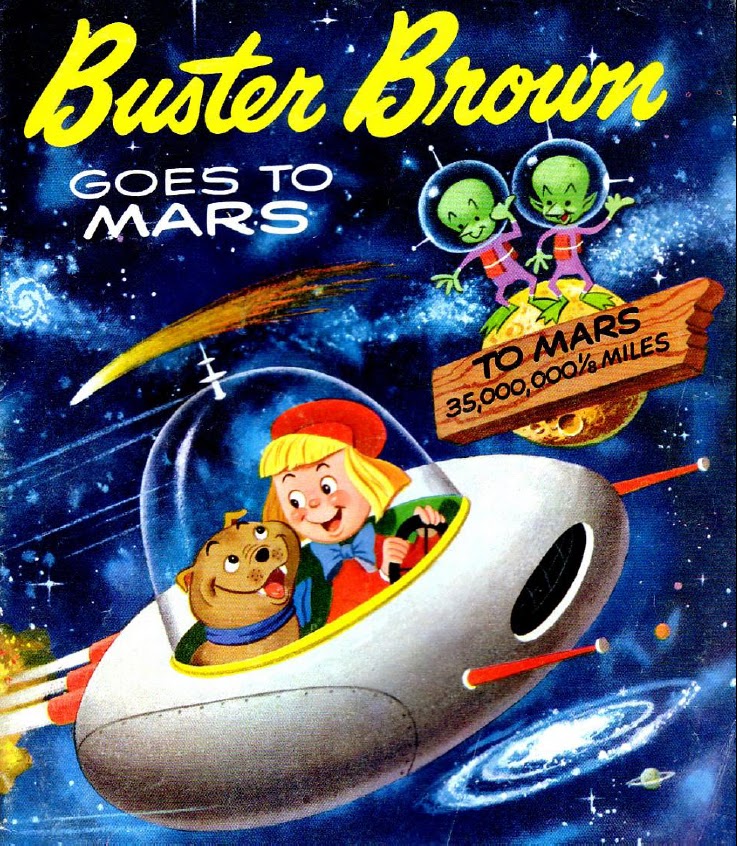
Buster Brown Goes to Mars 


Publisher: Western Publishing 
Year: Early 1958 


Mystery in Space: Cowboy on Mars 


Publisher: DC Comics 
Year: February-March 1952 


John Carter of Mars #36


Publisher: The Funnies 
Year: October 1938 


Mystery in Space: The Martian Horse


Publisher: DC Comics 
Year: August-September 1952 


Wonder Woman: Mystery of the Rhyming Riddle 


Publisher: DC Comics 
Year: March-April 1949 


Lars of Mars


Publisher: Ziff-Davis Comic #10 
Year: April-May 1951 


The Face on Mars


Publisher: Harvey Comics 
Year: September 1958 


John Carter of Mars #375

 
Publisher: Dell 
Year: 1952 


The Planetary Adventures of Flint Baker

 
Publisher: Planet Comics #1 
Year: January 1940 


The Martian from Gotham City 


Publisher: DC Comics 
Year: June 1960 


First Earthman on Mars

 
Publisher: Fiction House Comics 
Year: July 1944 


Lost in Space


Publisher: EC Comics 
Year: March/April 1955 


Flash Gordon: Trapped on Mars 


Publisher: Indrajal Comics (India) 
Year: November 1973 


Gulliver Jones: Warrior of Mars


Publisher: Marvel Comics 
Year: 1971 

September 27, 2012

BOOK REVIEW

The Mighty Marvel Superheroes’ Cookbook (1977) 

Can comic-books be considered as books? Strictly no, unless they're like Stan Lee's The Mighty Marvel Superheroes’ Cookbook. A perfect recipe for Friday's Forgotten Books over at Patti Abbott's blog Pattinase which is being hosted by Todd Mason at his blog Sweet Freedom this week. Check out the two blogs for plenty of FFB action.

Now your kids can cook with the comics! 

As a kid I used to wonder how Superman could drink water, sip wine or eat food when he was made of steel. I don’t think Jerry Siegel and Joe Shuster ever explained these life-sustaining aspects of their superhero’s life. As a teenager I wondered how the Man of Steel could make love to Lois Lane. Imagine the bionically-challenged Terminator taking a woman to bed…something like that. And as a grown-up I’m still wondering how he’s doing all of the above.

Come to think of it, in the comics Superman is rarely shown drinking or eating let alone making love though in the movie, Superman-II, he (Christopher Reeve) does sleep with his girlfriend (Margot Kidder) on a crystalline bed created out of kryptonite.

Turns out Superman isn’t the only superhero who drinks and eats and burps (let’s forget the sex for now).


A caboodle of Marvel superheroes not only wolf down large quantities of food, they even cook their own food, or so Stan Lee would like us to believe in The Mighty Marvel Superheroes’ Cookbook which is one of the most imaginative comic-book offshoots I have read—and own. Good thing I do: exaggerated as it sounds, used paperbacks of this book cost $124 (Rs.6,200) on Amazon USA and £109.90 (Rs.8,800) on Amazon UK.

A Fireside book published by Simon and Schuster, New York, in 1977, Superheroes’ Cookbook is a 95-page book of everyday recipes by some of Marvel’s leading heroes. Stan Lee claims it’s “the world’s first (and only) superhero cookbook.” It must be—I haven’t come across cookbooks of its kind over the past thirty-five years. At least, I don’t think DC came out with a rival cookbook by the Justice League of America. 

“Our recipes taste and smell Marvel-ous!” Head Chief Captain America proclaims as he takes you through what appears to be a normal cookbook with recipes for five-course meals, kitchen guide, do’s and don’ts, tips and all, except with one significant difference—you feel as if you’re reading a comic-book while browsing through the delectable recipes, which are accompanied by large colourful illustrations of the superheroes as they show off their favourite dishes.

So, for ‘Heroic Breakfast’ you can try out Captain America’s day starters comprising fruit juice pancakes and milk; cereal with milk; or fruit juice, eggs, bacon, toast and milk; or you can have the Hulk’s fried potatoes with bacon and eggs; or the Thing’s clobbered omelette. I can picture his brick-coloured fist pounding the eggs.

You can skip the breakfast and jump to the Fantastic Four’s superhero sandwiches and soups; the Sub-Mariner’s Submarine; The Human Torch’s Fireball; Spider-Man’s Parmigiani; or the Hulk’s Hulkburger.

 
There are six exclusive Heroic Combos as well, if you like.

If you’re still hungry then you can go for the main meal starting with soups from Dr. Strange’s instant eatery besides Doctor Doom’s Lima Bean Chowder; Thor’s Asgardian Vegetable Soup, Iron Man’s Splendid Split Pea Soup; or Silver Surfer’s Surfboard Sensation.

In the main course you have some mighty recipes consisting of meats, poultry, pasta, and fish. Particularly, Thor’s Cabbage Rolls; Doctor Strange’s Mysterious Stew; Daredevil’s De-Deviled Swiss Steak; Conan’s Kung Fu Chicken; Sub-Mariner’s Magnificent Tuna Bake; the Hulk’s Jumbo Shrimp in a Basket; and Spider-Man’s Seafood Platter.

If these sound a tad boring or if you’re looking for something light on the tummy, then you can have some vegetables and salads in 
the Hulk’s kitchen where you'll find the Fantastic Four enticing you with Zangy Casseroles, Stuffed Peppers, Spinach and Corn Casserole, and Grilled Tomato with Cheese. 

Pasta can hardly satiate the Hulk’s hunger and so the green goliath often has Spaghetti and Meat Balls in between clobbering General Thaddeus ‘Thunderbolt’ Ross’ armed lilliputs. He has a simple credo: “Hulk hungry—must feed face.” 

The Marvel gang takes the battle of the palate right to the end with recipes for delicious cakes and cookies, pies and tarts, and desserts and beverages.

The Mighty Marvel Superheroes’ Cookbook has great art and lettering by Joe Giella, a renowned American comic book artist who was on the staff of both DC Comics and Marvel. Presented by Stan Lee, the book is the brainchild of Gene Malis and the recipes are by Jody Cameron Malis of Celebrity Kitchen, Inc.

To round up here’s a tip from the superheroes’ kitchen guide: "Be Neat!! Don’t forget to clean up the mess in the kitchen! It’s easier to clean as you go along than to leave it for later."


August 31, 2012

BOOK REVIEW

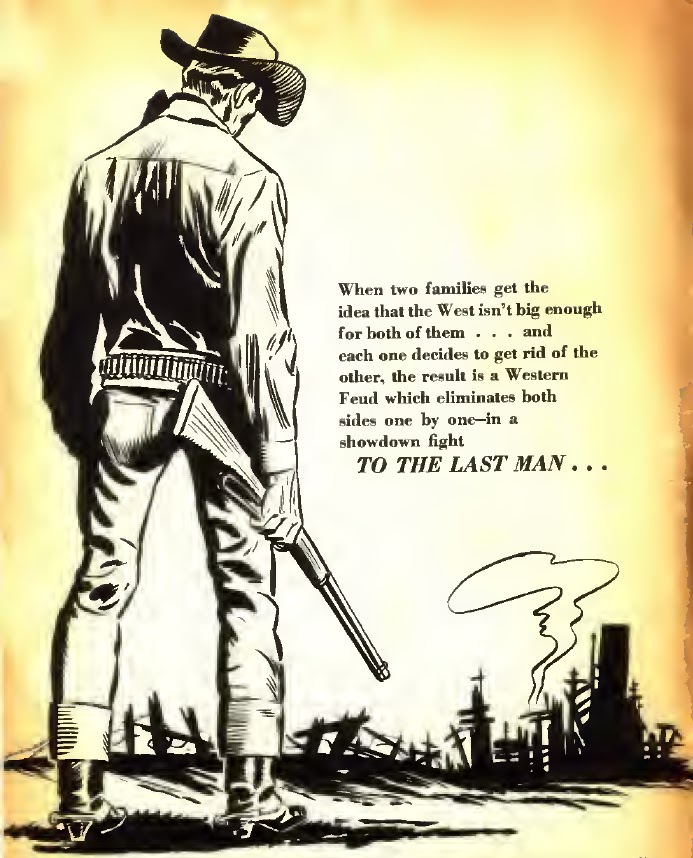
To The Last Man by Zane Grey

Another comic-book contribution for this Friday’s Forgotten Books edition over at Patti Abbott’s blog Pattinase. Don’t forget to read the fine reviews of forgotten books by other bloggers over there. 

Much of my reading of western fiction in early days was shaped by Oliver Strange, Zane Grey, Louis L’amour, George G. Gilman and J.T. Edson. British writer Strange remains a favourite to this day. His ten Corgi paperbacks about Sudden, the heroic two-gun Texas outlaw, captured my youthful imagination of the Wild West like little else. His compatriot Frederick W. Nolan did a terrific job by writing five more books in the Sudden series. There have been no reprints since.

Zane Grey came next and one of his novels that I read very early on was To The Last Man which he wrote in 1921. Unlike Strange and Nolan, I haven’t read all of Grey but I remember liking this novel a lot. It had an original storyline, I’d assume, of love between a young man and woman caught on the opposite sides of a blood feud between their two frontier families. 


The theme soon became staple diet for subsequent books and movies, both western and non-western. Bollywood still thrives on it.

Young John Isbel and Ellen Jorth are loyal to their families and at the same time hopelessly in love with each other. They realise the futility of the range war sparked by rustling by one of the two families and played out in Tonto Basin, Arizona.


Grey first serialised To The Last Man in The Country Gentleman magazine during May-July 1921. But then, many of his stories were serialised in various magazines before they were published into books. 

A couple of days ago I downloaded To The Last Man comic-book by Dell and was pleased to find that it stayed true to Grey’s story based on the Pleasant Valley War or the Tonto Basin War. Having read the comic-book, I now want to reread the book and see if I feel differently about it. I doubt it, though.

August 23, 2012

BOOK REVIEW

Comic-books on economy

A not-too-insignificant contribution to this Friday’s Forgotten Books edition over at Patti Abbott’s blog Pattinase. Don’t forget to read the fine reviews of forgotten books by other bloggers over there.

Back in school, comic-books gave me more education than text-books, starting with Amar Chitra Katha (Immortal Picture Stories), India's largest and most popular comics imprint. In spite of their often mediocre artwork, these comics retold captivating stories from the great Indian epics like the Mahabharata and Ramayana, history, mythology, fables and folklore, and the Indian freedom movement, apart from easy-to-read profiles of noted social reformers, political leaders, freedom fighters, and spiritual gurus—all in comic-book format.

I don't know much about economy, so these days I'm brushing up my knowledge of this rather tiresome subject by reading the comic-book series brought out by the publications division of the Federal Reserve Bank of New York. You can read and learn the basics of economy in comic-book format and enjoy it too.

Here are introductions to six comics from the series, courtesy of the Federal Reserve Bank of New York, Public Affairs Department.


Learn the major functions of the Federal Reserve System, the tools of monetary policy and how they work, and the other ways in which the Fed helps the US economy and financial system to function.


A history of the US monetary system and events leading to the establishment of the Federal Reserve System.


This comic-book explains the meaning and purpose of monetary policy, how the Federal Reserve makes monetary policy, and how the tools of monetary policy work.


Find out the causes and effects of inflation.


Illustrates the importance of savings, how it benefits all of us, and the various types of savings instruments and institutions.


Three young entrepreneurs use sophisticated bank services over a 23-year period. It also explores the role of checking deposits and lending in money creation.