January 02, 2015

Dubai by Robin Moore, 1977

Patti Abbott hosts 2015's first Friday’s Forgotten Books at her blog Pattinase.

Robin Moore (1925-2008) was a prolific American writer of crime, war, and espionage fiction. He wrote some of his books in collaboration with other writers.

His novels were racy and entertaining with edge-of-the-seat action. Remember Gene Hackman and the famous car chase in The French Connection? That, apparently, came out of his 1969 book The French Connection: A True Account of Cops, Narcotics, and International Conspiracy (1969), a nonfiction book that exposed the French connection in a drug trafficking racket.

Moore was also known for another nonfiction book called The Green Berets (1965) set during the Vietnam War. According to Wikipedia, the author used his connections with Harvard classmate Robert F. Kennedy for access to the US Special Forces and write about the elite unit. Later, John Wayne played the lead in the film version.
I have not read either The French Connection or The Green Berets, but I read one other novel more than two decades ago which led to my discovery of Robin Moore—Dubai (1977).

I remember Dubai well but not well enough to write a review. Moore’s Dubai, one of the seven emirates of the United Arab Emirates, is very different from Dubai as we know it today—crazy rich, swanky, polished, and glittering through its imposing manmade glass towers and hotels, artificial palm-shaped islands, and super cars and superhighways. 

Instead, Moore gives us a Dubai of the seventies, a Dubai still in the making, where westerner Fitz, a disgraced army officer, exploits the desert land of opportunities and conspiracies to make his fortunes. Fitz uses his connections with the ruler, Sheikh Rashid, to engage in high-risk business ventures including smuggling.

Dubai is a thriller set around oil deals and cartels, gambling and drug smuggling, beautiful women and sex, and power and politics. Above all, it revolves around the smuggling of gold in dhows from Dubai to Bombay, across the Arabian Sea. The route was once notorious for smuggling of all kinds of goods between India and the tiny oil kingdom.

Good writing style, a well-crafted story, and virtually unputdownable.

January 01, 2015

Books I read in 2014

I’m combining my post on books and short stories I read in the fourth quarter of 2014 with the total for the year because I read very little in the last three months of the year gone by—only nine novels and novellas and a handful of short stories. I spent far too much time playing chess and scrabble, watching films, and blogging.

In all, I read 41 novels and novellas and 31 short stories in 2014, an average of 3.41 and 2.58 a month, respectively. Clearly, I need to read more.

However, I'm satisfied with what I read.

The novels, novellas, and short stories were published over 155 years and covered several genres like crime and mystery, war and western, thriller and espionage, horror and science fiction, young adult, humour, and nonfiction.

The earliest book I read (reread actually) was A Tale of Two Cities by Charles Dickens, 1859, and the most recent book I read was Gray Mountain, 2014, by John Grisham.

There were some notable takeaways from my reading in 2014.

01. Interviews with my blog friends Charles Gramlich and Elizabeth Spann Craig (look in the sidebar). My thanks to both for their very prompt and enthusiastic response to my questionnaire. I hope to do more author interviews in 2015.

02. I read more contemporary fiction last year than I ever did since I started blogging in 2009—11 novels and novellas and four short stories published this century. I should celebrate!

03. Most difficult book I read was The Sound and the Fury by William Faulkner, 1929. I almost gave up after the first few pages.

04. At five novels, Jack Higgins (Harry Patterson in real life) was the most read author of the year. He might be the first to breast the tape again this year.

05. Book that resonated with me the most was the media-centric The Imperfectionists by Tom Rachman, 2011. A journalist’s life in Rome isn't very different from that of one in Bombay or Delhi. The young author shows you how to write nonfiction and make it read like fiction.

06. The White House Connection by Jack Higgins, 1998, and Deception Point by Dan Brown, 2001, had two of the most improbable plots. Among other things, it’s very easy to pull one over the President of the United States.

07. Late 2014, I kicked off my own ‘first novels’ challenge with The Hardy Boys: The Tower Treasure by the pseudonymous Franklin W. Dixon, 1927, and War Against the Mafia by Don Pendleton, 1969.

08. Two titles I found discomfiting to an extent were both legal novels—Defending Jacob by William Landay, 2012, and Gray Mountain by John Grisham, 2014.

09. The grittiest crime novel and police procedural was Public Murders by Bill Granger, 1980.

10. In short stories, I enjoyed reading The Education of a Pulp Writer & Other Stories by David Cranmer, 2008-2014, and Green Acres, 2012, and Ding Dong Bell The Kitten in the Well, 2014, by Dorte Hummelshøj Jakobsen. Both David and Dorte are my good friends.

I have listed below all the novels and novellas and short stories I read in 2014. They are not in the order I read them. Rather, I have listed them according to their year of publication, from the earliest to the most recent.

Novels & Novellas

1859 - A Tale of Two Cities by Charles Dickens (reread)
1888 - Buck Hawk, Detective by Edward L. Wheeler
1899 - The Bread Line: A Story of a Paper by Albert Bigelow Paine
1900 - Sister Carrie by Theodore Dreiser
1907 - The Rome Express by Arthur Griffiths
1927 - The Hardy Boys: The Tower Treasure by Franklin W. Dixon
1928 - The Dunwich Horror by H.P. Lovecraft
1929 - The Sound and the Fury by William Faulkner
1933 - Carved in Sand by Erle Stanley Gardner
1951 - Bullet Proof by Frank Kane
1951 - A Noose for the Desperado by Clifton Adams
1957 - Hostage for a Hood by Lionel White
1957 - The Legion of the Damned by Sven Hassel
1960 - To Kill a Mockingbird by Harper Lee (reread)
1962 - The Loneliness of the Long Distance Runner by Alan Sillitoe
1963 - The Dark Side of the Island by Jack Higgins
1963 - The Power of Your Subconscious Mind by Joseph Murphy
1968 - Greylorn by Keith Laumer
1969 - War Against the Mafia by Don Pendleton
1971 - The Last Place God Made by Jack Higgins (reread)
1972 - The Savage Day by Jack Higgins
1973 - The Way to Dusty Death by Alistair MacLean

1975 - The Miracle of Mindfulness by Thich Nhat Hanh
1980 - The Man in the Moon by James Reasoner
1980 - Public Murders by Bill Granger
1982 - Touch the Devil by Jack Higgins
1986 - Stallion Gate by Martin Cruz Smith
1988 - The Hell Raisers (originally Saddle Pals) by Lee Floren
1998 - The White House Connection by Jack Higgins
1999 - The Renos by Wolf Lundgren

2001 - Deception Point by Dan Brown
2005 - Beating Around the Bush by Art Buchwald
2011 - The Imperfectionists by Tom Rachman
2012 - The Red Reef by James Reasoner
2012 - Defending Jacob by William Landay
2012 - A Body in the Backyard by Elizabeth Spann Craig
2012 - Rendezvous by Nelson DeMille
2013 - Splatterpunk: AN.AL—The Origins by Athul DeMarco
2014 - The Button Man by Mark Pryor
2014 - The Common Room by K.B. Rao
2014 - Gray Mountain by John Grisham

Short Stories

1856 - The Wreck of the Golden Mary by Charles Dickens
1893 - The Mystery of the Semi-Detached by Edith Nesbit
1899 - Anne by Fanny Stevenson
1902 - The Fifth String by John Philip Sousa
1902 - The Conspirators by John Philip Sousa
1902 - Experiences of a Bandmaster by John Philip Sousa
1911 - Comrades by Elizabeth Stuart Phelps
1912 - Smothered in Corpses, three stories by Ernest Bramah
1913 - The Adventure of the Dying Detective by Arthur Conan Doyle
1917 - Whiffet Squirrel by Julia Greene
1922 - The Suppressed Poems of Ernest Hemingway
1933 - Hot Goods by Ray Cummings
1935 - Who Murdered the Vets? by Ernest Hemingway
1940 - Day Time Stopped Moving by Bradner Buckner
1943 - Nice Corpses like Flowers by Dorothy Les Tina
1948 - Charles by Shirley Jackson
1949 - The Witch by Shirley Jackson
1951 - The White Fruit of Banaldar by John D. MacDonald
1953 - Lamb to the Slaughter by Roald Dahl
1953 - The Complete Stories of Evelyn Waugh
1954 - The Intruders by Evan Hunter
1954 - Sorry: Wrong Dimension by Ross Rocklynne
1954 - The Father-Thing by Philip K. Dick
1956 - Love Story by Irving E. Cox
1959 - Rain, Rain, Go Away by Isaac Asimov
1960 - Hemingway in Space by Kingsley Amis
1963 - A Woman on a Roof by Doris Lessing
2008 - The Education of a Pulp Writer by David Cranmer
2010 - Killing Trail, four stories by Charles Allen Gramlich
2012 - Green Acres by Dorte Hummelshøj Jakobsen
2014 - Ding Dong Bell The Kitten in the Well by Dorte Hummelshøj Jakobsen

December 30, 2014

Happy New Year!

© DC Comics
The 3Cs wishes all its readers and visitors a Happy, Peaceful and Prosperous New Year! To all my blog friends, a very special thanks for your unstinted support and encouragement this year. Your visits and comments have enriched this blog in more ways than one. See you in 2015 with books, more books, and still more books.

© DC Comics

December 28, 2014

Musings on the last Sunday of the year

I had no intention of buying any more books between Christmas and New Year but the devil tempted me with a sale organised by Strand Book Stall, a popular bookstore. It was held in the foyer of the 144-year old David Sassoon Library and Reading Room in the south of the city.

© www.davidsassoonlibrary.com
I bought Deadly Justice (1993) by William Bernhardt, an American author of thriller and mystery fiction known for his Ben Kincaid series. The writer is new to me but I think he specialises in legal thrillers. “Justice” is a recurring word in his titles.

The family bought two books, To Be the Best (1988) by Barbara Taylor Bradford, the continuing saga of a family dynasty, and Sons of Fortune (2003) by Jeffrey Archer, which has shades of his famous novel Kane and Abel.

We also bought a spiritual book called Mantram Handbook by the late Eknath Easwaran, a renowned Indian spiritual teacher who, in 1960, established the Blue Mountain Centre of Meditation in Berkeley, California. The book tells us how we can release new energy, recast our old ways of thinking, and become more sensitive to the needs of others, by using the mantram, a short, powerful spiritual formula, to call up “what is best and deepest in ourselves.”

I have been reading and rereading Easwaran’s writing for the past two decades. His books are an infallible antidote to worry, fear, and depression. Spiritual books are like tonic. They keep you going through all the vicissitudes of life. I keep one handy.

Comics go extinct
It saddens me to learn that the thin A4-size comic books we read as kids have disappeared. DC and Marvel and the others stopped publishing them a long time ago. They have been replaced by glossy volumes and graphic novels whose computer generated illustrations are as unappealing as their price. This year, I received inquiries from people looking for some of these old-fashioned comics. I’m tempted to sell my lot to the highest bidder. But I know I won’t.

Drinking, driving, killing
With New Year’s Eve round the corner, the traffic police department is already cracking down on drunk driving. The number of fatalities due to drinking and driving has been increasing every year and a lot of innocent people are getting killed. It gets worse on the night of December 31. At the various check posts across the city, traffic police stop bikers and motorists, stick their heads very close, and ask them for their names. If they suspect alcohol, they use a breathalyzer to confirm it.

On New Year’s Eve, last year, I was stopped thrice on the highway and asked to state my name. I don’t drink but I felt silly repeating my name until the cop was satisfied he couldn’t smell liquor on my breath. My wife had a good laugh.

This breathe-in-my-face method can’t be hygienic for the cops.

To read or not to read
As I type this I’m looking at two formidable trilogies from my daughter’s collection—The Lord of the Rings by J.R.R. Tolkien and the Millennium series by Stieg Larsson. Rather, Tolkien and Larsson are giving me inquiring looks—“Are you going to read either or both of us in 2015?” I don’t think so. “You’re both part of my post-retirement reading plan,” I tell them. They seem offended.

Christmas movies
This weekend, I watched two of the five Christmas films I wrote about last week—Christmas in Connecticut and It’s a Wonderful Life. The first was a mild romantic drama, enjoyable but passable actually; the second was an intense family drama that was more depressing than elating in spite of its happy ending. I liked both, though. It put me in the mood for more golden age cinema.

That is all for now. I hope you found these musings amusing.

December 26, 2014

Hot Goods by Ray Cummings, 1933

I think our good friend Todd Mason is compiling the links for Friday’s Forgotten Books, today, as Patti Abbott is on a well-deserved holiday.

It was crook against crook when Pete Leroy met Basker — with the devil after both of them.

Hot Goods is one of many short stories written by American sf author Ray Cummings (1887-1957) except this one isn't a tale of science fiction. It’s a straightforward crime story involving, as the above line tells you, two crooks who try to swindle one another and fall prey to a cop who promptly hauls them to the police station.

Much of the action takes place inside a train compartment where Basker is pleading with Pete to buy his diamond ring for $450. He desperately needs the money to bail out his kid brother. Basker had seen Pete with a wad of cash and decides to relieve him of it. Pete, supposedly younger and smarter of the two, sizes up Basker as a sham and decides to turn the tables on him. He ropes in his partner George Snell in his little caper.

But something goes wrong. The old woman from whom Basker stole the diamond ring and $650 raises an alarm and soon cops are pounding on the door of their compartment. The armed trio escapes through the window of the stationery train. They run across the tracks and bundle into the front seat of a parked sedan whose backseat occupant turns out to be an off-duty cop taking a nap—and off he marches them to the police station. They had stolen a police car!

I like the sheer atmosphere in such stories and there is a good deal of it in Hot Goods, which appeared in Argosy Weekly, September 9, 1933. The three characters are drawn well in spite of little or no description. I especially liked the opening line—“Pete Leroy had the theory that crooks were the easiest suckers of all to swindle. And it gave him a thrill when this fellow Basker tackled him”—which suggested humour. An easy and entertaining tale you can clearly picture in your mind.

© www.ebooks-library.com
Author Ray Cummings has been described as one of the “founding fathers of the science fiction pulp genre” and I'm looking forward to reading some of his sf including his major work The Girl in the Golden Atom published in 1922. Among his other occupations, Cummings worked with Thomas Edison and wrote stories for Timely Comics, which we now know as Marvel Comics. His own quote, “Time…is what keeps everything from happening at once,” has been immortalised by both science and science fiction.

December 25, 2014

Miracles: A true story

Occasionally, I post stuff at B+ve, my other blog on all things positive. Last month, I wrote a piece called Miracles based on a true story. I want to share it with you in this wonderful season. Merry Christmas and Happy Holidays! 

A mall in northwest Mumbai wears a festive look.
© Prashant C. Trikannad
Jon believed in miracles because his father did. His father believed in them because they happened in his life and he told his son about them. As Jon grew up he saw miracles occur in his family, usually when his mom and dad thought they were down on their luck. Miracles came to their rescue at the most unexpected times and in the bleakest moments of their lives, or so it seemed. His father wasn't surprised for he knew miracles were always round the corner, waiting to step in, take hold of their lives, and set things right.

"That's what miracles do. They set things right," Jon's father told him. "you won't even know when they do."

Jon learnt about the power of miracles very early on in his life even though sometimes he saw them and sometimes he didn't. For instance, the new clothes his sister and he wore on occasions like birthdays were bought on shop credit. How his father managed to pay back each time, out of his meagre income, was a miracle. The children were never deprived of anything.

"Do you know why miracles happen?" Jon's father asked him one day. "They happen because of faith. There is divine hand behind every miracle. If you don't have faith, you won't believe in miracles and neither will you see them."

When he was very young, Jon's father told him a story about himself.

© Parizad Trikannad
When Jon was a tiny tot, his father went out of the city on an assignment which took him to a small town. It was night and the streets were dimly lit. The 34-year old man entered a restaurant and ordered food and while he waited at his table, he asked for directions to the toilet. A waiter pointed to the back door. Jon's father stepped out into pitch darkness and assuming that the toilet was some distance away, as was common in those days, he began to walk, feeling the ground beneath his feet.

After what seemed like a long time, he halted and looked over his shoulder and saw the lights of the restaurant in the distance. He was a little afraid. Instinct told him not to venture further. He stood there, unzipped, and started to pee, when he suddenly heard the waiter's frantic voice somewhere behind him.

"What the hell do you think you are doing, sir?" he demanded of Jon's father. "You are peeing in our well!"


The waiter stood beside him and flashed a torch on the ground except there was no ground, only a yawning black hole. Jon's father was standing on the very edge of the well, level with the ground. He staggered behind. One step, just one more step, and that would have been the end of him.

Jon never got bored of hearing the story and his father never tired of telling it. They were on the same miracle wavelength.

He told Jon, "Miracles are God's way of telling us that he is watching over us and that we have nothing to fear. They are like blessings. Count them every time they occur in your life and never forget to send up a silent thank you."

Thanks to the valuable lesson his father taught him, Jon is mindful of miracles in his life, and they happen every day, or at least as often as he sees them.

Copyright: B+ve

December 23, 2014

Five popular Christmas films I have never seen

These memorable Christmassy films have been overlooked by me and thus make it to Overlooked Films, Audio & Video at Todd Mason's blog Sweet Freedom this Tuesday.

It’s a coincidence that the five Christmas or Christmas-related films I chose this wonderful season were all made in the forties, a decade of intense strife and insensate destruction. Perhaps, that’s why the makers of these films, variously described as “charming” and “delightful,” decided to make them—to spread a little joy and happiness around.

The Shop Around the Corner (1940)
This sounds like the original version of You've Got Mail (1998). Two sales people, Alfred Kralik (James Stewart) and Klara Novak (Margaret Sullavan), work together in a store in Budapest, Hungary, but can’t stand each other. Little do they realise that they're falling in love by writing to one another, as anonymous pen pals.


Christmas in Connecticut (1945)
Elizabeth Lane (Barbara Stanwyck) is a famous food writer who lies about her life in her food columns. One day, she is forced to play host to a war hero at a traditional family Christmas. Will her lies—marriage, kids, and working on a farm—be exposed and will it ruin her career?


It's a wonderful life (1946)
A guardian angel named Clarence (Henry Travers) comes to the aid of a compassionate but frustrated and suicidal businessman, George Bailey (James Stewart), by showing what life would have been like, for his town, his family, and his friends, if he were never born. George doesn't know that he is already living out his dream.
The Bishop's Wife (1947)
Cary Grant plays Dudley, a guardian angel, who wants to help Bishop Henry Brougham (David Niven) realise his dream of building a new cathedral, but the priest, unlike everyone else who likes the angel, is suspicious of Dudley's motives—is Dudley out to replace him both inside his church and in his wife Julia's (Loretta Young) life?
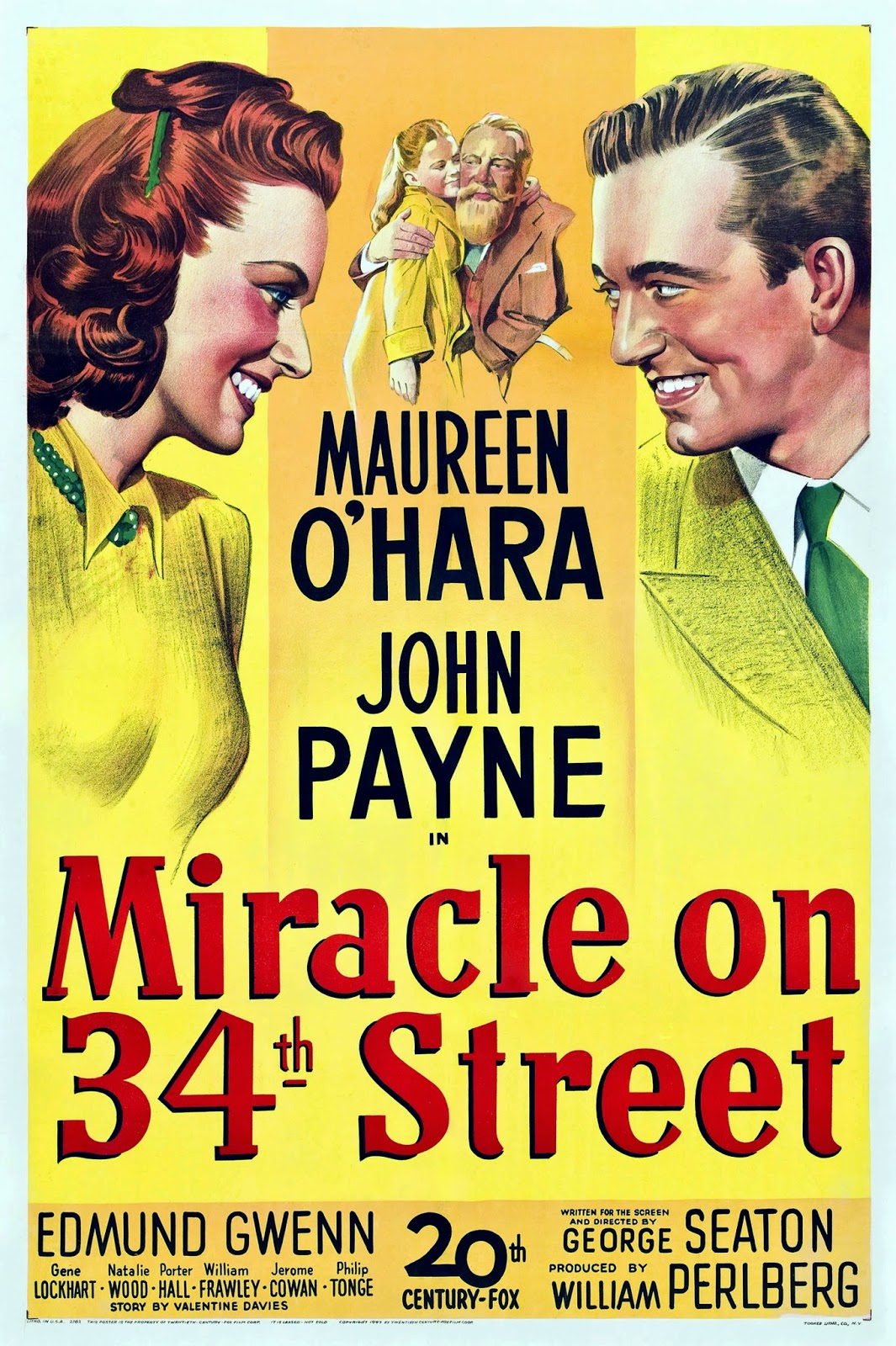
Miracle on 34th Street (1947)
Do you believe in Santa? Whether you do or not, this is the film to watch. Edmund Gwenn plays old man Kris Kringle who not only behaves like Santa Claus but actually claims to be one, which gets him into trouble. I saw the 1994 version where Richard Attenborough reprises Kringle’s role. As an aside, I didn’t know Kris Kringle and Father Christmas were the American and British names of Santa Claus.


© Wikimedia Commons
The last Christmas movie I saw, all over again, was The Polar Express (2004), an animated film in which a young boy doubts the existence of Santa Claus, rides in a magical train all the way to the North Pole and to Santa’s home, and discovers more than the legendary friend of children. Don’t miss the film and don't miss Tom Hanks in it.

Merry Christmas!