December 28, 2014

Musings on the last Sunday of the year

I had no intention of buying any more books between Christmas and New Year but the devil tempted me with a sale organised by Strand Book Stall, a popular bookstore. It was held in the foyer of the 144-year old David Sassoon Library and Reading Room in the south of the city.

© www.davidsassoonlibrary.com
I bought Deadly Justice (1993) by William Bernhardt, an American author of thriller and mystery fiction known for his Ben Kincaid series. The writer is new to me but I think he specialises in legal thrillers. “Justice” is a recurring word in his titles.

The family bought two books, To Be the Best (1988) by Barbara Taylor Bradford, the continuing saga of a family dynasty, and Sons of Fortune (2003) by Jeffrey Archer, which has shades of his famous novel Kane and Abel.

We also bought a spiritual book called Mantram Handbook by the late Eknath Easwaran, a renowned Indian spiritual teacher who, in 1960, established the Blue Mountain Centre of Meditation in Berkeley, California. The book tells us how we can release new energy, recast our old ways of thinking, and become more sensitive to the needs of others, by using the mantram, a short, powerful spiritual formula, to call up “what is best and deepest in ourselves.”

I have been reading and rereading Easwaran’s writing for the past two decades. His books are an infallible antidote to worry, fear, and depression. Spiritual books are like tonic. They keep you going through all the vicissitudes of life. I keep one handy.

Comics go extinct
It saddens me to learn that the thin A4-size comic books we read as kids have disappeared. DC and Marvel and the others stopped publishing them a long time ago. They have been replaced by glossy volumes and graphic novels whose computer generated illustrations are as unappealing as their price. This year, I received inquiries from people looking for some of these old-fashioned comics. I’m tempted to sell my lot to the highest bidder. But I know I won’t.

Drinking, driving, killing
With New Year’s Eve round the corner, the traffic police department is already cracking down on drunk driving. The number of fatalities due to drinking and driving has been increasing every year and a lot of innocent people are getting killed. It gets worse on the night of December 31. At the various check posts across the city, traffic police stop bikers and motorists, stick their heads very close, and ask them for their names. If they suspect alcohol, they use a breathalyzer to confirm it.

On New Year’s Eve, last year, I was stopped thrice on the highway and asked to state my name. I don’t drink but I felt silly repeating my name until the cop was satisfied he couldn’t smell liquor on my breath. My wife had a good laugh.

This breathe-in-my-face method can’t be hygienic for the cops.

To read or not to read
As I type this I’m looking at two formidable trilogies from my daughter’s collection—The Lord of the Rings by J.R.R. Tolkien and the Millennium series by Stieg Larsson. Rather, Tolkien and Larsson are giving me inquiring looks—“Are you going to read either or both of us in 2015?” I don’t think so. “You’re both part of my post-retirement reading plan,” I tell them. They seem offended.

Christmas movies
This weekend, I watched two of the five Christmas films I wrote about last weekChristmas in Connecticut and It’s a Wonderful Life. The first was a mild romantic drama, enjoyable but passable actually; the second was an intense family drama that was more depressing than elating in spite of its happy ending. I liked both, though. It put me in the mood for more golden age cinema.

That is all for now. I hope you found these musings amusing.

December 26, 2014

Hot Goods by Ray Cummings, 1933

I think our good friend Todd Mason is compiling the links for Friday’s Forgotten Books, today, as Patti Abbott is on a well-deserved holiday.

It was crook against crook when Pete Leroy met Basker — with the devil after both of them.

Hot Goods is one of many short stories written by American sf author Ray Cummings (1887-1957) except this one isn't a tale of science fiction. It’s a straightforward crime story involving, as the above line tells you, two crooks who try to swindle one another and fall prey to a cop who promptly hauls them to the police station.

Much of the action takes place inside a train compartment where Basker is pleading with Pete to buy his diamond ring for $450. He desperately needs the money to bail out his kid brother. Basker had seen Pete with a wad of cash and decides to relieve him of it. Pete, supposedly younger and smarter of the two, sizes up Basker as a sham and decides to turn the tables on him. He ropes in his partner George Snell in his little caper.

But something goes wrong. The old woman from whom Basker stole the diamond ring and $650 raises an alarm and soon cops are pounding on the door of their compartment. The armed trio escapes through the window of the stationery train. They run across the tracks and bundle into the front seat of a parked sedan whose backseat occupant turns out to be an off-duty cop taking a nap—and off he marches them to the police station. They had stolen a police car!

I like the sheer atmosphere in such stories and there is a good deal of it in Hot Goods, which appeared in Argosy Weekly, September 9, 1933. The three characters are drawn well in spite of little or no description. I especially liked the opening line—“Pete Leroy had the theory that crooks were the easiest suckers of all to swindle. And it gave him a thrill when this fellow Basker tackled him”—which suggested humour. An easy and entertaining tale you can clearly picture in your mind.

© www.ebooks-library.com
Author Ray Cummings has been described as one of the “founding fathers of the science fiction pulp genre” and I'm looking forward to reading some of his sf including his major work The Girl in the Golden Atom published in 1922. Among his other occupations, Cummings worked with Thomas Edison and wrote stories for Timely Comics, which we now know as Marvel Comics. His own quote, “Time…is what keeps everything from happening at once,” has been immortalised by both science and science fiction.

December 25, 2014

Miracles: A true story

Occasionally, I post stuff at B+ve, my other blog on all things positive. Last month, I wrote a piece called Miracles based on a true story. I want to share it with you in this wonderful season. Merry Christmas and Happy Holidays! 

A mall in northwest Mumbai wears a festive look.
© Prashant C. Trikannad
Jon believed in miracles because his father did. His father believed in them because they happened in his life and he told his son about them. As Jon grew up he saw miracles occur in his family, usually when his mom and dad thought they were down on their luck. Miracles came to their rescue at the most unexpected times and in the bleakest moments of their lives, or so it seemed. His father wasn't surprised for he knew miracles were always round the corner, waiting to step in, take hold of their lives, and set things right.

"That's what miracles do. They set things right," Jon's father told him. "you won't even know when they do."

Jon learnt about the power of miracles very early on in his life even though sometimes he saw them and sometimes he didn't. For instance, the new clothes his sister and he wore on occasions like birthdays were bought on shop credit. How his father managed to pay back each time, out of his meagre income, was a miracle. The children were never deprived of anything.

"Do you know why miracles happen?" Jon's father asked him one day. "They happen because of faith. There is divine hand behind every miracle. If you don't have faith, you won't believe in miracles and neither will you see them."

When he was very young, Jon's father told him a story about himself.

© Parizad Trikannad
When Jon was a tiny tot, his father went out of the city on an assignment which took him to a small town. It was night and the streets were dimly lit. The 34-year old man entered a restaurant and ordered food and while he waited at his table, he asked for directions to the toilet. A waiter pointed to the back door. Jon's father stepped out into pitch darkness and assuming that the toilet was some distance away, as was common in those days, he began to walk, feeling the ground beneath his feet.

After what seemed like a long time, he halted and looked over his shoulder and saw the lights of the restaurant in the distance. He was a little afraid. Instinct told him not to venture further. He stood there, unzipped, and started to pee, when he suddenly heard the waiter's frantic voice somewhere behind him.

"What the hell do you think you are doing, sir?" he demanded of Jon's father. "You are peeing in our well!"


The waiter stood beside him and flashed a torch on the ground except there was no ground, only a yawning black hole. Jon's father was standing on the very edge of the well, level with the ground. He staggered behind. One step, just one more step, and that would have been the end of him.

Jon never got bored of hearing the story and his father never tired of telling it. They were on the same miracle wavelength.

He told Jon, "Miracles are God's way of telling us that he is watching over us and that we have nothing to fear. They are like blessings. Count them every time they occur in your life and never forget to send up a silent thank you."

Thanks to the valuable lesson his father taught him, Jon is mindful of miracles in his life, and they happen every day, or at least as often as he sees them.

Copyright: B+ve

December 23, 2014

Five popular Christmas films I have never seen

These memorable Christmassy films have been overlooked by me and thus make it to Overlooked Films, Audio & Video at Todd Mason's blog Sweet Freedom this Tuesday.

It’s a coincidence that the five Christmas or Christmas-related films I chose this wonderful season were all made in the forties, a decade of intense strife and insensate destruction. Perhaps, that’s why the makers of these films, variously described as “charming” and “delightful,” decided to make them—to spread a little joy and happiness around.

The Shop Around the Corner (1940)
This sounds like the original version of You've Got Mail (1998). Two sales people, Alfred Kralik (James Stewart) and Klara Novak (Margaret Sullavan), work together in a store in Budapest, Hungary, but can’t stand each other. Little do they realise that they're falling in love by writing to one another, as anonymous pen pals.


Christmas in Connecticut (1945)
Elizabeth Lane (Barbara Stanwyck) is a famous food writer who lies about her life in her food columns. One day, she is forced to play host to a war hero at a traditional family Christmas. Will her lies—marriage, kids, and working on a farm—be exposed and will it ruin her career?


It's a wonderful life (1946)
A guardian angel named Clarence (Henry Travers) comes to the aid of a compassionate but frustrated and suicidal businessman, George Bailey (James Stewart), by showing what life would have been like, for his town, his family, and his friends, if he were never born. George doesn't know that he is already living out his dream.
The Bishop's Wife (1947)
Cary Grant plays Dudley, a guardian angel, who wants to help Bishop Henry Brougham (David Niven) realise his dream of building a new cathedral, but the priest, unlike everyone else who likes the angel, is suspicious of Dudley's motives—is Dudley out to replace him both inside his church and in his wife Julia's (Loretta Young) life?
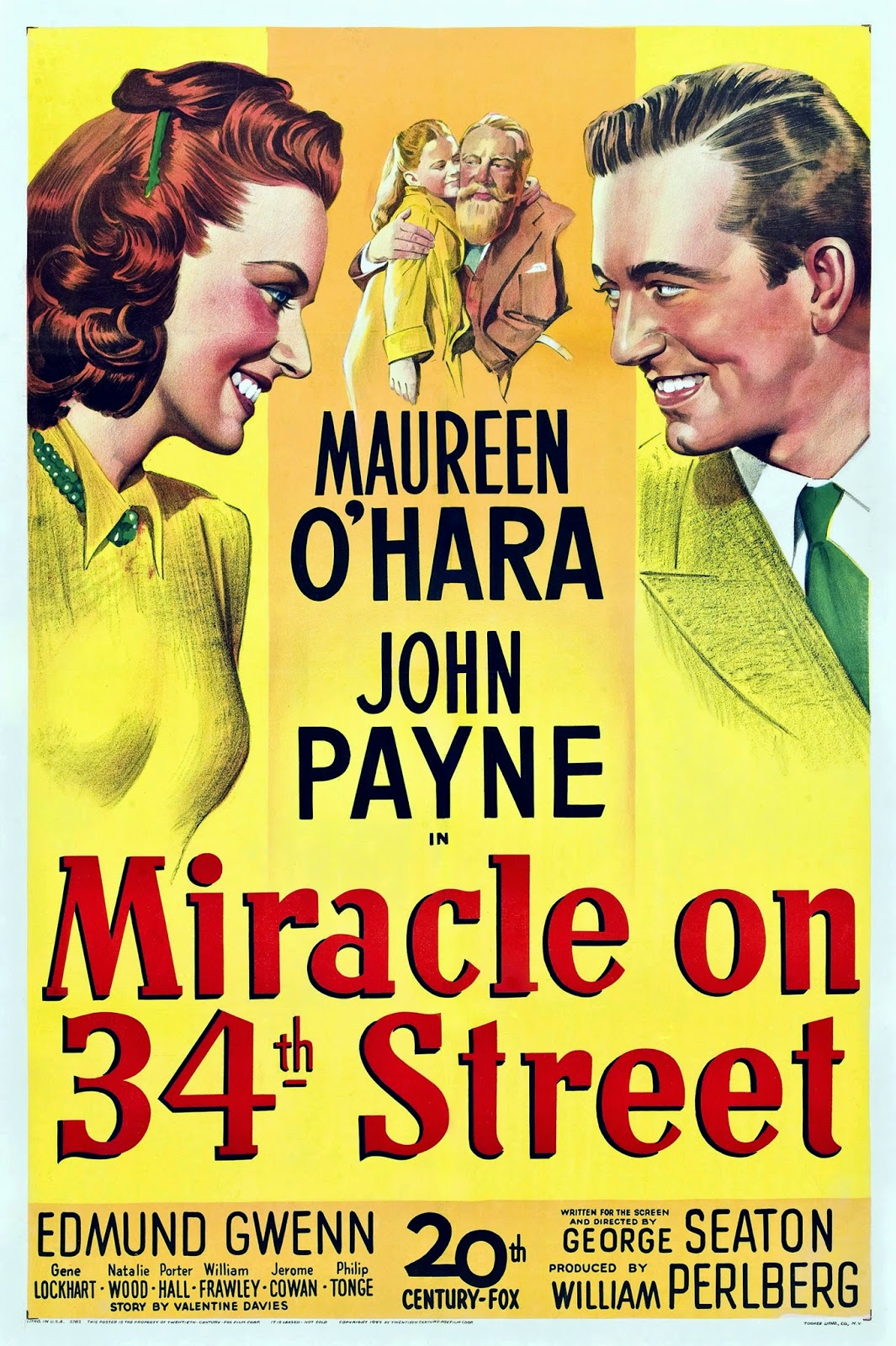
Miracle on 34th Street (1947)
Do you believe in Santa? Whether you do or not, this is the film to watch. Edmund Gwenn plays old man Kris Kringle who not only behaves like Santa Claus but actually claims to be one, which gets him into trouble. I saw the 1994 version where Richard Attenborough reprises Kringle’s role. As an aside, I didn’t know Kris Kringle and Father Christmas were the American and British names of Santa Claus.


© Wikimedia Commons
The last Christmas movie I saw, all over again, was The Polar Express (2004), an animated film in which a young boy doubts the existence of Santa Claus, rides in a magical train all the way to the North Pole and to Santa’s home, and discovers more than the legendary friend of children. Don’t miss the film and don't miss Tom Hanks in it.

Merry Christmas!

December 22, 2014

Rebecca Bradley launches Shallow Waters

© Rebecca Bradley
My blog friend, Rebecca Bradley, has launched her debut novel Shallow Waters, the first in her DI Hannah Robbins series. 

Rebecca’s crime novel is about teenage murders and a killer on the loose. She whets your appetite some more with this blurb.


When the naked, battered body of an unidentified teenager is found dumped in an alleyway, post-mortem finds evidence of a harrowing series of events. 

Another teenage death with the same MO pushes DI Hannah Robbins and her team on the Nottingham City division Major Crimes Unit, to their limits, and across county borders. In a race against the clock they attempt to unpick a thick web of lies and deceit to uncover the truth behind the deaths. 

But it doesn't stop there. When catching a killer isn't enough, just how far are the team willing to push themselves to save the next girl?

DI Hannah Robbins will return in 2015, says Rebecca.

Rebecca Bradley lives in Nottinghamshire, United Kingdom, with her family and her one-year old Cockerpoo, Alfie, who keeps her company while she writes. She says she needs to drink copious amounts of tea to function throughout the day and if she could, she would survive on a diet of tea and cake while committing murder on a regular basis, in her writing, of course.

Once a month Rebecca hosts a crime book club on Google+ hangouts where you can live chat about a crime book everyone has read and has members in the UK, the US, France, and Australia. She blogs regularly at rebeccabradleycrime.com.

Shallow Waters is currently available on Amazon and Kobo in all countries.

The 3Cs wishes Rebecca and her novel, a police procedural, the best of readership and sales.

December 20, 2014

Stone in the Crick by Granville Wyche Burgess, 2014

I received a review copy of Stone in the Crick by email recently. It is authored by Emmy-nominated writer Granville Wyche Burgess of Greenwich, Connecticut. 

Photos: www.granvilleburgess.com
Stone in the Crick, is a tale of mystery, romance, intrigue, and danger set against the backdrop of a traditional Amish community. According to the email, Burgess was inspired by his own marriage to an Amish-Mennonite wife. 

I have not read the novel but I loved the cover. It’s refreshing to look at. This is what the blurb says.

Rebecca Zook feels as stuck as a stone in her family farm’s crick. On the surface, the twenty-two-year-old Amish woman seems happy enough. A talented quilt-maker, Rebecca is engaged to Jacob, an honest, God-fearing man with a successful farm of his own. Jacob would make most young women proud to be his fiancée, but Rebecca remains restless and unsure. Whether she’s performing her chores or working at Mrs. Ansbacher’s quilt shop, Rebecca finds herself resisting the Amish way of life despite her love for her family and her culture. Even her quilting seems at odds with her heritage. Rebecca yearns to be an artist and knows self-expression is vital for true art, but the Amish feel any act that draws attention to the individual can lead to the sin of pride, so artistic expression is viewed with suspicion. 

Then good-looking Englisher Gregory Pinckney comes to the county, searching for the birth mother he never knew. Despite their differences, Rebecca and Gregory find a common bond in their love of horses, especially Gregory’s horse, Bojangles. As their friendship grows, Rebecca’s heart is torn in yet another direction.

Rebecca has competition though, when Wanda, the beautiful daughter of dissolute horse-farm owner Ivan Heminger, sets her sights on Gregory. Then Rebecca’s old boyfriend reappears, and her heart is torn in many directions. When an insurance scam almost kills Bojangles, events are set in motion that will test Rebecca’s faith and her family’s future. Is Gregory’s life in danger? Must the farm be sold? And does Rebecca dare follow her heart, or is she destined to remain a Stone in the Crick?

Of the novel, Elizabeth Oberbeck, author of The Dressmaker, has said: “Burgess weaves a page-turner tale of intrigue and romance. A skillful, colorful, witty novel, full of humor and intelligence, with memorable, well-rounded characters who feel life-like enough to hug. Burgess has treated us to a rare glimpse inside the rich and complex community life of the Pennsylvania Dutch Amish.”

The author
Granville Wyche Burgess is a playwright, lyricist, novelist, director, actor, producer, and teacher, and also co-founder and chief executive officer of Quill Entertainment Company, a nonprofit dedicated to creating and producing original history musicals. He is the author of two screenplays, a novel about Shoeless Joe Jackson, and a children’s book. He has produced, directed, or acted in over fifty musicals and plays.

The 262-page novel is published by Honey Brook Publishers. You can learn more about the author at his website and buy the book at Amazon.

December 19, 2014

Bullet Proof by Frank Kane, 1951

For Friday's Forgotten Books at Patti Abbott's blog Pattinase.

If you think being a walking shooting-gallery is my idea of a good clean night’s fun, you’re mistaken,” Liddell retorted hotly. “I don’t like cluttering up the sidewalks with corpses any better than you do. Especially when one of them is liable to be mine.”

My 1968 Dell copy
© Prashant C. Trikannad
Bullet Proof is the fourth book in the Johnny Liddell Mystery Series by Frank Kane (1912-1968), an American writer of short stories and novels and radio shows and television series. He wrote some four hundred short stories and thirty novels, most of them based on adventures of his popular New York detective Johnny Liddell, as well as screenplays for the Mike Hammer, Special Agent 7, and The Investigators television series. 

He also wrote the script for one of his novels, Key Witness (1960). It was directed by Phil Karlson, who specialised in gritty and violent crime films, and starring a young Dennis Hopper.

More than anything, Frank Kane was known for his pulp stories revolving around his private eye. These stories appeared in leading detective magazines of his era, like Manhunt, The Saint Detective Magazine, Mike Shayne Mystery Magazine, Private Eye, and Pursuit. It was a matter of time before Kane successfully novelised the adventures of his hero. Frank Boyd was his only pen name.
 

© www.pulpcovers.com
Bullet Proof is my first trip into the hardboiled fiction of Frank Kane and into the crime-infested world of Johnny Liddell.

Liddell is fearless as hardboiled PIs are known to be; the kind of man who likes to take the fight right into enemy camp. When a bunch of hoods repeatedly use him for target practice, he turns the tables and instead uses them to prove just how deadly he can be with a .45. He takes out two gunmen right in the beginning and then goes after Frankie Cappola, the fat mobster who set him up. Cappola’s boss, Pete Velie, is cooling his heels in prison from where he's giving orders to his henchmen.

Liddell finds himself on the wrong side of the mob and the law the moment he accepts a $500 retainer from a beautiful socialite called Jean Merritt who hires him to find out the real truth behind her father Matt Merritt’s death. Jean, who mysteriously vanishes before their first meeting, is convinced that her father didn’t commit suicide and was, in fact, murdered. Liddell believes her and suspects that she has been kidnapped by the gangsters who probably killed her father and now want to silence him. They don’t want him to go sniffing around Merritt’s corpse and dig it out.

© www.occultnoir.com
Described as tall, broad shouldered, and ruggedly handsome, Johnny Liddell’s character reminded me of Mike Hammer who lets his trigger finger do the talking instead of his tongue, always in self-defence. The story and the style are a mixture of a Mickey Spillane yarn and a James Hadley Chase novel, while some of the characters, like District Attorney William Deats and Inspector Herlehy, sound like less civilised versions of Hamilton Burger and Lieutenant Tragg in the Perry Mason novels. Even Liddell’s redhead secretary, Pinky, is not unlike Mason’s Della Street although the detective has an occasional girlfriend called Muggsy Kiely, a lovely and know-it-all reporter who dreams of being an actress.

As the private eye piles up the corpses, Deats and Herlehy become more sceptical about his self-defence theory. The reason is they are after the mob and they know Liddell is on to something and they want in.


The fat man squinted at him, scowled, “Who are you and what’s the idea?”
“My name’s Liddell. Mean anything to you?”
“Not a thing.”
Liddell grinned tightly. “It must have the other night. You tried to part my hair with a tommy gun. I kept Scoda as a souvenir. Remember?”


Bullet Proof is an old-fashioned detective story written in a style reminiscent of mid-20th century pulp fiction: clean-cut and without fuss. The 191-page novel has a lot of gunplay, stakeouts at sordid bars and seedy joints, black suits and fedoras, guns and tommy guns, gangster’s molls and naked hookers, corpses and morgues, and beggars as informants. Kane knew how to tell an entertaining story. I was amused by his repeated use of words like “shamus,” referring to the private eye; and “torpedo,” a hired gun—both, a first for me, I should think.


Recommended, if you like crime thrillers with nonstop action.

Further reading
Maura Fox, the granddaughter of Frank Kane, has written a nice profile of the writer at Thrilling Detective where she quotes fellow crime writer and our blog friend Bill Crider as saying, if it's a Frank Kane book, chances are “it'll be a competent, straightforward P.I. story.” Bullet Proof is exactly that. In May 2012, author James Reasoner reviewed Frank Kane’s Stacked Deck at his blog, Rough Edges. It's a collection of novelettes and short stories starring Johnny Liddell and, I'd think, a good place to start reading about the adventures of the private eye from the Big Apple.