August 25, 2014

Rest in Peace: Richard Attenborough

The actor’s director
August 29, 1923-August 24, 2014
I didn't know Richard Attenborough through his films as well as I knew him from reading about his films. I could relate to him as an actor, director, and producer of a little over a hundred films. I have, of course, seen less than ten that include The Great Escape, Miracle on 34th Street, and Jurassic Park in the three categories.

He was mostly an actor who catapulted into the limelight in India with Gandhi, his epic directorial venture. Suddenly, Attenborough was a household name, as was the man he cast in the Mahatma's slippers, Ben Kingsley, who by a coincidence happened to be half-Indian; he was born Krishna Pandit Bhanji, in England. Attenborough could not have chosen a more suitable actor to play Mohandas Karamchand Gandhi. Even today, for many in India Kingsley is still Gandhi.

When Gandhi won eight Academy Awards, an entire nation rejoiced as if the film was made by an Indian. The only thing Indian about Gandhi was its frail and sparsely-clad subject. The award-winning Slumdog Millionaire by Danny Boyle evoked a similar response, though on a much smaller scale. Still, we felt a kinship with both the films, especially Gandhi as it was about a historically important period of time and because it had several noted Indian character actors.


Attenborough (left) directs Kingsley in Gandhi
© Frank Connor/www.bafta.org

Richard Attenborough brought to life the larger-than-life persona of Mahatma Gandhi, more than scores of books and comic-books and audio and video documentaries ever had until 1982.

I think one of the primary reasons why Gandhi became a phenomenal success in India was because Attenborough did not deviate from the real-life script of the Mahatma’s life, his trials and tribulations, the freedom struggle, the partition of India into India and Pakistan, independence in 1947, and his assassination.
 Everything was as we'd learned about him since school. In fact, as the film rolled we could anticipate certain events that occurred during the freedom movement; like the Jallianwala Bagh massacre in Punjab, in April 1919, when General Dyer ordered his men to open fire directly on a crowd of peaceful protesters. Over a thousand men and women died; scores of others jumped into the garden's wells to escape the bullets and were killed. It remains one of the bleakest periods and Dyer the most hated man in Indian history. 

Gandhi is one of my all-time favourite movies and I see it at least once a year when, in a spirit of patriotism, it is telecast on India's republic day, January 26, and on her independence day, August 15—a memorable tribute to a great man and to the human spirit. In India, at least, Richard Attenborough sealed his fame with that epochal film.
August 23, 2014

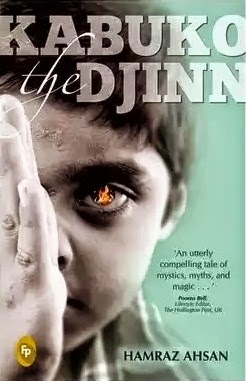
Kabuko the Djinn by Hamraz Ahsan, 2013

I have said elsewhere on this blog and in comments on other blogs that I rarely put a book away after I have started reading it, even if I’m plodding through the book. I will read it anyway because I always find something that redeems the book in my eyes. And sometimes I feel I owe it to the author.

In the case of Kabuko the Djinn, 2013, by the London-based journalist and author, Hamraz Ahsan, I didn’t make that exception because, much as I liked the storyline and writing style, which is really good, I lost interest after the initial few pages. I didn’t feel like reading further about the occult and the mystical world of the djinn who enters the body of a young boy, around which this story revolves.

There are two reasons. One, I wanted to get back to the fast-paced fiction, the thrillers, the mysteries, and the westerns, that I’m fond of reading. I’m a brainwashed prisoner of the American paperback. And two, however absorbing Indian fiction is, given its literary style, the narrative is often long winding, as I felt about Kabuko the Djinn. Indian fiction is also more descriptive and 
almost academic in tone.

I understand that you cannot judge a book by reading only a few pages and I’ll probably try and read it at some point in the near future. But not just yet. I
’ve to be in the mood for a fictional tale involving “mystics, myths, and magic.”

For now, I’ll leave you with the synopsis of Kabuko the Djinn which has received much praise from more discerning readers.


“Kabuko the djinn is the evocative story of a djinn who journeys through human life in search of occult knowledge. Wishing to study the dynamics of the human species for himself, in order to unearth the secrets of human power, Kabuko enters the body of Ajee Shah, a boy born in post-independence Punjab, Pakistan. As Kabuko loses himself to the trials and tribulations of living an ordinary yet intrinsically exceptional human life through Ajee, sex and the supernatural collide, entangling them both in a cataclysmic event that is to change their lives forever. Woven throughout this tapestry of youthful yearnings and a desire for transcendental knowledge are real secrets of the Islamic occult, true stories of Muslim saints, and the folklore of the Punjab.”

I’m grateful to Fingerprint, an imprint of Prakash Books India Pvt. Ltd, New Delhi, for my copy of this book. You can order your copy from Amazon.

August 16, 2014

How long? A poem by Ramabai C. Trikannad

Ramabai C. Trikannad, my late grandmother, was a writer, columnist, poet, and a deeply spiritual woman. She read a lot. Classics were her favourite. She wrote about family life and parenting in newspapers in the mid-20th century. One of her columns was called Cat 'N' Bells. She also published a book of short stories called Victory of Faith and Other Stories, 1935. I have most of her published and unpublished writings including a hardback of her short story collection. Once in a while I read her poems and stories and what she said more than half a century ago resonates with me even today. How Long? is one of her poems that I like very much. 

Inconsistent, changing — weary yet restless —
We dance to the rhythm of nature.
Hoping, fearful — lest we lose them —
We try to hold and keep the things
Our fancy rests upon.
We strive and strive — not towards the Eternal —
But for the empty shows of life.
Thus, while in silence Mother smiles and watches over us,
We jostle and struggle on.

In some quiet hour
The heart draws back from all the world.
Whence — to where? To what purpose
This fruitless, aimless hurry and rush?
How long before delusion is destroyed and freedom gained?
For a moment, for a single moment,
Before the mind drops again
Into the ever intricating web of fancies and desires,
From the solitude of the heart
Comes the cry: “O Mother! How long?”


© Ramabai C. Trikannad

August 15, 2014

A Woman on a Roof by Doris Lessing, 1963

A review of a short story by the British novelist for Friday's Forgotten Books at Patti Abbott's blog Pattinase.

There was a fine view across several acres of roofs. Not far off a man sat in a deckchair reading the newspapers. Then they saw her, between chimneys, about fifty yards away. She lay face down on a brown blanket. They could see the top part of her: black hair, a flushed solid back, arms spread out.

© Wikimedia Commons
It’s not everyday that I read a short story that can be interpreted in different ways by different readers. A Woman on a Roof (Encounter, March 1963) is one of those stories that leaves you nowhere long after you have read it, talked about it, and argued over it. But it won’t make this story any less tantalisingly charming.

The premise is simple: three men are working on the roof of a building on a hot June day in London when they see a woman sunbathing on the roof of an adjoining building. She is almost naked.

Harry, the oldest, is forty-five years old. Stanley is young and newly married. And Tom is only seventeen.

As the three men sweat it out on the roof and at times in the basement of the block of flats, to escape the wretched heat, they can’t take their thoughts away from the nearly naked woman. At least Stanley and Tom can’t.

The characters

Harry is mature and circumspect and with a son as old as Tom, he prefers to look the other way and do his work. He humours the other two, especially Stanley.

Stanley is the loudest and most affected. He sounds annoyed with the bare woman but you know he is annoyed with himself. He tells the others that she is a bitch for no apparent reason other than that she is tormenting him. He’d rather she wasn't lying lying around naked like that, for him to see and agonise over. He is married and there is not a damn thing he can do about it. He knows it and you know it.

Young Tom is quiet and reserved even though he joins Stanley in whistling and shouting loudly across the roofs. He dreams of the naked woman every night. He thinks she is lovely and that she belongs to him. Tom also happens to see more than Harry and Stanley. He likes to think of it as a secret between him and the woman.

Tom's report was that she hadn't moved, but it was a lie. He wanted to keep what he had seen to himself: he had caught her in the act of rolling down the little red pants over her hips, till they were no more than a small triangle. She was on her back, fully visible, glistening with oil.

Final word
In the story the mysterious woman appears oblivious to the presence of the three men and their whistles and catcalls from across the roofs. Of course, she knows they can see her but she doesn't give a hoot. She sleeps half-naked on her roof through a whole week. This angers Stanley even more.

Doris Lessing, the British novelist, playwright and poet who passed away in November 2013, has crafted a very clever story. She plays around with human emotions subtly, not just those of the workmen but also those of the readers. Through the naked woman, she brings out the best and the worst in the three men, particularly Stanley and Tom, who first love her and then hate her for what she is doing to them when, in effect, she isn't doing anything at all.

Lessing holds back more than she gives and still doesn't leave the reader unfulfilled. Her prose is simple and lucid. She doesn't beat around the bush. She comes straight to the point. I liked A Woman on a Roof mainly on account of the story, which is a real tease, and the brevity of words. I'd never read anything by Doris Lessing before. This was a good introduction to her writing.

August 14, 2014

Reading Habits #13: Back of the book

My copy of the book
First question

Does the synopsis on the back cover help you decide whether to read a book or not?

In my case it does if I don’t know who the author is or if I'm familiar but not quite or if I'm reading his or her book for the first time. However, I’d make an immediate exception if the book is a western or espionage in which case I couldn’t care less if the back cover was ripped off.


It doesn’t if I'm really familiar with the author and I have read and liked his or her books. To give you an idea, I won’t turn the book over if it is a P.G. Wodehouse, Jack Higgins, A.J. Cronin, Edgar Rice Burroughs, Oliver Strange, John le Carré, Agatha Christie, John Irving, Louis L'Amour, Kurt Vonnegut or Erle Stanley Gardner because I have read and enjoyed many of their novels and know exactly how they will tickle me.

Second question

Do you have a favourite or a memorable blurb or summary, one that you remember?

I remember only one and it has stayed with me since I read the novel when I was sixteen. Not surprisingly, it is a western—The Marshal of Lawless by British writer Oliver Strange whose ten books take you through the adventures of his hero James Green alias Sudden, the Texas outlaw. He is not an outlaw and earns the nickname because he is fast with his twin guns. The ‘Sudden’ series is my favourite western.

This is what the back cover of The Marshal of Lawless says.

“Being Marshal of Lawless is plain suicide!” That's what they told the young fellow who applied for the job. They figured that anyone who had hocked his horse, his saddle and his guns to get money for liquor, was not the kind of man who could hold down one of the toughest towns in the West. But then the young stranger redeemed his guns and strapped them on. Lawless looked again. “Gentlemen, hush!” said one inhabitant. “A man has come to town!”

One of the reasons why I like James Green is because of his near flawless character. He is just, brave, honest, friendly, caring, intelligent, and a dogged fighter. His quest for two men who cheated the man who raised him makes him bitter but he doesn’t show it as he quietly goes about fulfilling a promise he made to the dying man. Nor does it stop him from going to the aid of people in the towns and ranches he visits, and making friends along the way. His deeds speak for the kind of person he is. Green is modest as he seldom reveals that he is United States Deputy Marshal. In short, he is a man who wears a badge on his pocket and honour on his sleeve.

How about you?


For previous Reading Habits, see under ‘Labels’.

August 10, 2014

The day I launched my blog

Some time in August the 3Cs completes six years. I can’t recall the date. I was a few years younger and wiser and saner. But I remember it was in 2009 that I decided to launch Chess, Comics and Crosswords with fanfare and fireworks. It was a memorable day. Someday I will tell my grandchildren about it. You tell yours.

It was a gay and festive evening. Throngs of people gathered at the seaside venue, standing on their toes and pushing and jostling each other for a glimpse of the rare event the like of which they would never witness again. Not in their lifetime, not in this century. The mayor was going to cut the ribbon and give a speech on the creative hazards of blogging. Somewhere a band played Here Comes the Blog to the music of Wedding March. The air was rent with cries and laughter. The sky lit up with pyrotechnics, confetti, and colourful balloons. Young boys and girls went around with trays of food and drinks, and distributed little flags with 3Cs embossed in red and gold. They were sold at a discount by the sponsor. This was greeted with loud cheers which soon turned to loud jeers. There was no sign of the mayor.

As time passed the crowds grew restless and they rushed forward, pushing against the ropes that held them back. The few skinny khaki-clad home guards who were manning the ropes with their little bamboo sticks couldn’t hold them back. They dropped the ropes and their sticks and ran for their lives. I took cover behind one of the giant speakers just in time as two empty coke cans and a food tray whizzed past my head.

The situation became tense and there was pandemonium. The police had to use water cannons to disperse the crowds which made them even more angry as they were already drenched from the rain. There was much cursing and gnashing of teeth. Riot police stood nearby. They wore helmets and bulletproof jackets and carried batons and shields. They looked like they meant business. They were itching to smash a few heads and break a few bones. I prayed it wouldn
’t be mine.

At one point, the situation looked so alarming that an aide to the mayor who huddled next to me wondered if it wouldn’t be wise to call off the launch. He was worried about the political fallout for the mayor who was running for the chief minister’s office. I looked at him grimly and said no. I had consulted an astrologer who had assured me the day and time was just right. God knows when the next auspicious moment would come.

A police inspector crawled up to us and said the mayor’s convoy had come under attack on the road leading to the venue and there was no way he was going to make it to the launch alive. He was whisked off to a safe place, into the basement of a hospital on the corner, where he was cowering behind a car and refusing to move out even under police escort.

As I peered over the speaker, something came flying out of the air and smacked me in the face and knocked me out cold. When I came to I found myself alone in the dark and on the floor next to my computer. I looked up at the screen and read “Welcome to Chess, Comics & Crosswords!” I must have dozed off and fallen off the chair. I pulled myself up and reached for the cup of tea. It was cold. I logged off and dropped my head on the keyboard. My first post could wait.

*    *    *


Thank you everyone for all your support and encouragement through my blog years!