August 14, 2014

Reading Habits #13: Back of the book

My copy of the book
First question

Does the synopsis on the back cover help you decide whether to read a book or not?

In my case it does if I don’t know who the author is or if I'm familiar but not quite or if I'm reading his or her book for the first time. However, I’d make an immediate exception if the book is a western or espionage in which case I couldn’t care less if the back cover was ripped off.


It doesn’t if I'm really familiar with the author and I have read and liked his or her books. To give you an idea, I won’t turn the book over if it is a P.G. Wodehouse, Jack Higgins, A.J. Cronin, Edgar Rice Burroughs, Oliver Strange, John le Carré, Agatha Christie, John Irving, Louis L'Amour, Kurt Vonnegut or Erle Stanley Gardner because I have read and enjoyed many of their novels and know exactly how they will tickle me.

Second question

Do you have a favourite or a memorable blurb or summary, one that you remember?

I remember only one and it has stayed with me since I read the novel when I was sixteen. Not surprisingly, it is a western—The Marshal of Lawless by British writer Oliver Strange whose ten books take you through the adventures of his hero James Green alias Sudden, the Texas outlaw. He is not an outlaw and earns the nickname because he is fast with his twin guns. The Sudden series is my favourite western.

This is what the back cover of The Marshal of Lawless says.

“Being Marshal of Lawless is plain suicide!” That's what they told the young fellow who applied for the job. They figured that anyone who had hocked his horse, his saddle and his guns to get money for liquor, was not the kind of man who could hold down one of the toughest towns in the West. But then the young stranger redeemed his guns and strapped them on. Lawless looked again. “Gentlemen, hush!” said one inhabitant. “A man has come to town!”

One of the reasons why I like James Green is because of his near flawless character. He is just, brave, honest, friendly, caring, intelligent, and a dogged fighter. His quest for two men who cheated the man who raised him makes him bitter but he doesn’t show it as he quietly goes about fulfilling a promise he made to the dying man. Nor does it stop him from going to the aid of people in the towns and ranches he visits, and making friends along the way. His deeds speak for the kind of person he is. Green is modest as he seldom reveals that he is United States Deputy Marshal. In short, he is a man who wears a badge on his pocket and honour on his sleeve.

How about you?


For previous Reading Habits, see under ‘Labels’.

August 10, 2014

The day I launched my blog

Some time in August the 3Cs completes six years. I can’t recall the date. I was a few years younger and wiser and saner. But I remember it was in 2009 that I decided to launch Chess, Comics and Crosswords with fanfare and fireworks. It was a memorable day. Someday I will tell my grandchildren about it. You tell yours.

It was a gay and festive evening. Throngs of people gathered at the seaside venue, standing on their toes and pushing and jostling each other for a glimpse of the rare event the like of which they would never witness again. Not in their lifetime, not in this century. The mayor was going to cut the ribbon and give a speech on the creative hazards of blogging. Somewhere a band played Here Comes the Blog to the music of Wedding March. The air was rent with cries and laughter. The sky lit up with pyrotechnics, confetti, and colourful balloons. Young boys and girls went around with trays of food and drinks, and distributed little flags with 3Cs embossed in red and gold. They were sold at a discount by the sponsor. This was greeted with loud cheers which soon turned to loud jeers. There was no sign of the mayor.

As time passed the crowds grew restless and they rushed forward, pushing against the ropes that held them back. The few skinny khaki-clad home guards who were manning the ropes with their little bamboo sticks couldn’t hold them back. They dropped the ropes and their sticks and ran for their lives. I took cover behind one of the giant speakers just in time as two empty coke cans and a food tray whizzed past my head.

The situation became tense and there was pandemonium. The police had to use water cannons to disperse the crowds which made them even more angry as they were already drenched from the rain. There was much cursing and gnashing of teeth. Riot police stood nearby. They wore helmets and bulletproof jackets and carried batons and shields. They looked like they meant business. They were itching to smash a few heads and break a few bones. I prayed it wouldn
t be mine.

At one point, the situation looked so alarming that an aide to the mayor who huddled next to me wondered if it wouldn’t be wise to call off the launch. He was worried about the political fallout for the mayor who was running for the chief minister’s office. I looked at him grimly and said no. I had consulted an astrologer who had assured me the day and time was just right. God knows when the next auspicious moment would come.

A police inspector crawled up to us and said the mayor’s convoy had come under attack on the road leading to the venue and there was no way he was going to make it to the launch alive. He was whisked off to a safe place, into the basement of a hospital on the corner, where he was cowering behind a car and refusing to move out even under police escort.

As I peered over the speaker, something came flying out of the air and smacked me in the face and knocked me out cold. When I came to I found myself alone in the dark and on the floor next to my computer. I looked up at the screen and read “Welcome to Chess, Comics & Crosswords!” I must have dozed off and fallen off the chair. I pulled myself up and reached for the cup of tea. It was cold. I logged off and dropped my head on the keyboard. My first post could wait.

*    *    *


Thank you everyone for all your support and encouragement through my blog years!

August 08, 2014

The White Fruit of Banaldar by John D. MacDonald, 1951

An interesting story with a twist in the tail for Friday’s Forgotten Books at Patti Abbott’s blog Pattinase.

The auctioning of the five planets marked the end of one part of life, the beginning of a new, for Timothy Trench.

September 1951
The White Fruit of Banaldar is a science fiction tale by John D. MacDonald and was published in the September 1951 issue of Startling Stories. It is about man’s curious nature and his innate desire to posses the very thing that is out of his reach.

Timothy Trench is a tall, young man with an entrepreneurial streak. He wants to buy the planet of Banaldar that his former employer, Transgalactic Development, is putting up for auction along with four other planets. He has a vision for Banaldar where he once worked. It is a beautiful earth-size planet with green hills, rolling seas, and a climate fit for man. After much pleading and begging he manages to raise two thousand mil-pesos from reluctant investors. The auction takes place in Mexico City, capital of the world. However, his hopes and dreams are soon dashed when he is outbid by Morgan, leader of the Free Lives, a group of seven hundred men, women, and children who live the way they were meant to live—naked.


“What are you going to do on Banaldar?” Timothy asked hopelessly.

Morgan turned. “Do? We live naked and eat berries and hunt with stones and clubs. What do you think men are meant to do? Live like this?” He included in an expressive gesture all of the glitter and bustle of the capital. “No. We live in caves and we fill our bellies and breed our children and sleep well at night.”

Timothy still has a chance of acquiring his beloved planet. As the second highest bidder he is entitled to the planet if Morgan does not develop or populate it at the end of three years.

The young man has little patience. He takes off for Banaldar almost immediately. When he lands on the planet, he finds it deserted and uninhabited. He searches far and wide but the Free Lives are nowhere to be seen. And then he sees them—hanging in clusters in five-hundred foot giant trees he thought were long dead. The Free Lives have undergone physiological changes. They are like pale fruit. They are white, soft, and bloated. They have green stalks entering the backs of their necks. Their eyes are almost closed and they look deeply contented. They sway helplessly in the breeze.


As Timothy stares in fascination at the new form of the Free Lives, one of the monster trees casts its hypnotic spell on him and begins to nuzzle him at the back of his neck and nibble at it with a million little needle-like teeth.

The White Fruit of Banaldar is traditional science fiction until you come to the end when John D. MacDonald takes you by surprise with an element of horror. I didn’t see it coming but I was a trifle disappointed with the end. As I see it, though, horror is not misplaced in science fiction, especially when you don’t know what’s out there. All in all, a nice little story told in JDM’s inimitable style.

August 05, 2014

The Laurel-Hardy Murder Case, 1930

After you read this don’t forget to hop over to Todd Mason’s blog Sweet Freedom for more reviews of Overlooked Films, Audio & Video.

Mr. Laurel and Mr. Hardy decided that they needed a rest. They had been looking for work since 1921.

If the tagline of this classic Laurel and Hardy movie brings a smile to your face, this short film directed by old L&H hand James Parrott will have you in splits from scene one.

Stan Laurel and Oliver Hardy are sitting on the docks with their legs over the side. They are at peace with themselves and with the world. Laurel is trying to catch fish while Hardy is trying to catch forty winks. That is, if Laurel allows him to. Laurel is swinging his fishing tackle—a ball of string tied round a piece of wood—over his head, with the harmless intent of dropping it into the sea and baiting the fish; instead, he hooks it into his friend’s hat and tosses it into the water. And that is just the beginning of their troubles and our laughter.

Matters between the two friends would probably have taken a turn for the worse, if such a thing is indeed possible, if a fish-wrapped newspaper didn’t catch poor Hardy smack in the face. As he pulls the damp and smelly paper away, a news item catches his attention—Ebeneezer Laurel has just died and has left behind a vast estate. Relatives of the wealthy man are advised to gather at the Laurel mansion where the will is to be read.

Hardy, who thinks for both of them, usually with disastrous results, is convinced that Laurel is the long lost heir and that they, mind you, not Laurel alone, are going to become millionaires. He promptly throws his friend’s ingenious tackle into the water.


It’s another story that the only Ebeneezer Laurel our Laurel thinks he knew broke his neck a long time ago.

When Laurel and Hardy reach the mansion on a dark and stormy night, they are greeted by a devilish-looking butler, police detectives, and half-a-dozen claimants to the property. The chief inspector informs the pair that he had planted the notice about the will in the paper so that he could bring all of Ebeneezer’s relatives together in one place. Apparently, the rich man was murdered and the police are investigating the crime.

What follows next is the finest bit of slapstick comedy I have seen. Laurel and Hardy, already scared to death, are shown to their room, which just happens to be the one where Ebeneezer was murdered. The room is in darkness and all the furniture is covered in shrouds of white, giving the place an eerie appearance in candlelight. Our friends are convinced the mansion is haunted. In effect, they become their own worst spooks.

As Laurel and Hardy prepare for bed (they wear their night clothes under their suits), they see ghosts everywhere, in the howling of the wind, in the cat that darts across their bellies, in the bat that hides under their white blanket and takes to the air with it, in the wooden clothes rack that Laurel inadvertently drags through the hall. Each ghostly episode is followed by a fresh round of terrified screams both from Laurel and Hardy and from the assorted guests who run helter-skelter and fall over each other, to the irritation of the police inspector and his gun-toting men.

The film seemingly culminates with the real murderer, a man disguised as a woman, and his accomplice, the butler, luring all the guests one by one into Ebeneezer’s office where a trapdoor swallows them. But then, a film about Laurel and Hardy must end with Laurel and Hardy and it does so in a nice little anticlimax. You won’t see it coming.

If you like slapstick comedy as I do, then this film is for you, for there is no one better at it than Laurel and Hardy. They mean well even if they are not “there” most of the time. Their humourous appeal lies in their utter innocence and in the acceptance of their lot, as they chase one dream after another with little more than a smile to gain.

Highly recommended.

Incidentally, in 1934, MGM released Oliver the Eighth whose plot was loosely based on this film.

August 04, 2014

The Adventure of the Dying Detective by Arthur Conan Doyle, 1913

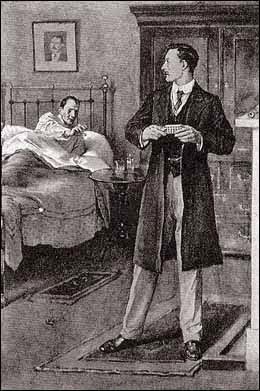
“He's dying, Dr. Watson,” said she. “For three days he has been sinking, and I doubt if he will last the day.”

November 1913
In The Adventure of the Dying Detective, the famous sleuth of 221B, Baker Street, London, is very ill and dying from a rare eastern disease. At least, that is what his landlady Mrs. Hudson and his friend Dr. Watson fear. As would his readers who may be forgiven for their initial startled reaction to Holmes' dire state.

Watson is especially horrified when he finds his friend confined to bed and ailing from a disease he didn’t know Holmes had. The detective is delirious and incoherent and his face is pale and gaunt with bones sticking out of it. His sickly appearance sends a chill into Watson’s heart.

Lest we forget, Holmes is a master of disguise and he uses it most effectively to divert Watson’s attention from his real purpose—to expose Culverton Smith as the man who murdered his own nephew, Victor, by injecting him with the same virus that has apparently made Holmes sick.


Smith is an expert in tropical diseases, including the one afflicting the detective, and he has already tried to kill Holmes in a similar manner. Only the sleuth knows about it.

Holmes in his bed.
Holmes is secretive and ingenious as he instructs Watson to summon Culverton Smith to his house at any cost, ostensibly to cure him but in reality to unmask him in a final showdown.

I liked Watson’s role in this story. He shows his worth as a true and loyal friend when he doesn't ask too many questions and does exactly as Holmes bids him to do. Admirably, Watson is not upset when Holmes summons another doctor to cure him or when Holmes speaks to him in a brusque manner and orders him around. 

In the end Watson realises why, as his dear friend solves Victor’s murder and his own attempted murder from his so-called deathbed. 

The thing with Arthur Conan Doyle's fiction is that, having tasted one, you want several more helpings of his well-crafted stories.

The Adventure of the Dying Detective was first published in Collier’s Weekly Magazine in November 1913 and subsequently in The Strand Magazine in December 1913. Later, it formed one of eight stories in His Last Bow collection. The short story is available free online.

August 01, 2014

Famous Monsters’ Film Fantasy Yearbook, 1982

Todd Mason, who hosts Friday’s Forgotten Books in place of Patti Abbott, will have more knowledge about this magazine and its background.

March 1982
If you like watching horror, fantasy, and science fiction movies, then you’ll like this annual yearbook on some of the famous monsters brought to life by Hollywood.

The 1982 edition of Famous Monsters’ Film Fantasy Yearbook looks at the “creatures” in eleven films, namely Raiders, Titans, Superman II, Halloween II, Dragonslayer, The Howling, Friday the 13th II, Wolfen, Excalibur, Outland, and Werewolf. The cover image is awful while inside the text is clear though the pictures are hazy.


Famous Monsters was one of several horror-fantasy-sf magazines launched by James Warren who founded Warren Publishing in 1957. Over the next twenty-six years, until 1983, he published magazines like After Hours, Creepy, Eerie, Famous Monsters of Filmland, Help!, Spacemen, and Vampirella. The last of these, reproduced below, has cover art by the legendary Frank Frazetta who was noted for his fantasy and sf artworks as well as covers of books and comic books, posters, paintings, and LP record albums. I just read about him.

No.1, September 1969.
Cover art by Frank Frazetta
Warren’s initial publications, Famous Monsters of Filmland and Monster World, were edited by Forrest J. Ackerman, an American collector of science fiction books and movie memorabilia.

I don’t know much about these magazines and chanced upon this hundred-page free yearbook at Archive. You can read more about Warren Publishing at Wikipedia.