October 05, 2012

BOOK REVIEW 

Cape Fear (The Executioners), 1957, 
by John D. MacDonald

My maiden read and review of a John D. MacDonald thriller goes towards Friday's Forgotten Books over at Patti Abbott's blog Pattinase which is being hosted by Todd Mason at his blog Sweet Freedom this week. Check out the two blogs for plenty of other great reviews.

What do you do when an insane criminal threatens to destroy your family and the police are powerless to protect you? 

My copy of Cape Fear
Coronet Books
There is a scene in Friends where Chandler (Matthew Perry) is upset because he sees a video of Richard (Tom Selleck) having sex with a woman he mistakes for his girlfriend Monica (Courteney Cox). When he mentions the video to Monica and insists that Richard is holding on to it because he hasn't got over her, she runs the tape and finds that it isn't her at all. Chandler is ecstatic and blurts out, “Life is good again!”  

It’s the sort of positive sentiment most people express, or say to themselves, after they are out of a particularly difficult period, especially where families are involved. It feels no less than a rebirth. 

Just as it does for Sam and Carol Bowden after they almost single-handedly confront the psychopathic killer who has been terrorising them and their three children, two boys and a teenage girl, for several weeks.

John D. MacDonald deserves sincere praise for writing a gripping tale as well as a gentle rap on the knuckle for putting you through 160-pages of edge-of-the-seat suspense. You want to sit through Sam and Carol’s nightmare and see what happens and you also want to walk away from the terror unfolding in their picture-perfect family life. The temptation to sit through it is greater. Morbid curiosity, perhaps.
 

In Cape Fear (previously The Executioners), MacDonald does not waste time in yanking the reader straightaway into the heart of his story, into the lives of three people—Sam and Carol, an intelligent and handsome couple deeply in love, and Max Cady, a mad criminal seeking to destroy everything they cherish. 

Many years ago, Lieutenant Sam Bowden, an air force pilot, was responsible for putting Cady in prison for the rape of a teenager, and now he is out, stalking the successful lawyer and his family with cold-blooded intent. He poisons their dog and nearly shoots to death the older son while at camp. The police are not especially cooperative. So Sam and Carol hit upon a plan that’s as daring as it’s stupid: use Carol as bait to trap the animal. But, what else can they do?

In Cape Fear, MacDonald has created a family that is as perfect as you would expect families to be—happy and vulnerable and fiercely protective of their small, cocooned world. And then, suddenly, he puts a crack in the mirror that widens and threatens to shatter into a thousand small pieces. Sam and Carol go nearly to pieces, themselves, to ensure their mirror is intact.
 

The other notable aspect of this blinder of a novel is the character and role of Max Cady. The author has portrayed a terrifying picture of a villain who remains largely in the shadow of the Bowdens, exposing himself neither too much nor too little. But you know he’s around somewhere, waiting, lurking, haunting, and you can’t help thinking to yourself, “Come on, Cady, do what you have to do and get it over with.” And while you wait for the cad to do something, you’re not thinking of Sam, he can take care of himself; you’re thinking of Carol and her children, especially their innocent and lovely teenage daughter. You’re thinking of your own family and their vulnerability. Damn you, MacDonald!

In the end, though, "Life is good again!" is what Sam Bowden is thinking as he tells Carol, "It's like recovering from a serious illness. All the world looks fresh and new. Everything looks special. I feel enormously alive. And I don't want that to fade. I want to hang on to that." How often have we felt that way?

And that, in essence, is the narrative power of John D. MacDonald. 


Cape Fear  is my first book by the legendary American crime and suspense writer and I'm looking forward to reading some of his other novels in my possession, including a couple of Travis McGee paperbacks.  


Note: I have deliberately left out mention of the two film adaptations of Cape Fear (1962 & 1991) because I haven't seen either. I’d, however, like to guide you to a past review of the book by Patti Abbott over at her blog Pattinase.

October 04, 2012

50 years of 007: Bond on Bond 

“I don't believe in Bond as a hero. It's a load of nonsense. How can you be a spy when any bar you walk into, the bartender says, ‘Ah, Mr. Bond. Shaken, not stirred?’”
— Sir Roger Moore 


Ian Fleming's impression of James Bond.
Source: Daily Express
This morning Sergio Angelini, a discerning reviewer of books and films, reminded me that Friday, October 5, is the 50th anniversary of the James Bond films. In a well-written piece titled Fifty shades of James Bond, he tells us which 007 movies worked their magic the best. You can read his article over at his blog Tipping My Fedora.

Jeff Flugel at The Stalking Moon gives us two opposing views of Bond films in twin posts titled Bottom of the Barrel Bonds and 50 Years of 007: My Best Bonds.


If you want something official, then head over to 007, the official James Bond site, and look Inside the World of Bond.

If you’re looking for trivia, then you stay right here and check out what each of the six Bond actors have to say about the other, in order of their screen appearance—Sean Connery, George Lazenby, Roger Moore, Timothy Dalton, Pierce Brosnan, and Daniel Craig. Connery made a comeback twice: in Diamonds Are Forever in 1971 and the rather forgettable Never Say Never Again, a 1983 remake of his previous Bond flick Thunderball, 1965. 

Of all the actors who played 007, Roger Moore is by far the funniest, not least because he says, “I like Bond. But it's silly to take it seriously. It's just a great big comic strip.” I like his self-deprecating humour.


Connery on Craig, Brosnan and Dalton
Craig's a great choice, really interesting—different. He's a good actor. It's a completely new departure.

I thought Pierce Brosnan was a good choice. I liked GoldenEye.

Timothy Dalton never got a handle on the role. He took it seriously in the wrong way. The person who plays Bond has to be dangerous. If there isn't a sense of threat, you can't be cool.


Lazenby on Brosnan
If Pierce Brosnan walked into a room, I doubt anyone would look up. But this is the '90s and women want a different man, a man who shows his feminine side. Pierce definitely has that. 


Moore on Craig
People don't realise how physically demanding the role is. I'm still amazed how many people ask me to this day if I did my own stunts. I tell them if I did or Sean did or Pierce did then we would have been physically dead by the end of the first reel of every film! I have seen Daniel Craig in a number of films. He is a thundering good actor. The movie Casino Royale showed me that he is one hell of an athlete. 


Dalton on Moore and Craig
Roger Moore was brilliant but the movies had gone a long way from their roots; they had drifted in a way that was chalk and cheese to Sean. And I think Daniel Craig will work well. I think he's going to be terrific, he's got danger and vulnerability. 


Brosnan on Connery
Well, I was very aware of being within the confines of a very iconic character. I’d seen the men who’d gone before me, and I’d seen the careers that they had afterward and the lives that they had lived as actors. Now, Sean (Connery) was the man for me—he was the Bond of my generation and the only one that I wanted to try to emulate, but with the firm knowledge that I couldn't do what he did, that I’d have to do what I do. But within my time of service to her majesty in that role, I always knew I wanted to have a career thereafter. And so, since then, that’s what I've been busy with. A working actor, just chipping away, chipping away.


Craig on Connery
Sean Connery set and defined the character. He did something extraordinary with that role. He was bad, sexy, animalistic and stylish, and it is because of him I am here today. I wanted Sean Connery's approval and he sent me messages of support, which meant a lot to me.


Barry Nelson 
Spare a thought for the American actor who was the first to play James Bond in a 1954 adaptation of Ian Fleming's novel Casino Royale for a television episode called Climax! This was some eight years before Sean Connery's Dr. No, the first official 007 flick. Nelson apparently played James Bond as an American named Jimmy Bond. I don't know much about Nelson or his brief role as Bond, so readers are welcome to enlighten me.

October 01, 2012

Virgil Finlay: Master of Fantasy

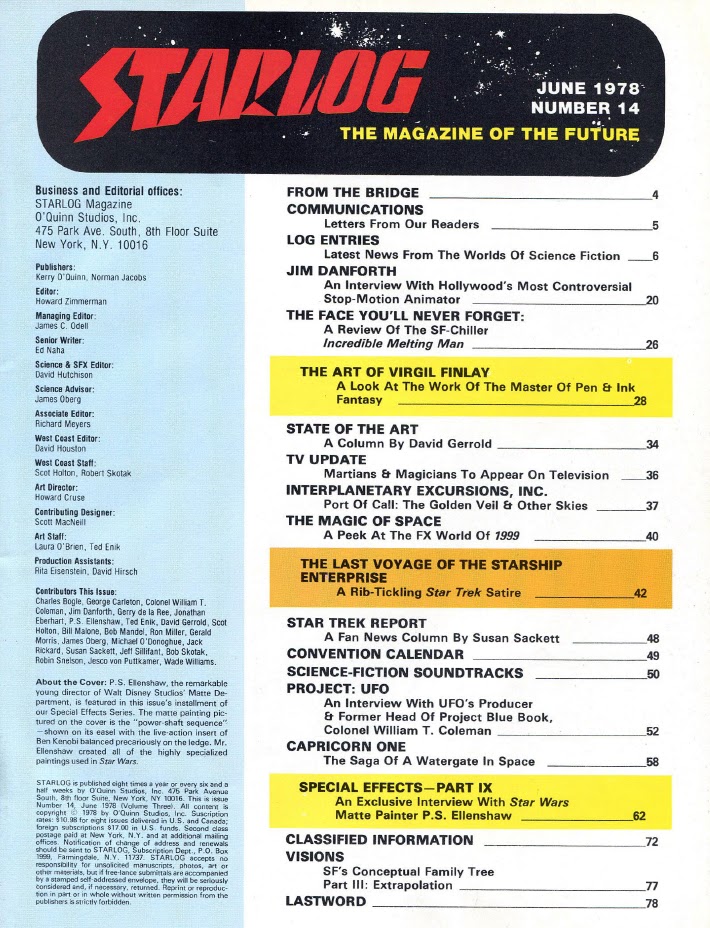
This Monday I was back into my favourite pursuit—looking up rare and vintage stuff in the world of literature. And this is what I came up with: an illustrated article by Gerry de la Ree on the brilliant art of Virgil Finlay in Starlog: The Magazine of the Future, No.14, June 1978.

Ree, a noted American publisher of fanzines, appears to have been somewhat obsessed with Finlay's work in the field of American pulp—science fiction, fantasy and horror. According to the internet, between 1975 and 1981 Ree published a series of seven books that explored the spectacular art of Virgil Finlay accompanied by some 800 high-quality illustrations and detailed essays. The seven books are:


1. Finlay's Last Drawings: For Shakespeare's Midsummer Night's Dream (1975)
2. The Book of Virgil Finlay (1976)
3. Second Book of Virgil Finlay (1978)
4. The Third Book of Virgil Finlay (1979)
5. The Fourth Book of Virgil Finlay (1979)
6. The Fifth Book of Virgil Finlay (1979)
7. The Sixth Book of Virgil Finlay: The Astrology Years (1980)
8. The Seventh Book of Virgil Finlay—Virgil Finlay Remembered (1981) 


In a career spanning more than thirty years, Virgil Finlay (1914-1971) contributed over 2,600 illustrations to popular sf and fantasy and horror magazines like Amazing Stories, Weird Tales and Famous Fantastic MysteriesHis speciality was pen-and-ink drawings which he "accomplished with abundant stippling, cross-hatching, and scratchboard techniques."

He was the master of the scratchboard (or scraperboard) technique where, according to an article on Wikipedia, drawings are created using sharp knives and tools for etching into a thin layer of white China clay that is coated with black India ink. 

Virgil Finlay by artist Charlie McGill
Since the article from Starlog is under Creative Commons License, I'm taking the liberty of quoting Gerry de la Ree. Of Finlay's art, he writes, "His use of the stipple and cross-hatch techniques, and an ability to enhance drawings quickly rocketed him to the top. Over the years many artists would attempt to duplicate Finlay's techniques, but none ever attained the quality that was the trademark of Finlay's finest efforts."

According to him, Finlay did his black-and-white drawings in a variety of techniques, employing pen, brush, spatter, lithographic pencils, sponges, and knives on a variety of paper; the majority were done on scratchboard.

Virgil Finlay's art brought alive the stories of most of the top writers we have heard of, and read, in the sf-fantasy-horror spectrum. Mentioning names would be a waste of time and space though I was surprised with the inclusion of William Shakespeare and John D. MacDonald. You'll find hundreds of covers with Finlay's art over at Internet Speculative Fiction db.

I don't understand Finlay's art or his technique but I admire his work immensely, particularly his black-and-white illustrations. Scroll down for a look…


You can read the Starlog article at www.archive.org. Todd Mason has also featured Virgil Finlay over at his blog Sweet Freedom. Walker Martin's Favourite WEIRD TALES covers, one of which includes cover art by Finlay, can be accessed at Laurie Powers blog Laurie's Wild West.

September 30, 2012

20 books to read before you… 

There's nothing like a list of books to read or movies to watch. The internet is filled with such trivia. My own favourite list for reading books or watching films is the one before you die. Nothing beats it. In fact, Goodreads has a list of 20 books “you must definitely read” before you die. What a shame if you don’t! But why must you read a particular book or watch a specific movie before you kick the bucket? What's the occasion? I can see we're back to square one.

For the heck of it, I compiled my own list of 20 books that I am going to read before I…no, not that…let’s just say in the next two years. I know I'm being overly optimistic. These are titles of books handed down over the past three decades. Actually, my to-be-read list of some of the great books is much longer and so I have put down only those b
ooks I have been wanting to read for a while now. Books that come with high recommendations from all kinds of sources. Books I ought to have read a long time ago. Books I should be rereading now. 

So, what does my Top 20 look like? Take a look below… I might add that I have a vague recollection of having read books 2, 3 & 5 in college though I can't say for sure.

01. Jane Austen — Pride and Prejudice
02. F. Scott Fitzgerald — The Great Gatsby
03. John Steinbeck — The Grapes of Wrath
04. Joseph Conrad — Heart of Darkness
05. George Orwell — 1984
06. J.D. Salinger — The Catcher in the Rye
07. Anthony Burgess — A Clockwork Orange
08. Jack London — The Call of the Wild
09. Fyodor Dostoevsky — The Brothers Karamazov
10. Philip Roth — American Pastoral
11. James Joyce — Dubliners
12. Norman Mailer — The Naked and the Dead
13. Henry Miller — Tropic of Cancer
14. William Faulkner — As I Lay Dying
15. Saul Bellow — The Adventures of Augie March
16. William Styron — Sophie's Choice
17. Leo Tolstoy — War and Peace
18. Oscar Wilde — The Picture of Dorian Gray
19. Gabriel García Márquez — One Hundred Years of Solitude
20. William Golding — Lord of the Flies


Though not a part of the list, I'm going to squeeze in Fountainhead by Ayn Rand as well.

I can hear the authors sniggering—“You didn’t read our books all these years. What makes you think you’re going to read them now? You might as well read them before you…”

September 29, 2012

VINTAGE PICTURES

Murder on the Orient Express was born here


This is Room 411 in Hotel Pera Palace in Istanbul, Turkey, where Agatha Christie wrote Murder on the Orient Express in which Belgian detective Hercule Poirot investigates the murder of Samuel Ratchett, a passenger on the train.


September 27, 2012

BOOK REVIEW

The Mighty Marvel Superheroes’ Cookbook (1977) 

Can comic-books be considered as books? Strictly no, unless they're like Stan Lee's The Mighty Marvel Superheroes’ Cookbook. A perfect recipe for Friday's Forgotten Books over at Patti Abbott's blog Pattinase which is being hosted by Todd Mason at his blog Sweet Freedom this week. Check out the two blogs for plenty of FFB action.

Now your kids can cook with the comics! 

As a kid I used to wonder how Superman could drink water, sip wine or eat food when he was made of steel. I don’t think Jerry Siegel and Joe Shuster ever explained these life-sustaining aspects of their superhero’s life. As a teenager I wondered how the Man of Steel could make love to Lois Lane. Imagine the bionically-challenged Terminator taking a woman to bed…something like that. And as a grown-up I’m still wondering how he’s doing all of the above.

Come to think of it, in the comics Superman is rarely shown drinking or eating let alone making love though in the movie, Superman-II, he (Christopher Reeve) does sleep with his girlfriend (Margot Kidder) on a crystalline bed created out of kryptonite.

Turns out Superman isn’t the only superhero who drinks and eats and burps (let’s forget the sex for now).


A caboodle of Marvel superheroes not only wolf down large quantities of food, they even cook their own food, or so Stan Lee would like us to believe in The Mighty Marvel Superheroes’ Cookbook which is one of the most imaginative comic-book offshoots I have read—and own. Good thing I do: exaggerated as it sounds, used paperbacks of this book cost $124 (Rs.6,200) on Amazon USA and £109.90 (Rs.8,800) on Amazon UK.

A Fireside book published by Simon and Schuster, New York, in 1977, Superheroes’ Cookbook is a 95-page book of everyday recipes by some of Marvel’s leading heroes. Stan Lee claims it’s “the world’s first (and only) superhero cookbook.” It must be—I haven’t come across cookbooks of its kind over the past thirty-five years. At least, I don’t think DC came out with a rival cookbook by the Justice League of America. 

“Our recipes taste and smell Marvel-ous!” Head Chief Captain America proclaims as he takes you through what appears to be a normal cookbook with recipes for five-course meals, kitchen guide, do’s and don’ts, tips and all, except with one significant difference—you feel as if you’re reading a comic-book while browsing through the delectable recipes, which are accompanied by large colourful illustrations of the superheroes as they show off their favourite dishes.

So, for ‘Heroic Breakfast’ you can try out Captain America’s day starters comprising fruit juice pancakes and milk; cereal with milk; or fruit juice, eggs, bacon, toast and milk; or you can have the Hulk’s fried potatoes with bacon and eggs; or the Thing’s clobbered omelette. I can picture his brick-coloured fist pounding the eggs.

You can skip the breakfast and jump to the Fantastic Four’s superhero sandwiches and soups; the Sub-Mariner’s Submarine; The Human Torch’s Fireball; Spider-Man’s Parmigiani; or the Hulk’s Hulkburger.

 
There are six exclusive Heroic Combos as well, if you like.

If you’re still hungry then you can go for the main meal starting with soups from Dr. Strange’s instant eatery besides Doctor Doom’s Lima Bean Chowder; Thor’s Asgardian Vegetable Soup, Iron Man’s Splendid Split Pea Soup; or Silver Surfer’s Surfboard Sensation.

In the main course you have some mighty recipes consisting of meats, poultry, pasta, and fish. Particularly, Thor’s Cabbage Rolls; Doctor Strange’s Mysterious Stew; Daredevil’s De-Deviled Swiss Steak; Conan’s Kung Fu Chicken; Sub-Mariner’s Magnificent Tuna Bake; the Hulk’s Jumbo Shrimp in a Basket; and Spider-Man’s Seafood Platter.

If these sound a tad boring or if you’re looking for something light on the tummy, then you can have some vegetables and salads in 
the Hulk’s kitchen where you'll find the Fantastic Four enticing you with Zangy Casseroles, Stuffed Peppers, Spinach and Corn Casserole, and Grilled Tomato with Cheese. 

Pasta can hardly satiate the Hulk’s hunger and so the green goliath often has Spaghetti and Meat Balls in between clobbering General Thaddeus ‘Thunderbolt’ Ross’ armed lilliputs. He has a simple credo: “Hulk hungry—must feed face.” 

The Marvel gang takes the battle of the palate right to the end with recipes for delicious cakes and cookies, pies and tarts, and desserts and beverages.

The Mighty Marvel Superheroes’ Cookbook has great art and lettering by Joe Giella, a renowned American comic book artist who was on the staff of both DC Comics and Marvel. Presented by Stan Lee, the book is the brainchild of Gene Malis and the recipes are by Jody Cameron Malis of Celebrity Kitchen, Inc.

To round up here’s a tip from the superheroes’ kitchen guide: "Be Neat!! Don’t forget to clean up the mess in the kitchen! It’s easier to clean as you go along than to leave it for later."


September 25, 2012

FILM REVIEW

Wild Hogs (2007)

A Walt Becker comedy for this Tuesday's edition of Overlooked/Forgotten Films and Television at Todd Mason’s blog Sweet Freedom. Don't forget to check out the other fascinating reviews over there.

Dudley Frank (Tim Allen): What'd you do, Woody?
Woody Stevens (John Travolta): I cut the gas lines of their bikes, and then I maybe blew up their bar. 


I am not a particular fan of John Travolta. I enjoyed Saturday Night Fever, Grease and Staying Alive—musical hits that launched his film career and cast the young, lanky, muscular testosterone-driven actor into public limelight. But those were early days and you can't judge Travolta by the way he danced, swore and grinned widely. A lot of people judge Travolta as an actor from his performances in Pulp Fiction and Face/Off, which left me confused by the end. I couldn't figure out who was Travolta and who was Cage.

Over the years John Travolta, who hails from New Jersey, acted in some fine movies which, amongst the ones I have seen, include The Taking of Pelham 1 2 3, Wild Hogs, Ladder 49, Swordfish, The Thin Red Line, Primary Colors, Broken Arrow, and Get Shorty. Mum's the word on the Look Who's Talking series—never did like it.

I liked Travolta best in Wild Hogs (2007). He is seriously funny in this riot of a film about four bikers who hit the high road and get into unforeseen trouble with a gang of professional bikers called the Del Fuegos led by the mean, nasty and sneering Ray Liotta.

Woody Stevens (John Travolta) joins his buddies Doug Madsen (Tim Allen), Bobby Davis (Martin Lawrence) and Dudley Frank (William H. Macy) on a bike adventure and end up in a small town whose sheriff, Charley (Stephen Tobolowsky), and his two squabbling partners are too scared to protect from Jack (Ray Liotta) and his gang.

 
Actually, the Del Fuegos roar into town because they’re after the guy who tampered with their bikes, a guy called Woody. His friends, of course, don’t know anything about it. But when they do, they stand by him, like all good friends. What follows is nearly an hour of sheer fun as Woody and his pals indulge in a good deal of fisticuffs, filibuster and slapstick with the bike gang. And what was meant to be a simple bike adventure nearly turns into a messy affair as the four buddies stand their ground, shaky as it seems under their feet, in defence of the small town and its fun-loving folk.

Pick of the film is the bespectacled and bumbling Dudley Frank (William H. Macy) who is in his element as he spars with the dirt bikers on one hand and courts Maggie (Marisa Tomei) on the other, both with hilarious consequences.

Wild Hogs, see it if you haven't.