September 10, 2012

Robert E. Howard
When Robert E. Howard
got a rejection letter

While Farnsworth Wright was a veteran of World War I and a music critic for the Chicago Herald and Examiner, he was best-known as the firebrand editor of the pulp magazine Weird Tales, a man who often thrust rejection slips into the hands of famous writers and showed them the door. 

Wright regularly published sf, fantasy and horror stories by Robert E. Howard, H.P. Lovecraft and Clark Ashton Smith in Weird Tales. However, he had a difficult relationship with the three authors, as this article tells you. It says, "Wright had a strained relationship with all three writers, rejecting major works by them, such as Lovecraft's At the Mountains of Madness and The Shadow Over Innsmouth, Howard's The Frost Giant's Daughter, and Smith's The Seven Geases (which Wright dismissed as just 'one geas after another')." He also published most of their stories that made them famous.


Here's what Farnsworth Wright thought of Robert E. Howard's story The Frost-Giant's Daughter (1932), an early short story about Conan the Cimmerian which, I believe, was not published in Howard's lifetime. It was published in The Coming of Conan in 1953, seventeen years after he passed away.

© Creative Commons

September 07, 2012

BOOK REVIEW

Anthologies: Best Ghost Stories, The Haunted Hour, and Devil Stories by various authors

These anthologies are my meagre contribution to Friday's Forgotten Books over at Patti Abbott's blog Pattinase.

"Mortal, mock not at the devil, life is short and soon will fail, and the 'fire everlasting' is no idle fairy-tale." — Heine (a reference to the 19th century German poet Heinrich Heine, I think.)
  
© www.library.sc.edu

I haven't done a serious review of a forgotten book since Friday, August 10. I have been taking the easy way out by reading and writing about vintage comic-books, in the main the economy series by the Federal Reserve Bank of New York (August 23) and To The Last Man by Zane Grey (August 31) and, more recently, a historical work, The Story of the Outlaw, by western author Emerson Hough (September 3). Varied stuff, nonetheless.

This Friday is going to be no different because I still haven't read a forgotten novel. I just finished reading Gun Man by Loren D. Estleman, am nearing the end of Harry Potter and the Half-Blood Prince, have read the initial ten pages of Black Dice by Mack Bolan (Don Pendleton), and am tempted to pick up a Lawrence Block, either A Walk Among the Tombstones or Like A Lamb to Slaughter.

Mack Bolan and his allies, Able Team and Phoenix Force, can be considered as forgotten books except for one thing: people like me still read them. Together with Nick Carter, Ian Fleming, Carter Brown, and James Hadley Chase.

So then, this week I bring you previews of three anthologies I discovered at Project Gutenberg and ManyBooks, which have been kind enough to reserve a permanent seat for me over at their ebook libraries. The anthologies by various authors pertain to ghost stories and they are Best Ghost Stories (1919) with an introduction by Arthur B. Reeve, the American mystery writer; The Haunted Hour (1920), a collection of ghost poems compiled by Margaret Widdemer who doesn’t require an introduction; and Devil Stories (1921) edited by Maximilian J. Rudwin who, I think, is a German writer of fantasy and horror.

All three anthologies have contributions by some of the finest writers known to you and me. Here’s how each of the collections stack up…

Best Ghost Stories
Man is incurably fascinated by the mysterious. If all the ghost stories of the ages were blotted out, man would invent new ones.
Arthur B. Reeve in his introduction


01. The Apparition of Mrs. Veal by Daniel Defoe
02, Canon Alberic's Scrap-Book by Montague Rhodes James
03. The Haunted and the Haunters by Edward Bulwer-Lytton
04. The Silent Woman by Leopold Kompert
05. Banshees
06. The Man Who Went Too Far by E.F. Benson
07. The Woman's Ghost Story by Algernon Blackwood
08. The Phantom Rickshaw by Rudyard Kipling
09. The Rival Ghosts by Brander Matthews
10. The Damned Thing by Ambrose Bierce
11. The Interval by Vincent O'sullivan
12. Dey Ain't No Ghosts by Ellis Parker Butler
13. Some Real American Ghosts

The Haunted Hour
I have not considered as ghost-poems anything but poems which related to the return of spirits to earth.
— Margaret Widdemer in her preface


The Far Away Country by Nora Hopper Chesson

“The Nicht Atween The Sancts An' Souls”
All-Souls Katherine by Tynan
All-Saints' Eve by Lizette Woodworth Reese
A Dream by William Allingham
The Neighbors by Theodosia Garrison
A Ballad of Hallowe'en by Theodosia Garrison
The Forgotten Soul by Margaret Widdemer
All-Souls' Night by Dora Sigerson Shorter
Janet's Tryst by George Macdonald
Hallows' E'en by Winifred M. Letts
On Kingston Bridge by Ellen M.H. Cortissoz
All-Souls' Night by Louisa Humphreys

“All The Little Sighing Souls”
Mary Shepherdess by Marjorie L.C. Pickthall
The Little Ghost by Katherine Tynan
Two Brothers by Theodosia Garrison
The Little Dead Child by Josephine Daskam Bacon
The Child Alone by Rosamund Marriott Watson
The Child by Theodosia Garrison
Such are the Souls in Purgatory by Anna Hempstead Branch
The Open Door by Rosamund Marriott Watson
My Laddie's Hounds by Marguerite Elizabeth Easter
The Old House by Katherine Tynan

Shadowy Heroes
Ballad of the Buried Sword by Ernest Rhys
The Looking-Glass by Rudyard Kipling
Drake's Drum by Henry Newbolt
The Grey Ghost by Francis Carlin
Ballad of Douglas Bridge by Francis Carlin
The Indian Burying Ground by Philip Freneau

“Rank On Rank Of Ghostly Soldiers”
The Song of Soldiers by Walter De La Mare
The Blockhouse on the Hill by Helen Gray Cone
Night at Gettysburg by Don C. Seitz
The Riders by Katherine Tynan
The White Comrade by Robert Haven Schauffler
Ghosts of the Argonne by Grantland Rice
November Eleventh by Ruth Comfort Mitchell

Sea Ghosts
The Flying Dutchman by Charles Godfrey Leland
The Phantom Ship by Henry Wadsworth Longfellow
The Phantom Light of the Baie Des Chaleurs by Arthur Wentworth Hamilton Eaton
The Sands of Dee by Charles Kingsley
The Lake of the Dismal Swamp by Thomas Moore
The Flying Dutchman of the Tappan Zee by Arthur Guiterman
The White Ships and the Red by Joyce Kilmer
Featherstone's Doom by Robert Stephen Hawker
Sea-Ghosts by May Byron
Fog Wraiths by Mildred Howells

Cheerful Spirits
Cape Horn Gospel by John Masefield
Legend of Hamilton Tighe by Richard Harris Barham
The Supper Superstition by Thomas Hood
The Ingolds Penance by Richard Harris Barham
Pompey's Ghost by Thomas Hood
The Ghost by Thomas Hood
Mary's Ghost by Thomas Hood
The Superstitious Ghost by Arthur Guiterman
Dave Lilly by Joyce Kilmer
Martin by Joyce Kilmer

Haunted Places
The Listeners by Walter De La Mare
Haunted Houses by Henry Wadsworth Longfellow
The Beleaguered City by Henry Wadsworth Longfellow
A Newport Romance by Bret Harte
A Legend by May Kendall
A Midnight Visitor by Elizabeth Akers Allen
Haunted by Amy Lowell
The Little Green Orchard by Walter De La Mare
Fireflies by Louise Driscoll
The Little Ghost by Edna St. Vincent Millay
Haunted by Louis Untermeyer
Ghosts by Madison Cawein
The Three Ghosts by Theodosia Garrison

“You Know The Old, While I Know The New”
After Death by Christina Rossetti
The Passer-By by Edith M. Thomas
At Home by Christina Rossetti
The Return by Minna Irving
The Room's Width by Elizabeth Stuart Phelps Ward
Haunted by Don Marquis

“My Love That Was So True”
One Out-Of-Doors by Sarah Piatt
Sailing Beyond Seas by Jean Ingelow
Betrayal by Aline Kilmer
The True Lover by A.E. Housman
Haunted by G.B. Stuart
The White Moth by Sir Arthur Quiller-Couch
The Ghost by Walter De La Mare
Luke Havergal by Edwin Arlington Robinson
The Highwayman by Alfred Noye Noyes
The Blue Closet by William Morris
The Ghost's Petition by Christina Rossetti
He and She by Sir Edwin Arnold

Shapes Of Doom
The Dead Coach by Katherine Tynan
Deid Folks' Ferry by Rosamund Marriott Watson
Keith of Ravelston by Sydney Dobell
The Fetch by Dora Sigerson Shorter
The Banshee by Dora Sigerson Shorter
The Seven Whistlers by Alice E. Gillington
The Victor by Theodosia Garrison
Mawgan of Melhuach by Robert Stephen Hawker
The Mother's Ghost by Henry Wadsworth Longfellow
The Dead Mother by Robert Buchanan

Legends And Ballads Of The Dead
The Folk of the Air by William Butler Yeats
The Reconciliation by A. Margaret Ramsay
The Priest's Brother by Dora Sigerson Shorter
The Ballad of Judas by Iscariot Robert Buchanan
The Eve of St. John by Walter Scott
Fair Margaret's Misfortunes, Anon.
Sweet William's Ghost, Anon.
Clerk Saunders, Anon.
The Wife of Usher's Well, Anon.
A Lyke-Wake Dirge, Anon.

Devil Stories
The reader will find between the covers of this book Devils fascinating and fearful, Devils powerful and picturesque, Devils serious and humorous, Devils pathetic and comic, Devils phantastic and satiric, Devils gruesome and grotesque. I have tried, though, to keep them all in good humour throughout the book, and can accordingly assure the reader that he need fear no harm from an intimate acquaintance with the diabolical company to which he is herewith introduced.
Maximilian J. Rudwin in his introduction


01. The Devil in a Nunnery: A Mediaeval Tale by Francis Oscar Mann
02. Belphagor, Or The Marriage of the Devil by Niccolò Machiavelli
03. The Devil and Tom Walker by Washington Irving
04. From the Memoirs of Satan by Wilhelm Hauff
05. St. John's Eve by Nikolái Vasilévich Gógol
06. The Devil's Wager by William Makepeace Thackeray
07. The Painter's Bargain by William Makepeace Thackeray
08. Bon-Bon by Edgar Allan Poe
09. The Printer's Devil, Anon.
10. The Devil's Mother-In-Law by Fernán Caballero
11. The Generous Gambler by Charles Pierre Baudelaire
12. The Three Low Masses: A Christmas Story by Alphonse Daudet
13. Devil-Puzzlers by Frederick Beecher Perkins
14. The Devil's Round: A Tale of Flemish Golf by Charles Deulin
15. The Legend of Mont St. Michel by Guy De Maupassant
16. The Demon Pope by Richard Garnett
17. Madam Lucifer by Richard Garnett
18. Lucifer by Anatole France
19. The Devil by Maxím Gorky
20. The Devil and the Old Man by John Masefield

Since I haven’t reviewed the anthologies here, as I should have, the least I can do is provide you with the links to all three, at Manybooks, right here—Best Ghost Stories, The Haunted Hour and Devil Stories. You can download them in any format you like. Hurrah for Creative License!

September 04, 2012

MUSIC & LYRICS

Say You Love Me and Mehbooba, Mehbooba

This week I have two classic audio-video songs for you as part of Tuesday’s Overlooked/Forgotten films and television over at Todd Mason’s blog Sweet Freedom.

When I first heard Say You Love Me by Greek singer Demis Roussos, I was struck by its musical resemblance to Mehbooba, Mehbooba from the Hindi cult film Sholay (1975) which many consider to be the greatest Indian film ever made. Roussos, himself, appears to have borrowed the musical score of Say You Love Me from Ta Rialia sung by another Greek singer Michalis Violaris. I haven't heard his version yet.

Sholay, produced and directed by the father-son duo of G.P. Sippy and Ramesh Sippy, was influenced by spaghetti westerns and particularly by John Sturges' The Magnificent Seven (1960), or Akira Kurosawa's Seven Samurai (1954) if you like. I intend to write about Sholay someday. It was called  Embers in English.

Mehbooba, Mehbooba, which means my love or my beloved, was composed and sung by the late R.D. Burman, one of India's most versatile musicians, in his trademark soul-filled baritone voice. You can picture an RD song the moment you hear the opening lines. His fan following has grown since he passed away in 1994.

In Sholay, the song is pictured on Indian character-actor Jalal Agha and dance queen Helen who, as a couple of wandering gypsy musicians, sing Mehbooba, Mehbooba before Gabbar Singh (Amjad Khan) who plays a dreaded dacoit from Chambal Valley, the once-notorious bandit hideout in central India.

Most Indians, I'm sure, have never heard Say You Love Me and I don't think they really need to, because Mehbooba, Mehbooba outscores Demis Roussos' solo number which sounds tame in comparison. The Hindi song is vastly superior in musical texture, thanks to the use of a wide array of musical instruments by R.D. Burman.

It's the kind of song you'll enjoy even if you don't fathom the lyrics but then Mehbooba, Mehbooba is about RD’s score and Helen’s dance, and little else. I suggest that you listen to Say You Love Me first and then its near Hindi copy. It was plagiarism at its best, as so many Hindi films and film songs have been over the years. Let me know what you think.


September 03, 2012

VINTAGE PICTURES

The Story of the Outlaw

The Story of the Outlaw: A Study of the Western Desperado by Emerson Hough, writer of western stories and historical novels, should ideally be my entry for Friday's Forgotten Books over at Patti Abbott's blog. It isn't because I can't wait to feature it now, in slide-show format which tells its own story. It would take me at least a week, or more, to read the 232-page ebook from Project Gutenberg and probably as much time to write about it. A review of a western historical work requires some understanding of the period and the events around it as opposed to a review of a western novel. In spite of its historical backdrop, I'd be more comfortable writing about a novel I read.

The book offers "historical narratives of famous outlaws, the stories of noted border wars, vigilante movements and armed conflicts on the frontier." The copyright to this fascinating chroncile of the western outlaw, in his various avatars, is held by two entities, the Curtis Publishing Company, 1905, and Emerson Hough and the Outing Publishing Company, New York, 1907. I'm not sure what that means.

"The stories of modern train-robbing bandits and outlaw gangs are taken partly from personal narratives, partly from judicial records, and partly from works frequently more sensational than accurate, and requiring much sifting and verifying in detail. Naturally, very many volumes of Western history and adventure have been consulted," Emerson Hough writes in his preface to The Story of the Outlaw.
 

"Much of this labor has been one of love for the days and places concerned, which exist no longer as they once did. The total result, it is hoped, will aid in telling at least a portion of the story of the vivid and significant life of the West, and of that frontier whose van, if ever marked by human lawlessness, has, none the less, ever been led by the banner of human liberty," he adds. 

The book is divided into following twenty-two chapters:

01. The Desperado
02. The Imitation Desperado
03. The Land of The Desperado
04. The Early Outlaw
05. The Vigilantes Of California
06. The Outlaw of the Mountains
07. Henry Plummer
08. Boone Helm
09. Death Scenes of Desperadoes
10. Joseph A. Slade
11. The Desperado of the Plains
12. Wild Bill Hickok
13. Frontier Wars
14. The Lincoln County War
15. The Stevens County War
16. Biographies of Bad Men
17. The Fight of Buckshot Roberts
18. The Man Hunt
19. Bad Men of Texas
20. Modern Bad Men
21. Bad Men of the Indian Nations
22. Desperadoes of the Cities

From the dust jacket of The Man Next Door, 1917.
© University of Iowa Libraries

If you're an expert on Western history and frontier life, as Ron Scheer of California is, then you'll know what each of these chapters is about. Ron has covered Emerson Hough's work quite extensively at his blog Buddies in the Saddle. Here are the links to his posts on the American historian and his books, in order of publication:

1. Emerson Hough, The Story of the Cowboy (1897), October 11, 2010
2. Emerson Hough, again, October 14, 2010
3. Emerson Hough, Heart’s Desire (1905), October 19, 2010

Now then, the slide-show I promised earlier...

Plummer's Men

The Scene of Many Little Wars

Types of Border Barricades

The Scene of Many Hangings

Sheriff Pat F. Garrett who killed
Billy the Kid

Billy the Kid shoots Deputy Sheriff
Bob Ollinger

How the rustler worked

Texas rancher John Chisum

Billy the Kid

The Old Chisum Ranch


Border Fortress

Western Man Hunt

If you enjoyed the images, then you might also want to read the ebook at Project Gutenberg or ManyBooks. Click on the links.

September 02, 2012

Indradhanush over Bombay skyline

Last Saturday evening, I was walking towards Marine Lines Station, South Bombay, to catch a "local" train for a suburb up northwest where I live, when I noticed people looking up at the sky and taking photographs on their cellphones. They seemed excited about something. I looked up and saw the most spectacular rainbow I'd ever seen in my life. The rainbow, showing off all its seven primary colours, arched right over our heads, stretching from one end of the Arabian Sea to the other. It was clearly visible all over South Bombay (now Mumbai), an island city, and appeared so close that you felt like reaching out and touching it. It was a rare sight.

It seemed as if Lord Indra, the Hindu king of gods and the god of rain, thunder and lightning, had raised his potent weapon, the dhanush (bow), and was about to launch his celestial arrows into space. In Hindu mythology, the rainbow is known as Indradhanush or Indra's bow.

Here are some images I couldn't resist taking on my cellphone with a 
2 megapixel camera.


Copyright: Prashant C. Trikannad

August 31, 2012

BOOK REVIEW

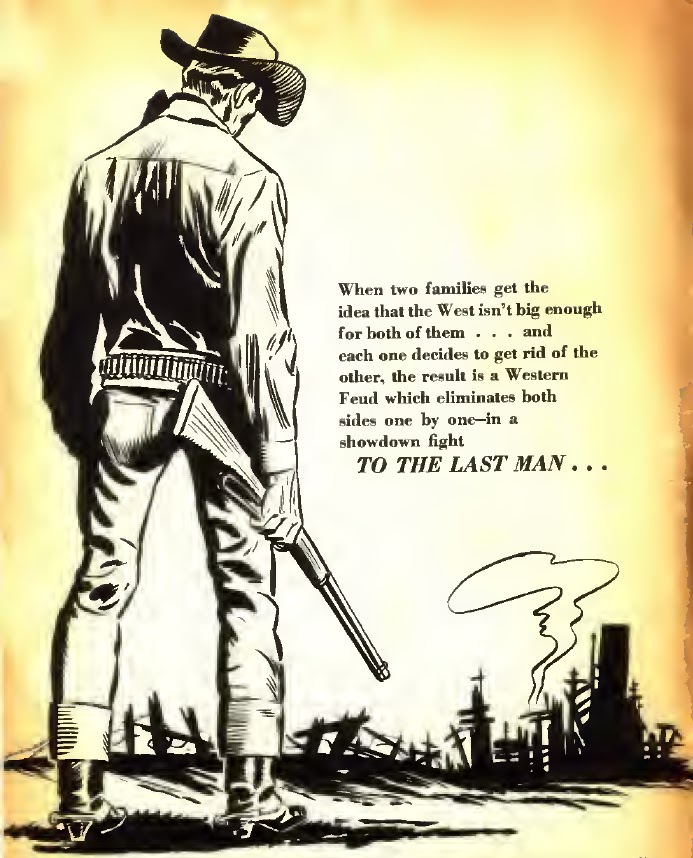
To The Last Man by Zane Grey

Another comic-book contribution for this Friday’s Forgotten Books edition over at Patti Abbott’s blog Pattinase. Don’t forget to read the fine reviews of forgotten books by other bloggers over there. 

Much of my reading of western fiction in early days was shaped by Oliver Strange, Zane Grey, Louis L’amour, George G. Gilman and J.T. Edson. British writer Strange remains a favourite to this day. His ten Corgi paperbacks about Sudden, the heroic two-gun Texas outlaw, captured my youthful imagination of the Wild West like little else. His compatriot Frederick W. Nolan did a terrific job by writing five more books in the Sudden series. There have been no reprints since.

Zane Grey came next and one of his novels that I read very early on was To The Last Man which he wrote in 1921. Unlike Strange and Nolan, I haven’t read all of Grey but I remember liking this novel a lot. It had an original storyline, I’d assume, of love between a young man and woman caught on the opposite sides of a blood feud between their two frontier families. 


The theme soon became staple diet for subsequent books and movies, both western and non-western. Bollywood still thrives on it.

Young John Isbel and Ellen Jorth are loyal to their families and at the same time hopelessly in love with each other. They realise the futility of the range war sparked by rustling by one of the two families and played out in Tonto Basin, Arizona.


Grey first serialised To The Last Man in The Country Gentleman magazine during May-July 1921. But then, many of his stories were serialised in various magazines before they were published into books. 

A couple of days ago I downloaded To The Last Man comic-book by Dell and was pleased to find that it stayed true to Grey’s story based on the Pleasant Valley War or the Tonto Basin War. Having read the comic-book, I now want to reread the book and see if I feel differently about it. I doubt it, though.

August 28, 2012

FILM REVIEW

Twister (1996)

Twister is my contribution to Tuesday’s Overlooked/Forgotten films and television over at Todd Mason’s blog Sweet Freedom. Don't forget to check out the other fascinating reviews over there.

Dustin Davis (Philip Seymour Hoffman): Jo, Bill, it's coming! It's headed right for us!
Bill Harding (Bill Paxton): It’s already here!


Two of my blog friends, writers Charles Gramlich and F.T. Bradley, are taking evasive action in the wake of Tropical Storm Isaac which is expected to cut through the US Gulf Coast sometime Tuesday. The US National Hurricane Centre in Miami, Florida, warned that Isaac was on the verge of becoming a full-blown hurricane and advised hundreds and thousands of residents from low-lying areas to evacuate to high ground which, the way I see it, could be anywhere.

Evacuation, either due to a natural disaster or a manmade catastrophe, is never easy. It's one thing to pack up a few prized possessions, bundle your family and your pets into a car, and drive away to safety. It’s quite another to live in your temporary accommodation with fear and uncertainty, wondering if the beautiful home you left behind is still going to be there when you go back. This is no vacation.

I hope Charles Gramlich and F.T. Bradley and their families and everyone else in the path of Storm Isaac are safe and sound and there is no recurrence of something even remotely close to Hurricane Katrina.

For Tuesday's Overlooked Films and Television, I write about films and serials I watched over the weekend. While I can recall a face I saw wedged between two boxes of Betty Crocker pancake mix in the grocery section of a packed mall two years ago, I can’t remember everything about a film I watched, say, nine months ago. I usually need a refresher. So, last Saturday, I watched parts of a film I had seen before, Twister, and decided to write about it after reading the storm-related posts by Charles and F.T. Bradley, both published authors. 

A tornado in Hardtner, Kansas, in 1929.


Before I touch upon this film, however, here’s a question: do hurricanes or typhoons (known as cyclones in the Indian subcontinent) cause tornadoes or twisters? Apparently, when they make landfall, they do. 

The computerised twisters in Dutch filmmaker Jan Le Bont’s action-adventure film don’t look as terrifying as they obviously do in real life. There is something surreal about tornadoes, especially multiple tornadoes, particularly those swaying eerily far off at sea and heading for the nearest shore. You know where Spielberg got the idea for his giant alien tripods in War of the Worlds.

 
Tornado chasers Dr. Jo Harding (Helen Hunt) and Bill Harding (Bill Paxton) are in the middle of a ridiculous divorce, he chasing her for her stamp of approval on the divorce papers but not really wanting to divorce her, and she chasing twisters that killed her father. Vengeance can be a stormy affair. Caught between Jo and Bill is his new girlfriend Dr. Melissa Reeves (Jami Gertz) whose look throughout the film can only mean two things—“no one loves me, sniff,” or “what the hell am I doing in this place?” I’ll opt for the former.

Accompanying Jo and Bill on their reckless adventure are half-a-dozen fellow researchers and weathermen including the eccentric Dustin Davis, played by the talented Philip Seymour Hoffman who looks older than his age, currently 45, in most of his films (somebody’s got to check out his BC). 
Hoffman  has “lost it” in Twister as his loud persona and inane comments fail to evoke laughter. For instance, when a particularly nasty twister gobbles up a truck and throws it right back into the path of his own truck, Davis tells a petrified Melissa in the driver's seat, “Did you just miss that truck? That's awesome!”  Hoffman  was equally obnoxious as Ben Stiller’s sidekick in Along Came Polly which, of course, is not to take away his stellar performance in Capote and Doubt, to name a few. He's got to junk these silly roles. Leave them for Jack Black.


Twister is an average film, entertaining nonetheless. Helen Hunt and Bill Paxton act well though you can’t help thinking the film owes more to Hunt than Paxton. I have never seen a real tornado in my life (they don’t occur in India) though I know that real-life twisters are scarier as hell. The romantic interlude between the couple overshadows the terrifying realities of tornadoes swirling around them. I should know better: this is a romantic drama, not a climate documentary.