September 03, 2012

VINTAGE PICTURES

The Story of the Outlaw

The Story of the Outlaw: A Study of the Western Desperado by Emerson Hough, writer of western stories and historical novels, should ideally be my entry for Friday's Forgotten Books over at Patti Abbott's blog. It isn't because I can't wait to feature it now, in slide-show format which tells its own story. It would take me at least a week, or more, to read the 232-page ebook from Project Gutenberg and probably as much time to write about it. A review of a western historical work requires some understanding of the period and the events around it as opposed to a review of a western novel. In spite of its historical backdrop, I'd be more comfortable writing about a novel I read.

The book offers "historical narratives of famous outlaws, the stories of noted border wars, vigilante movements and armed conflicts on the frontier." The copyright to this fascinating chroncile of the western outlaw, in his various avatars, is held by two entities, the Curtis Publishing Company, 1905, and Emerson Hough and the Outing Publishing Company, New York, 1907. I'm not sure what that means.

"The stories of modern train-robbing bandits and outlaw gangs are taken partly from personal narratives, partly from judicial records, and partly from works frequently more sensational than accurate, and requiring much sifting and verifying in detail. Naturally, very many volumes of Western history and adventure have been consulted," Emerson Hough writes in his preface to The Story of the Outlaw.
 

"Much of this labor has been one of love for the days and places concerned, which exist no longer as they once did. The total result, it is hoped, will aid in telling at least a portion of the story of the vivid and significant life of the West, and of that frontier whose van, if ever marked by human lawlessness, has, none the less, ever been led by the banner of human liberty," he adds. 

The book is divided into following twenty-two chapters:

01. The Desperado
02. The Imitation Desperado
03. The Land of The Desperado
04. The Early Outlaw
05. The Vigilantes Of California
06. The Outlaw of the Mountains
07. Henry Plummer
08. Boone Helm
09. Death Scenes of Desperadoes
10. Joseph A. Slade
11. The Desperado of the Plains
12. Wild Bill Hickok
13. Frontier Wars
14. The Lincoln County War
15. The Stevens County War
16. Biographies of Bad Men
17. The Fight of Buckshot Roberts
18. The Man Hunt
19. Bad Men of Texas
20. Modern Bad Men
21. Bad Men of the Indian Nations
22. Desperadoes of the Cities

From the dust jacket of The Man Next Door, 1917.
© University of Iowa Libraries

If you're an expert on Western history and frontier life, as Ron Scheer of California is, then you'll know what each of these chapters is about. Ron has covered Emerson Hough's work quite extensively at his blog Buddies in the Saddle. Here are the links to his posts on the American historian and his books, in order of publication:

1. Emerson Hough, The Story of the Cowboy (1897), October 11, 2010
2. Emerson Hough, again, October 14, 2010
3. Emerson Hough, Heart’s Desire (1905), October 19, 2010

Now then, the slide-show I promised earlier...

Plummer's Men

The Scene of Many Little Wars

Types of Border Barricades

The Scene of Many Hangings

Sheriff Pat F. Garrett who killed
Billy the Kid

Billy the Kid shoots Deputy Sheriff
Bob Ollinger

How the rustler worked

Texas rancher John Chisum

Billy the Kid

The Old Chisum Ranch


Border Fortress

Western Man Hunt

If you enjoyed the images, then you might also want to read the ebook at Project Gutenberg or ManyBooks. Click on the links.

September 02, 2012

Indradhanush over Bombay skyline

Last Saturday evening, I was walking towards Marine Lines Station, South Bombay, to catch a "local" train for a suburb up northwest where I live, when I noticed people looking up at the sky and taking photographs on their cellphones. They seemed excited about something. I looked up and saw the most spectacular rainbow I'd ever seen in my life. The rainbow, showing off all its seven primary colours, arched right over our heads, stretching from one end of the Arabian Sea to the other. It was clearly visible all over South Bombay (now Mumbai), an island city, and appeared so close that you felt like reaching out and touching it. It was a rare sight.

It seemed as if Lord Indra, the Hindu king of gods and the god of rain, thunder and lightning, had raised his potent weapon, the dhanush (bow), and was about to launch his celestial arrows into space. In Hindu mythology, the rainbow is known as Indradhanush or Indra's bow.

Here are some images I couldn't resist taking on my cellphone with a 
2 megapixel camera.


Copyright: Prashant C. Trikannad

August 31, 2012

BOOK REVIEW

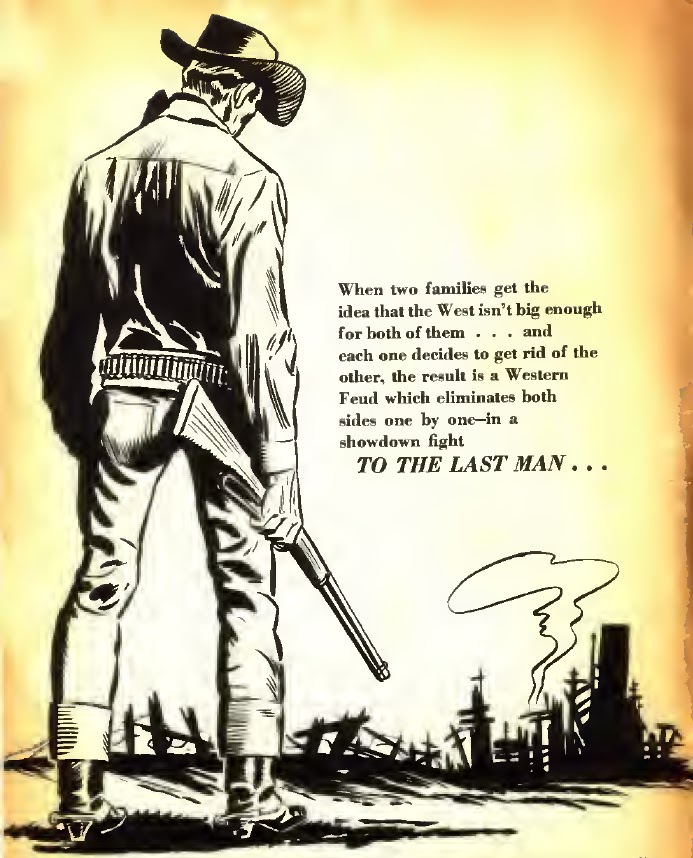
To The Last Man by Zane Grey

Another comic-book contribution for this Friday’s Forgotten Books edition over at Patti Abbott’s blog Pattinase. Don’t forget to read the fine reviews of forgotten books by other bloggers over there. 

Much of my reading of western fiction in early days was shaped by Oliver Strange, Zane Grey, Louis L’amour, George G. Gilman and J.T. Edson. British writer Strange remains a favourite to this day. His ten Corgi paperbacks about Sudden, the heroic two-gun Texas outlaw, captured my youthful imagination of the Wild West like little else. His compatriot Frederick W. Nolan did a terrific job by writing five more books in the Sudden series. There have been no reprints since.

Zane Grey came next and one of his novels that I read very early on was To The Last Man which he wrote in 1921. Unlike Strange and Nolan, I haven’t read all of Grey but I remember liking this novel a lot. It had an original storyline, I’d assume, of love between a young man and woman caught on the opposite sides of a blood feud between their two frontier families. 


The theme soon became staple diet for subsequent books and movies, both western and non-western. Bollywood still thrives on it.

Young John Isbel and Ellen Jorth are loyal to their families and at the same time hopelessly in love with each other. They realise the futility of the range war sparked by rustling by one of the two families and played out in Tonto Basin, Arizona.


Grey first serialised To The Last Man in The Country Gentleman magazine during May-July 1921. But then, many of his stories were serialised in various magazines before they were published into books. 

A couple of days ago I downloaded To The Last Man comic-book by Dell and was pleased to find that it stayed true to Grey’s story based on the Pleasant Valley War or the Tonto Basin War. Having read the comic-book, I now want to reread the book and see if I feel differently about it. I doubt it, though.

August 28, 2012

FILM REVIEW

Twister (1996)

Twister is my contribution to Tuesday’s Overlooked/Forgotten films and television over at Todd Mason’s blog Sweet Freedom. Don't forget to check out the other fascinating reviews over there.

Dustin Davis (Philip Seymour Hoffman): Jo, Bill, it's coming! It's headed right for us!
Bill Harding (Bill Paxton): It’s already here!


Two of my blog friends, writers Charles Gramlich and F.T. Bradley, are taking evasive action in the wake of Tropical Storm Isaac which is expected to cut through the US Gulf Coast sometime Tuesday. The US National Hurricane Centre in Miami, Florida, warned that Isaac was on the verge of becoming a full-blown hurricane and advised hundreds and thousands of residents from low-lying areas to evacuate to high ground which, the way I see it, could be anywhere.

Evacuation, either due to a natural disaster or a manmade catastrophe, is never easy. It's one thing to pack up a few prized possessions, bundle your family and your pets into a car, and drive away to safety. It’s quite another to live in your temporary accommodation with fear and uncertainty, wondering if the beautiful home you left behind is still going to be there when you go back. This is no vacation.

I hope Charles Gramlich and F.T. Bradley and their families and everyone else in the path of Storm Isaac are safe and sound and there is no recurrence of something even remotely close to Hurricane Katrina.

For Tuesday's Overlooked Films and Television, I write about films and serials I watched over the weekend. While I can recall a face I saw wedged between two boxes of Betty Crocker pancake mix in the grocery section of a packed mall two years ago, I can’t remember everything about a film I watched, say, nine months ago. I usually need a refresher. So, last Saturday, I watched parts of a film I had seen before, Twister, and decided to write about it after reading the storm-related posts by Charles and F.T. Bradley, both published authors. 

A tornado in Hardtner, Kansas, in 1929.


Before I touch upon this film, however, here’s a question: do hurricanes or typhoons (known as cyclones in the Indian subcontinent) cause tornadoes or twisters? Apparently, when they make landfall, they do. 

The computerised twisters in Dutch filmmaker Jan Le Bont’s action-adventure film don’t look as terrifying as they obviously do in real life. There is something surreal about tornadoes, especially multiple tornadoes, particularly those swaying eerily far off at sea and heading for the nearest shore. You know where Spielberg got the idea for his giant alien tripods in War of the Worlds.

 
Tornado chasers Dr. Jo Harding (Helen Hunt) and Bill Harding (Bill Paxton) are in the middle of a ridiculous divorce, he chasing her for her stamp of approval on the divorce papers but not really wanting to divorce her, and she chasing twisters that killed her father. Vengeance can be a stormy affair. Caught between Jo and Bill is his new girlfriend Dr. Melissa Reeves (Jami Gertz) whose look throughout the film can only mean two things—“no one loves me, sniff,” or “what the hell am I doing in this place?” I’ll opt for the former.

Accompanying Jo and Bill on their reckless adventure are half-a-dozen fellow researchers and weathermen including the eccentric Dustin Davis, played by the talented Philip Seymour Hoffman who looks older than his age, currently 45, in most of his films (somebody’s got to check out his BC). 
Hoffman  has “lost it” in Twister as his loud persona and inane comments fail to evoke laughter. For instance, when a particularly nasty twister gobbles up a truck and throws it right back into the path of his own truck, Davis tells a petrified Melissa in the driver's seat, “Did you just miss that truck? That's awesome!”  Hoffman  was equally obnoxious as Ben Stiller’s sidekick in Along Came Polly which, of course, is not to take away his stellar performance in Capote and Doubt, to name a few. He's got to junk these silly roles. Leave them for Jack Black.


Twister is an average film, entertaining nonetheless. Helen Hunt and Bill Paxton act well though you can’t help thinking the film owes more to Hunt than Paxton. I have never seen a real tornado in my life (they don’t occur in India) though I know that real-life twisters are scarier as hell. The romantic interlude between the couple overshadows the terrifying realities of tornadoes swirling around them. I should know better: this is a romantic drama, not a climate documentary.

August 25, 2012

I can't leave a comment...

Blogger has tweaked something, somewhere. Google's blog-publishing service has been rejecting my comments on other blogs that require word verification. I have no problem commenting on blogs where I don't have to prove I'm not a robot. I tried to leave comments through a PC and two laptops just in case there was something amiss with the one I use. No luck. There are no such issues with Wordpress, though. I can't think of a solution at the moment. Do you have one? Many thanks...

August 23, 2012

BOOK REVIEW

Comic-books on economy

A not-too-insignificant contribution to this Friday’s Forgotten Books edition over at Patti Abbott’s blog Pattinase. Don’t forget to read the fine reviews of forgotten books by other bloggers over there.

Back in school, comic-books gave me more education than text-books, starting with Amar Chitra Katha (Immortal Picture Stories), India's largest and most popular comics imprint. In spite of their often mediocre artwork, these comics retold captivating stories from the great Indian epics like the Mahabharata and Ramayana, history, mythology, fables and folklore, and the Indian freedom movement, apart from easy-to-read profiles of noted social reformers, political leaders, freedom fighters, and spiritual gurus—all in comic-book format.

I don't know much about economy, so these days I'm brushing up my knowledge of this rather tiresome subject by reading the comic-book series brought out by the publications division of the Federal Reserve Bank of New York. You can read and learn the basics of economy in comic-book format and enjoy it too.

Here are introductions to six comics from the series, courtesy of the Federal Reserve Bank of New York, Public Affairs Department.


Learn the major functions of the Federal Reserve System, the tools of monetary policy and how they work, and the other ways in which the Fed helps the US economy and financial system to function.


A history of the US monetary system and events leading to the establishment of the Federal Reserve System.


This comic-book explains the meaning and purpose of monetary policy, how the Federal Reserve makes monetary policy, and how the tools of monetary policy work.


Find out the causes and effects of inflation.


Illustrates the importance of savings, how it benefits all of us, and the various types of savings instruments and institutions.


Three young entrepreneurs use sophisticated bank services over a 23-year period. It also explores the role of checking deposits and lending in money creation.

August 13, 2012

VINTAGE ADS

Unknown World


This is the ad that Fawcett Publications, Inc. of Greenwich, Connecticut, USA, published in its inaugural issue of Unknown World, released in June 1952, to advertise its new comic magazine. Will Lieberson was the executive editor and Al Jetter was the art editor.

According to his obituary in The New York Times, published January 17, 1995, William H. Lieberson, 79, was a successful director and playwright before he became editor-in-chief of Fawcett Comics, "where he oversaw the production of such monthly comic books as Captain Marvel."

Fawcett published comics across many genres including horror comics in the 1950s, a string of titles which, apart from Unknown World, also included This Magazine Is Haunted, Beware! Terror Tales, Worlds of Fear, and Strange Suspense Stories.

Lieberson and Jetter also collaborated on other horror comics from the Fawcett stable, notably This Magazine Is Haunted, which resembled EC's distinct brand of horror comics.