July 03, 2012

Charles Dickens on copyright

English author Charles Dickens had strong views about copyright and its infringement by publishers and newspapers, as evident from this letter he wrote his close friend and brother-in-law, Henry Austin, an American architect and artist, on May 1, 1842. Not much has changed since Dickens’ angry outburst against “scoundrel booksellers” and “detestable newspaper(s)” a hundred and seventy years ago.

“I am glad you exult in the fight I have had about the copyright. If you knew how they tried to stop me, you would have a still greater interest in it. The greatest men in England have sent me out, through Forster, a very manly, and becoming, and spirited memorial and address, backing me in all I have done. I have despatched it to Boston for publication, and am coolly prepared for the storm it will raise. But my best rod is in pickle.

“Is it not a horrible thing that scoundrel booksellers should grow rich here from publishing books, the authors of which do not reap one farthing from their issue by scores of thousands; and that every vile, blackguard, and detestable newspaper, so filthy and bestial that no honest man would admit one into his house for a scullery door-mat, should be able to publish those same writings side by side, cheek by jowl, with the coarsest and most obscene companions with which they must become connected, in course of time, in people's minds? 

“Is it tolerable that besides being robbed and rifled an author should be forced to appear in any form, in any vulgar dress, in any atrocious company; that he should have no choice of his audience, no control over his own distorted text, and that he should be compelled to jostle out of the course the best men in this country who only ask to live by writing? I vow before high heaven that my blood so boils at these enormities, that when I speak about them I seem to grow twenty feet high, and to swell out in proportion. Robbers that ye are, I think to myself when I get upon my legs, here goes!”

[The above section has been excerpted from The Letters of Charles Dickens Vol.1 (of 3), 1833-1856, edited by Georgina Hogarth, his sister-in-law, and Mamie Dickens, his eldest daughter, under Project Gutenberg License.]

July 02, 2012

JUKE BOX

Love Is a Many Splendored Thing
by The Four Aces


Love is a many splendored thing
It's the April rose
That only grows in the early spring
Love is nature's way of giving
A reason to be living
The golden crown that makes a man a king


This is one of the most beautiful songs I have ever heard. The lyrics and music are soulful. The song, which first played in the 1955-film Love Is a Many Splendored Thing, was written and composed by Paul Francis Webster and Sammy Fain respectively. The music duo collaborated on the original score for several films including "Secret Love" in Calamity Jane, 1954. They won the Oscar for both these songs.


Since the song played out in the William Holden-Jennifer Jones romantic film, set in Hong Kong, it has been recorded by various singers like Nat King Cole, Engelbert Humperdinck, Andy Williams, The Four Aces, Frank Sinatra, Ringo Starr, Neil Sedaka, and Connie Francis who sang it in Italian. 


So far I have only heard two versions, those by The Four Aces and Engelbert Humperdinck. Though I have loved nearly every song of Humperdinck and though he sings this number well, I like The Four Aces version more. They sing it slowly and the chorus by the American quartet blends in really well with the music, the gentle highs and lows at just the right pitch not to mention the element of Chinese music in the beginning. Humperdinck sings Love Is a Many Splendored Thing in his trademark deep voice which somehow didn't work for me. 

Love Is a Many Splendored Thing belonged to my parents' generation and yet I can easily identify with the song and the era it was recorded in. It reminds you of the innocence and simplicity of life back then and kind of makes you homesick.

July 01, 2012

The horror of horror films

Which horror films scared you the most? I was fourteen when The Exorcist chilled me to the bone. I saw the movie at an aunt’s place one late night. It was raining heavily and I had to return home through a dark and narrow alley running through a high-walled home for the aged and a deserted home for the mentally challenged. I made it home safely but swore never to watch a horror film again. It’s now more than three decades, the possessed face of Regan is still fresh in my memory.


Back then, morbid curiosity got the better of me. A couple of days after I saw Regan wrestle Father Karras on the floor and to his death, I watched Friday the 13th and The Omen series over two days, both in the dead of night – when the sands of time trickle slowly through the hourglass of horror.

I have a vague recollection of the many-parts Friday the 13th in which a mysterious entity murders young campers. It was a well-made thriller. 

The Omen was scarier because there was no hideous face to Damien, the antichrist, unlike in The Exorcist. I remember a few scenes from The Omen, most especially the end when a young Damien, having destroyed his family, stands at the top of the stairs of a building, looks in the distance (or at his chauffeur down below) and smiles. At least I think that’s how it went. Damien Thorn was a cute kid who won many hearts; you couldn't believe he was also the devil incarnate.

Incidentally, The Omen was directed by Richard Donner who also gave us the Superman and Lethal Weapon series – a trilogy of supernatural, superhero and super-crime films.

These horror flicks were soon followed by The Entity whose ultimate scary proposition lay in its stalking music, like Jaws. Shut off the sound and you might as well be watching Mel Brooks tickling you to death. Two scenes were spooky – when the invisible entity slaps Carla Moran (Barbara Hershey) in front of her dressing table, throws her on the bed and molests her, and when the front door slams in the end, indicating the demon has left for good. Has it really?

Yet another film that freaked me out was An American Werewolf in London, the terrifying metamorphosis of a young tourist from man to beast and beast to man. I saw parts of this cult film a few weeks ago but, thankfully, it didn’t hold.

In the mid-1980s, I saw quite a few horror films that bordered on the ridiculous, like Evil Dead that had a tree raping a woman or something like that, and A Nightmare on Elm Street that didn’t make much sense either; though, it had twenty-one year old Johnny Depp making his dream debut in a nightmare of a film.

Around this time I also saw The Fly on VCR. The 1958 original gave me the creeps, particularly the end scene where the wife of the half man-half fly scientist is forced to destroy it. I think the scientist, played by Vincent Price if I’m not mistaken, pleads with his wife to kill him after she recovers from the initial shock of seeing her husband’s face appended to the body of a fly, perched on a plant in their garden. I’m writing this straight from memory and I hope it’s the way I remember it. 

So, these are some of the horror films that scared the pants off me. How about you?

June 29, 2012

BOOKS

Five forgotten books I want to read...

...ought to be a fairly decent post for Friday’s Forgotten Books meme normally hosted by Patti Abbott at her blog Pattinase and hosted by the very considerate Todd Mason this week. Don’t forget to read about the many forgotten books over at his blog Sweet Freedom.

I have been preoccupied with urgent personal work, hence I don't have the time for a regular book review. Since I don't want to miss FFB entirely, I have put together a few covers of books written by some of my favourite authors, books I have been on the lookout for in new and secondhand bookstores in Bombay, in vain so far. Maybe, I haven’t looked in the right places. Hopefully, I’ll have better luck online.

How many of these vintage books have you read?
 I have read just one.


P.G. Wodehouse, of whom Evelyn Waugh once said “He has made a world for us to live and delight in,” published Love Among the Chickens in June 1906. He serialised it in Circle magazine, New York, during 1908 and 1909 before launching the US edition of the book in May 1909. The narrator of the novel is Jeremy Garnet, a writer and old friend of Stanley Featherstonehaugh Ukridge, a recurring character in Wodehouse’s stories. Garnet regales us with his adventures on Ukridge’s chicken farm in Dorset, England. 


Lloyd C. Douglas, a minister and author, built a great career out of writing about religious and historical fiction. His most famous work is The Robe (1942) in which a Roman tribune recounts his personal and emotional experience of the Crucifixion and its aftermath. Published in 1929, Magnificent Obsession is the story of two men who dedicate their lives to helping people. Both these novels were made into blockbusters. 


Frank G. Slaughter, American author and physician, was one of the finest writers of the last century. The Thorn of Arimathea remains my favourite book by Slaughter who, I suspect, was influenced by the work of Lloyd C. Douglas. I still have to read many of Slaughter’s novels including Fort Everglades (1951) which tells the story of a bloody struggle between a White and a Red in the wild swamplands of Florida in 1840. 


John Steinbeck’s first novel, published in 1929, is about legendary pirate Henry Morgan’s obsession with a beautiful woman and the conquest of Panama — the Cup of Gold. The American writer’s only historical novel is described as “a lush, lyrical fantasy.” 


A.J. Cronin, the Scottish physician and author, is renowned for The Citadel and Hatter’s Castle though he wrote several memorable books including The Keys of the Kingdom, The Green Years and The Spanish Gardener, the last reviewed here. My own favourite has always been Beyond This Place (1953), a book I read in college. It’s about a young man who sets out to prove his father innocent of a murder conviction. You will see little shades of this story in John Grisham’s The Chamber. Strangely, I never came across the novel after I read it the first time.

Now if I could mention one more forgotten author here, it would be Nevil Shute, the British-Australian author and aeronautical engineer, who has written sagas about wars and Australia, many in the backdrop of aviation. I reviewed Shute's Beyond the Black Stump here.

June 27, 2012

John Fernie on a Perry Mason paperback

I was reading The Case of the Gilded Lily by Erle Stanley Gardner in a suburban train, on my way to work this morning, when I casually looked at the cover, as I had done many times before, and wondered who might have painted it. I turned to the back cover and found the words "Cover Painting: John Fernie" in small print, alongside a black-and-white photograph of Raymond Burr advertising "Another case for PERRY MASON, on CBS-TV, Saturday nights."

My copy of the Perry Mason paperback (left) claims to be 
a Genuine Cardinal Edition, June 1959. I wonder if John Fernie illustrated other Perry Mason covers. I'm sure he did as most of the ESG paperbacks have similar covers.

I looked up John Fernie (below) on the internet and found that he was an illustrator and artist from Dundee, Scotland, who was commissioned to do illustrations for the Saturday Evening Post and Cosmopolitan, among others, as well as paintings for Broadway the­atre posters Bye-Bye Birdie, Baker Street and the Ice Capades.


The John Fernie website says that his paintings are in collec­tions in Canada, England, Italy, Spain and throughout America.

Fernie (1919-2001) was, no doubt, a very gifted artist who brought his paintings to life with vibrant colours. Check out some of his paintings here.


June 26, 2012

FILM REVIEW

Operation: Daybreak (1975)

This review of Operation: Daybreak is my contribution to Tuesday’s Overlooked/Forgotten films and television over at Todd Mason’s blog Sweet Freedom. Don't forget to check out the other fascinating reviews over there.


On June 22, Yvette Banek wrote a stirring piece on the award-winning film Brokeback Mountain at her blog In So Many Words… (click on the link to read it). In my brief appreciation of her article, I mentioned that the real story lay in the tragic end. This got me thinking about other films where two men are caught in a similarly poignant and hopeless situation towards the end, though, under vastly different circumstances.

Two films came instantly to my mind — the daring exploits of Butch Cassidy (Paul Newman) and The Sundance Kid (Robert Redford) in Butch Cassidy and the Sundance Kid (1969) and the courageous acts of Sergeant Jan Kubis (Timothy Bottoms) and Sergeant Jozef Gabcík (Anthony Andrews) in Operation: Daybreak (1975).

Both films end in tragedies but not before entertaining the viewers sufficiently through the better part of their nearly two-hour length. The final scenes in the two films are stamped on our minds — Cassidy and the Kid running out of the house with their guns blazing and Kubis and Gabcík turning their guns on each other in a suicidal embrace.

Of the two films, Butch Cassidy and the Sundance Kid is decidedly more glamourous, as is the case with nearly everything about the Wild West, at least in books and films. Newman and Redford only add to the glamour quotient.

There is seldom an aura to war films which are entertaining in their own way, albeit in the shadow of the grim and frightening realities of war and conflict and their bloody aftermath.

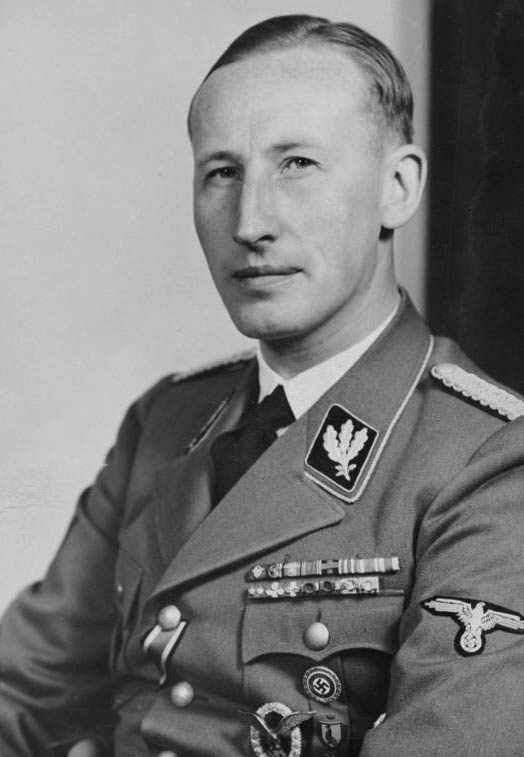
The real SS General Heydrich
Operation: Daybreak is the kind of war film you’ll marvel at, because of the way it is made — a true story in the chilling backdrop of the Nazi regime and World War II. Hitler has occupied Czechoslovakia and a squad of recklessly brave resistance fighters is trained by British Special Operations Forces and airdropped into Prague to eliminate SS General Reinhard Heydrich (Anton Diffring), the very evil Reich Protector — known to the world as The Hangman and The Butcher of Prague. 

In the film, shot on location in Prague, Kubis (Bottoms) and Gabcík (Andrews) ambush Heydrich but fail to kill him the first time. The underground fighters, however, regroup and succeed in their second attempt though not without hiccoughs. If my memory serves me correctly (I saw this film only once, in early 1980), the duo miss their target and a grenade tossed by Kubis in a last-ditch effort falls short of Heydrich but the resultant explosion injures him grievously and he dies a few days later.

This is exactly what happened to Reinhard Heydrich in real life: he was killed in a secret Allied mission known as Operation Anthropoid.


For me, Operation: Daybreak is not about the plot to kill the Nazi maniac or the brutal reprisals that followed the deed but the courage of two young men who, holed up in the underground loft of a building, decide to kill each other rather than fall to a hail of bullets from hundreds of Jerries advancing upon their position. 


When the German soldiers start flooding the basement with water, in a final attempt to flush out the Czech fighters, Sergeants Kubis and Gabcík realise they are doomed. Standing in neck-deep water, they take out their revolvers, point them at each other’s head and fire, point blank. The final scene has stayed with me since the first and only time I saw it. I don’t remember Anthony Andrews much but I do remember the look on Timothy Bottoms’ face as he pulls the trigger in that emotionally charged scene.

Now thirty years is a very long time and it’s possible I've been sketchy with the facts, so I invite readers to correct me and set them right.


Operation: Daybreak, one of the great war movies to be made, is directed by Lewis Gilbert known for his James Bond flicks You Only Live Twice, The Spy Who Loved Me and Moonraker, and is based on the book Seven Men at Daybreak by English author Alan Burgess. Americans watched the film as The Price of Freedom


Reinhard Heydrich Photo Courtesy: Wikimedia Commons

June 25, 2012

Short Story: Carroll John Daly

The Giant Has Fleas

It was a detective's stubbornness that made big Joe Fenton, racketeer, and it was a detective's stubbornness that broke him.

The world's first hardboiled detective was, apparently, created by Carroll John Daly (1889-1958) and not Dashiell Hammett (1894-1961) as lot of people think. I thought so too, but that is because Daly has largely remained in my peripheral vision unlike Hammett whose novels I have read in the distant past. 

Daly invented Race Williams a few months before Hammett produced The Contintenal Op. Both the hardboiled private detectives made their debut in Black Mask magazine in 1923, Race Williams in June and The Continental Op in October of that year. Their names sound like the names of superheroes.

Daly brought his most famous detective to life in the imaginatively titled Knights of the Open Palm. While searching for this short story online I stumbled upon another short story by him, The Giant Has Fleas, published in Detective Story Magazine in February 1947. I read the 15-page story partly because of the title and partly because I wanted to get acquainted with Daly's work anyway.

In this story the American author introduces us to Eddie Blair, a cool-headed detective whose obsession with prosecuting gangster Joseph R. Fenton, a childhood acquaintance, for a woman's murder nearly costs him the sergeant's post and his reputation.

Blair is, however, unconcerned about the rank or his name as he pursues big man Fenton with single-minded focus, so much so that Inspector O'Leary, his mentor and superior, reminds him of his other cases, their trails gone cold. Not for long, though, as Blair quietly produces evidence in an envelope. That's how he works.

Leary is weary of going after Fenton, a powerful man, whose probable arrest, conviction and trial would "shake the very foundations of the city government...shake the confidence of the citizens." The inspector is indirectly asking Blair to lay off Fenton because even if he did have clinching evidence against the gangster, it would be to risky to bring it out into the open.


But, "Joe Fenton" — he laid emphasis on the "Joe," noticing the inspector's use of the "Joseph" — "was and is the greatest single menace to law and order and decent government in the city today."

Unrelenting in his pursuit of Fenton, the detective uses the fleas on the giant's back to get to him — the boys who either knew Fenton or were friends with the racketeer.

As Blair tells Leary, "I'm sort of messed up on Big Joe Fenton. Now I'm having a little fling. I like to call it an investment in..."

"In what?" asked the inspector.

"Fleas," said Eddie, and went out of the room whistling.


He invests in one of Big Joe's fleas called Gunner Duncan, a killer, whose mind he poisons against the gangster...

Joseph R. Fenton is soon found dead. That's how Eddie Blair likes it. Get the fleas to go after the giants and then go after the fleas.


"Fascinating thing, fleas. Even giants have them."

The Giant Has Fleas is a clean tale and moves at a fairly brisk pace. The narrative is compact with little room for details or descriptions, of characters and settings. A straitjacketed story but quite readable.