June 29, 2012

BOOKS

Five forgotten books I want to read...

...ought to be a fairly decent post for Friday’s Forgotten Books meme normally hosted by Patti Abbott at her blog Pattinase and hosted by the very considerate Todd Mason this week. Don’t forget to read about the many forgotten books over at his blog Sweet Freedom.

I have been preoccupied with urgent personal work, hence I don't have the time for a regular book review. Since I don't want to miss FFB entirely, I have put together a few covers of books written by some of my favourite authors, books I have been on the lookout for in new and secondhand bookstores in Bombay, in vain so far. Maybe, I haven’t looked in the right places. Hopefully, I’ll have better luck online.

How many of these vintage books have you read?
 I have read just one.


P.G. Wodehouse, of whom Evelyn Waugh once said “He has made a world for us to live and delight in,” published Love Among the Chickens in June 1906. He serialised it in Circle magazine, New York, during 1908 and 1909 before launching the US edition of the book in May 1909. The narrator of the novel is Jeremy Garnet, a writer and old friend of Stanley Featherstonehaugh Ukridge, a recurring character in Wodehouse’s stories. Garnet regales us with his adventures on Ukridge’s chicken farm in Dorset, England. 


Lloyd C. Douglas, a minister and author, built a great career out of writing about religious and historical fiction. His most famous work is The Robe (1942) in which a Roman tribune recounts his personal and emotional experience of the Crucifixion and its aftermath. Published in 1929, Magnificent Obsession is the story of two men who dedicate their lives to helping people. Both these novels were made into blockbusters. 


Frank G. Slaughter, American author and physician, was one of the finest writers of the last century. The Thorn of Arimathea remains my favourite book by Slaughter who, I suspect, was influenced by the work of Lloyd C. Douglas. I still have to read many of Slaughter’s novels including Fort Everglades (1951) which tells the story of a bloody struggle between a White and a Red in the wild swamplands of Florida in 1840. 


John Steinbeck’s first novel, published in 1929, is about legendary pirate Henry Morgan’s obsession with a beautiful woman and the conquest of Panama — the Cup of Gold. The American writer’s only historical novel is described as “a lush, lyrical fantasy.” 


A.J. Cronin, the Scottish physician and author, is renowned for The Citadel and Hatter’s Castle though he wrote several memorable books including The Keys of the Kingdom, The Green Years and The Spanish Gardener, the last reviewed here. My own favourite has always been Beyond This Place (1953), a book I read in college. It’s about a young man who sets out to prove his father innocent of a murder conviction. You will see little shades of this story in John Grisham’s The Chamber. Strangely, I never came across the novel after I read it the first time.

Now if I could mention one more forgotten author here, it would be Nevil Shute, the British-Australian author and aeronautical engineer, who has written sagas about wars and Australia, many in the backdrop of aviation. I reviewed Shute's Beyond the Black Stump here.

June 27, 2012

John Fernie on a Perry Mason paperback

I was reading The Case of the Gilded Lily by Erle Stanley Gardner in a suburban train, on my way to work this morning, when I casually looked at the cover, as I had done many times before, and wondered who might have painted it. I turned to the back cover and found the words "Cover Painting: John Fernie" in small print, alongside a black-and-white photograph of Raymond Burr advertising "Another case for PERRY MASON, on CBS-TV, Saturday nights."

My copy of the Perry Mason paperback (left) claims to be 
a Genuine Cardinal Edition, June 1959. I wonder if John Fernie illustrated other Perry Mason covers. I'm sure he did as most of the ESG paperbacks have similar covers.

I looked up John Fernie (below) on the internet and found that he was an illustrator and artist from Dundee, Scotland, who was commissioned to do illustrations for the Saturday Evening Post and Cosmopolitan, among others, as well as paintings for Broadway the­atre posters Bye-Bye Birdie, Baker Street and the Ice Capades.


The John Fernie website says that his paintings are in collec­tions in Canada, England, Italy, Spain and throughout America.

Fernie (1919-2001) was, no doubt, a very gifted artist who brought his paintings to life with vibrant colours. Check out some of his paintings here.


June 26, 2012

FILM REVIEW

Operation: Daybreak (1975)

This review of Operation: Daybreak is my contribution to Tuesday’s Overlooked/Forgotten films and television over at Todd Mason’s blog Sweet Freedom. Don't forget to check out the other fascinating reviews over there.


On June 22, Yvette Banek wrote a stirring piece on the award-winning film Brokeback Mountain at her blog In So Many Words… (click on the link to read it). In my brief appreciation of her article, I mentioned that the real story lay in the tragic end. This got me thinking about other films where two men are caught in a similarly poignant and hopeless situation towards the end, though, under vastly different circumstances.

Two films came instantly to my mind — the daring exploits of Butch Cassidy (Paul Newman) and The Sundance Kid (Robert Redford) in Butch Cassidy and the Sundance Kid (1969) and the courageous acts of Sergeant Jan Kubis (Timothy Bottoms) and Sergeant Jozef Gabcík (Anthony Andrews) in Operation: Daybreak (1975).

Both films end in tragedies but not before entertaining the viewers sufficiently through the better part of their nearly two-hour length. The final scenes in the two films are stamped on our minds — Cassidy and the Kid running out of the house with their guns blazing and Kubis and Gabcík turning their guns on each other in a suicidal embrace.

Of the two films, Butch Cassidy and the Sundance Kid is decidedly more glamourous, as is the case with nearly everything about the Wild West, at least in books and films. Newman and Redford only add to the glamour quotient.

There is seldom an aura to war films which are entertaining in their own way, albeit in the shadow of the grim and frightening realities of war and conflict and their bloody aftermath.

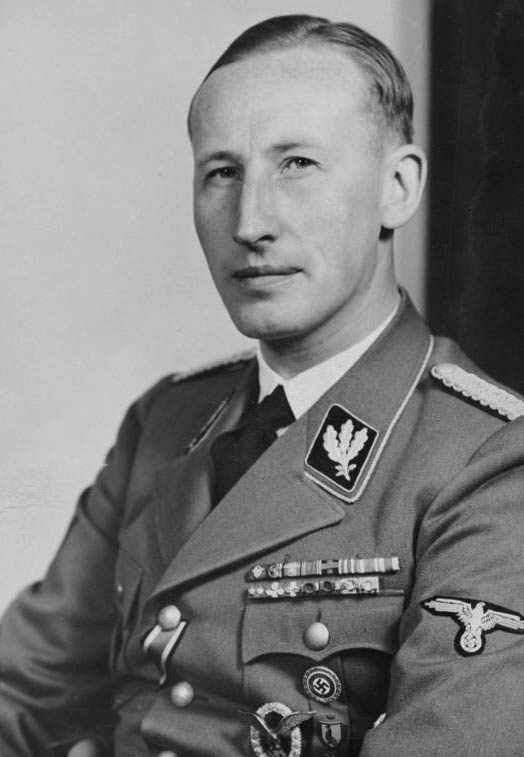
The real SS General Heydrich
Operation: Daybreak is the kind of war film you’ll marvel at, because of the way it is made — a true story in the chilling backdrop of the Nazi regime and World War II. Hitler has occupied Czechoslovakia and a squad of recklessly brave resistance fighters is trained by British Special Operations Forces and airdropped into Prague to eliminate SS General Reinhard Heydrich (Anton Diffring), the very evil Reich Protector — known to the world as The Hangman and The Butcher of Prague. 

In the film, shot on location in Prague, Kubis (Bottoms) and Gabcík (Andrews) ambush Heydrich but fail to kill him the first time. The underground fighters, however, regroup and succeed in their second attempt though not without hiccoughs. If my memory serves me correctly (I saw this film only once, in early 1980), the duo miss their target and a grenade tossed by Kubis in a last-ditch effort falls short of Heydrich but the resultant explosion injures him grievously and he dies a few days later.

This is exactly what happened to Reinhard Heydrich in real life: he was killed in a secret Allied mission known as Operation Anthropoid.


For me, Operation: Daybreak is not about the plot to kill the Nazi maniac or the brutal reprisals that followed the deed but the courage of two young men who, holed up in the underground loft of a building, decide to kill each other rather than fall to a hail of bullets from hundreds of Jerries advancing upon their position. 


When the German soldiers start flooding the basement with water, in a final attempt to flush out the Czech fighters, Sergeants Kubis and Gabcík realise they are doomed. Standing in neck-deep water, they take out their revolvers, point them at each other’s head and fire, point blank. The final scene has stayed with me since the first and only time I saw it. I don’t remember Anthony Andrews much but I do remember the look on Timothy Bottoms’ face as he pulls the trigger in that emotionally charged scene.

Now thirty years is a very long time and it’s possible I've been sketchy with the facts, so I invite readers to correct me and set them right.


Operation: Daybreak, one of the great war movies to be made, is directed by Lewis Gilbert known for his James Bond flicks You Only Live Twice, The Spy Who Loved Me and Moonraker, and is based on the book Seven Men at Daybreak by English author Alan Burgess. Americans watched the film as The Price of Freedom


Reinhard Heydrich Photo Courtesy: Wikimedia Commons

June 25, 2012

Short Story: Carroll John Daly

The Giant Has Fleas

It was a detective's stubbornness that made big Joe Fenton, racketeer, and it was a detective's stubbornness that broke him.

The world's first hardboiled detective was, apparently, created by Carroll John Daly (1889-1958) and not Dashiell Hammett (1894-1961) as lot of people think. I thought so too, but that is because Daly has largely remained in my peripheral vision unlike Hammett whose novels I have read in the distant past. 

Daly invented Race Williams a few months before Hammett produced The Contintenal Op. Both the hardboiled private detectives made their debut in Black Mask magazine in 1923, Race Williams in June and The Continental Op in October of that year. Their names sound like the names of superheroes.

Daly brought his most famous detective to life in the imaginatively titled Knights of the Open Palm. While searching for this short story online I stumbled upon another short story by him, The Giant Has Fleas, published in Detective Story Magazine in February 1947. I read the 15-page story partly because of the title and partly because I wanted to get acquainted with Daly's work anyway.

In this story the American author introduces us to Eddie Blair, a cool-headed detective whose obsession with prosecuting gangster Joseph R. Fenton, a childhood acquaintance, for a woman's murder nearly costs him the sergeant's post and his reputation.

Blair is, however, unconcerned about the rank or his name as he pursues big man Fenton with single-minded focus, so much so that Inspector O'Leary, his mentor and superior, reminds him of his other cases, their trails gone cold. Not for long, though, as Blair quietly produces evidence in an envelope. That's how he works.

Leary is weary of going after Fenton, a powerful man, whose probable arrest, conviction and trial would "shake the very foundations of the city government...shake the confidence of the citizens." The inspector is indirectly asking Blair to lay off Fenton because even if he did have clinching evidence against the gangster, it would be to risky to bring it out into the open.


But, "Joe Fenton" — he laid emphasis on the "Joe," noticing the inspector's use of the "Joseph" — "was and is the greatest single menace to law and order and decent government in the city today."

Unrelenting in his pursuit of Fenton, the detective uses the fleas on the giant's back to get to him — the boys who either knew Fenton or were friends with the racketeer.

As Blair tells Leary, "I'm sort of messed up on Big Joe Fenton. Now I'm having a little fling. I like to call it an investment in..."

"In what?" asked the inspector.

"Fleas," said Eddie, and went out of the room whistling.


He invests in one of Big Joe's fleas called Gunner Duncan, a killer, whose mind he poisons against the gangster...

Joseph R. Fenton is soon found dead. That's how Eddie Blair likes it. Get the fleas to go after the giants and then go after the fleas.


"Fascinating thing, fleas. Even giants have them."

The Giant Has Fleas is a clean tale and moves at a fairly brisk pace. The narrative is compact with little room for details or descriptions, of characters and settings. A straitjacketed story but quite readable.

June 22, 2012

BOOK REVIEW

The Summer Man (1967) by Jory Sherman

This book review is offered as part of Friday’s Forgotten Books meme over at Patti Abbott’s blog Pattinase. Hop over and check out the fine mix of reviews by other book bloggers.

The women of Cambrian Grove were restless and bored with small-town men... Johnny was an exciting stranger, a folk singer who played his guitar with sensuous vitality. 

Renowned author Jory Sherman writes like a poet, which isn’t surprising considering he started his writing career as a poet. There is music in his prose — the lines have a certain rhythmic quality to them, like the notes of a musical score, as evident from his narrative style in The Summer Man.

Sherman wrote The Summer Man in 1967 (Challenge Books) and, I presume, it is one of his earliest works in general fiction before he went on to make a name as a prolific award-winning Western author. So far this is the only book of his I have read and if his writing style and storytelling is anything like it is in The Summer Man, I am going to read almost everything he has written.

The Summer Man is the story of wandering folk singer Johnny O’Neil who is as skilled with women in bed as he is playing the guitar. His nomadic existence takes him from one place to another and into the waiting arms of one lonely housewife to another. He fills a vacuum their husbands can’t or won’t. However, his restless nature does not permit him to stay very long in one place lest he gets used to the idea. The women, sexy as they come, are loath to see him go. But Johnny moves on because he is basically a loner and loves his freedom more than anything else.

Until one day, he arrives in Cambrian Grove, to the home of his best friend, Jim, an insecure alcoholic badly in need of rehab, and his sister Marty, a divorcee seeking love and comfort again. And then he meets Marty’s friend and neighbour, the beautiful and sensuous Lola, and life for the wanderer is never the same again. The explosive chemistry between the folk singer and the forlorn housewife is what this story is about.


"Lovely and lost, she struck a poignant minor key and touched Johnny in a new, disturbing way." 

Prolific author Jory Sherman. Photo: www.jorysherman.com

Sherman’s description of the lovemaking between Johnny and Lola is so poetic that you actually think you are reading one. The lure of Lola is so powerful that Johnny sheds his inhibitions and tells her that he loves her, a sentiment she reciprocates without hesitation. But then, Lola has a husband who doesn’t behave like one and Johnny has a disposition he can’t seem to get rid of.

"Lola offered more than a tender night's pleasure. Johnny knew he should move on, that it could only end sadly. Still he lingered."


I liked The Summer Man for the way it is written and not so much for the story. Although the story is narrated in the third person, in a mild sort of way, Johnny talks about his own itinerant life and sexual dalliances in the first person, but without being too explicit. For an initiation into Jory Sherman’s writing, the book made for interesting reading. I am looking forward to reading his Western fiction.

June 20, 2012

JUKE BOX

Kung Fu Fighting by Carl Douglas

Everybody was kung fu fighting
Those cats were fast as lightning
In fact it was a little bit frightning
But they fought with expert timing


There isn't a single 1970s kid in India who didn't swing or lip sync to the popular disco song Kung Fu Fighting written and sung by the Jamaican-born, UK-based singer Carl Douglas and produced by the Indian-born, British composer and singer Biddu Appaiah. The 1974 song, with its farcical lyrics, became a hit single and sold eleven million records at the time. It also made disco music more popular than ever. In this video you have Douglas and Biddu (extreme left) singing and swaying to the martial arts number.


Mind Your Language, 1977

This week the British sitcom Mind Your Language is my contribution to Tuesday’s Overlooked/Forgotten films and television over at Todd Mason’s blog Sweet Freedom. Don't forget to check out the other interesting reviews over there.

The family often sits down to watch Mind Your Language, the popular and entertaining British sitcom of the late seventies. My generation first got to see it on the state-run Doordarshan channel in the early eighties. It was a hit in India and in most parts of Asia. In those days and long before cable TV, Doordarshan (which loosely means ‘Far Sight’ in Hindi) used to telecast only British serials like To the Manor Born, Some Mothers Do 'ave 'em, Sorry!, Are You Being Served? and 'Allo 'Allo! Some of these sitcoms are now back and they are as funny as they were back then. Yes Minister came later.

The only American serial that ran around the time was Lucy. She was fun too, up to a point, and as long as Mr. Mooney was around. 


Mind Your Language, made by LWT (London Weekend Television) and directed by British director-producer Stuart Allen, is about an affable and gentlemanly English teacher Jeremy Brown (Barry Evans) who teaches English as a foreign language to a heterogeneous bunch of students from across the world. 

Mr. Brown and his class.

The students are all grown-ups—with families, love lives, careers, unemployment, and immigration issues—who attend Mr. Brown's class with unfailing regularity even if it leaves the "professori" at his wits end. It doesn't help much that the students, especially Danielle (Françoise Pascal) from France, are fond of their teacher and go out of their way to put him at ease even if the outcome is the opposite of what they'd intended. They mean well and Mr. Brown knows it.

The students speak in halting English and without a care for the language in terms of diction, pronunciation, accent, phonetics, spellings, figures of speech. Still, they communicate all the same, with each other and with Mr. Brown who has a befuddled expression on his face most of the time.
 

Mr. Brown: What was that again?
 
When the students answer Mr. Brown’s questions, the result is often hilarious. For instance, when he tells the Greek student, Maximillian (Kevork Malikyan), that the collective name for a group of cows is a herd of cows, the Greek student replies, “Of course, I heard of cows!”

His best friend Giovanni (George Camiller) plays class monitor in Mr. Brown’s absence. In one scene, when Mr. Brown returns, the lanky Italian tells his teacher in mock seriousness, “Professori, I don’t know how you put up with these people everyday!”

Mind Your Language is full of such humour, as the foreign students speak in their own distinct voices, reflective of the country they come from. This leaves Mr. Brown and Ms. Dolores Courtney (Zara Nutley), the very propah and formidable school principal, exasperated and at a loss for words.

While the sitcom is a family entertainer, it has been considered offensive for political incorrectness, pitting one nationality against another. 

Mr. Brown with Ali Nadeem and Jamila Ranjha.

For example, the sari-clad Jamila Ranjha (Jamila Massey) is a housewife from India while Ranjeet Singh, a Sikh portrayed by Albert Moses, is from Punjab, which, in spite of being a part of India, is shown as a separate country.

The serial also shows frequent rivalry between some of the students—Ranjeet Singh of Punjab against Ali Nadeem (Dino Shafeek) of Pakistan (reflecting the bitter relations between the two countries); a Chairman Mao-obsessed Chung Su-Lee (Pik-Sen Lim) of China against Taro Nagazumi (Robert Lee) of Japan (a throwback to WWII rivalry); and Maximillian of Greece against Giovanni of Italy (probably alluding to the Greco-Italian conflict during WWII).

On the racial bias in the series, Ranjeet Singh is often portrayed as being subservient—every time he makes a mistake he joins his hands, bows, and says, “A thousand apologies” to Mr. Brown or Ms. Courtney.

For some reason, Ali Nadeem, the most comic of the lot, mouths English catchphrases like “Oh blimey!”, “Jolly good,” and “Yes, please.” He’s at his innocent best when he smiles, "Squeeze me, please!" instead of “Excuse me, please!”

None of these so-called issues bothered me. I had a good laugh throughout the series.