Showing posts with label Vintage Pictures. Show all posts

January 08, 2017

With Great Truth & Regard: The Story of the Typewriter in India, 2016


I wrote my first story on a Godrej typewriter. It was an interview with former playback singer Preeti Sagar. The Q&A appeared in Free Press Bulletin shortly after I joined the tabloid as a reporter in the mid-eighties. Until then, I had only been editing stories on India’s first homegrown typewriter, which, in many offices, occupied a large portion of a Godrej horizontal desk and sat next to a Godrej vertical cabinet. In those days, Godrej was synonymous with office furniture.

Long before that, I cut my teeth on portable typewriters. I learnt to change the ribbon and roll foolscap paper on Brother, Smith Carona and Remington that my father and uncle owned. Both were journalists and between them they had a top speed of nearly 200 words per minute. Cigarette between lips, they pounded away at their portables and delivered clean copies for the next day’s edition. You could hear them speed typing in the newsroom from quite a distance. It was, no doubt, music to the ears of editors with stubborn deadlines.

A year before I took up my first newspaper job at Free Press Journal Group, I enrolled into a typing and shorthand institute where I learnt the rudiments of ten-finger typing on Godrej machines, beginning with the home or middle row—‘asdf’ with the left hand followed by ‘;lkj’ with the right. I found it tedious. A month later, I was back to rapid two-finger typing. It was an insult to the typewriter. But that’s how I type to this day.


And that’s just the tip of the iceberg of memories that came back after I read With Great Truth & Regard: The Story of the Typewriter in India edited by senior journalist and author Sidharth Bhatia. It resonated with me because of my experience with this unwieldy machine that made writers and letter writers out of so many of us. The 304-page well-illustrated hardback chronicles the long and rich anecdotal history of the manual typewriter, from the time industrialist Naval Godrej pioneered the first all-Indian typewriter in 1955 to its inevitable death by computers in 2011. The company stopped production that year, though you can still find old working typewriters outside courts, at street corners, and in small towns.

As Jamshyd N. Godrej, son of Naval Godrej and CMD of Godrej & Boyce, notes in his Foreword, “The book captures the story of typewriters in India from many perspectives, including the socio-economic perspective, which is about the impact typewriters had on the Indian masses. It is also about the contribution typewriters made to bring women into offices in larger numbers—a huge step forward for their empowerment in India.”

The Godrej typewriter, a complex machine with 2,000 high-precision components, was one of post-Independent India’s earliest instances of self-reliance in manufacturing. It was testimony to a young nation’s capability to mass-produce an indigenous typewriter and take on established foreign brands like Remington, Underwood, and Imperial. And it came 60 years before the government launched its ‘Make in India’ initiative.


“The story of the Indian typewriter is more than just a matter of manufacturing a piece of office equipment; it is the story of one man's dogged determination to make a machine that would compete against the world's best. And most of all, it is part of India's own goal of becoming self-reliant,” Bhatia writes in his engaging piece titled Making the Indian Typewriter: The Godrej Story.

In many ways, the history of the typewriter is also the history of the typist.

An entire generation of people across cultures and communities—from the office stenographer to the court typist and from the public librarian to the newspaper editor—broke their backs and built their careers on the typewriter. There was no social barrier to using the machine. The typewriter was an equaliser. It defined the Indian workplace more than any other office device. In nearly every commercial enterprise or government office someone or other hunched over a typewriter, either typing from a handwritten document at the side, winding a new spool and occasionally making a mess of it, or rubbing out lines with a circular ink eraser and tearing a hole through the paper. It was both frustrating and satisfying.

The typewriter sat on the office desk or a roadside table with a degree of self-importance. Over tea and gossip, it did many things at once—it told stories, dictated letters, made rules, typed affidavits, hired people, balanced accounts, prepared invoices, and wrote out inventories. It was also privy to all kinds of information, including secrets and lies. If the typewriter could talk, I suspect, it would have strained ties and damaged relations among peoples and societies. But noisy as it was, the typewriter remained a mute spectator throughout its eventful existence.


With Great Truth & Regard is a nostalgic throwback to a time when typewriters influenced and shaped ordinary lives. It is an evocative collection of memories, essays, observations, short accounts, and titbits about a 20th century innovation that users took for granted. No one really expected the typewriter to all but vanish. After all, it had achieved so much in the sphere of communication, employment, socio-cultural diversity, including film and television, and women emancipation.   

Launched on December 2, 2016—to commemorate the birth centenary of Naval Godrej (1916-2016)—the volume contains personal narratives by eminent Indian writers, historians, journalists, and social commentators. It is not just a tribute to Godrej typewriters but a testimonial to all typewriters in India. Some of the chapters that I particularly enjoyed were The Rise of the Indian Typewriter, South India's Relationship with Typing, The World of Steno Stereotypes, The Shift from Typewriters to Computers in Journalism, Writing the Script of Life: The Typewriter in Hindi Cinema, and The Immortal Typewriter. It is further enriched by dozens of photographs by Chirodeep Chaudhuri. The vintage illustrations and advertisements of typewriters tell their own story.

If you worked on typewriters, then this book will take you down memory lane. And if you did not, you can still enjoy reading about one of the great utilitarian devices of the 20th century and see what you missed. At 300-plus pages, I felt the book was a tad long but I suppose that bit can be overlooked given the fond memories the typewriter evokes.

Now, the "Backspace" has long replaced the "xxxx" but I would like to think that a part of the manual typewriter still lives on in the keyboards we use today. 


Recommended. 

Title: Great Truth & Regard: The Story of the Typewriter in India
Year: 2016
Editor: Sidharth Bhatia
Pages: 304
Publisher: Godrej
Distributor: Roli Books, India


Note: All images are sourced from the book.


July 05, 2014

Fourth of July

I'm probably a day late, but here's wishing all my American blogger friends a Happy 4th of July!

© J.L.G. Ferris/Wikimedia Commons
In the picture, Benjamin Franklin reads a draft of the Declaration of Independence as the other Founding Fathers, John Adams (seated) and Thomas Jefferson (standing), listen. The number of key Founding Fathers has been put at seven which includes George Washington. The painting is by Jean Leon Gerome Ferris (1863-1930), an American painter who famously recreated 78 scenes from American history known as The Pageant of a Nation, which, according to Wikipedia, is the largest series of American historical paintings by a single artist. It'd be worth taking a look at the others.

October 19, 2013

Steamboats on the Mississippi


I received this lovely photograph of steamboats on the Mississippi River, 1907, by email. It shows hectic activity on the 6,210-km (3,860-mile) long river which rises in northern Minnesota and flows southward into the Gulf of Mexico. Steam-powered river boats carried both passengers and cargo up and down the river until the advent of the US railroad in early 19th century. Even then, steamboats continued to play a key role in trade and commerce till the 20th century. Frontier settlements came up in the Mississippi River region as well as on the vast and barren land between the river and the Rocky Mountains. Several rivers like the Missouri, Ohio, Tennessee, and Arkansas are tributaries of this great river. The Mississippi has a rich history. It was the cradle of the Frontier.

For previous Vintage Pictures, see under Labels.

January 31, 2013

VINTAGE PICTURES

The cover art of Frank Schoonover

The proof of the book is not only in the reading. It is also in feasting the eyes on the cover. Particularly, if the art is by an illustrator like Frank Earle Schoonover (1877-1972).

Schoonover, one of the foremost students of renowned illustrator and author Howard Pyle, had more than 2,000 illustrations to his credit and many of these adorned the dust jackets of well-known books and magazines that included stories of Hopalong Cassidy by Clarence E. Mulford, A Princess of Mars by Edgar Rice Burroughs, and Blackbeard Buccaneer by Ralph Delahaye Paine. 

Hopalong Takes Command oil on canvas
by Schoonover for The Fight at Buckskin
story (1905).
Schoonover worked in his studio in Wilmington, Delaware, where he earned the title of the Dean of Delaware Artists. His art collection, pertaining mainly to the early 20th century period, is preserved at the Delaware Art Museum. The museum was founded in 1912 as the Wilmington Society of the Fine Arts in honour of Howard Pyle. It celebrated its centennial last year.

According to the Schoonover Studios Ltd, “Schoonover’s subject matter included cowboys, Indians, and Canadian trappers. His forms were simple and well defined and his moods powerful. Later in his career, his style became less rigid and more impressionistic. Schoonover was also an accomplished water colourist and muralist and an avid photographer. He used photographs as references for his illustrations to remind himself of the mood and character of the models.”
 

The Golden Age illustrator was born in New Jersey, educated at Drexel University, Philadelphia, and died in Wilmington at the age of 95.

You can learn more about Frank Schoonover at Schoonover Studios Ltd and the Schoonover Fund.


Pictures: © Wikimedia Commons

January 16, 2013

The world through a View-Master

On July 23, 2012, I did a small post on the century-old stereoscopic viewer, the “modern version” of which, Ron Scheer of Buddies in the Saddle reminded me, was the View-Master which came with circular picture discs, each containing over a dozen colourful images of animals, cartoons, and other themes. The pictures were sharp and clear and gave out a 3D effect. You went click, click, click…till you went full circle and returned to the first slide. 

© Andrew Hazelden

I thought of the View-Master again while writing about Beautiful People yesterday. The animals in the documentary reminded me of the picture disc of animals that I used to look at through my View-Master. The colour of most of the View-Masters I saw in childhood, including my own, was red while others were in blue.

The View-Master, which belonged to the family of special-format stereoscopes, was introduced by Sawyer's Photo Services in 1939, a few years after Kodachrome colour film which gave us small high-quality photographic colour images. The View-Master reels, as they were known, were thin cardboard disks containing seven stereoscopic 3D pairs of small colour photographs on film. You can read more about it here.

The View-Master held a strange fascination for me then, as the Samsung Galaxy Note does now. One was a simple and satisfying childhood indulgence, the other is an extravagance I can do without.

November 11, 2012

VINTAGE PICTURES

The age of Dickens

Dickens by Leslie Ward
In the Literature & Books section of The Booklovers Magazine No.1 Vol.1, January-June 1903, published by The Library Publishing Company, Walnut Street, Philadelphia, USA, Andrew Lang presents a fascinating study on Charles Dickens. Lang (1844–1912), who was a Scottish poet, novelist, literary critic, contributor to the field of anthropology, and best known as a collector of folk and fairy tales (courtesy: Wikipedia), dissects Dickens and his writing with a fine-tooth comb. The article has a few interesting illustrations of the celebrated English writer from Portsmouth. 

Among many things, Lang says...


After the original sketch by "Spy"
"The century in which Dickens lived and wrote has gone where the roses go. He died before young readers now alive were born. His world is not their world ; many conditions of life have altered ; opinions have changed; some manners and customs which he knew are scarcely recognizable. "The great divide" between the age of Dickens and ours is the railway cutting, as Thackeray said. Dickens' first and best novels deal with the old stagecoaches and the life of the road, though he lived to suffer in a great railway accident. Criminals, in Dickens' time, were publicly hanged for the edification or amusement of the crowd. When he visited America for the first time, slavery was a flourishing institution in the Southern States. Any American by reading Martin Chuzzlewit will perceive that, even allowing for wild, exaggerated caricature, the world has changed out of knowledge since the youth of Dickens."


"I have a tenderness. One who is still so happy as to have all of Dickens unread before him had probably better begin with David Copperfield. If he does not enjoy this delightful book, it is likely that he had better abandon his researches into Dickens. The story, as every one knows, is partly autobiographical."


An etching by Theodore Joyeuse
"After Copperfield, Pickwick ought to be read. Dickens never again wrote such a book—nobody has ever written such a book; but some readers may prefer Copperfield, which contains more story and plenty of ' the love interest." After reading these a man may go on with confidence."


Original Pickwick cover with Dickens autograph

October 19, 2012

VINTAGE PICTURES

Where Next?


Where Next?: The gentleman in the picture is employed in a global banking firm that has forced him to go on a thirty-day privilege leave failing which he forfeits it, a company regulation. So he and his wife are pouring over a world map to decide where to go next on their annual vacation. The woman looks as if she has picked out a destination, perhaps the Maldives or Seychelles in the Indian Ocean. In his Where Next art, I’m not sure if English landscape painter Edward Frederick Brewtnall (1846-1902) meant for the couple to visit either of the archipelagos. But just look at that backdrop! Do they really need to go anywhere when the sea is coming right in to meet them?

Source: Wikimedia Commons

September 29, 2012

VINTAGE PICTURES

Murder on the Orient Express was born here


This is Room 411 in Hotel Pera Palace in Istanbul, Turkey, where Agatha Christie wrote Murder on the Orient Express in which Belgian detective Hercule Poirot investigates the murder of Samuel Ratchett, a passenger on the train.


September 03, 2012

VINTAGE PICTURES

The Story of the Outlaw

The Story of the Outlaw: A Study of the Western Desperado by Emerson Hough, writer of western stories and historical novels, should ideally be my entry for Friday's Forgotten Books over at Patti Abbott's blog. It isn't because I can't wait to feature it now, in slide-show format which tells its own story. It would take me at least a week, or more, to read the 232-page ebook from Project Gutenberg and probably as much time to write about it. A review of a western historical work requires some understanding of the period and the events around it as opposed to a review of a western novel. In spite of its historical backdrop, I'd be more comfortable writing about a novel I read.

The book offers "historical narratives of famous outlaws, the stories of noted border wars, vigilante movements and armed conflicts on the frontier." The copyright to this fascinating chroncile of the western outlaw, in his various avatars, is held by two entities, the Curtis Publishing Company, 1905, and Emerson Hough and the Outing Publishing Company, New York, 1907. I'm not sure what that means.

"The stories of modern train-robbing bandits and outlaw gangs are taken partly from personal narratives, partly from judicial records, and partly from works frequently more sensational than accurate, and requiring much sifting and verifying in detail. Naturally, very many volumes of Western history and adventure have been consulted," Emerson Hough writes in his preface to The Story of the Outlaw.
 

"Much of this labor has been one of love for the days and places concerned, which exist no longer as they once did. The total result, it is hoped, will aid in telling at least a portion of the story of the vivid and significant life of the West, and of that frontier whose van, if ever marked by human lawlessness, has, none the less, ever been led by the banner of human liberty," he adds. 

The book is divided into following twenty-two chapters:

01. The Desperado
02. The Imitation Desperado
03. The Land of The Desperado
04. The Early Outlaw
05. The Vigilantes Of California
06. The Outlaw of the Mountains
07. Henry Plummer
08. Boone Helm
09. Death Scenes of Desperadoes
10. Joseph A. Slade
11. The Desperado of the Plains
12. Wild Bill Hickok
13. Frontier Wars
14. The Lincoln County War
15. The Stevens County War
16. Biographies of Bad Men
17. The Fight of Buckshot Roberts
18. The Man Hunt
19. Bad Men of Texas
20. Modern Bad Men
21. Bad Men of the Indian Nations
22. Desperadoes of the Cities

From the dust jacket of The Man Next Door, 1917.
© University of Iowa Libraries

If you're an expert on Western history and frontier life, as Ron Scheer of California is, then you'll know what each of these chapters is about. Ron has covered Emerson Hough's work quite extensively at his blog Buddies in the Saddle. Here are the links to his posts on the American historian and his books, in order of publication:

1. Emerson Hough, The Story of the Cowboy (1897), October 11, 2010
2. Emerson Hough, again, October 14, 2010
3. Emerson Hough, Heart’s Desire (1905), October 19, 2010

Now then, the slide-show I promised earlier...

Plummer's Men

The Scene of Many Little Wars

Types of Border Barricades

The Scene of Many Hangings

Sheriff Pat F. Garrett who killed
Billy the Kid

Billy the Kid shoots Deputy Sheriff
Bob Ollinger

How the rustler worked

Texas rancher John Chisum

Billy the Kid

The Old Chisum Ranch


Border Fortress

Western Man Hunt

If you enjoyed the images, then you might also want to read the ebook at Project Gutenberg or ManyBooks. Click on the links.

August 09, 2012

VINTAGE PICTURES

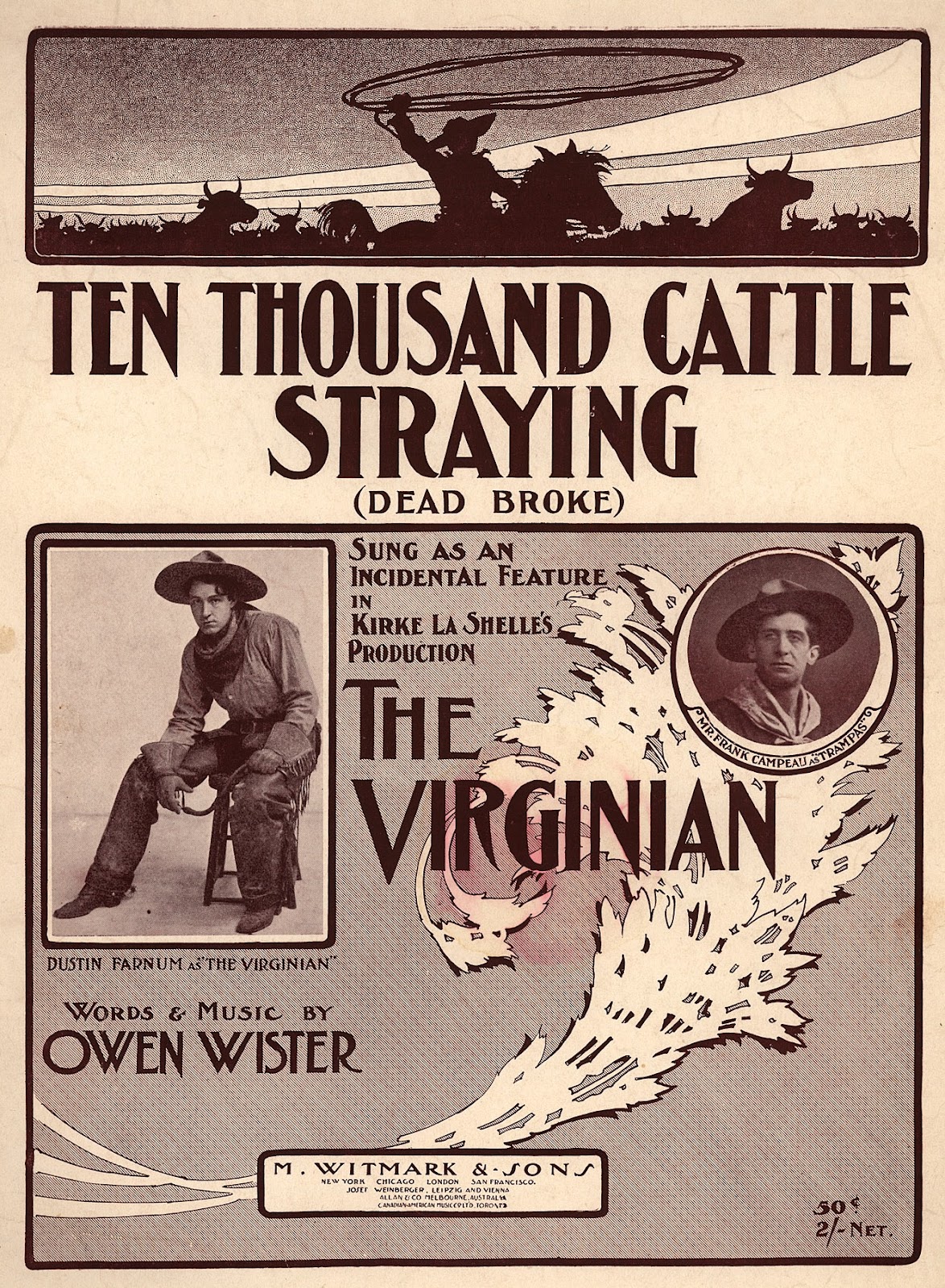
Ten Thousand Cattle Straying (Dead Broke)

Ten thousand cattle straying,
They quit my range and travell'd away,
And it's “sons-of-guns” is what I say,
I am dead broke, dead broke this day.
Dead broke. 


There is some confusion over the exact year in which Owen Wister, the American writer and pioneer of western fiction, wrote and composed the music of Ten Thousand Cattle Straying (Dead Broke) for the stage version of The Virginian, his epoch-making western novel that gave shape to the quintessential cowboy.

Some say 1888, others say 1904.

If Wister did, indeed, pen the song in 1888, he would have been only 28 years at the time and would have, remarkably, composed it 14 years before he wrote his famous novel, in 1902. 

© American Heritage Center
Further reading on the subject revealed that Wister (left) actually wrote the song in 1904, for theatre man Kirke La Shelle’s stage production of The Virginian. It was to be one of the last three successful plays of La Shelle, the other two being The Education of Mr. Pipp and The Heir to the Hoorah. La Shelle died in 1905 at the age of 43.

Ten Thousand Cattle Straying (Dead Broke) was the inspiration for American folk singer and writer Katie Lee’s best-known book Ten Thousand Goddam Cattle, A History of the American Cowboy in Song, Story and Verse, a study of the music, stories, and poetry of the American cowboy. The book, published in 1976, has illustrations by cowboy artist William Moyers and was also recorded as an album. 

US actor Dustin Farnum (pictured left in the poster) was cast as the first Virginian in Cecil B. DeMille’s 1914 film adaptation of Wister’s novel. The role was reprised by several actors, most notably Gary Cooper, in the first sound version of the film directed by Victor Fleming in 1929. There have also been a couple of television series based on The Virginian.

John D. Nesbitt, the author and teacher, has written a splendid article on Owen Wister titled "Inventor of the Good-guy Cowboy" and describes him as the creator of “the classic Western hero and the popular western novel.” You can read it here.

The Western and Cowboy Poetry Music & More at the Bar-D Ranch has carried an interesting article on Owen Wister’s Virginian on its website.

July 28, 2012

Vintage Pictures

Divided nation, divided books


The Partition of India by the British in August 1947 did more than create the two sovereign nations of India and Pakistan, displace millions of Hindus, Muslims and Sikhs on either side of the newly-drawn border, and result in one of the world's largest refugee crisis leading to violence and slaughter by people who once lived together. It also divided the libraries in the new dominions. In the above photograph, published by Life magazine on August 18, 1947, a curator at the Imperial Secretariat Library (now Central Secretariat Library) in Calcutta, West Bengal, tries to divide some 1.50 lakh books into equal parts for each of the two countries.

July 23, 2012

Vintage Pictures

Roundup on the Sherman Ranch


A cowboy in Genesee, Kansas, USA, with lasso at the ready maintains a vigil on the herd on the open range, in 1902. His fellow cowpunchers are seen on the horizon.

This image, culled from The U.S. National Archives and Records Administration, is a stereographic card that can be seen through a stereoscopic viewer, an optical device for viewing similar images or photographs. The picture is attributed to Keystone View Company, of Meadville, Pennsylvania, which produced and distributed educational and comic and sentimental stereoviews, and stereoscopes from 1892 through 1963.

According to an article at the Collectors Weekly website, “Stereoscopes use two nearly-identical images, each taken a few inches to the side of the other. When viewed through two lenses set 2.5 inches apart, approximately the space between the eyes, the result is the illusion of a three-dimensional picture. In fact, stereoscopes are seen as the precursors to 3D entertainment.”

Sir Charles Wheatstone of Great Britain is credited with inventing the first stereoscope in 1833.


Todd Mason has generously included this post in Tuesday's Overlooked Films/Television over at his blog Sweet Freedom. Don't forget to read the many fascinating entries over there.