September 02, 2014

The horrors of horror movies

Moments before the gory scene in Damien: Omen II.

When I think of horror movies I think of the immediate side effects—cold sweat, dry mouth, palpitation, tingling, loss of appetite, insomnia, tremors, and irrational behaviour. No, I didn't have an anxiety attack but it'd be the sum total of how I felt when I watched scary movies in my youth, and I saw quite a few of them including such absurd films like Evil Dead. I no longer have the stomach or the enthusiasm for horror flicks. That's not entirely true. I might have seen a couple of them over the past fourteen years, in broad daylight and in my living room, surrounded by family and friends, and a plate of chocolate cake and a glass of cold lemon iced tea.

Now, as I grow older, I'm afraid I'll scare to death easily.

I see enough horror in real life, as it were. One morning, a couple of years ago, I was taking the suburban train to work when I saw four porters running along a parallel track, carrying a dirty stretcher between them. I knew what was coming. Instead of turning my face away I looked out of the window just in time to see the porters haul a pair of bloody legs by the ankles and dump it on the aluminium stretcher. Crows circled above. The limbs were sliced at the waist and the innards were spilling out. The legs wore blue jeans. The rest of the dismembered body, which belonged to a young migrant from north of the country, was found half a mile away to where it was dragged by the express train. I read that in the papers the next day. 


In Bombay, fatalities due to track-crossing are routine. They run into thousands every year. I don't blame Indian Railways. I blame commuters who cross the tracks as a shortcut. The only shortcut they take is to death's door. 

If horror movies don’t kill me, morbid curiosity will.

The Exorcist was the scariest horror film I saw. As a westerner might say, it scared the crap outta me. Young Indians use that a lot now. The Entity and The Omen trilogy didn’t have a hideous face on a rotating head but I still found them disturbing. Perhaps, it was the music that freaked me out. Every time it played you knew something was coming, from somewhere behind you. Remember Jaws?

Which brings me to the purpose of this hellish post: which scene in a horror flick do you remember well?

I can recall many but one that comes to mind, for no apparent reason other than that Satan put it there, is the raven scene in Damien: Omen II. There is this woman in red who is wise to young Damien Thorn’s terrifying identity. After meeting the handsome boy on a football field and seeing the devil in his eyes, she hurriedly gets into her car and drives away. But then, her car breaks down on a long and deserted stretch of the road. She gets out of the car and looks right into the shining black eyes of a raven perched on the roof. The bird attacks her, scratches up her face and claws her eyes out, and in her blind moment of pain and panic, she stumbles onto the road and right into the path of a speeding truck that blows her away. Hazy memory but that is how I remember it.

August 29, 2014

Defending Jacob by William Landay, 2012

© Random House
This is not a conventional review. Rather, these are my observations of a book, a legal thriller, which offers a profound insight into how bad things can happen all of a sudden to good people, happy families, and destroy their seemingly pleasant lives. 

In recent years, few novels have touched me as deeply and compellingly as Defending Jacob by William Landay. I think it is because as a father of a seventeen-year old teenager I could feel a sense of empathy for Andrew Barber and his wife, Laurie, whose fourteen-year old son, Jacob, is accused of murdering his classmate in the beautiful Cold Spring Park in a Massachusetts suburb. Jacob is like any teenager, reclusive and rebellious, and mostly preoccupied with his thoughts, his cellphone, and his laptop. The question is what lies beneath.

I read books with a certain level of detachment. I try not to get involved in what transpires between the covers of a book, however gut-wrenching the story may be. But sometimes it’s not possible to be a mere witness to the emotional drama unfolding in the pages in front of you. You leap right into the narrative because somewhere in the back of your head you feel you have a stake too, in this case knowing what happens to the once happy Barber family.


If you are a devoted husband and a doting father, you’ll feel the pain of Andy Barber who refuses to admit to himself that his son could be guilty because he loves him deeply and because he owes it to him. It’s a terrible choice for any father to make, especially if, like Andy, you are a respected and a successful assistant district attorney who has stood by his conviction that the law must take its course no matter who the suspect is. You know you have to stick by your son because you’re responsible for him and because he is your flesh and blood. Hell with conviction and all that. You know you are wrong but you also know you are right.

© www.williamlanday.com
As I read through the book, I found myself frequently walking beside Andy, who is forced to go on leave owing to possible conflict of interest, and watch him do everything in his capacity to defend his son and prove he is innocent. He hires a close acquaintance to fight the case. For me, this is Andy’s story more than Jacob’s; the father is the pivot around which the son’s fate hinges.

Let’s not forget Laurie Barber. Once the cynosure of all eyes, Andy’s beautiful wife slowly disintegrates, first with the onslaught of her son’s indictment and the possibility of his guilt and then when, after years of a beautiful love marriage, she learns from Andy that his side of the family has a history of violent behaviour. She feels betrayed. In many ways Laurie suffers more than Andy because, unlike her husband, she is willing to acknowledge that their son could be the murderer of his fellow eighth grader Benjamin Rifkin. She feels responsible for Jacob and that they must have done something wrong raising him.


What Laurie Barber goes through would be any mother’s worst nightmare, as defending Jacob takes its toll on her and the family she has loved and cherished.

Final word
William Landay has produced a cracker of a novel. The suspense is intense, in a non-brutal way, and consistent throughout the 448 pages, alternating between the Barbers’ isolated existence at home and shamed public life in the courtroom, and finally culminating in an unforeseen end.

Defending Jacob is a legal thriller in every sense of the term as William takes the reader through a realistic and gripping homicide investigation and judicial process complete with jury and grand jury, and courtroom scenes. He explains the legal terms including how the system works as well as the theory of a murder gene that the prosecutor is more than keen to bring up in court. I found that aspect of the book very interesting. Can someone commit a crime because it’s in his or her DNA? Is it admissible as evidence in court? The writer offers plausible answers.

The author’s writing style is engaging and he keeps you engrossed with twists and turns every few pages so much so that you feel compelled to finish the book in two sittings as I did.


The author
William Landay was an assistant district attorney in Boston before he took to writing fiction and authored the award-winning Mission Flats and The Strangler—the latest in a long line of seasoned attorneys turned successful writers. He brings his firsthand experience as a legal brain to bear upon his third novel, Defending Jacob.

Earlier this month, when I wrote to William requesting an interview based on this novel, he replied saying that he was too busy at the moment to answer—he is working on his next suspense novel among other things—and, very thoughtfully, invited me to quote freely from a similar interview on his website. I thought that wouldn’t be right, but you can read it here.

August 26, 2014

Real Steel, 2011

This Tuesday, a film from the near future for Overlooked Films, Audio & Video over at Todd Mason’s blog Sweet Freedom.

Real Steel is a futuristic movie about boxing, not between people but between robots. Hugh Jackman plays Charlie Kenton, a former boxer turned promoter of robot boxing, except his robots don’t do as well in the ring as he himself once did, though he refuses to admit it. With mounting losses and debts, Charlie is at wit’s end. He desperately needs money for a new robot that will get him back into the ring. And then one day Charlie learns that his ex-wife has died leaving behind their eleven-year old son, Max Kenton (Dakota Goyo). That's the last thing he needs.

Max is a precocious kid who quickly endears himself to his newfound father who’d rather gladly surrender him to his sister-in-law Debra (Hope Davis) and her husband Marvin (James Rebhorn), for a million dollars and get on with his life, programming robots to fight other robots. There is no serious custody battle, only a rich aunt who would rather raise her nephew than leave him with her sister's struggling ex.

Max and his father Charlie bond over robots.

The rest of the film is about Charlie and Max discovering more than just their passion for robot boxing; they also discover each other as father and son. Helping them to bond is Atom, an old discarded robot Max finds in a scrapyard and has enough faith in to win them matches and moolah. Charlie is initially amused but then quickly realises that Max’s gaming brain is working wonders for their two-man team. In the end he finds a son who teaches him how to win at robot boxing, and at life.

Real Steel, directed by Shawn Levy (The Pink Panther, Night of the Museum), is a silly but an entertaining film. At one point I didn’t know if I was watching Real Steel or one of the Transformers. When my teenage son asked me why Hugh Jackman would do such a film, I said probably for the money. Who wouldn't? Jackman is mild-mannered throughout the film and acquits himself well as Charlie Kenton who teaches a robot how to box.

August 25, 2014

Rest in Peace: Richard Attenborough

The actor’s director
August 29, 1923-August 24, 2014
I didn't know Richard Attenborough through his films as well as I knew him from reading about his films. I could relate to him as an actor, director, and producer of a little over a hundred films. I have, of course, seen less than ten that include The Great Escape, Miracle on 34th Street, and Jurassic Park in the three categories.

He was mostly an actor who catapulted into the limelight in India with Gandhi, his epic directorial venture. Suddenly, Attenborough was a household name, as was the man he cast in the Mahatma's slippers, Ben Kingsley, who by a coincidence happened to be half-Indian; he was born Krishna Pandit Bhanji, in England. Attenborough could not have chosen a more suitable actor to play Mohandas Karamchand Gandhi. Even today, for many in India Kingsley is still Gandhi.

When Gandhi won eight Academy Awards, an entire nation rejoiced as if the film was made by an Indian. The only thing Indian about Gandhi was its frail and sparsely-clad subject. The award-winning Slumdog Millionaire by Danny Boyle evoked a similar response, though on a much smaller scale. Still, we felt a kinship with both the films, especially Gandhi as it was about a historically important period of time and because it had several noted Indian character actors.


Attenborough (left) directs Kingsley in Gandhi
© Frank Connor/www.bafta.org

Richard Attenborough brought to life the larger-than-life persona of Mahatma Gandhi, more than scores of books and comic-books and audio and video documentaries ever had until 1982.

I think one of the primary reasons why Gandhi became a phenomenal success in India was because Attenborough did not deviate from the real-life script of the Mahatma’s life, his trials and tribulations, the freedom struggle, the partition of India into India and Pakistan, independence in 1947, and his assassination.
 Everything was as we'd learned about him since school. In fact, as the film rolled we could anticipate certain events that occurred during the freedom movement; like the Jallianwala Bagh massacre in Punjab, in April 1919, when General Dyer ordered his men to open fire directly on a crowd of peaceful protesters. Over a thousand men and women died; scores of others jumped into the garden's wells to escape the bullets and were killed. It remains one of the bleakest periods and Dyer the most hated man in Indian history. 

Gandhi is one of my all-time favourite movies and I see it at least once a year when, in a spirit of patriotism, it is telecast on India's republic day, January 26, and on her independence day, August 15—a memorable tribute to a great man and to the human spirit. In India, at least, Richard Attenborough sealed his fame with that epochal film.

August 23, 2014

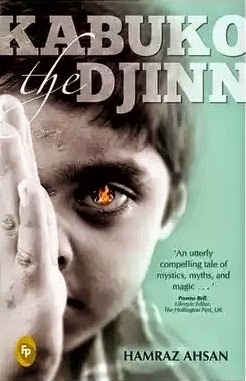
Kabuko the Djinn by Hamraz Ahsan, 2013

I have said elsewhere on this blog and in comments on other blogs that I rarely put a book away after I have started reading it, even if I’m plodding through the book. I will read it anyway because I always find something that redeems the book in my eyes. And sometimes I feel I owe it to the author.

In the case of Kabuko the Djinn, 2013, by the London-based journalist and author, Hamraz Ahsan, I didn’t make that exception because, much as I liked the storyline and writing style, which is really good, I lost interest after the initial few pages. I didn’t feel like reading further about the occult and the mystical world of the djinn who enters the body of a young boy, around which this story revolves.

There are two reasons. One, I wanted to get back to the fast-paced fiction, the thrillers, the mysteries, and the westerns, that I’m fond of reading. I’m a brainwashed prisoner of the American paperback. And two, however absorbing Indian fiction is, given its literary style, the narrative is often long winding, as I felt about Kabuko the Djinn. Indian fiction is also more descriptive and 
almost academic in tone.

I understand that you cannot judge a book by reading only a few pages and I’ll probably try and read it at some point in the near future. But not just yet. I
ve to be in the mood for a fictional tale involving “mystics, myths, and magic.”

For now, I’ll leave you with the synopsis of Kabuko the Djinn which has received much praise from more discerning readers.


“Kabuko the djinn is the evocative story of a djinn who journeys through human life in search of occult knowledge. Wishing to study the dynamics of the human species for himself, in order to unearth the secrets of human power, Kabuko enters the body of Ajee Shah, a boy born in post-independence Punjab, Pakistan. As Kabuko loses himself to the trials and tribulations of living an ordinary yet intrinsically exceptional human life through Ajee, sex and the supernatural collide, entangling them both in a cataclysmic event that is to change their lives forever. Woven throughout this tapestry of youthful yearnings and a desire for transcendental knowledge are real secrets of the Islamic occult, true stories of Muslim saints, and the folklore of the Punjab.”

I’m grateful to Fingerprint, an imprint of Prakash Books India Pvt. Ltd, New Delhi, for my copy of this book. You can order your copy from Amazon.

August 16, 2014

How long? A poem by Ramabai C. Trikannad

Ramabai C. Trikannad, my late grandmother, was a writer, columnist, poet, and a deeply spiritual woman. She read a lot. Classics were her favourite. She wrote about family life and parenting in newspapers in the mid-20th century. One of her columns was called Cat 'N' Bells. She also published a book of short stories called Victory of Faith and Other Stories, 1935. I have most of her published and unpublished writings including a hardback of her short story collection. Once in a while I read her poems and stories and what she said more than half a century ago resonates with me even today. How Long? is one of her poems that I like very much. 

Inconsistent, changing — weary yet restless —
We dance to the rhythm of nature.
Hoping, fearful — lest we lose them —
We try to hold and keep the things
Our fancy rests upon.
We strive and strive — not towards the Eternal —
But for the empty shows of life.
Thus, while in silence Mother smiles and watches over us,
We jostle and struggle on.

In some quiet hour
The heart draws back from all the world.
Whence — to where? To what purpose
This fruitless, aimless hurry and rush?
How long before delusion is destroyed and freedom gained?
For a moment, for a single moment,
Before the mind drops again
Into the ever intricating web of fancies and desires,
From the solitude of the heart
Comes the cry: “O Mother! How long?”


© Ramabai C. Trikannad

August 15, 2014

A Woman on a Roof by Doris Lessing, 1963

A review of a short story by the British novelist for Friday's Forgotten Books at Patti Abbott's blog Pattinase.

There was a fine view across several acres of roofs. Not far off a man sat in a deckchair reading the newspapers. Then they saw her, between chimneys, about fifty yards away. She lay face down on a brown blanket. They could see the top part of her: black hair, a flushed solid back, arms spread out.

© Wikimedia Commons
It’s not everyday that I read a short story that can be interpreted in different ways by different readers. A Woman on a Roof (Encounter, March 1963) is one of those stories that leaves you nowhere long after you have read it, talked about it, and argued over it. But it won’t make this story any less tantalisingly charming.

The premise is simple: three men are working on the roof of a building on a hot June day in London when they see a woman sunbathing on the roof of an adjoining building. She is almost naked.

Harry, the oldest, is forty-five years old. Stanley is young and newly married. And Tom is only seventeen.

As the three men sweat it out on the roof and at times in the basement of the block of flats, to escape the wretched heat, they can’t take their thoughts away from the nearly naked woman. At least Stanley and Tom can’t.

The characters

Harry is mature and circumspect and with a son as old as Tom, he prefers to look the other way and do his work. He humours the other two, especially Stanley.

Stanley is the loudest and most affected. He sounds annoyed with the bare woman but you know he is annoyed with himself. He tells the others that she is a bitch for no apparent reason other than that she is tormenting him. He’d rather she wasn't lying lying around naked like that, for him to see and agonise over. He is married and there is not a damn thing he can do about it. He knows it and you know it.

Young Tom is quiet and reserved even though he joins Stanley in whistling and shouting loudly across the roofs. He dreams of the naked woman every night. He thinks she is lovely and that she belongs to him. Tom also happens to see more than Harry and Stanley. He likes to think of it as a secret between him and the woman.

Tom's report was that she hadn't moved, but it was a lie. He wanted to keep what he had seen to himself: he had caught her in the act of rolling down the little red pants over her hips, till they were no more than a small triangle. She was on her back, fully visible, glistening with oil.

Final word
In the story the mysterious woman appears oblivious to the presence of the three men and their whistles and catcalls from across the roofs. Of course, she knows they can see her but she doesn't give a hoot. She sleeps half-naked on her roof through a whole week. This angers Stanley even more.

Doris Lessing, the British novelist, playwright and poet who passed away in November 2013, has crafted a very clever story. She plays around with human emotions subtly, not just those of the workmen but also those of the readers. Through the naked woman, she brings out the best and the worst in the three men, particularly Stanley and Tom, who first love her and then hate her for what she is doing to them when, in effect, she isn't doing anything at all.

Lessing holds back more than she gives and still doesn't leave the reader unfulfilled. Her prose is simple and lucid. She doesn't beat around the bush. She comes straight to the point. I liked A Woman on a Roof mainly on account of the story, which is a real tease, and the brevity of words. I'd never read anything by Doris Lessing before. This was a good introduction to her writing.