July 08, 2014

Flight of the Phoenix, 2004

It’s Tuesday and here’s an entertaining desert film to back up Overlooked Films, Audio & Video at Todd Mason’s blog Sweet Freedom.

Last week, I set out to watch Robert Aldrich's The Flight of the Phoenix, 1965, starring James Stewart, Richard Attenborough, Peter Finch, George Kennedy, and Ernest Borgnine.

Instead, I ended up watching its remake, John Moore's Flight of the Phoenix, 2004, starring Dennis Quaid, Tyrese Gibson, Giovanni Ribisi, Hugh Laurie, Miranda Otto, and Tony Curran.

Both films are based on the novel by Elleston Trevor (born Trevor Dudley Smith). I have not read the book.

Stewart and Quaid play the lead character, Frank Towns, the captain of the ill-fated cargo plane that crash lands during a storm in the Sahara Desert in Africa and in the Gobi Desert in Mongolia, depending on which version you've seen.

Frank Towns (Quaid) and his co-pilot A.J. (Tyrese Gibson) are on their way back to civilisation after picking up crew and cargo at an immobilised oil well when a mighty dust storm forces Towns to crash his C-119 Flying Boxcar in the Gobi, somewhere in the middle of nowhere. The plane is at least two hundred miles off course and there are immediate casualties.


Towns is initially indifferent and is reluctant to take charge of the situation, the meagre rations of food and water, and the rudderless passengers, but relents when Kelly Johnson (Miranda Otto), one of the oil workers, pricks his conscience. 

What follows next is a lesson in team motivation and management as Towns strives to keep the spirits of his despairing passengers alive on one hand and struggles to protect his restless flock from the vagaries of the desert weather and ruthless smugglers on the other.

How they manage to get out of the desert, which can well be described as last place god made, is what makes this special effects film worth watching even though the plot is so-so. Of particular note is the way Towns brings down the plane through swirling storm and sand, in brief but terrifying moments that an artist or a photographer would capture perfectly on canvas or through a lens. The brilliant tan of the desert sand, caught on camera by cinematographer Brendan Galvin, seems to stretch forever and forms an immense backdrop throughout the nearly two-hour film.

In terms of individual performance, Dennis Quaid’s acting is along expected lines, only his films change. The actor to watch, if at all, is the reclusive Elliott (Giovanni Ribisi), a slightly eccentric design engineer who builds model airplanes. He’s the guy who plays Phoebe’s crazy half-brother in Friends.

July 05, 2014

Fourth of July

I'm probably a day late, but here's wishing all my American blogger friends a Happy 4th of July!

© J.L.G. Ferris/Wikimedia Commons
In the picture, Benjamin Franklin reads a draft of the Declaration of Independence as the other Founding Fathers, John Adams (seated) and Thomas Jefferson (standing), listen. The number of key Founding Fathers has been put at seven which includes George Washington. The painting is by Jean Leon Gerome Ferris (1863-1930), an American painter who famously recreated 78 scenes from American history known as The Pageant of a Nation, which, according to Wikipedia, is the largest series of American historical paintings by a single artist. It'd be worth taking a look at the others.

July 02, 2014

Q2 review: more books, fewer stories

I'm still in the thick of "closing" the special edition of my newspaper, which I mentioned in my last post. It'll have dozens of specially commissioned views and interviews of experts in the field of infrastructure in India. It is in the context of the new political dispensation in New Delhi, the result of a nine-phase general election held in April-May—the world's largest electoral exercise by the world's largest democracy. Hope has replaced despair, for now. While the articles are informative and analytical, they are obviously not as stimulating as fiction and fantasy. There are more exciting things outside of a job.

A slight respite from all the editing and pagemaking allowed for this post, a summary of books and short stories I read during the second quarter, April-June.

In the first quarter I read nine books and twenty short stories. In the second quarter I read eleven books and only seven short stories.

First, the books...


My pick of the quarter.
Crime: Public Murders by Bill Granger, 1980

War: The Legion of the Damned by Sven Hassel, 1957

Espionage: Stallion Gate by Martin Cruz Smith, 1986

Western: The Hell Raisers (originally Saddle Pals) by Lee Floren, 1988

Quasi Western: Carved in Sand by Erle Stanley Gardner, 1933

General (academia): The Common Room by K.B. Rao, 2014

General (media): The Bread Line: A Story of a Paper by Albert Bigelow Paine, 1899

General (media): The Imperfectionists by Tom Rachman, 2010

Thriller: The Last Place God Made by Jack Higgins, 1971

Thriller: The Savage Day by Jack Higgins 1972

Classic: A Tale of Two Cities by Charles Dickens, 1859

The last three books were re-reads.

And the short stories…

The Fifth String, The Conspirators, and Experiences of a Bandmaster by John Philip Sousa

Anne by Fanny Stevenson, 1899

The Intruders by Evan Hunter, 1954

Lamb to the Slaughter by Roald Dahl, 1953

Love Story by Irving E. Cox, 1956

I could swear I read more shorts. Then again, maybe I did not.

If I were to do a SWOT analysis of my less than average reading during the past three months, it'd be something like this.

Strengths: Quick to start
Weaknesses: Slow to finish
Opportunities: Plenty of books, plenty of time
Threats: Other distractions, mainly movies, chess, and Scrabble

Talking about movies, I recently saw (again) Raid on Entebbe (1977) directed by Irvin Kershner (Star Wars: The Empire Strikes Back, RoboCop 2, Never Say Never Again, Eyes of Laura Mars).

Based on a true story, as any film or book about Israel seems to be, this one too has many well-known stars like Peter Finch, Charles Bronson, Martin Balsam, John Saxon, Horst Buchholz, Jack Warden, Sylvia Sidney, Robert Loggia, and James Woods. A plane with as many as hundred Jewish passengers is hijacked by militants loyal to the Palestine movement and flown to Entebbe, Uganda. Since Israel does not negotiate with terrorists, it sends commandos to Entebbe, located more than 2,000 miles away, to flush out the hijackers and rescue its citizens. The rescue op is realistic. The highlight of the film is Yaphet Kotto as President Idi Amin.

Next up is The Flight of the Phoenix (1965) made by Robert Aldrich (The Dirty Dozen) based on a novel by Elleston Trevor (born Trevor Dudley Smith). I haven’t seen this one before. In between, I’ll be reading some books.

June 27, 2014

Musings on a fourth Thursday

I'm going to be awfully busy over the next ten days as I rush to “close” the anniversary edition of my fortnightly tabloid-size newspaper which completed thirteen years in May. In my case and probably in the case of every other journalist on the news desk in India, the term “closing” is associated with sending a paper or magazine to print which means writing and editing stories, overseeing production, and meeting deadlines. It has become a sort of a joke in the family. If someone invites me over for a function around the due date of my paper, the word out is, “Oh no, he can’t make it. He has his closing this week” which is met with the predictable response “Not again!” I'm secretly happy, for genuine as the reason is, it has allowed me to skip many a social gathering.

The immediate casualty of my workload is a Forgotten Books review over at Patti Abbott’s blog, Friday, and a second quarter roundup of books and short stories I read during April to June. The summary will have to wait until next weekend.

These days I’m reading more books, watching more films, and reviewing less, because I’m afflicted with what I’d like to call review fatigue.

I finished reading three nice books recently—Stallion Gate by Martin Cruz Smith and The Hell Raisers (or Saddle Pals) by Lee Floren—both of which I started over a month ago, and The Imperfectionists by Tom Rachman. I’m undecided on which of these to review; most likely it’ll be the first-edition western paperback by Lee Floren. It has a couple of unusual cowboy characters who get involved in a range war between simple farmers and a devious cattleman in Wyoming, and some interesting elements with regard to life in the plains and the badlands.

NetGalley has sent me Rachman’s The Rise & Fall of Great Powers which I intend to read and review in July.

The six western movies I saw and wrote about in the third week of this month have had a few more companions since, in the form of The Avengers, The Towering Inferno, and The Dirty Dozen.

I’d forgotten that Fred Astaire had a part in The Towering Inferno, his last major picture, I think, or that O.J. Simpson played a young security officer in the ill-fated building. It was one of many disaster movies to come out of the seventies alongside The Poseidon Adventure, Earthquake, Hurricane, Avalanche, and the Airport series.

I'm now looking for The Cassandra Crossing, Black Sunday, Rollercoaster, and Damnation Alley.

As you can see I have a predilection for blockbusters with lots of famous actors commonly seen in war, western, action, and disaster flicks.

The death of Eli Wallach, June 24, had me watching The Magnificent Seven and The Good, the Bad and the Ugly all over again, and each time it seems like the first time.

There are a lot of memorable scenes in both the films and many of those involve Wallach. The Magnificent Seven opens with a fine musical score by Elmer Bernstein which plays in the background as Calvera (Eli Wallach) and his bandits ride into the farming village. In fact, the orchestral score plays throughout in the background. In the Sergio Leone classic, his ‘Ugly’ character, Tuco, is transformed into an ecstatic ten-year old as he runs circles around the gravestones literally in step with Ennio Morricone’s lilting score that has become a popular mobile ringtone.

How would you rate his performance in the two movies where he is said to have overshadowed both Yul Brynner and Clint Eastwood and the others? I don’t think he stole the limelight from Brynner, Buchholz and company as much as he did from Eastwood and Lee Van Cleef in their respective films.

I’ll end this post by recommending one of Eli Wallach’s last films, The Holiday (2006), a nice little romantic comedy. Born in the second year of World War I, Wallach was 91 when he made this film. How is that for a perspective?

June 24, 2014

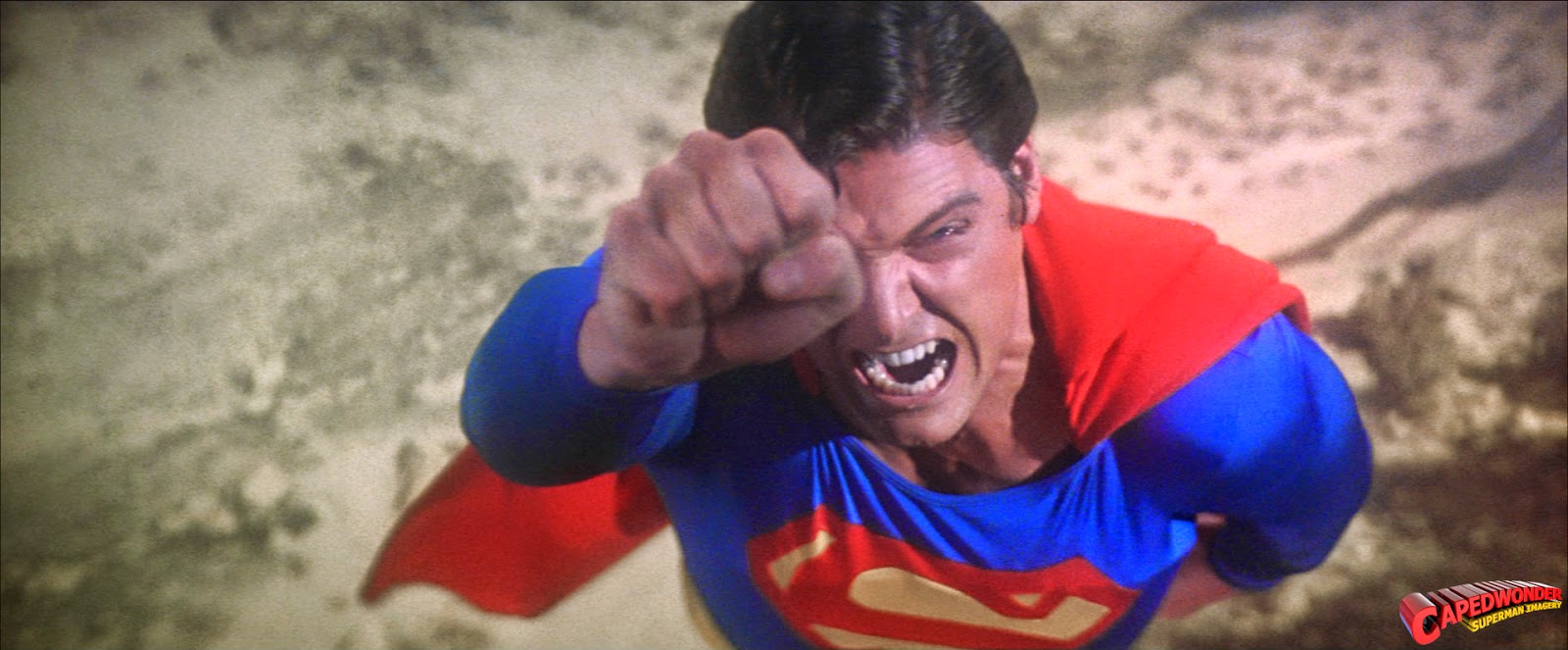
Superman, 1978, and Superman II, 1980

A different take on the mother of all superhero films for this Tuesday’s edition of Overlooked Films, Audio & Video at Todd Mason’s blog Sweet Freedom.


This is not a review of Superman or its sequel directed by Richard Donner and Richard Lester, respectively. Rather, this post looks at two specific scenes in both the films which invited ridicule from a lot of viewers in India, including me and my friends. I saw the films in my teens and I recall emerging from the theatre absolutely spellbound—Hollywood had made a real man fly not just through earth's atmosphere but through infinite space without any strings attached.

Everything is spot-on about Superman I & II (though the plot in the sequel was too weak as to be really convincing), except for a couple of scenes that took some of the shine off the films. Both scenes take place in the end.

In Superman, the Man of Steel is distraught with grief when he finds Lois Lane (Margot Kidder) buried alive in her car, the result of an earthquake triggered by a nuclear explosion set off by the villainous Lex Luthor (Gene Hackman). What happens next is almost unbelievable: Superman flies and flies around earth at hundreds of times of the speed of light and turns the world, or time, back to pre-quake. He returns to earth in time to see Lane alive and out of her car and Jimmy Olsen (Marc McClure), his best friend at The Daily Planet, making his way towards them. Superman had saved Olsen earlier. All's well again.

That one scene, turning the time back, is the stuff of science fiction, but it defies logic in the movie even though it can be argued that Superman is a product of that genre. It raises so many questions that you don't know where to begin. For instance, Lane remembers the earthquake and going under ground and while she is visibly flustered she seems okay with it, and since there has been no nuclear triggered earthquake, why does Superman hand Luthor and his sidekick Otis (Ned Beatty) over to the police? Superman knows Luthor is a criminal, in fact, “The greatest criminal mind of our time!” as Luthor brags, but what’s the charge. Am I missing something here?

I thought the scene was silly and Richard Donner lost his way. I'm sure Donner must have toyed with several endings. Sadly, he settled for one that didn't work in what was otherwise a technically brilliant film with excellent music by John Williams. 

In Superman II, Lois Lane is hyper when she finally discovers, over Niagara Falls, that Superman is actually Clark Kent, her bespectacled and bumbling colleague at the paper. Superman, ever the magnanimous and self-sacrificing hero, decides to put his girlfriend out of her misery: he kisses her and erases her memory of him as Superman. When she opens her eyes, she sees Clark Kent and not Superman before her and, I think, she straightaway orders the poor fellow to fetch coffee or something. Again, all’s well that ends well.

With that one scene, Superman proves that he is also Supergod. Although there can be no limit to his superpowers, I can stretch disbelief only so much.

Thirty-six years on Christopher Reeve remains the ultimate Superman/Clark Kent as I've known the kryptonian of the comic books. In 2006, Brandon Routh bravely stepped into those famous red boots, in Superman Returns, but there can be no comparison with Reeve—in coat or cloak, Routh looked the same as Clark Kent and Superman. I'm surprised Lois Lane (Kate Bosworth) didn't see the close resemblance.

While we’re on Superman, it’s one of three movies whose catchy soundtrack has stayed with me since my teens, the other two being Jaws and The Omen. Turn off the sound and you’ll see what I mean.

June 20, 2014

99 Novels by Anthony Burgess, 1984

This anthology by the English writer is considered “neglected” by some which makes it a suitable entry for Forgotten Books at Patti Abbott’s blog Pattinase.

© www.anthonyburgess.org
As a rule, I don’t publish lists of novels or short stories I read or come across in an anthology or collection. However, I'm making an exception in the case of 99 Novels: The Best in English since 1939 by Anthony Burgess.

Neither do I have the book and nor have I read it, but I'm excited enough to share it with those who didn’t know about it until now. I read about it online and I'm ashamed to admit that I've read less than half of the ninety-nine novels which, according to the late English writer and composer, were the best since 1939. Worse still, I have not read anything by Burgess himself, not even A Clockwork Orange.

The anthology covers a forty-four year period between 1939 and 1983. Fiction of the fifties and sixties finds pride of place in the author’s personal choice of books.

Burgess, who was a prolific writer, reader, and reviewer of books, was comfortable with all types of authors including “practitioners of well-wrought sensational fiction” like Irving Wallace, Arthur Hailey, Frederick Forsyth, and Ken Follett.

© Simon & Schuster
He once revealed in an interview that the book was originally commissioned by a Nigerian publishing company and that he wrote it in two weeks. You can listen to the interview at Wired for Books.

I'm tempted to reproduce passages from his introduction to 99 Novels but that would be neither here nor there. Instead, you can read it at The New York Times where Anthony Burgess gives his reasons for choosing the books he did. It makes interesting reading. The book is available at Amazon.

The 99 novels, sorted by year, are given below, courtesy Wikipedia. The author has kept himself out of his own list.


1930s

1939 – Henry Green – Party Going (1939)
1939 – Aldous Huxley – After Many a Summer (1939)
1939 – James Joyce – Finnegans Wake (1939)
1939 – Flann O'Brien – At Swim-Two-Birds (1939)

1940s

1940 – Graham Greene – The Power and the Glory (1940)
1940 – Ernest Hemingway – For Whom the Bell Tolls (1940)
1940 – C.P. Snow – Strangers and Brothers (1940)
1941 – Rex Warner – The Aerodrome (1941)
1944 – Joyce Cary – The Horse's Mouth (1944)
1944 – W. Somerset Maugham – The Razor's Edge (1944)
1945 – Evelyn Waugh – Brideshead Revisited (1945)
1946 – Mervyn Peake – Titus Groan (1946)
1947 – Saul Bellow – The Victim (1947)
1947 – Malcolm Lowry – Under the Volcano (1947)
1949 – Elizabeth Bowen – The Heat of the Day (1949)
1948 – Graham Greene – The Heart of the Matter (1948)
1948 – Aldous Huxley – Ape and Essence (1948)
1948 – Nevil Shute – No Highway (1948)
1948 – Norman Mailer – The Naked and the Dead (1948)
1949 – George Orwell – Nineteen Eighty-Four (1949)
1949 – William Sansom – The Body (1949)

1950s

1950 – William Cooper – Scenes from Provincial Life (1950)
1950 – Budd Schulberg – The Disenchanted (1950)
1951 – Anthony Powell – A Dance to the Music of Time (1951)
1951 – J.D. Salinger – The Catcher in the Rye (1951)
1951 – Henry Williamson – A Chronicle of Ancient Sunlight (1951)
1951 – Herman Wouk – The Caine Mutiny (1951)
1952 – Ralph Ellison – Invisible Man (1952)
1952 – Ernest Hemingway – The Old Man and the Sea (1952)
1952 – Mary McCarthy – The Groves of Academe (1952)
1952 – Flannery O'Connor – Wise Blood (1952)
1952 – Evelyn Waugh – Sword of Honour (1952)
1953 – Raymond Chandler – The Long Goodbye (1953)
1954 – Kingsley Amis – Lucky Jim (1954)
1957 – John Braine – Room at the Top (1957)
1957 – Lawrence Durrell – The Alexandria Quartet (1957)
1957 – Colin MacInnes – The London Novels (1957)
1957 – Bernard Malamud – The Assistant (1957)
1958 – Iris Murdoch – The Bell (1958)
1958 – Alan Sillitoe – Saturday Night and Sunday Morning (1958)
1958 – T.H. White – The Once and Future King (1958)
1959 – William Faulkner – The Mansion (1959)
1959 – Ian Fleming – Goldfinger (1959)

1960s

1960 – L.P. Hartley – Facial Justice (1960)
1960 – Olivia Manning – The Balkan Trilogy (1960)
1961 – Ivy Compton-Burnett – The Mighty and Their Fall (1961)
1961 – Joseph Heller – Catch-22 (1961)
1961 – Richard Hughes – The Fox in the Attic (1961)
1961 – Patrick White – Riders in the Chariot (1961)
1961 – Angus Wilson – The Old Men at the Zoo (1961)
1962 – James Baldwin – Another Country (1962)
1962 – Aldous Huxley – Island (1962)
1962 – Pamela Hansford Johnson – An Error of Judgement (1962)
1962 – Doris Lessing – The Golden Notebook (1962)
1962 – Vladimir Nabokov – Pale Fire (1962)
1963 – Muriel Spark – The Girls of Slender Means (1963)
1964 – William Golding – The Spire (1964)
1964 – Wilson Harris – Heartland (1964)
1964 – Christopher Isherwood – A Single Man (1964)
1964 – Vladimir Nabokov – The Defense (1964)
1964 – Angus Wilson – Late Call (1964)
1965 – John O'Hara – The Lockwood Concern (1965)
1965 – Muriel Spark – The Mandelbaum Gate (1965)
1966 – Chinua Achebe – A Man of the People (1966)
1966 – Kingsley Amis – The Anti-Death League (1966)
1966 – John Barth – Giles Goat-Boy (1966)
1966 – Nadine Gordimer – The Late Bourgeois World (1966)
1966 – Walker Percy – The Last Gentleman (1966)
1967 – R.K. Narayan – The Vendor of Sweets (1967)
1968 – J.B. Priestley – The Image Men (1968)
1968 – Mordecai Richler – Cocksure (1968)
1968 – Keith Roberts – Pavane (1968)
1969 – John Fowles – The French Lieutenant's Woman (1969)
1969 – Philip Roth – Portnoy's Complaint (1969)

1970s

1970 – Len Deighton – Bomber (1970)
1973 – Michael Frayn – Sweet Dreams (1973)
1973 – Thomas Pynchon – Gravity's Rainbow (1973)
1975 – Saul Bellow – Humboldt's Gift (1975)
1975 – Malcolm Bradbury – The History Man (1975)
1976 – Robert Nye – Falstaff (1976)
1977 – Erica Jong – How to Save Your Own Life (1977)
1977 – James Plunkett – Farewell Companions (1977)
1977 – Paul Mark Scott – Staying On (1977)
1978 – John Updike – The Coup (1978)
1979 – J.G. Ballard – The Unlimited Dream Company (1979)
1979 – Bernard Malamud – Dubin's Lives (1979)
1979 – Brian Moore – The Doctor's Wife (1976)
1979 – V.S. Naipaul – A Bend in the River (1979)
1979 – William Styron – Sophie's Choice (1979)

1980s

1980 – Brian Aldiss – Life in the West (1980)
1980 – Russell Hoban – Riddley Walker (1980)
1980 – David Lodge – How Far Can You Go? (1980)
1980 – John Kennedy Toole – A Confederacy of Dunces (1980)
1981 – Alasdair Gray – Lanark (1981)
1981 – Alexander Theroux – Darconville's Cat (1981)
1981 – Paul Theroux – The Mosquito Coast (1981)
1981 – Gore Vidal – Creation (1981)
1982 – Robertson Davies – The Rebel Angels (1982)
1983 – Norman Mailer – Ancient Evenings (1983)


This list goes on my tackboard.

June 17, 2014

A week of western films

This Tuesday, a festival of western movies for Overlooked Films, Audio & Video at Todd Mason’s blog Sweet Freedom.

With my home computers giving trouble I was pretty much off blogging last week. The break gave me a chance to do what I rarely do nowadays—watch western films. I saw six in all, one for each day of the week, well almost. These were Hour of the Gun (1967), Three Men from Texas (1940), The Five Man Army (1969), The Hills Run Red (1966), The Magnificent Seven (1998), and Unforgiven (1992).

The Magnificent Seven is actually a television series that ran from 1998 through 2000. It starred Michael Biehn, Ron Perlman, and Eric Close. I saw the first episode of the first season the theme of which was the same as the 1960 John Sturges classic. It’s worth a look.

For now, I’ll give you my impressions of the initial three movies.


Hour of the Gun is a very well made film about Wyatt Earp (James Garner) and Doc Holliday (Jason Robards) who take on crooked rancher Ike Clanton (Robert Ryan) and his hired guns. In spite of his stature, Ryan doesn't have much of a role, somewhat like his cameo in The Dirty Dozen. It's Garner and Robards all the way.

After Tombstone (1993) this was only the second Wyatt Earp movie I saw. Garner and Robards are vengeful but milder versions of Kurt Russell and Val Kilmer although the end result is the same. One of the things that struck me about Hour of the Gun was the differences between Garner and Robards over how to fight Clanton. It’s all very quiet and never heated. But Robards, in spite of his alcohol-induced ill-health, stays close to his friend often at risk to his life.


While the gunfights in Hour of the Gun are nowhere as loud and violent as in Tombstone, the two versions made by John Sturges and George P. Cosmatos respectively are mirror images in many ways. Garner, 86, is quiet and unsmiling and rather daunting on screen. In my opinion both films are a classic.

Next up was Three Men from Texas directed by Lesley Selander. Renamed as Ranger Guns West, the film is one of many adaptations of stories based on Hopalong Cassidy, the fictional cowboy created by American author Clarence E. Mulford.

Cassidy, once again played by William Boyd, is a clean-shaven and mild-mannered Texas Ranger who refuses to take up an assignment to rid a California town of a bunch of outlaws because he is nearing retirement. Instead, his partner, the impulsive Lucky Jenkins (Russell Hayden), goes in his place and soon finds out that he has bitten more than he can chew. Fortunately, a crooked trail that Cassidy is following takes him to the lawless town where he finally teams up with Lucky and the cowardly buffoon California Carlson (Andy Clyde), and some bandits led by Pico Serrano (Thornton Edwards), to restore law and order.


Andy Clyde stands out with his noisy act in this limited action western film.

I saw The Five Man Army in my school days and haven’t forgotten it since. Big man Bud Spencer (born Carlo Pedersoli) remains a favourite comedian along with his Italian compatriot Terence Hill (Mario Girotti). Together, Bud Spencer and Terence Hill made several comedy films including spaghetti westerns—one used his fist, the other his brain, and all hell broke loose.

Terence Hill does not star in this Italian production made by Don Taylor and Italo Zingarelli. Instead, with Mesito (Bud Spencer) are Dutchman (Peter Graves) who hires him and three other men he knows equally well—Capt. Nicolas Augustus (James Daly), Samurai (Tetsurô Tanba), and Luis Dominguez (Nino Castelnuovo)—to rob a train.

Each of the men has a specialised skill: Graves (planning and plotting), Spencer (fists), Daly (dynamites), Samurai (knives and swords), and Luis (guns).


The Five Man Army is set during the Mexican Revolution. Dutchman leads his ragtag team on an ambush of a heavily-armed train carrying $500,000 in gold that belongs to the Mexican army. In return, he promises his men $1,000 each as reward. Once the gold-laden coach is successfully diverted, the men want more than their promised share, but Dutchman turns the tables and says the gold is to be used to buy arms and ammunition for the revolutionaries. The four men are taken aback and accuse him of betrayal. Dutchman then reveals that although he is a white man he supports the cause because his wife, a Mexican peasant, was killed by soldiers.

The Five Man Army may not hold up today because it lacks the technical superiority of latter-day westerns and the plot is so weak as to seem implausible. The armed soldiers fall like nine pins and the men take over the canon-secured train quite effortlessly. That said, there is a lot of action and comic moment in this spaghetti western that many consider a cult film. For me the key highlights are the music by Ennio Morricone (The Good, the Bad and the Ugly) and, of course, the irrepressible Bud Spencer. 


However, watching Bud Spencer without his lifelong friend and co-star Terence Hill beside him is like watching Oliver Hardy without Stan Laurel, or vice versa.