October 14, 2012

The joy of reading comfort books

In my earlier post on Agatha Christie for Friday's Forgotten Books, Mystica and Yvette commented that Christie's mysteries and the classics, like those by Jane Austen, were “comfort reads,” books they went back to again and again because they genuinely love those books and also in times of hardship.

In stressful situations, people tend to read books that help them relax and take their mind off their immediate problems. It may act as a temporary balm but you look forward to those moments with certain books you enjoy reading more than others; solace reading as you might call it.

I’m not talking about self-help, spiritual, and motivational books. They’re usually the first choice of the undiscerning reader.

How many times have I put down a novel because it was too “heavy” and I was too “stressed” at the time to read even a few pages from it? Good number of times.

I don’t find all the classics relaxing, or comfort reads, at least not the ones I have read or I’m reading currently. A few days ago, I put away Moll Flanders by Daniel Defoe because I just couldn’t focus on the narrative that spoke of a courageous woman determined to put her impoverished life behind her. Yet, some years ago, I couldn’t put down Defoe’s Robinson Crusoe whose humdrum existence on a desolate island did nothing to dampen my enthusiasm to finish the book. I loved Crusoe’s spirit of adventure, guided as he was by his faith in the Creator and the companionship of a dog, fowls, birds, sheep, and goats until Friday came along.

Instead, I picked up the long overdue Harry Potter and the Half-Blood Prince and read the sixth of the series in four days. I enjoyed the book in spite of the many loopholes in it. Among other things Albus Dumbledore’s exit was unconvincing.

I’m tempted to reach out for Deathly Hallows but that’ll happen only if I tire of reading the psychological thriller The Ninth Configuration by William Peter Blatty or the India-centric A Son of the Circus by John Irving. I should finish Blatty’s short fiction, about a bunch of crazy war vets interned by the Pentagon, in the next couple of days though Irving’s 678-page tale of an Indian who is not an Indian but keeps coming back to India might take much longer. Irving’s characters, places and settings are often predictable, but he is one of the finest writers I have read over the past two decades. Hopefully, next up is A Prayer for Owen Meany which, I am assured, is a most absorbing story. 

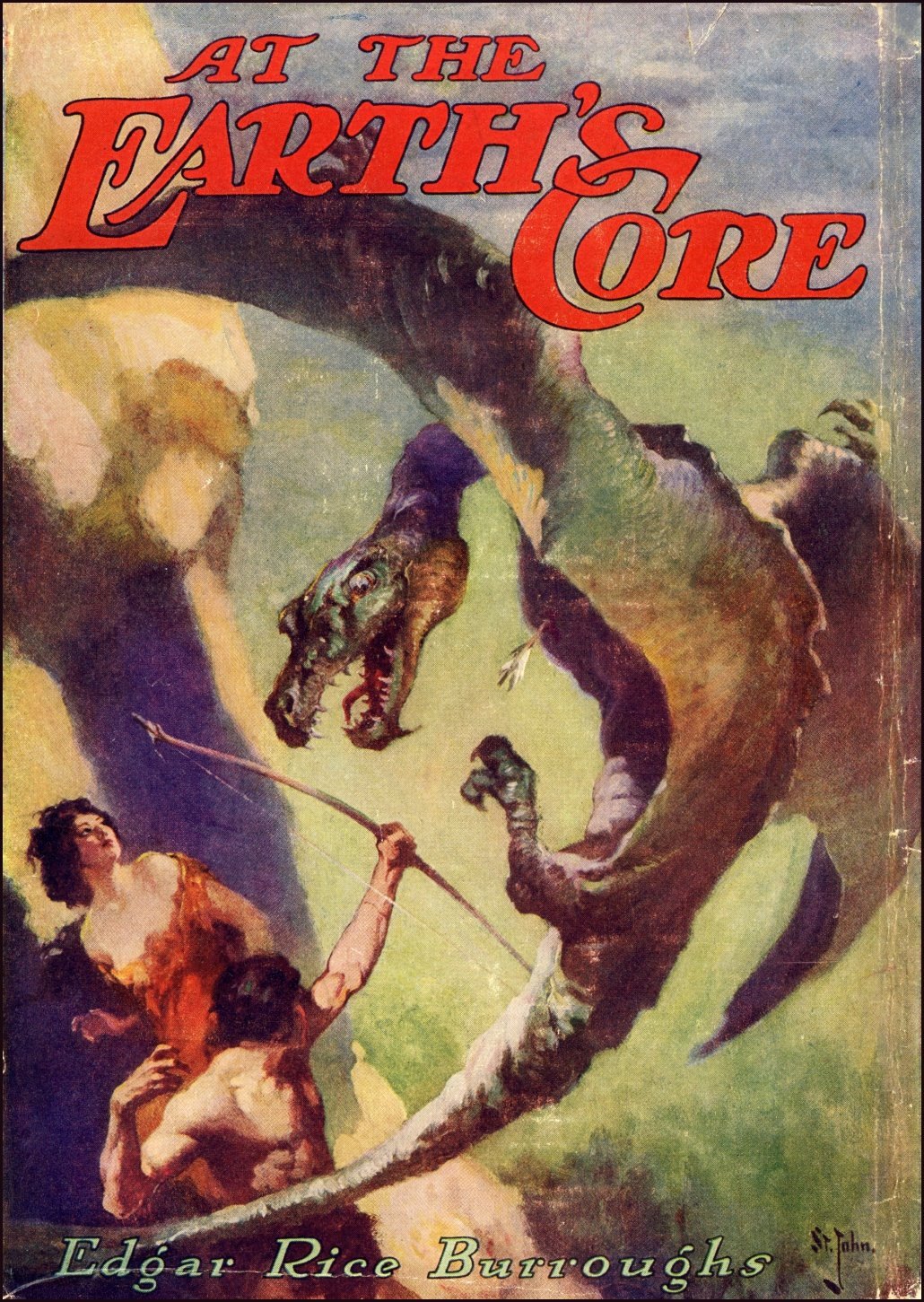
It’s probably a male thing but men usually veer towards more serious genres, such as thriller, horror, sf, fantasy or western, as a form of relaxation. I remember, sometime last year, I put away Jude the Obscure by Thomas Hardy because I was suddenly too tired to read it and picked up At the Earth’s Core by Edgar Rice Burroughs and went underground with Tarzan, into a Jurassic kind of world that was an amazing experience. I eventually finished reading Hardy’s intense tale of the self-sacrificing Jude but found ERB’s fantasy novel unputdownable. A pulp for a classic! Why not? A pulp is a classic for a lot of people.

My reading habits swing like the pendulum, usually before bedtime when I’m most likely to switch over to books that are less taxing on a tired brain. For such an eventuality, I have books and comics that I can read at a moment’s notice. 

The pile of some read-mostly unread cross-section of books would include those by Agatha Christie, Ed McBain, Brian Garfield and John D. MacDonald (crime and suspense), P.G. Wodehouse and Tom Sharpe (humour), Jack Higgins, Tom Clancy, Don Pendleton (Mack Bolan), Thomas Craig and John le Carré (espionage), Oliver Strange and Louis L'amour (westerns), Edgar Rice Burroughs, H.G. Wells and Ray Bradbury (sf and fantasy), Hardy Boys, , Richmal Crompton and Roald Dahl (YA), and occasionally, the classics.

On the other hand, I have read most of the comic-books in my collection but there are a few that I go back to again and again, like Phantom, Mandrake the Magician, Flash Gordon, Bahadur (the Indian vigilante), Rip Kirby, Tarzan and Korak, Conan the Barbarian, and Calvin and Hobbes. I also enjoy re-reading comics under various popular labels such as Marvel and DC, Classics Illustrated, Dell and Gold Key, Harvey Comics, Commando and Western, and India’s Amar Chitra Katha (Immortal Picture Stories).
If these don’t work then I turn to self-help, spiritual, and motivational books! They never fail to lift my flagging spirit.

October 12, 2012

BOOK REVIEW

Agatha Christie and The Secret Adversary (1922)

It’s Agatha Christie Week at Friday’s Forgotten Books over at Patti Abbott’s blog Pattinase. Hop over and read other reviews, analyses and perspectives on the Queen of Crime and her immortal mysteries.

“I found myself making up stories and acting the different parts. There's nothing like boredom to make you write,” Dame Agatha Christie said in an interview on BBC Radio in 1955. “So by the time I was 16 or 17, I'd written quite a number of short stories and one long, dreary novel. By the time I was 21, I had finished the first book of mine ever to be published, The Mysterious Affair at Styles.


The writer
An Agatha Christie Week is an imposing challenge. Can you say anything new about a writer who has probably been written about more than most writers of her period and whose books have plausibly been reviewed more than those of her contemporaries? While I visit fifty-odd blogs through the course of the week, not to mention dozens of literary websites, rare is the blog or site that hasn't glorified the Dame and her Detectives in some way or the other. Her presence, both online and offline, is overwhelming in a pleasant kind of way. 

The Queen of Crime, arguably, the most famous mystery writer of the last century, has penned nearly seventy novels out of which I have, happily, read less than half. Yet, there is little that I don’t know about Christie’s work or her life in the public domain. She was a very private woman and rarely ever gave interviews. I expected to read at least one in The Paris Review, no luck there either.

She did appear on BBC’s radio programme, though. You will find Agatha Christie: A look at the life and craft of the world's most successful crime writer at BBC Archive rather fetching. It includes a 2.42-hour interview on How to write a best-selling novel (1955) as well as a 5-minute talk by her archaeologist-husband Sir Max Mallowan who recalls his wife, “the talented archaeologist” (1977).

Christie was as prolific a writer as she was a woman of few words, speaking of which her most famous quote concerned her marriage to her second husband, Mallowan. She says, wittily, “An archaeologist is the best husband a woman can have. The older she gets the more interested he is in her.” They had a common interest, archaeology, and set up their matrimonial camp next to the many digs she accompanied him on, which might explain why their marriage lasted forty-eight years, until her death in 1976. 

I think she retained her first husband Archibald’s last name because she had already written some half-a-dozen novels and numerous short stories as ‘Agatha Christie’ during their fourteen years of marriage. Probably, she didn’t want to switch to ‘Agatha Mallowan’ and risk being forgotten in the early stages of her literary career. I don’t know if she ever wrote anything as ‘Agatha Christie Mallowan’ which, if you think of it, sounds oddly familiar.

The book
You cannot write about Agatha Christie without writing about her books. The real Agatha Christie challenge lies in reviewing her novels and not so much her life and its colourful vicissitudes. I said before that I had read less than half of her novels, so I don’t have much to go on. I, therefore, decided to pick the last novel I read—The Secret Adversary. Only the second of her sixty-six mysteries, it has received highly favourable reviews on hundreds of blogs and websites.

You would expect Christie to stick to the formula behind her hugely successful first novel, The Mysterious Affair at Styles, which introduces Hercule Poirot, the Belgian detective with the egg-shaped head and handlebar moustache. Instead, she reaches into her box of mysteries and pulls out something different entirely. The Secret Adversary, I suspect, might have been part of an experiment by Christie to try out new characters and storylines early in her writing, and have some fun while she was at it. 

The Secret Adversary is a well-written novel about a young couple, Tommy Beresford and Tuppence ‘Prudence’ Cowley, looking for work in London at the end of World War I. Instead of finding conventional jobs, they go hunting for adventure and to prove they are earnest they even call themselves The Young Adventurers Ltd. Their youthful and reckless exuberance lands them in a serious mess rather than in a harmless adventure with a little money at the end of it: in the middle of a sinister conspiracy that threatens to topple the British government and shake the foundations of democracy on both sides of the Atlantic.

This is the only book where I guessed correctly, and very early on, the identity of the elusive Mr. Brown, the mastermind behind the secret plot to unleash a Bolshevik-type of revolution in Britain.


Bring out your knives. In my opinion, The Secret Adversary is not a serious mystery, in the mould of Christie’s cracking whodunits. It lacked the panache, intellect and intensity of Hercule Poirot and his methodical investigation of crimes and murders. In the main, it’s a nice adventure, in the mould of YA fiction, involving two friends out to have some fun which is what they have in spite of being cornered and caught by the mysterious Mr. Brown's cronies and later by Mr. Brown himself. It’s also a love story, with a dose of Wodehousian humour initially, as Tommy and Tuppence realise their feelings for each other even as they are on the trail of the Bolshevik conspirators and vice-versa. Lastly, I'm not sure political conspiracy, especially on such a grand scale, was really Christie’s forte: in spite of the bold plot, it wasn't convincing enough. 

For these reasons, I’d have enjoyed The Secret Adversary more than I did had Len Deighton or John le Carré written it.

Christie on Poirot
If this has left a bitter taste in your mouth, here's a sweetener in the form of Christie's unflattering view of her famous detective. As the Queen of Crime churned out mysteries like annual reports, she increasingly found Poirot "insufferable" and a "detestable, bombastic, tiresome, ego-centric little creep." She must have been in a pretty foul mood to tick off poor Poirot.

In a long-lost essay she wrote for the UK government in 1945, in praise of British crime-fiction, and first brought to my notice by Sergio Angelini in a post he wrote September 19, 2012, Christie pours more scorn on her creation: "My own Hercule Poirot is often somewhat of an embarrassment to me—not in himself, but in the calling of his life. Would anyone go and ' consult' him? One feels not."

Christie gives the impression that she was tired of Poirot when she says, "Poirot has made quite a place for himself in the world and is regarded perhaps with more affection by outsiders than by his own creator! I would give one piece of advice to young detective writers. Be very careful what central character you create—you may have him with you for a very long time!"

The only reason the endearing Belgian detective survived his creator's verbal onslaught, until 1975, was his popularity among his millions of fans.


"I had the last laugh, mon ami!" 

October 09, 2012

FILM REVIEW 

Notting Hill (1999) and Maid in Manhattan (2002)

If it’s Tuesday, it’s Overlooked/Forgotten Films and Television over at Todd Mason’s blog Sweet Freedom. Don't forget to check out the other fascinating reviews over there.

There’s something quite charming about movies where the hero and heroine, in typical Bollywood fashion, profess their love for each other in a public place and in broad daylight, usually towards the fag end of the film.

In Hindi films, for instance, it’s not uncommon to see the lovebirds—one of whom is always rich and the other always poor—declare their undying love (sic) for one another smack in the middle of a robust family reunion. Most Bollywood films end this way, on an unusually ecstatic note.

I can think of at least two English romantic comedies that have tried the formula with reasonable success—Notting Hill (1999) and Maid in Manhattan (2002). The difference is that Hollywood does it with finesse, though, in recent years Bollywood has been fine-tuning its final mushy scenes.


Anna Scott (Julia Roberts): Can I stay for a while?
William Thacker (Hugh Grant): You can stay forever.
 

In Notting Hill, local bookstore owner William Thacker (Hugh Grant) is in love with the rich and beautiful movie star Anna Scott (Julia Roberts) but he can’t come to terms with her fame or accept her entreaties to love her because, “I live in Notting Hill. You live in Beverly Hills. Everyone in the world knows who you are; my mother has trouble remembering my name.”

After much soul-searching with his oddball friends, William realises he’s made a terrible mistake and, helped by his buddies, rushes off to the hotel where dream girl Anna is giving her last press conference before flying back to America.


William, who claims he represents Horse and Hound, edges his way past the paparazzi and shutterbugs and stands before Anna. Here’s what happens, courtesy IMDb.

 
P.R. chief: Next question? Yes. You in the pink shirt (referring to William).
William: Uh, right. Miss Scott, are there any circumstances that you and he might be more than just friends.
Anna Scott: I hoped that there would be but I've been assured that there's not.
William: Yes, but what if...
P.R. Chief: I'm sorry. Just the one question.
Anna Scott: No. It's alright. You were saying?
William: I was just wondering what if this person...
Journalist: Thacker. His name is Thacker.
William: Right. Thanks. What if, uh, Mr. Thacker realised that he had been a daft prick and got down on his knees and begged you to reconsider if you would...indeed...reconsider.
Anna Scott: Yes. I believe I would.
William: That's wonderful news. The readers of Horse and Hound will be relieved.


Director Roger Michell not only gets William to reciprocate Anna's love for him, in public, he also does it with some fine humour. Imagine Horse and Hound!

Maid in Manhattan, directed by Wayne Wang, also ends with a press conference in a hotel foyer, where a young boy Ty Ventura (Tyler Posey) stands among journalists and asks the rich and famous Chris Marshall (Ralph Fiennes), who is standing for senate, why his mother and hotel maid Marisa Ventura (Jennifer Lopez) should not be given a second chance, the result of a misunderstanding between the much-in-love Chris and Marisa. 


Jerry Siegel (Stanley Tucci), who manages the prospective senator’s public image, is aghast and quite helpless as Ty leads Chris through the hotel, past the kitchen staff, and to his mother’s room with the paparazzi and shutterbugs desperately in tow.

Chris: Can we start over? Second chance, second date? You as you, me as me. No secrets. What do you think?

The Bollywood formula of boy-meets-girl in public (or vice versa) and all’s well that ends and that kind of thing worked well in both these Hollywood rom-coms.

October 07, 2012

Stamp of a Writer: Maxim Gorky

"Why, (reading books) is the only pleasure I have. While I'm reading it is as if I were living in another city, and when I have come to the end, as if I were falling from the belfry."

"The most beautiful words in the English language are 'not guilty'."

"Many contemporary authors drink more than they write."

"I caught a chill while I was tipsy. I had typhoid fever. When I began to get well—it was torture ! I lay quite alone all day and all night, and it seemed to me as if I were dumb and blind, thrown into a pit like a pup. Thanks to the doctor, he gave me books all the time, or else I'd have died of depression... I kept reading poetry... I read, and it was as sweet as if I were swallowing milk. There is, brother, such poetry, that when you read it, it's like your sweetheart kissing you. And sometimes a verse will give you such a blow on the heart: you blaze up as if it had struck a spark."
— From Three of Them

In the maxim of the past you cannot go anywhere.

The good qualities in our soul are most successfully and forcefully awakened by the power of art. Just as science is the intellect of the world, art is its soul.”
— From Untimely Thoughts: Essays on Revolution, Culture, and the Bolsheviks, 1917-1918

"You must write for children in the same way as you do for adults, only better."

"Keep reading books, but remember that a book’s only a book, and you should learn to think for yourself."

Note: For the 19 previous Celebrity Stamps, click here.

Leo Tolstoy and Maxmim Gorky


Anton Chekhov with Maxim Gorky


October 05, 2012

BOOK REVIEW 

Cape Fear (The Executioners), 1957, 
by John D. MacDonald

My maiden read and review of a John D. MacDonald thriller goes towards Friday's Forgotten Books over at Patti Abbott's blog Pattinase which is being hosted by Todd Mason at his blog Sweet Freedom this week. Check out the two blogs for plenty of other great reviews.

What do you do when an insane criminal threatens to destroy your family and the police are powerless to protect you? 

My copy of Cape Fear
Coronet Books
There is a scene in Friends where Chandler (Matthew Perry) is upset because he sees a video of Richard (Tom Selleck) having sex with a woman he mistakes for his girlfriend Monica (Courteney Cox). When he mentions the video to Monica and insists that Richard is holding on to it because he hasn't got over her, she runs the tape and finds that it isn't her at all. Chandler is ecstatic and blurts out, “Life is good again!”  

It’s the sort of positive sentiment most people express, or say to themselves, after they are out of a particularly difficult period, especially where families are involved. It feels no less than a rebirth. 

Just as it does for Sam and Carol Bowden after they almost single-handedly confront the psychopathic killer who has been terrorising them and their three children, two boys and a teenage girl, for several weeks.

John D. MacDonald deserves sincere praise for writing a gripping tale as well as a gentle rap on the knuckle for putting you through 160-pages of edge-of-the-seat suspense. You want to sit through Sam and Carol’s nightmare and see what happens and you also want to walk away from the terror unfolding in their picture-perfect family life. The temptation to sit through it is greater. Morbid curiosity, perhaps.
 

In Cape Fear (previously The Executioners), MacDonald does not waste time in yanking the reader straightaway into the heart of his story, into the lives of three people—Sam and Carol, an intelligent and handsome couple deeply in love, and Max Cady, a mad criminal seeking to destroy everything they cherish. 

Many years ago, Lieutenant Sam Bowden, an air force pilot, was responsible for putting Cady in prison for the rape of a teenager, and now he is out, stalking the successful lawyer and his family with cold-blooded intent. He poisons their dog and nearly shoots to death the older son while at camp. The police are not especially cooperative. So Sam and Carol hit upon a plan that’s as daring as it’s stupid: use Carol as bait to trap the animal. But, what else can they do?

In Cape Fear, MacDonald has created a family that is as perfect as you would expect families to be—happy and vulnerable and fiercely protective of their small, cocooned world. And then, suddenly, he puts a crack in the mirror that widens and threatens to shatter into a thousand small pieces. Sam and Carol go nearly to pieces, themselves, to ensure their mirror is intact.
 

The other notable aspect of this blinder of a novel is the character and role of Max Cady. The author has portrayed a terrifying picture of a villain who remains largely in the shadow of the Bowdens, exposing himself neither too much nor too little. But you know he’s around somewhere, waiting, lurking, haunting, and you can’t help thinking to yourself, “Come on, Cady, do what you have to do and get it over with.” And while you wait for the cad to do something, you’re not thinking of Sam, he can take care of himself; you’re thinking of Carol and her children, especially their innocent and lovely teenage daughter. You’re thinking of your own family and their vulnerability. Damn you, MacDonald!

In the end, though, "Life is good again!" is what Sam Bowden is thinking as he tells Carol, "It's like recovering from a serious illness. All the world looks fresh and new. Everything looks special. I feel enormously alive. And I don't want that to fade. I want to hang on to that." How often have we felt that way?

And that, in essence, is the narrative power of John D. MacDonald. 


Cape Fear  is my first book by the legendary American crime and suspense writer and I'm looking forward to reading some of his other novels in my possession, including a couple of Travis McGee paperbacks.  


Note: I have deliberately left out mention of the two film adaptations of Cape Fear (1962 & 1991) because I haven't seen either. I’d, however, like to guide you to a past review of the book by Patti Abbott over at her blog Pattinase.

October 04, 2012

50 years of 007: Bond on Bond 

“I don't believe in Bond as a hero. It's a load of nonsense. How can you be a spy when any bar you walk into, the bartender says, ‘Ah, Mr. Bond. Shaken, not stirred?’”
— Sir Roger Moore 


Ian Fleming's impression of James Bond.
Source: Daily Express
This morning Sergio Angelini, a discerning reviewer of books and films, reminded me that Friday, October 5, is the 50th anniversary of the James Bond films. In a well-written piece titled Fifty shades of James Bond, he tells us which 007 movies worked their magic the best. You can read his article over at his blog Tipping My Fedora.

Jeff Flugel at The Stalking Moon gives us two opposing views of Bond films in twin posts titled Bottom of the Barrel Bonds and 50 Years of 007: My Best Bonds.


If you want something official, then head over to 007, the official James Bond site, and look Inside the World of Bond.

If you’re looking for trivia, then you stay right here and check out what each of the six Bond actors have to say about the other, in order of their screen appearance—Sean Connery, George Lazenby, Roger Moore, Timothy Dalton, Pierce Brosnan, and Daniel Craig. Connery made a comeback twice: in Diamonds Are Forever in 1971 and the rather forgettable Never Say Never Again, a 1983 remake of his previous Bond flick Thunderball, 1965. 

Of all the actors who played 007, Roger Moore is by far the funniest, not least because he says, “I like Bond. But it's silly to take it seriously. It's just a great big comic strip.” I like his self-deprecating humour.


Connery on Craig, Brosnan and Dalton
Craig's a great choice, really interesting—different. He's a good actor. It's a completely new departure.

I thought Pierce Brosnan was a good choice. I liked GoldenEye.

Timothy Dalton never got a handle on the role. He took it seriously in the wrong way. The person who plays Bond has to be dangerous. If there isn't a sense of threat, you can't be cool.


Lazenby on Brosnan
If Pierce Brosnan walked into a room, I doubt anyone would look up. But this is the '90s and women want a different man, a man who shows his feminine side. Pierce definitely has that. 


Moore on Craig
People don't realise how physically demanding the role is. I'm still amazed how many people ask me to this day if I did my own stunts. I tell them if I did or Sean did or Pierce did then we would have been physically dead by the end of the first reel of every film! I have seen Daniel Craig in a number of films. He is a thundering good actor. The movie Casino Royale showed me that he is one hell of an athlete. 


Dalton on Moore and Craig
Roger Moore was brilliant but the movies had gone a long way from their roots; they had drifted in a way that was chalk and cheese to Sean. And I think Daniel Craig will work well. I think he's going to be terrific, he's got danger and vulnerability. 


Brosnan on Connery
Well, I was very aware of being within the confines of a very iconic character. I’d seen the men who’d gone before me, and I’d seen the careers that they had afterward and the lives that they had lived as actors. Now, Sean (Connery) was the man for me—he was the Bond of my generation and the only one that I wanted to try to emulate, but with the firm knowledge that I couldn't do what he did, that I’d have to do what I do. But within my time of service to her majesty in that role, I always knew I wanted to have a career thereafter. And so, since then, that’s what I've been busy with. A working actor, just chipping away, chipping away.


Craig on Connery
Sean Connery set and defined the character. He did something extraordinary with that role. He was bad, sexy, animalistic and stylish, and it is because of him I am here today. I wanted Sean Connery's approval and he sent me messages of support, which meant a lot to me.


Barry Nelson 
Spare a thought for the American actor who was the first to play James Bond in a 1954 adaptation of Ian Fleming's novel Casino Royale for a television episode called Climax! This was some eight years before Sean Connery's Dr. No, the first official 007 flick. Nelson apparently played James Bond as an American named Jimmy Bond. I don't know much about Nelson or his brief role as Bond, so readers are welcome to enlighten me.

October 01, 2012

Virgil Finlay: Master of Fantasy

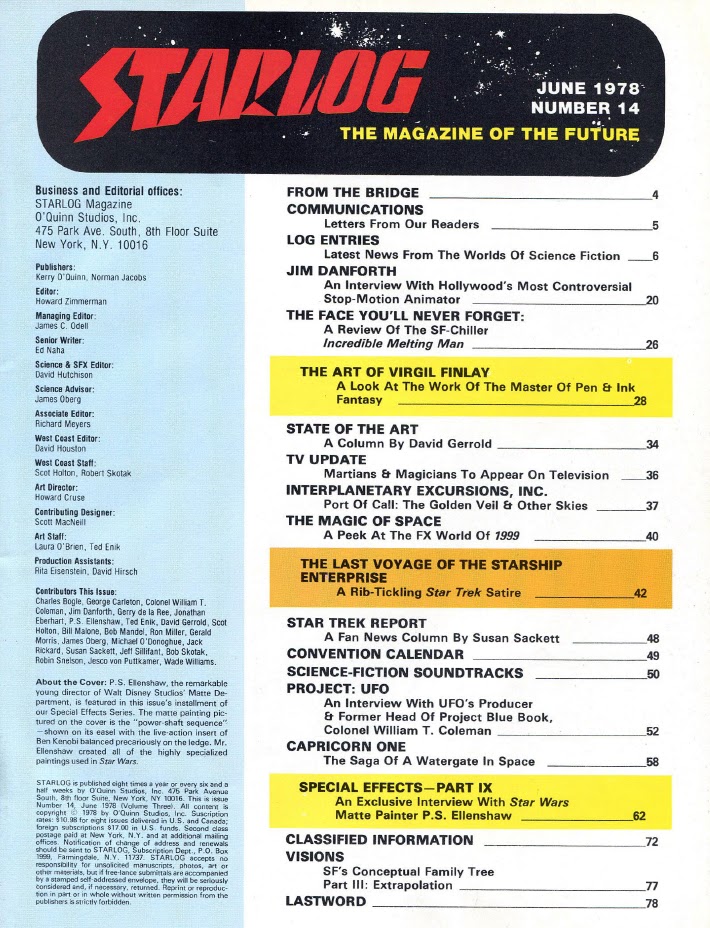
This Monday I was back into my favourite pursuit—looking up rare and vintage stuff in the world of literature. And this is what I came up with: an illustrated article by Gerry de la Ree on the brilliant art of Virgil Finlay in Starlog: The Magazine of the Future, No.14, June 1978.

Ree, a noted American publisher of fanzines, appears to have been somewhat obsessed with Finlay's work in the field of American pulp—science fiction, fantasy and horror. According to the internet, between 1975 and 1981 Ree published a series of seven books that explored the spectacular art of Virgil Finlay accompanied by some 800 high-quality illustrations and detailed essays. The seven books are:


1. Finlay's Last Drawings: For Shakespeare's Midsummer Night's Dream (1975)
2. The Book of Virgil Finlay (1976)
3. Second Book of Virgil Finlay (1978)
4. The Third Book of Virgil Finlay (1979)
5. The Fourth Book of Virgil Finlay (1979)
6. The Fifth Book of Virgil Finlay (1979)
7. The Sixth Book of Virgil Finlay: The Astrology Years (1980)
8. The Seventh Book of Virgil Finlay—Virgil Finlay Remembered (1981) 


In a career spanning more than thirty years, Virgil Finlay (1914-1971) contributed over 2,600 illustrations to popular sf and fantasy and horror magazines like Amazing Stories, Weird Tales and Famous Fantastic MysteriesHis speciality was pen-and-ink drawings which he "accomplished with abundant stippling, cross-hatching, and scratchboard techniques."

He was the master of the scratchboard (or scraperboard) technique where, according to an article on Wikipedia, drawings are created using sharp knives and tools for etching into a thin layer of white China clay that is coated with black India ink. 

Virgil Finlay by artist Charlie McGill
Since the article from Starlog is under Creative Commons License, I'm taking the liberty of quoting Gerry de la Ree. Of Finlay's art, he writes, "His use of the stipple and cross-hatch techniques, and an ability to enhance drawings quickly rocketed him to the top. Over the years many artists would attempt to duplicate Finlay's techniques, but none ever attained the quality that was the trademark of Finlay's finest efforts."

According to him, Finlay did his black-and-white drawings in a variety of techniques, employing pen, brush, spatter, lithographic pencils, sponges, and knives on a variety of paper; the majority were done on scratchboard.

Virgil Finlay's art brought alive the stories of most of the top writers we have heard of, and read, in the sf-fantasy-horror spectrum. Mentioning names would be a waste of time and space though I was surprised with the inclusion of William Shakespeare and John D. MacDonald. You'll find hundreds of covers with Finlay's art over at Internet Speculative Fiction db.

I don't understand Finlay's art or his technique but I admire his work immensely, particularly his black-and-white illustrations. Scroll down for a look…


You can read the Starlog article at www.archive.org. Todd Mason has also featured Virgil Finlay over at his blog Sweet Freedom. Walker Martin's Favourite WEIRD TALES covers, one of which includes cover art by Finlay, can be accessed at Laurie Powers blog Laurie's Wild West.