May 14, 2012

Stamp of a Singer: Louis Armstrong

"To jazz, or not to jazz, there is no question!"

"Man, all music is folk music. You ain’t never heard no horse sing a song, have you?"

"I never tried to prove nothing, just wanted to give a good show. My life has always been my music, it's always come first, but the music ain't worth nothing if you can't lay it on the public. The main thing is to live for that audience, 'cause what you're there for is to please the people."

 
"My whole life, my whole soul, my whole spirit is to blow that horn."

"The memory of things gone is important to a jazz musician. Things like old folks singing in the moonlight in the back yard on a hot night or something said long ago."


"Musicians don't retire; they stop when there's no more music in them."

"If I don’t practice for a day, I know it. If I don’t practice for two days, the critics know it. And if I don’t practice for three days, the public knows it."


"Do you know what it means to miss New Orleans?"

"Making money ain’t nothing exciting to me. You might be able to buy a little better booze than the wino on the corner. But you get sick just like the next cat and when you die you’re just as graveyard dead as he is."

"When I go to the Gate, I'll play a duet with Gabriel. Yeah, we'll play 'Sleepy Time Down South' and 'Hello, Dolly!.' Then he can blow a couple that he's been playing up there all the time."

Previous celebrity stamps featured on this blog: Edgar Allan Poe, Cary Grant, Mark Twain, John Wayne, Virginia Woolf, James Dean, Groucho Marx, Bette Davis, Edgar Rice Burroughs, Arthur Conan Doyle, Fyodor Dostoevsky, Elvis Presley, Walt Disney, Ernest Hemingway, Charlie Chaplin, and Bertrand Russell.

May 11, 2012

The Tree of Life


I took the picture of this magnificent tree in the garden of a century-old hospital in South Bombay. I don't know the botanical name of the tree but I'm pretty certain it's older than the two-storey heritage hospital it looms over. The tree is home to all kinds of birds, such as owls, crows, kites, sparrows, koyals (the long-tailed cuckoo), mynas (the Asian starling) and many others, which "come home" to roost every evening just as the sun sets over the Arabian Sea. The tree has been a quiet chronicler of health and sickness, of life and death, for a hundred years. If only the tree could talk...

Footnote: In case you're wondering which camera I used, it was my Nokia cellphone with a 2 megapixel camera.

Photo Copyright: Prashant C. Trikannad

May 10, 2012

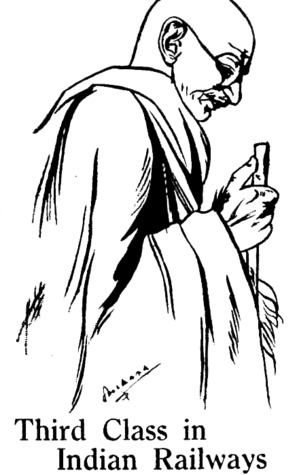
Third Class in Indian Railways by Mahatma Gandhi

This book review is offered as part of Friday’s Forgotten Books meme over at Patti Abbott’s blog Pattinase and Todd Mason’s blog Sweet Freedom. Don’t forget to check out the wide range of reviews, past and present, at both their blogs.


The manner in which Mahatma Gandhi travelled third class in an Indian train in 1917 is more or less how millions of people still travel by train in 2012 — nearly a century after Gandhi undertook that unforgettable journey from Bombay (now Mumbai, the capital of the western state of Maharashtra) to Madras (now Chennai, the capital of the southern state of Tamil Nadu), and back.

Train travel in India has improved vastly since independence in 1947, if not thirty years earlier, in terms of more trains and routes, frequency, amenities and luxuries but much of the rural and semi-urban population continue to travel like cattle. 

Had Gandhi travelled by any one of India’s long-distance express or passenger trains today, he would have found little difference in his experience then and now.

One of the first things the Indian statesman and spiritual preceptor did on arriving from South Africa in 1915 — to lead the freedom struggle against the British — was to travel by Indian Railways, and travel as the masses did, third class. He knew the only way to gauge the mood of the people was to travel by train wherever he went and if he had to champion their cause he had to become one of them. Gandhi did so in all humility and without any qualms.

Third Class in Indian Railways, a 31-page book published in 1917 by Gandhi Publications League in Lahore (now in Pakistan), chronicles the Mahatma’s two-day train journey from Bombay to Madras — a forty-eight hour period during which he studied the pitiable conditions under which hundreds of third-class passengers travelled and also endured insult, humiliation and degradation with them.
 

“On the 12th instant I booked at Bombay for Madras by the mail train… It was labelled to carry 22 passengers. These could only have seating accommodation. There were no bunks in this carriage whereon passengers could lie with any degree of safety or comfort,” Gandhi writes. “There were during this night as many as 35 passengers in the carriage during the greater part of it. Some lay on the floor in the midst of dirt and some had to keep standing.”

While Gandhi recoiled from the dirt, the filth, the lack of sanitation, the overcrowding, the absence of morality, the apathy, the sheer inhumanity of it all, he couldn’t, as a matter of principle, resort to violent protests as some of the other travellers did. Instead, he tried to improve their lot by bringing his critical observations to the notice of the managers of Indian Railways.

As Gandhi observes, “The existence of the awful war cannot be allowed to stand in the way of the removal of this gigantic evil. War can be no warrant for tolerating dirt and overcrowding. One could understand an entire stoppage of passenger traffic in a crisis like this, but never a continuation or accentuation of insanitation and conditions that must undermine health and morality.”

What hurt Gandhi most about the neglect of the third-class passengers was the loss of a grand opportunity — imparting “splendid education” to millions in orderliness, sanitation, a decent composite life, and cultivation of simple and clean tastes. “Instead of receiving an object lesson in these matters, third-class passengers have their sense of decency and cleanliness blunted during their travelling experience,” he writes.

While third-class passengers usually pay for the ever-increasing luxuries of first- and second-class travel, he felt they were entitled at least to the bare necessities of life.

Third Class in Indian Railways also consists of five other discourses, namely Vernaculars as medium of instruction, Swadeshi (self-sufficiency or self-sustenance), Ahimsa (non-violence), The moral basis of cooperation, and National dress.

May 08, 2012

FILM REVIEW

The Barretts of Wimpole Street (1957)

This film is my contribution to Tuesday’s Overlooked/Forgotten films and television over at Todd Mason’s blog Sweet Freedom. Don't forget to check out the other fascinating entries over there.

Passionate love and scintillating verse dominated the twenty-month courtship of Robert Browning and Elizabeth Barrett that eventually culminated in marriage on September 12, 1846, at Marylebone Church in London. The renowned English poets, described as the “most romantic literary couple from the Victorian era,” exchanged hundreds of letters affirming and reaffirming their mutual love and friendship.

 
“I love your verses with all my heart, dear Miss Barrett — I do, as I say, love these verses with all my heart,” Robert, the more expressive of the two, wrote after he read Elizabeth’s poems for the first time.

It wasn’t long before he fell in love with Elizabeth and expressed his feelings for her in nearly all his letters.

In one letter, written on December 27, 1845, Robert declares, “For ever and for ever I do love you, dearest — love you with my whole heart — in life, in death.”

Then, on February 23, 1846, a few months before they were married, he gushes, “Bless you, my sweetest. I love you with my whole heart; ever shall love you.” 


Elizabeth, the eldest of the nine Barrett children, reciprocated his love both during their affair and after their marriage. In August 1851, five years after they tied the knot, Elizabeth wrote to her old friend Mrs. Martin:

“So far from regretting my marriage, it has made the happiness and honour of my life; and every unkindness received from my own house makes me press nearer to the tenderest and noblest of human hearts proved by the uninterrupted devotion of nearly five years. Husband, lover, nurse — not one of these, has Robert been to me, but all three together. I neither regret my marriage, therefore, nor the manner of it, because the manner of it was a necessity of the act. I thought so at the time, I think so now; and I believe that the world in general will decide (if the world is to be really appealed to) that my opinion upon this subject (after five years) is worth more.”


Her words “every unkindness received from my own house…” are particularly significant for Elizabeth is alluding to a long life of tyranny under her widowed father, whose possessiveness of his eldest daughter bordered on incest. Elizabeth, therefore, felt deeply indebted to Robert for saving her life — by marrying her when she was ill and whisking her off to Italy where they lived for fifteen years before she died in his arms on June 29, 1861.

It is the tyranny of her father on one hand and the devotion of her lover on the other that is at the core of The Barretts of Wimpole Street made by Sidney Franklin in 1957. This colour film is apparently a scene-by-scene replica of the black-and-white version directed by Franklin in 1934.

John Gielgud and Jennifer Jones in a tense scene.

In the original edition, Charles Laughton plays Edward Moulton-Barrett, the father, a role that is tailor-made for John Gielgud in the latter version. While Norma Shearer and Fredric March act as Elizabeth Barrett and Robert Browning in the 1934 film, they are replaced by Jennifer Jones and Bill Travers in the 1957 offering.

I cannot compare the two versions as I haven’t seen the first.

Had there been a 2012 version, however, I’d have liked to see either Colin Firth or Johnny Depp as Robert Browning, Winona Ryder as Elizabeth Barrett, and Gene Hackman, provided he is still acting at the age of eighty, as Barrett Senior (I can picture him gritting his teeth, grabbing Elizabeth by her arm and pulling her roughly to him). But this is neither here nor there.
 

Bill Travers and Jennifer Jones take their vows.

The wonderful John Gielgud is terrific as Edward Moulton-Barrett, the widower, as he goes around the Wimpole household terrorising his adult children who are not allowed to have affairs or marry without his consent.

Elizabeth (Jennifer Jones), known by her nickname Ba, gets the brunt of her father’s insane behaviour — he is more possessive of her than his other children and confines her to a room most of the time, with only her beloved dog Flush and her maid Wilson (Jean Anderson) as her faithful companions. Elizabeth loves her father and does what he says, partly out of fear and partly because she thinks he knows best. After all, he is her “Papah” and she is quite ill, with rheumatic fever, it would seem; a fact Barrett keeps reminding her if only to ensure she does not move out of his sight.

Enter Robert Browning (Bill Travers), the dashing poet with long sideburns, and Father Barrett’s questionable conduct is at once exposed. Having prohibited his other daughter Henrietta Barrett (Virginia McKenna) from seeing Captain Surtees Cook (Vernon Gray), he turns his amorous attention to Elizabeth. In one scene — in fact, the scene of the movie — he grabs hold of his daughter, pulls her towards him and tries to embrace her in a very non-parental way, and castigates her for bringing another man into her life.


Elizabeth is shocked beyond belief and agrees to marry Robert and elope with him to Italy with her dog, Flush, and maid Wilson. The film ends on a happy note, though, in real life Edward Moulton-Barrett disowned his daughter while her brothers refused to accept Robert because he was from a lower class.

The Barretts of Wimpole Street, originally based on a play written by Rudolf Besier in 1930, is more about the Robert Browning-Elizabeth Barrett romance and the fight for one’s happiness and less about a widowed father who is almost insane with jealousy over his daughter.

May 04, 2012

BOOK REVIEW

The Payoff by Don Smith

This book review is offered as part of Friday’s Forgotten Books meme over at well-known writer Patti Abbott’s blog Pattinase. Don’t forget to check out the wide range of reviews at her blog.

I have a simple formula for deciding whether or not to read a book I have never heard of — I check out the picture on the front cover and the blurb on the back cover and if I like one or the other, or both, I go ahead and read the novel. So far it has worked for me.

It happened with The Payoff by Don Smith which I found under a pile of secondhand paperbacks. I knew I was going to read the book as soon as I pulled it out. As you can see, the cover is striking and the illustration smacks of corporate crime while the blurb on the back cover only hastened my decision to pick up the novel. It read...


"I've hit you three times and I'll go on hitting you unless you pay me two million dollars. If you discuss this with the police or the FBI you lose another plane..."

In addition, The Payoff was a Fawcett publication and Fawcett books rarely disappoint.

Now, you could write your own story with a blurb like that, but before you do, let's hear Don Smith's story first — it's his book.

Tim Parnell is trying to catch "trout" from a garbage can lying bottom side up in his office in Amsterdam airport when Bill Stanford, executive vice-president of Pan World Airways, hires him to investigate the mysterious bombing of three PWA planes followed by a two-million dollar ransom note.


The American detective's appearance doesn't inspire Standford's confidence — big frame, no tie, unbuttoned shirt, tousled hair, and fly casting at three o'clock in the afternoon. The former CIA agent is the best investigator of airline crimes and that's what a desperate Stanford needs to save his airline company.

"There was only one man in the world who had a prayer of doing that, and he was in Amsterdam. Tim Parnell. International private eye. If anyone could put a crimp in the Mafia's new sky-jack extortion game, it was Parnell..."

Parnell takes up the case, for a tidy fee and an all-expense account, because he provides good value for good money and because he knows where and how to find the hoods who are bombing planes with no passengers in them. The sleuth wastes no time in getting on the trail of the blackmailers whose tentacles are spread across America and Europe. He does so by accompanying Stanford on his first "drop" of ransom money somewhere between Zurich and Brussels.


The story then moves back and forth between Monte Carlo, Geneva, Marseilles, New York, Paris and Amsterdam as the hard-nosed detective with a predilection for taking risks discovers a caboodle of gangsters — American mafia led by the mastermind, the son of an NY don, and a big-time Italian drug runner — are behind the ransom caper. 

Even as Parnell gathers clinching evidence against the hoods, with help from a French private detective and an ex-cop, Standford, who has hired him on the sly, takes him off the case. The ransom has been paid and no more PWA planes have been bombed.

But the American detective continues his investigations, with what's left of the unaccounted fee from Stanford, because he realises that the people who bombed Pan World Airways planes will soon pick another target. They pick Lufthansa...and Parnell closes in. In the end Parnell, with a bit of smart thinking, is richer by the millions and a broad he has grown fond of.


The Payoff is a racy novel in the mould of a James Hadley Chase. There is never a dull moment in the 191-page turner which was published in 1973. It’s a predictable storyline but Don Smith tells it well. I recommend it if you have nothing better to read. 

There is very little about Don Smith and his other works on the internet, though I found something else. Private Eyes 101 Knights: A Survey of American detective Fiction 1922-1984 by Robert A. Baker and Michael T. Nietzel (1985), among other interesting things, briefly discusses the number of American detectives like Tim Parnell who have moved abroad to practice their investigative work. Don Smith has written books featuring Parnell — The Man Who Played Thief (1971), The Padrone (1971) and Corsican Takeover (1973) — as well as about a secret agent, Phil Sherman, who has featured in 16 secret missions.

April 30, 2012

Libraries of India Series #2

University Library of North Bengal


In November 2011, I started the Libraries of India series with the over a century old National Library of Kolkata in the East Indian state of West Bengal. For some inexplicable reason, I didn't continue the series. I have now decided to revive it with a brief look at the University Library of the University of North Bengal located near Siliguri in the picturesque district of Darjeeling in West Bengal. Darjeeling is famous for its tea.

 
Founded in 1962, the University Library has a vast and an impressive collection of books, reports and periodicals from all branches of Science, Arts, Commerce, and Management. The 2.35-lakh odd literary works include more than 1.80-lakh academic books, 36,000 bound periodicals, and over 600 rare books apart from reference books, theses, census, manuscripts, and gazettes.

 
Most university libraries in India owe their existence to the British who were mainly responsible for introducing and imparting English education as well as building grand edifices of learning that are heritage structures today.


Photos: University of North Bengal
Arnie writes his autobiography

Poor immigrant, bodybuilder, Mister Universe, mega film star, millionaire businessman, Governor of California… You can actually picture Arnold Schwarzenegger climbing the rags-to-riches ladder. The “Austrian Oak” would probably have climbed all the way into the Oval Office if the American constitution allowed him to.

But Schwarzenegger has achieved more than enough in his 64 years and he doesn’t have to run for US president to write his autobiography which Simon & Schuster will publish globally in October this year.

The book jacket art for Total Recall: My Unbelievably True Life Story was unveiled by the big man himself a fortnight ago, via Twitter and Facebook, so that his legion of fans could have a say in plans for the book — in terms of their choice of
favourite photographs from different stages of his life. The book's back cover will showcase his years as an athlete, movie star, and governor.

“One of the most anticipated autobiographies of this generation, Arnold Schwarzenegger’s Total Recall is the candid story by one of the world’s most remarkable actors, businessmen, and world leaders,” Simon & Schuster said in a media release.

Total Recall covers Schwarzenegger’s high stakes journey to the United States, from creating the international bodybuilding industry out of the sands of Venice Beach, to breathing life into cinema’s most iconic characters, and becoming one of the leading political figures of our time. Proud of his accomplishments and honest about his regrets, Schwarzenegger spares nothing in sharing his amazing story,” the release noted. 


Yet, a lot of people believe Arnie won't reveal much in his widely-awaited literary self-flagellation. He is expected to leave the juicier portions of his private life out of the public domain.

Good thing, too. I, for one, would like a Schwarzenegger autobiography to focus entirely on his movies starting with his first film Hercules in New York (1969) to the nearly fifty movies in his forty-three year acting career. He is one of the most entertaining and successful actors of our time and I’d like to know how he got there.

A post on Arnold “one liner” Schwarzenegger can never be complete without a list of sorts.

Which are your 5 favourite Arnie movies? Mine are: Conan the Barbarian (or Destroyer if you like), The Terminator, Commando, Raw Deal, and Predator.

Schwarzenegger may not be the ‘last action hero’ but he is the ultimate action hero...in a comic role.