Showing posts with label Indian Fiction. Show all posts

January 05, 2019

Book Review: On the Run with Fotikchand by Satyajit Ray

“...And who is this young assistant you have got here?”

The question came so unexpectedly that Fotik’s heart nearly jumped into his mouth.

The two men were standing nearby. They had just emerged out of the dark. On Fotik’s right stood Shyamlal, his bow legs covered by long trousers. Out of the corner of his eye, Fotik saw the blade of a knife flash, go past his ear and stop somewhere between him and Harun.

(As an Amazon Associate I earn from qualifying purchases.)

On the Run with Fotikchand by Satyajit Ray book cover
On the Run with Fotikchand by Satyajit Ray, the celebrated filmmaker, writer and cultural icon, is a charming adventure story about an 11-year-old boy who loses his family and his memory.

The story begins when Bablu, the son of a wealthy Calcutta barrister, is kidnapped by four criminals. Their plan takes a disastrously wrong when the stolen car carrying the boy crashes, killing two of the kidnappers. Bablu survives the accident but awakens with no memory of who he is or where he belongs.

Adopting the name Fotikchand, he drifts through the streets of Calcutta (now Kolkata) until he meets Harun, a poor but warm-hearted juggler who offers him food, shelter and work. As Fotik settles into his new life, helping at a tea stall by day and assisting Harun at local fairs by night, he becomes fascinated by the world of juggling and street performance.


His newfound happiness is short-lived, however. The two surviving kidnappers discover that the boy is alive and begin searching for him, still hoping to collect a ransom. As danger closes in, Fotik and Harun are forced to flee, setting the stage for an exciting climax in which the boy's lost memory begins to return. Meanwhile, back home, his influential father presses the police to intensify their search and places newspaper advertisements offering a reward of Rs.5,000 for information leading to his son's return.

On the Run with Fotikchand is not so much a tale of kidnapping as an endearing story of friendship between Fotik and Harun. The juggler’s hand-to-mouth existence does not come in the way of his kinship with, and generosity towards, the boy, the son of a rather selfish and calculated man. A not-so-subtle contrast between the arrogance of the privileged and the humility of those living on society's margins.

The 94-page novella is mildly suspenseful and moves at a brisk pace. The narrative is simple and engaging, thanks to Gopa Majumdar's translation from the original Bengali. Majumdar has translated several works by Satyajit Ray and other Bengali writers into English.

The book was adapted into the 1983 film Phatik Chand, which I have not seen. My Puffin Books edition (pictured above) also contains black-and-white illustrations by Ray himself. 

November 09, 2018

The Sheriff of Kalbadevi

I have been a big fan of Western Fiction or Frontier Fiction from the time a paternal uncle introduced me to English writer Oliver Strange's Sudden series. I was in my teens and I was hooked. His ten novels and an additional five by Frederick H. Christian (British writer and editor Frederick Nolan) have been featured on this blog a few times. The exploits of James Green, alias Sudden, the Texas outlaw, led to my heightened interest in other western authors, notably Louis L'Amour, J.T. Edson, Zane Grey, Max Brand, George G. Gilman, Wayne D. Overholser, Jonas Ward, Giles A. Lutz and others. I continue to read westerns.

Since then, however, I have always dreamed of writing a western novel. There were even a few halfhearted attempts. In August 2015, I began work on a Wild West-comes-to-India novel in earnest. At least, that was the plan. I typed out a few thousand words and was pleased with the way the story was shaping up. It was about a Western-styled Indian sheriff set in an old part of Mumbai in the 21st century. So it had cowboys and gunfights as well as four-wheeler taxis and pizza delivery.


But Procrastination and Distraction, the two nemesis of my writing life, bushwhacked me along the way and that was the end of what I thought would one day be my debut novel called The Sheriff of Kalbadevi.

Then, last month, I read about a short story contest at Juggernaut Books, a popular Indian writing platform where I had previously published an atmospheric tale set around a murder mystery, titled A Little Murder at Dinner. I retrieved my western story from the recesses of D drive on my computer, scaled it down to a little over 2,000 words, got the family to proofread the story, and uploaded it on the Juggernaut website. As of writing this post, the results were yet to be announced.

The story begins in Kalbadevi, an old neighbourhood of Mumbai named after the Hindu goddess Kalbadevi. The area has an old-world charm and is known for its wholesale markets, usually bustling with activity six days a week. I worked along its periphery for many years.

This is how The Sheriff of Kalbadevi begins.


Friday night descended on Kalbadevi like any other summer night, the weather still unforgiving. Long after the Indian sun ducked into the Arabian Sea, the old neighbourhood of Mumbai was enveloped in a haze of April heat and dust. Red earth rose and swirled in the air, settled down, and rose again.  
Kalinga sat hunched on his horse under a yellow streetlight. He blew smoke from a cigarette and looked around him with a sense of boredom. There was little movement on the intersection of Princess Street and JSS Road. Two young cowboys on horseback were riding out, back to their ranch or maybe to the seafront on the other side of town, to meet their girlfriends. A woman hurried across the street with her young son and disappeared round the corner of a dilapidated building. Shopkeepers and roadside hawkers were closing business for the day. A group of weary traders vanished behind a tobacco-stained curtain into a country liquor bar. When they staggered out, they would be men no more. He eyed them with distaste.

And here is a significant passage appearing towards the end.

The four gunmen stared in disbelief as two six-guns appeared magically in the sheriff's hands and spit fire simultaneously. They didn't stand a chance. His first bullet caught Balki plumb between the eyes. He died instantly and slid to the ground head first. His horse bolted. Two of his sidekicks got a bullet each in the chest and were thrown off their horses. His fourth bullet sliced through the throat of the last man who slumped in his saddle. It was all over in less than a minute.
Instantly, a new legend was born and it'd travel miles and miles, just like all of his fabled gunfights of the past.

If you're tempted to read the full story, then please click here. I hope you like it. I had fun writing it, partly because it was an original idea.

And if you're still around, you may also like to read A Little Murder at Dinner and the related Editor's Pick of the Week interview Juggernaut Books did with me in June this year.

November 06, 2016

Innocent Justice

A short story by Prashant C. Trikannad

The old proprietor of the country liquor shop dropped the coins in the drawer and handed Kiaan a bottle of hooch wrapped in newspaper.

"Now you be careful with that, kid," he said, leaning over the counter and pulling the young boy's raincoat together.

Kiaan nodded without looking up.

"Tell your father I said hi."

"He's not my father," the boy said.

"Uh, okay. You take care," the barman said. "The rain gods are in a foul mood tonight."

Kiaan gripped the bottle by the neck and went out into the night. Rain was falling hard and the narrow bridge leading to the other side of the creek where he lived was deserted. His shoes made a sucking sound as he walked through muddy water.

The night was eerily quiet.
The storm had taken out the street lights. Another kid would have shivered with cold fear. Not Kiaan. All he felt was a burning anger towards the man who beat his mother every night and had made life hell. He shook involuntarily and his fingers tightened around the bottle of cheap Feni. Tonight would be the last night his stepfather sent him out to fetch the bottle. As he walked across the bridge, he looked at the ghostly shapes of trawlers bobbing in the distance where the creek joined the sea.

His father had died when he was six. Four years later, his mother had married his father's school friend. She'd told him she took the step for his sake, because he needed a father figure in his life. His stepfather turned out to be a violent alcoholic whose physical abuse of his mother started almost immediately after they returned from honeymoon. Night after night the boy hid under his blanket to drown out the loud sounds from the other room and cried himself to sleep.


*          *         *

Kiaan crossed the creek, turned into a dark lane, and stopped. The rain was coming in torrents. Lightning and thunder rent the air. He looked down and found himself in knee-deep water. It felt cold against his skin. He waded through long shadows of dilapidated buildings on either side. Suddenly, he gave a startled cry when he felt something crawl across his legs and crawl back again. Terrified, he ran, splashed, ran as fast as he could through filthy water and floating garbage, clutching the bottle to his chest. 


When he reached the end of the lane, he turned left, clambered up the uneven footpath and entered a building. Light from a ceiling bulb danced in the pool of water on the floor. Flecks of yellow paint peeled off the walls. An ‘out of order’ sign hung on the metal-caged lift. Pigeons cooed in the ventilation above the doorway. And the storm cut through the stillness in the dingy hallway.

The kid pushed back the hood of his raincoat and carefully removed the bottle from the newspaper wrapping. He went back to the entrance, dipped the bottle into the water, and smashed it as hard as he could against the wall. It broke on the third blow. When he lifted it again, he was holding the neck of the bottle with jagged edges dripping blood and water. Tears rolled down his face as he pulled out a piece of glass from his hand. He wiped his face on the sleeve of his wet raincoat and hurried inside. 


He waited at the bottom of the stairs, his eyes searching for movement. Finding none, he began to climb, one step at a time — holding the bottle away from him, like a blood-stained knife after a murder.

*          *         *

Kiaan stood outside his door at the end of a dimly-lit corridor. He was breathing heavily and his heart was racing. Just like it did every time his stepfather returned home reeking of cheap liquor and stale smoke, and went after his mother. For the first time since he'd left the bar, he was frightened. He knew what awaited him on the other side of the door. What he didn't know was what would happen after he went in.

With tears in his eyes and a shaking hand, he inserted his key in the lock and turned it slowly when the door opened and slammed against the wall. Kiaan pulled back with a start and dropped the bottle. The storm drowned out the crash of splintered glass. No doors opened. He stood there, frozen.

His stepfather was just inside the door, swaying on his feet. He was clutching his throat with one hand. Blood, the colour of dark red cherry, oozed through his fingers and trickled down his arms and bare chest.

“Kiaan, my dear boy!” he croaked, like a raven, and fell on his face at the boy’s feet.

At that moment, lightning flashed through the living room. At first he thought he was seeing a ghost. Then he saw it was his mother, in an avatar he'd never seen before.

“It’s over, Kiaan, It's finally over,
She said and reached out with both her hands. "I love you so much.

Trembling, the boy backed away till his hands found cold wall. He began to weep.


© Prashant C. Trikannad, 2016

September 09, 2016

A few eminent Indian writers in English

Whenever someone asks me to recommend good fiction or nonfiction in English, I invariably draw their attention to books written by Western authors. And that’s because my reading of Indian literary works is abysmal. I have read very few writers from my own country known for its rich and diverse literary heritage, including many spellbinding works translated from a dozen languages. There are novels by globally acclaimed writers I should have read long ago. That I haven’t all these years is my loss. Every year I resolve to read Indian writers in English and every year I break that resolution.

Maybe, this chronological list of books by some of the most celebrated desi authors will motivate me to finally give Indian fiction its due. So far I have only read Khushwant Singh, R.K. Narayan, Salman Rushdie, and Rohinton Mistry, though just not these titles. They are all good books and worth reading.


Train to Pakistan by Khushwant Singh, 1956

Khushwant Singh was one of India’s most widely readand also one of its most provocativenovelists, satirists, and journalists.

“In the summer of 1947, when the creation of the state of Pakistan was formally announced, ten million people—Muslims and Hindus and Sikhs—were in flight. By the time the monsoon broke, almost a million of them were dead, and all of northern India was in arms, in terror, or in hiding. The only remaining oases of peace were a scatter of little villages lost in the remote reaches of the frontier.

© India Opines
One of these villages was Mano Majra. It is a place, Khushwant Singh goes on to tell us at the beginning of this classic novel, where Sikhs and Muslims have lived together in peace for hundreds of years. Then one day, at the end of the summer, the “ghost train” arrives, a silent, incredible funeral train loaded with the bodies of thousands of refugees, bringing the village its first taste of the horrors of the civil war.”

Train to Pakistan is the story of this isolated village that is plunged into the abyss of religious hate. It is also the story of a Sikh boy and a Muslim girl whose love endured and transcends the ravages of war.”


The Guide by R.K. Narayan, 1958

One of India’s most celebrated authors, R.K. Narayan’s best-known stories are set in the fictional town of Malgudi in South India. The Guide won Narayan the National Prize of the Indian Literary Academy, the country's highest literary honour.

The Guide describes the transformation of the protagonist, Raju, from a tour guide to a spiritual guide and then one of the greatest holy men of India.

“Formerly India's most corrupt tourist guide, Raju—just released from prison—seeks refuge in an abandoned temple. Mistaken for a holy man, he plays the part and succeeds so well that God himself intervenes to put Raju's newfound sanctity to the test.”


Grimus by Salman Rushdie, 1975

Salman Rushdie, whose Midnight’s Children won the Booker Prize and whose The Satanic Verses put a bounty on his head, made his literary debut with Grimus—a fantasy and science fiction novel.

“After drinking an elixir that bestows immortality upon him, a young Indian named Flapping Eagle spends the next seven hundred years sailing the seas with the blessing—and ultimately the burden—of living forever. Eventually, weary of the sameness of life, he journeys to the mountainous Calf Island to regain his mortality. There he meets other immortals obsessed with their own stasis and sets out to scale the island’s peak, from which the mysterious and corrosive Grimus Effect emits.


© Emory College of Arts and Sciences
“Through a series of thrilling quests and encounters, Flapping Eagle comes face-to-face with the island’s creator and unwinds the mysteries of his own humanity. 

“Salman Rushdie’s celebrated debut novel remains as powerful and as haunting as when it was first published more than thirty years ago.”


The Golden Gate by Vikram Seth, 1986

The Golden Gate is the debut novel of novelist and poet Vikram Seth (below). Its uniqueness lies in its narrative form—it is composed in verse, 590 Onegin stanzas. The book was apparently inspired by Charles Johnston's translation of Alexander Pushkin's Eugene Onegin.

“Set in the 1980s in the affluence and sunshine of California's Silicon Valley, The Golden Gate is an exuberant and witty story of twenty-somethings looking for love, pleasure and the meaning of life. It was awarded the 1986 British Airways Commonwealth Poetry Prize.”

© Penguin Books India


The Shadow Lines by Amitav Ghosh, 1988

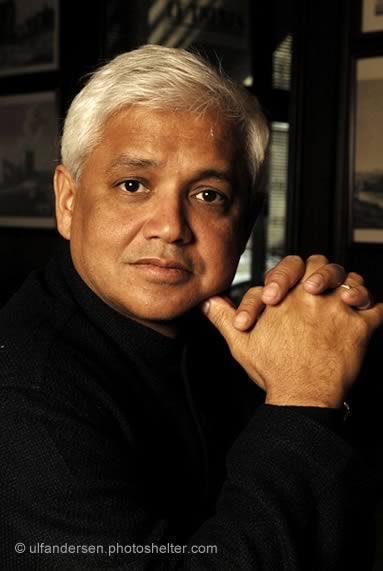
Amitav Ghosh (below), who is best-known for historical fiction, has written both fiction and nonfiction of international acclaim. Many of his novels are set around “the Bay of Bengal, the Arabian Sea, the Indian Ocean, and the connections and the cross-connections between these regions.”

“Opening in Calcutta in the 1960s, Amitav Ghosh's radiant second novel, The Shadow Lines, follows two families—one English, one Bengali—as their lives intertwine in tragic and comic ways. The narrator, Indian born and English educated, traces events back and forth in time, from the outbreak of World War II to the late twentieth century, through years of Bengali partition and violence, observing the ways in which political events invade private lives.

© Amitav Ghosh


English, August by Upamanyu Chatterjee, 1988

Upamanyu Chatterjee is an IAS officer whose debut novel English, August: An Indian Story was adapted to film. Its success inspired many low budget independent movies in Indian cinema. Punch described English, August as “a marvelously intelligent and entertaining novel, and especially for anyone curious about modern India.”

“Agastya Sen, known to friends by the English name August, is a child of the Indian elite. His friends go to Yale and Harvard. August himself has just landed a prize government job. The job takes him to Madna, “the hottest town in India,” deep in the sticks. There he finds himself surrounded by incompetents and cranks, time wasters, bureaucrats, and crazies. What to do? Get stoned, shirk work, collapse in the heat, stare at the ceiling. Dealing with the locals turns out to be a lot easier for August than living with himself.

English, August is a comic masterpiece from contemporary India. Like A Confederacy of Dunces and The Catcher in the Rye, it is both an inspired and hilarious satire and a timeless story of self-discovery.”

Such A Long Journey by Rohinton Mistry, 1991

Indian-born Canadian author Rohinton Mistry’s second novel, Such A Long Journey, was shortlisted for the Booker Prize and the Trillium Award. It has won several awards including the Governor General's Award, the Commonwealth Writers Prize for Best Book, the W.H. Smith/Books in Canada First Novel Award, and the Neustadt International Prize for Literature.

“It is Bombay in 1971, the year India went to war over what was to become Bangladesh. A hard-working bank clerk, Gustad Noble is a devoted family man who gradually sees his modest life unravelling. His young daughter falls ill; his promising son defies his father’s ambitions for him. He is the one reasonable voice amidst the ongoing dramas of his neighbours.

“One day, he receives a letter from an old friend, asking him to help in what at first seems like an heroic mission. But he soon finds himself unwittingly drawn into a dangerous network of deception. Compassionate, and rich in details of character and place, this unforgettable novel charts the journey of a moral heart in a turbulent world of change.

A River Sutra by Gita Mehta, 1993

Gita Mehta, who comes from a political family, is a well-known writer, journalist, and documentary filmmaker. She was a television war correspondent for NBC. Her first book, Karma Cola, 1979, is about thousands of Westerners who came to India in the 1960s and 1970s to rediscover “the magic and mystery missing from their lives.”

A River Sutra is an enchanting collection of vignettes tells the story of a retired bureaucrat who has escaped the world to spend his twilight years running a guest house on the banks of the country’s holiest river, the Narmada. But he has chosen the wrong place for peace and quiet: too many lives converge here and he meets a series of unusual characters including a privileged young executive bewitched by a mysterious lover; a novice Jain monk moving from opulence to poverty; and a woman with a golden voice and a broken heart. As the bureaucrat moves from story to story, he ponders the meaning of each tale and the dark secrets which the river hides within its waters.

© Penguin Books India